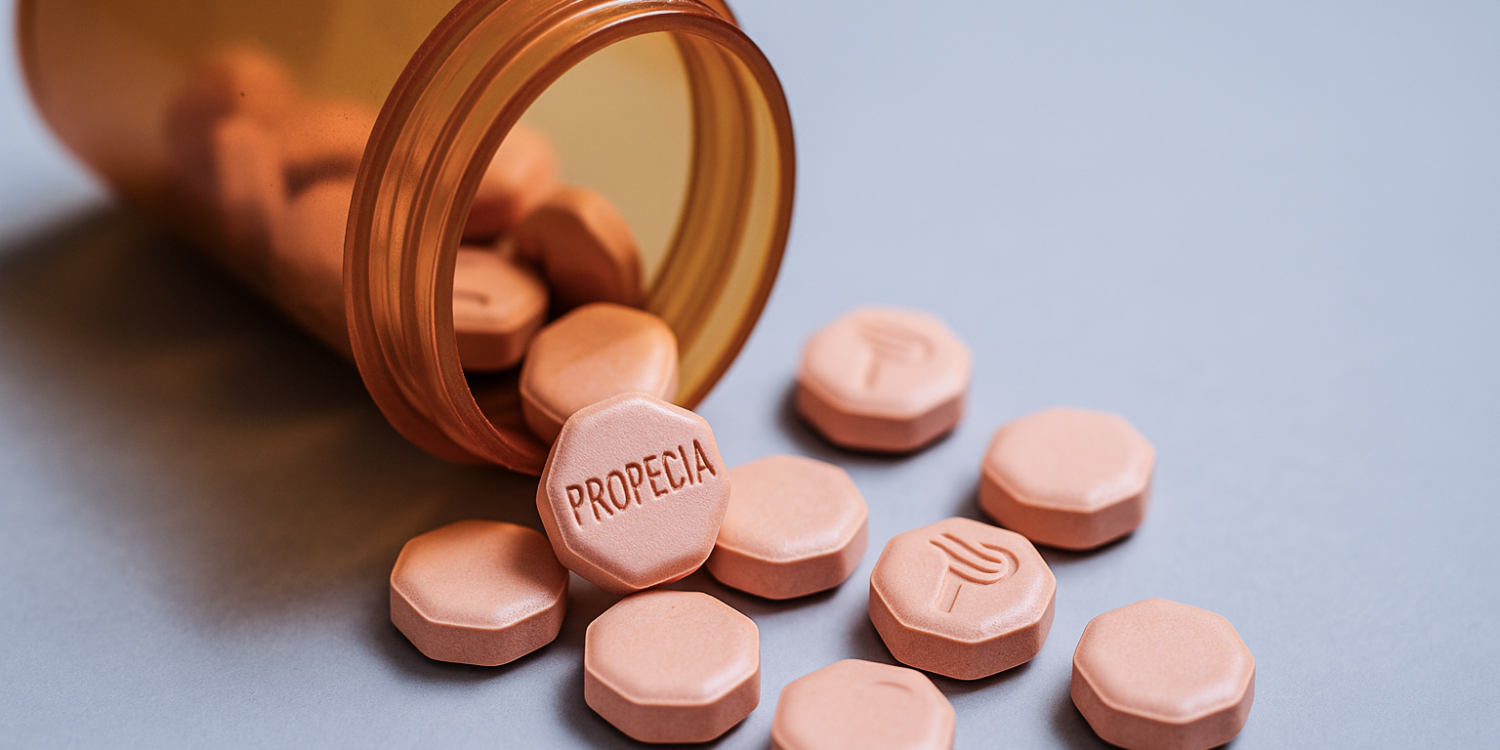
Post-finasteride syndrome (PFS)
- Post-finasteride syndrome (PFS) is a multisystem condition caused by finasteride and related drugs. It can affect sexual function, mental health and cognition, and erode the male body.
- Not just lingering side effects. It can start after you quit the drug, and it can be permanent.
- Not recognised as a condition by regulators. No diagnosis code of its own, no test, no approved treatment.
Post-finasteride syndrome on CBC News
A Radio-Canada investigation, shown on CBC’s The National in March 2025 (5 minutes).
- Millions of men have taken finasteride (Propecia) to slow hair loss.
- Experts warn of rare but life-altering side effects that persist after stopping.
- The report examines allegations that the developer, Merck, downplayed the risks.
- It discusses suicide. For support, call Samaritans on 116 123 (UK) or 988 (US).

Post-finasteride syndrome symptoms
PFS can affect sexual function, mental health, cognition and the male body. If you have thoughts of suicide, call Samaritans on 116 123 (UK) or 988 (US), free, at any hour.
Sexual
5- Loss of sexual desire (libido)
- Erectile dysfunction (difficulty getting or keeping an erection)
- Less feeling in the genitals
- Weaker or less pleasurable orgasms
- Problems with ejaculation, including less semen
Mind and mood
5- Depression (low mood that does not lift)
- Anxiety
- Brain fog (impaired concentration and cognition)
- Difficulty sleeping (insomnia)
- Suicidal thoughts
Body
5- Breast swelling or tenderness (gynaecomastia)
- Muscle cramps, twitching or weakness
- Tiredness that does not go away (chronic fatigue)
- Dry or thinner skin
- Joint pain
Patient stories
Three men describe what happened, in interviews with the Moral Medicine channel. Each shows one person’s experience, not how often PFS happens.
Two years on, in his own words
He stopped finasteride hoping his neurological symptoms would fade. Instead he describes a crash and new symptoms, more than two years on.

Sam
Sam describes the side effects he had while taking finasteride for hair loss, and those that continued after he stopped.

Ryan
Ryan talks about taking finasteride for hair loss, and the side effects that stayed with him after he stopped.
Key facts about PFS
- 1
Diagnostic criteria were published in 2022. They centre on sexual symptoms; many people also report changes in mood, cognition and the body.
- 2
Finasteride blocks 5-alpha reductase throughout the body, including the brain. The enzyme makes DHT, and also neurosteroids that act on mood and the nerves.
- 3
The UK and US product information list sexual problems that continued after stopping. In 2024 the MHRA found the risks “not well known by prescribers and patients”.
- 4
There is no test, and how often PFS happens is unknown: the UK product information says “cannot be determined”.
- 5
There is no approved treatment, and recovery has never been properly studied. PFS “can remain for months, years or indefinitely”.
Questions people ask about PFS
How long does post-finasteride syndrome last?
Post-finasteride syndrome can last for months or years, and it can be permanent. The authors of the 2022 diagnostic criteria write that PFS “can remain for months, years or indefinitely” after the drug is stopped. How many people recover fully has never been properly investigated, so nobody can tell you whether your own PFS will pass.
Is post-finasteride syndrome real?
Some symptoms of post-finasteride syndrome are documented in finasteride’s own product information. The UK and US versions list sexual problems that continued after stopping, and the UK version also lists depression and anxiety. Diagnostic criteria for PFS were published in 2022. No regulator has recognised PFS as a condition, and it has no diagnosis code of its own.
Can post-finasteride syndrome be reversed?
There is no approved treatment for post-finasteride syndrome. In September 2026 we found no treatment trial for PFS registered on ClinicalTrials.gov. Research towards a possible treatment is still in rats: allopregnanolone reduced several changes seen after finasteride was stopped. It has not been tested in people. We do not recommend any of the treatments offered online or in private clinics.
What happens after stopping finasteride?
Half of a dose of finasteride leaves the blood within 5 to 6 hours. Problems that clear after stopping are not post-finasteride syndrome. In PFS, symptoms continue after the drug has left the body, and for some people they first appear, or get worse, after stopping. The UK and US product information list sexual problems that continued after stopping.
How common is post-finasteride syndrome?
Nobody knows how common post-finasteride syndrome is. No one has measured a rate, and the UK product information says it “cannot be determined”. By April 2024 the MHRA, the UK regulator, had 426 Yellow Card reports of sexual problems with finasteride. In almost half, the outcome was recorded as “not recovered” or “not resolved”. These are reports, not a rate.
Can women get post-finasteride syndrome?
Little is known about post-finasteride syndrome in women. Finasteride is not licensed for women in the UK. In the MHRA’s 2023 search, all UK reports of sexual side effects that gave a sex came from men. We found no study of lasting side effects in women. If you are a woman with symptoms, talk to your doctor and report them.
If you think you have PFS
Do not stop or change a medicine because of anything on this page. The MHRA makes one exception: if you take finasteride 1 mg and develop depression or suicidal thoughts, it says to stop and see your doctor as soon as possible.
Talk to your doctor
Even if you stopped years ago. See what to do if you think you have PFS.
Report it
Use the Yellow Card scheme (UK) or MedWatch (US), with the term “Post 5-alpha-reductase inhibitor syndrome”. No proof needed. Other countries.
Join the registry
Joining the SIDEfxHUB Registry needs no diagnosis.
Find other people
Join one of our private WhatsApp support groups.
If you are struggling, call Samaritans on 116 123 in the UK (free, any hour) or 988 in the US. In an emergency, call 999 or 911.
The full guide to PFS
What it is, who gets it, what regulators have done, the research, diagnosis, treatment and recovery, with sources.
What is post-finasteride syndrome?
Post-finasteride syndrome (PFS) is a multisystem condition caused by finasteride and related drugs. Symptoms can begin during treatment or only after stopping, and continue after the drug has left the body.
Half of a dose leaves the blood within 5 to 6 hours, yet PFS can last for years. Nobody yet knows why.
PFS is one of three related conditions, with PSSD (after SSRI and SNRI antidepressants) and PAS (after isotretinoin). The 2022 criteria cover all three.
The 2022 diagnostic criteria
There is no blood test or scan for PFS. In 2022, 37 doctors and researchers from ten countries agreed diagnostic criteria for it.
- Required: you took finasteride or a related drug, such as dutasteride.
- Required: sexual problems continued after you stopped.
- Supporting: low desire, erectile dysfunction or less genital and orgasm feeling, lasting 3 months or more.
- Ruled out: the same problems before the drug, or another illness, medicine or drug use that explains them. The criteria also ask for no earlier isotretinoin or SSRI-type antidepressant.
Problems that clear after stopping are not PFS. A mental health diagnosis does not rule it out. The criteria are an expert consensus, not official guidance, built from cases reported to RxISK.org, a drug safety website linked to three of the authors.
Names, codes and drugs
- Patients’ name
- Post-finasteride syndrome (PFS)
- MedDRA term
- Post 5-alpha-reductase inhibitor syndrome, code 10082430. MedDRA is the dictionary regulators use to record side effect reports.
- Orphanet (rare disease database)
- Post 5-alpha-reductase inhibitors treatment syndrome (ORPHA:686468)
- ICD code
- None of its own (ICD codes are what doctors use in medical records). Orphanet provisionally links it to F52.8, a broad code for sexual dysfunction “not caused by organic disorder or disease”.
- Drugs involved
- Finasteride 1 mg (Propecia and generics) and finasteride sprays, for hair loss. Finasteride 5 mg (Proscar) and dutasteride (Avodart), for an enlarged prostate.
- How they work
- They block an enzyme, 5-alpha reductase, found throughout the body, including the brain. It turns testosterone into DHT, but it also makes neurosteroids such as allopregnanolone, which act on the brain, the nerves and mood. Blocking it does far more than slow hair loss and shrink the prostate.
More about the symptoms
The criteria require sexual symptoms. Depression, cognitive problems and suicidal thoughts can come with them or appear on their own, the criteria say.
The sexual symptoms come from the 2022 criteria, and the UK product information lists depression, anxiety and suicidal thoughts. The rest come mainly from patient reports, collected in Orphanet’s entry and a survey of 131 men with symptoms.
Symptoms can start while you take the drug. For some people they first appear, or get worse, after stopping. More in what happens when you stop taking finasteride.
Who gets PFS
Most published cases are young men who took finasteride 1 mg for hair loss. Beyond that, little is known about who is at risk.
- Age. The 1 mg dose is licensed for men aged 18 to 41. In reports to the FDA (the US regulator), men with lasting problems after Propecia were younger than those after Proscar, the prostate dose.
- Dose. Lasting problems have been reported after both 1 mg and 5 mg. UK reports come more often from 1 mg, though 5 mg is prescribed more. The MHRA, the UK regulator, says this “does not necessarily mean a different level of risk”.
- How long. In a PFS Network survey of its own members, just over half of 427 respondents had used finasteride for 200 days or less. Yet in one US records study, young men on it for over 205 days had more lasting erectile dysfunction than shorter users.
- Sex. Finasteride is not licensed for women in the UK. In the MHRA’s 2023 search, all UK reports of sexual side effects that gave a sex came from men. We found no study of lasting side effects in women.
- Mental health history. Some studies found side effects more likely after a personal or family history of mental illness, but the MHRA notes many were small and relied on memory.
Nobody knows why some people are affected and others are not, and no test can predict who will be.
How common is PFS?
Nobody knows how common PFS is. Regulators hold hundreds of reports, but no one has measured a rate.
While people take finasteride, the UK label rates lower sex drive and depression as “uncommon” (1 in 1,000 to 1 in 100 people). For problems after stopping, it gives no figure.
What is reported
By April 2024 the MHRA had 426 Yellow Card reports (the UK reporting scheme) of sexual problems with finasteride. In almost half, the outcome was recorded as “not recovered” or “not resolved”.
Why there is no rate
A rate needs two numbers: how many people have PFS, and how many took finasteride. Neither is known; the MHRA calls this a “lack of denominator”. Finasteride 1 mg is not prescribed on the NHS, so “accurate prescription numbers are not available”.
Trials “do not routinely include follow-up” to check that sexual side effects clear, the criteria’s authors write. In 2012 the FDA knew of no controlled study “to determine their cause or duration”.
Studies of frequency
- The trials. During treatment, 3.8% of men on finasteride reported a sexual side effect, against 2.1% on placebo (a dummy pill). From these trials, the FDA says “only a small percentage of men” are affected.
- Medical records. A 2017 US study looked at 11,909 men given finasteride or dutasteride. Of these, 167 (1.4%) had erectile dysfunction that lasted at least 90 days after stopping. Among 4,284 men aged 16 to 42 on the hair-loss dose, it was 34 (0.8%). One health system, erectile dysfunction only, no proof of cause: not a rate for PFS.
The MHRA adds that media attention and the “nocebo” effect (symptoms caused by expecting harm) may add to reports. A study with a comparison group, following people after they stop, would answer the question.
What regulators have done
Regulators in the UK and the US warn that finasteride’s sexual side effects can continue after stopping. None has recognised PFS as a condition. When patients asked, the MHRA said that is “not within the MHRA’s remit”.
Approved, with sexual side effects on the label
The US approves 5 mg in 1992 and 1 mg in 1997; the UK licenses 1 mg in 1999. In the trials, the sexual side effects on the labels “resolved in patients who stopped”.
UK: problems that persisted after stopping
The UK product information adds reports of erectile dysfunction that persisted after stopping (2010), then of lower sex drive and ejaculation problems (2013).
US: problems that continued after stopping
US labels add erectile dysfunction that “continued after drug discontinuation” (2011), then libido, ejaculation and orgasm disorders (April 2012). Of 421 reports the FDA reviewed, 59 lasted 3 months or more. Clear causal links “have NOT been established”, the FDA says.
UK: depression and suicidal thoughts
The MHRA reports depression and, “in rare cases, suicidal thoughts”. Doctors are told to advise stopping the 1 mg dose “immediately” if depression develops.
US: depression and suicidal thoughts on the label
After an FDA order in May 2022, the Propecia label lists “depression, suicidal ideation and behavior” among side effects reported after approval.
UK: a patient card in 1 mg packs
The MHRA’s review finds the side effects on the label but “not well known by prescribers and patients”. A card in every 1 mg pack now says they may continue after stopping.
EU: suicidal thoughts confirmed
An EU review, started at France’s request, confirms suicidal thoughts as a side effect of finasteride tablets. Its frequency is “unknown”. Packs of 1 mg get a patient card.
US: a warning on pharmacy-made sprays
The FDA reports 32 cases, from 2019 to 2024, with pharmacy-made finasteride sprays. Most said the problems “continued to persist after product discontinuation”.
UK: stronger warnings
The MHRA advises that finasteride “is associated with depression, suicidal ideation and sexual dysfunction which may persist after treatment is stopped”. The 1 mg product information now warns that sexual problems may contribute to low mood.
How finasteride 1 mg is supplied in the UK
In the UK, finasteride 1 mg is not prescribed on the NHS. It comes from private clinics or, “more often”, from online pharmacies. Regulating pharmacies “is not within the remit of the MHRA”; the General Pharmaceutical Council sets their standards.
Some online pharmacies screen and monitor patients thoroughly, the MHRA found, and “others do not”.
Is finasteride safe? What regulators conclude
In 2025 the EMA (the EU medicines agency) concluded that the benefits of finasteride and dutasteride “continue to outweigh their risks for all approved uses”. No regulator can yet say how often the lasting harm happens.
By 31 May 2025 the MHRA had 170 reports of suicidal thoughts and related terms with finasteride, and 19 reports of death by suicide. These are reports, not a rate. The MHRA adds that a report “does not necessarily mean that the medicine has caused the reaction”.
If this is close to home, Samaritans are on 116 123 in the UK, free, at any hour. In the US, call or text 988.
Research on PFS
Research on PFS is small and comes mostly from a few groups. It has found differences in men with PFS, but it is “not clear whether these were present before treatment”.
The first case series (2011)
Doctors at George Washington University interviewed 71 men whose sexual side effects had lasted at least 3 months after stopping. 94% had low libido and 92% erectile dysfunction, on average for 40 months.
Men chosen for lasting symptoms, with no comparison group. The authors list selection bias (who took part) and recall bias (relying on memory).
Depression in former users (2012)
Of 61 former users with lasting sexual side effects, 46 (75%) had symptoms of depression. So did 3 of 29 men (10%) with hair loss who had never taken finasteride.
Small, and the former users were chosen for lasting symptoms. Depression was measured by questionnaire. A pattern, not a rate.
No hormone deficit found (2016)
A Harvard team compared 25 men with lasting symptoms, 13 users without symptoms and 18 non-users. Testosterone and DHT did not differ. Men with symptoms reported more depression and cognitive problems, but scored normally on cognitive tests.
Small and measured once, so it cannot show cause. Funded in part by the Post-Finasteride Syndrome Foundation, a non-profit that supports research.
Brain hormones and a gene (2017, 2019)
A Milan team studied spinal fluid from 16 men with PFS. Brain-acting hormones (neuroactive steroids) were altered. The gene for the enzyme finasteride blocks more often carried a chemical mark that can silence it: 9 of 16 men, against 1 of 13 healthy men.
Small pilot studies. The authors “cannot conclude” whether the gene pattern was there before finasteride.
Gene activity in penile skin (2021)
A US team compared penile skin from 26 men with PFS symptoms and 26 men having circumcision. In the men with PFS, 3,764 genes were more or less active, including the androgen receptor gene (which responds to testosterone).
One tissue, no samples from before the drug, and the men may not be typical. The authors say it cannot show cause.
Studies in rats (2025 and 2026)
Rats given finasteride for 20 days changed little while on it, but developed gut and brain inflammation and anxious behaviour after it was stopped. In 2025, allopregnanolone, a hormone the body makes, reduced several of the inflammatory changes.
Rats, not people, after a short course. These are the first two studies of the Milano Project, which SIDEfxHUB raises money for.
Most of these studies measured small groups of men with PFS once, after the drug. Following people from before they start would show which changes came first.
How PFS is diagnosed
There is no test for PFS. A doctor diagnoses it from your history, using the 2022 criteria: what you took, when, and what changed.
Your doctor may not have come across it. The criteria’s authors write that these conditions are “little known and poorly understood by healthcare professionals”.
What to bring to your doctor
- The patient card from the pack, if you have one: it says these effects may continue.
- A printed copy of the 2022 criteria, which are free to read.
- Your dose, and roughly when you started and stopped.
- What changed, and when. Say whether it started or continued after stopping.
- Any change in mood, even if it seems unrelated.
- Other medicines, past and present, especially antidepressants or isotretinoin.
Our letter for your doctor puts this on one page, with sources, ready to hand over.
Ruling out other causes
The criteria require that no other illness, medicine or drug explains your symptoms. So a doctor may check for other causes first. That is part of a proper diagnosis, not a sign of disbelief.
Normal blood tests do not settle it either way. Borderline hormone levels may be “a consequence of the conditions rather than a cause”, the criteria’s authors write.
PFS treatment and recovery
There is no approved treatment for PFS. In September 2026 we found no treatment trial for it registered on ClinicalTrials.gov.
What research is testing
The Milano Project at the University of Milan, led by Professor Roberto Melcangi, which SIDEfxHUB raises money for, is working towards a possible treatment. In rats, allopregnanolone reduced several changes seen after finasteride was stopped. It has not been tested in people.
Is PFS permanent?
It can be. PFS “can remain for months, years or indefinitely” after the drug is stopped, the criteria’s authors write. How many people recover fully “has never been properly investigated”.
A 2012 follow-up study reassessed 54 men 9 to 16 months later, and 96% still had symptoms. But they were chosen because their symptoms had already lasted, so this cannot tell you your own chances.
So nobody can tell you whether your own PFS will pass. More in is full recovery from PFS possible?
How to judge a treatment offer
You may come across treatments offered online or in private clinics. We do not recommend any. These questions help you and your doctor weigh an offer:
- Has it been tested in people with PFS, with a comparison group? Or only in case reports, patient stories or animals?
- What are its own side effects, and what happens when you stop it?
- What does it cost, and does the person recommending it also sell it?
- Will your own doctor know you are taking it?
What SIDEfxHUB does
SIDEfxHUB is the UK patient charity (registered charity 1203385) for people living with post-drug syndromes. Our focus is PFS, PSSD and PAS. We fund research, push for these conditions to be recognised, and support patients.
- The registry. Our registry follows people over months and years. The people in it chose to join, so it cannot say how common PFS is. It can show how symptoms change over time, which a one-off report cannot.
- Research. We raise money for the Milano Project at the University of Milan, which studies what finasteride and SSRIs change in the body. Its two studies published so far were done in rats.
Sources
Every source below was checked on 26 September 2026.
Diagnostic criteria for PFS (2022)
Healy and 36 co-authors, International Journal of Risk & Safety in Medicine.
Read the paper→MHRA Drug Safety Update, May 2026
Updated UK warnings, with Yellow Card figures.
Read on GOV.UK→MHRA review of finasteride, 2024
The UK report behind the patient card.
Read on GOV.UK→EMA review of finasteride and dutasteride, 2025
The EU review of suicidal thoughts with these medicines.
Read on the EMA site→FDA finasteride label changes, 2012
The FDA on the 2011 and 2012 label changes, archived.
Read the archive→Propecia US label
US prescribing information, on DailyMed.
Read the label→Propecia UK product information
UK prescribing information, on the medicines compendium.
Read the label→Orphanet: ORPHA:686468
The rare disease database entry.
Open Orphanet→PFS research on PubMed
Published studies on post-finasteride syndrome.
Search PubMed→Read next about PFS
This information does not replace medical advice. Talk to your doctor before you make any decision about your treatment.
Lasting side effects after finasteride?
You are not alone.
Free. Sign up takes 2 minutes.