Does finasteride lower testosterone?
Finasteride lowers DHT, not testosterone, which tends to rise slightly. So people with post-finasteride syndrome (PFS) can have normal hormone tests.
SIDEfxHUB is a patient charity. We are not health professionals, and this does not replace medical advice. Don't start, stop or change any medicine because of what you read here. Talk to your doctor first.
If you are in crisis:116 123 Samaritans (UK)988 Lifeline (US)Find a helpline
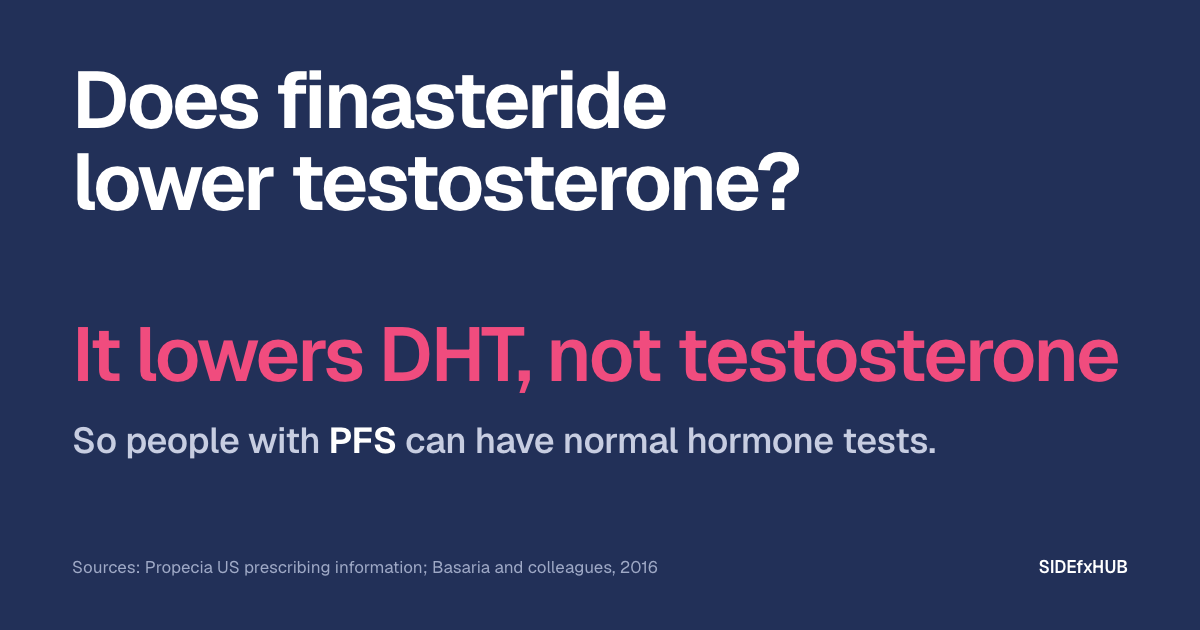
Finasteride lowers DHT, a stronger hormone the body makes from testosterone, and testosterone itself tends to rise slightly. So people with post-finasteride syndrome (PFS) often have normal hormone tests, even when symptoms have continued, or begun, after stopping.
Many people with lasting symptoms say they were told their testosterone was normal, and were left with no answer. The NHS page says finasteride stops testosterone turning into DHT, but doesn’t mention what that does to a blood test.
The story in 3 lines
- Propecia’s US label says one 1 mg tablet cuts DHT in the blood by about two thirds within a day. Testosterone rises slightly.
- The UK leaflet lists erection, sex drive and ejaculation problems that persisted after stopping.
- In a Harvard study, men with these lasting problems had normal testosterone and DHT. Patients call it PFS.
Press: contact@sidefxhub.com
Chirag had side effects on finasteride, and took his last tablet on 1 January 2024. That July, he says, “something just turned off”.

For weeks he couldn’t get an erection, and for 10 days he barely slept. He has since seen five or six doctors. “My test levels are normal,” he says, meaning his testosterone.
What does finasteride do to testosterone?
It blocks the step that turns testosterone into DHT. So DHT falls, and testosterone tends to go up a little.
An enzyme called 5-alpha reductase does that job. Propecia’s US label says one 1 mg tablet cuts the DHT in the blood by about two thirds within a day. Testosterone, on average, stays within the normal range.
The UK leaflet links male hair loss to DHT, and says Propecia lowers DHT in the scalp. The US label says DHT falls in other tissues too. Our article on DHT and 5-alpha reductase explains what else the hormone does.
Why is my testosterone normal if I have PFS?
Probably because finasteride doesn’t lower it in the first place. And DHT comes back: the label for Proscar, a 5 mg finasteride tablet, says it returned to its old level about two weeks after healthy men stopped taking it.
The symptoms don’t always ease when it does. The diagnostic criteria for PFS note that problems can appear, or get worse, after the drug is stopped. Chirag’s crash came months after his last tablet.
Sam, who also spoke to Moral Medicine, found the same as Chirag. “I got my testosterone checked. It’s normal,” he says.
A Harvard study compared men with lasting symptoms after finasteride with men who’d taken it without problems, and with men who had never taken it. Testosterone and DHT were similar in every group, and normal, years after the last tablet. The brain scans of the men with symptoms did differ, in circuits linked to sexual arousal and to depression.
So a normal result doesn’t rule PFS out.
Finasteride and your hormone tests
Could finasteride change hormones in the brain?
It may, and a blood test might not show it. The enzyme finasteride blocks also helps make neurosteroids, hormones that act on mood and the nerves.
A team at the University of Milan has measured hormones in the spinal fluid, the fluid around the brain, of men with PFS. Their 2017 study found less DHT there, and more testosterone. The changes in the blood didn’t fully match.
The study was small, and nobody knows yet whether the changes were there before finasteride. The team, led by Professor Roberto Melcangi, had reported changes in hormone levels in an earlier study too. It now runs the Milano Project, which SIDEfxHUB raises money for.
Dr Michael Irwig, a hormone specialist, published one of the first studies of PFS in 2011. In a film posted the next year, he asked whether hormone changes in the brain might be altering the nerve cells behind sex drive and orgasm.

What can I do?
Finasteride helps many men keep their hair. If you have side effects, that’s a decision for you and your prescriber. The UK leaflet says that if you have low mood or depression, you should stop taking it and contact your doctor as soon as possible.
If symptoms have lasted since you stopped, tell your GP and give your dates: “Finasteride 1 mg from May 2022, last tablet February 2024.” Take your test results too: the PFS criteria ask doctors to rule out other causes first.
Many people say it took time to be taken seriously. Bring the leaflet’s line on persistent erection problems after stopping. You can report it without a doctor agreeing.
Our guide to PFS blood tests lists the hormones people often discuss with their doctor.
Report it: it helps everyone
A doctor’s note helps you. A report to the medicines regulator helps everyone else: it is how patterns get noticed.
- No proof needed. A suspicion is enough, even years after stopping.
- Where: the Yellow Card scheme in the UK, MedWatch in the US.
- Use the right words. If symptoms continued after stopping, write Post 5-alpha-reductase inhibitor syndrome (MedDRA 10082430).
Our reporting guide walks you through it
What else do people ask?
Does finasteride raise oestrogen? A little, in the blood. Propecia’s US label says oestradiol, the main oestrogen, rose slightly on average, as testosterone did, and stayed in the normal range. The UK leaflet lists breast swelling or tenderness as a side effect, though nobody knows how often it happens.
Does dutasteride lower testosterone? No, testosterone tends to rise on it too. Dutasteride, a similar drug, cuts DHT even further: by more than nine tenths in men with an enlarged prostate, its US label says. Our article on dutasteride side effects covers what can last.
What if my testosterone is borderline? Some people with PFS do get borderline results. The authors of the PFS criteria write that this “may be a consequence of the conditions rather than a cause”. Low testosterone has other possible causes too, so it still needs looking into.
Chirag’s testosterone came back normal, and his symptoms were still getting worse when he spoke to Moral Medicine. If symptoms of PFS have lasted since your last tablet, report them: a report counts, whatever your blood tests say.
Sources
- Propecia (finasteride) 1 mg, US prescribing information, Organon, prescribing information revised August 2022 (patient information November 2023). DailyMed, US National Library of Medicine. Section 12.1: finasteride blocks type II 5-alpha reductase, which converts testosterone into DHT, “resulting in significant decreases in serum and tissue DHT concentrations”. Section 12.2: “65% suppression within 24 hours of oral dosing with a 1-mg tablet”; “Mean circulating levels of testosterone and estradiol were increased by approximately 15% as compared to baseline, but these remained within the physiologic range”; no clinically meaningful changes in LH, FSH or prolactin.
- Proscar (finasteride) 5 mg, US prescribing information, Organon, revised March 2026. DailyMed. Section 12.2: in healthy men given Proscar for 14 days, stopping “resulted in a return of DHT levels to pretreatment levels in approximately 2 weeks”. On 5 mg, median testosterone rose by about 10 to 20%, within the normal range.
- Propecia 1 mg Film-coated Tablets, patient leaflet, Organon, Electronic Medicines Compendium (emc 2194), last revised May 2026. Section 1: hair loss and DHT; Propecia “lowers the levels of DHT in the scalp”. Section 2: for depressed mood or depression, “stop taking Propecia and contact your doctor for further medical advice as soon as possible”. Section 4, frequency unknown: breast swelling or tenderness; “persistent difficulty having an erection after discontinuation of treatment”; persistent decrease in sex drive and persistent problems with ejaculation after discontinuation.
- NHS, Common questions about finasteride, page last reviewed 2 August 2023.
- Basaria S, Jasuja R, Huang G and colleagues. Characteristics of men who report persistent sexual symptoms after finasteride use for hair loss. J Clin Endocrinol Metab 2016;101(12):4669-80. Brigham and Women’s Hospital, Harvard Medical School. 25 men with persistent symptoms, 13 finasteride users without symptoms, 18 men who had never used it. Median time since the last dose 3.5 and 3.0 years. Total and free testosterone, DHT, LH, FSH, oestradiol and SHBG did not differ between the groups and were within the normal range for healthy young men. fMRI showed abnormal responses in brain circuits linked to sexual arousal and major depression. The authors suggest the mood and cognitive complaints could come from lower neurosteroid production in parts of the brain, which blood DHT levels did not reflect. Measured once, so it cannot show cause. Funded in part by the Post-Finasteride Syndrome Foundation.
- Caruso D, Abbiati F, Giatti S and colleagues. Patients treated for male pattern hair with finasteride show, after discontinuation of the drug, altered levels of neuroactive steroids in cerebrospinal fluid and plasma. J Steroid Biochem Mol Biol 2015;146:74-9. Paired cerebrospinal fluid and plasma samples from men with PFS and healthy controls; the authors reported altered levels of neuroactive steroids in both. The journal published a corrigendum in 2023 (J Steroid Biochem Mol Biol 234:106405, PubMed record). Its text is not openly available and we have not been able to read it, so this article takes no specific finding from the 2015 paper.
- Melcangi RC, Santi D, Spezzano R and colleagues. Neuroactive steroid levels and psychiatric and andrological features in post-finasteride patients. J Steroid Biochem Mol Biol 2017;171:229-35. 16 men with PFS. In cerebrospinal fluid, decreased DHT and increased testosterone, among other changes; plasma levels were also altered, but “these changes did not reflect exactly what occurs in CSF”.
- Healy D, Bahrick A, Bak M and colleagues. Diagnostic criteria for enduring sexual dysfunction after treatment with antidepressants, finasteride and isotretinoin. Int J Risk Saf Med 2022;33(1):65-76. Section 5: PFS criteria, including no current medical condition, medicine or substance that could account for the symptoms; altered neuroactive steroids have been found, “it is not clear whether these were present before treatment”. Section 9: a lasting problem may only appear when the drug is stopped, or a mild one may worsen on stopping; borderline testosterone or other hormone levels “may be a consequence of the conditions rather than a cause”.
- Avodart (dutasteride), US prescribing information, revised October 2023. DailyMed. Section 12.2: in men with benign prostatic hyperplasia on 0.5 mg a day, median serum DHT fell by 93 to 95% over four years; median testosterone rose by 19 to 26%, within the normal range.
- Irwig MS, Kolukula S. Persistent sexual side effects of finasteride for male pattern hair loss. J Sex Med 2011;8(6):1747-53. Interviews with 71 men whose sexual side effects lasted at least 3 months after stopping. The 2022 criteria cite it as the first description of PFS.
- Moral Medicine, Doctors Said Post-Finasteride Syndrome Wasn’t Real. Then It Happened to Him, interview with Chirag, 25 March 2025. Side effects after 10 days at 5:05, and a lower dose from June 2023 at 5:51. Stopped on 1 January 2024 at 6:45. “Something just turned off” on 9 July 2024 at 9:00. No erections for 2 to 3 weeks at 9:37, and 10 days of barely sleeping (“maybe 30 minutes”) at 9:53. “Fully regressed” at 12:35, and a new side effect every month at 13:45. “Five or six” doctors at 16:32, and “my test levels are normal” at 16:55. His story on our site: Chirag’s story: the crash in July 2024.
- Moral Medicine, The Hidden Devastation of Finasteride – Sam’s Story, June 2025. “I got my testosterone checked. It’s normal” at 15:36. His story on our site: Sam’s story.
- PFS Foundation, Persistent sexual side effects of finasteride (Propecia) for male pattern hair loss, Dr Michael Irwig, then at George Washington University, posted 28 August 2012. How finasteride works at 2:39; hormones in the brain at 3:36.
This information does not replace medical advice. Talk to your doctor before you make any decision about your treatment.
590+ people have joined the community.
Join them, then report your side effects.
No diagnosis needed. Researchers never see your name.