Emotional numbness: could a medicine be why?
Emotional numbness has many causes, like depression. It's also reported with SSRIs, finasteride and isotretinoin, sometimes after stopping: PSSD, PFS, PAS.
SIDEfxHUB is a patient charity. We are not health professionals, and this does not replace medical advice. Don't start, stop or change any medicine because of what you read here. Talk to your doctor first.
If you are in crisis:116 123 Samaritans (UK)988 Lifeline (US)Find a helpline
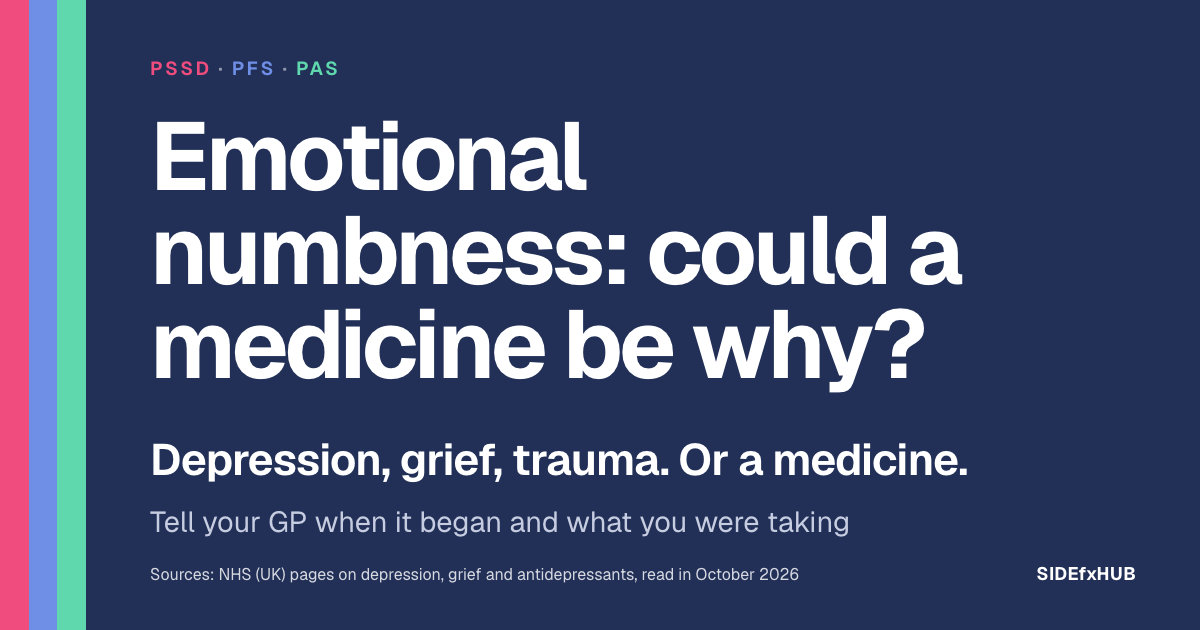
Emotional numbness has many causes, including depression, grief and trauma. A medicine can be one: SSRI antidepressants can flatten feelings, and people report the same with finasteride and isotretinoin. When symptoms last after stopping, the conditions are called post-SSRI sexual dysfunction (PSSD), post-finasteride syndrome (PFS) and post-Accutane syndrome (PAS).
That’s easy to miss if you feel flat and can’t say why. The finasteride and isotretinoin leaflets warn about low mood and say nothing about numbness.
Feeling numb can come with feeling very low. If you ever think about harming yourself, or feel you can’t go on, you are not alone. In the UK and Ireland, call Samaritans free on 116 123, day or night. You can also ask for an urgent GP appointment or call NHS 111. Our page on suicidal thoughts lists more lines.
The story in 3 lines
- Depression can take the enjoyment out of life, and grief and trauma can leave you numb, says the NHS.
- The NHS lists feeling “emotionally numb” among the common side effects of antidepressants.
- Researchers' 2022 criteria for PSSD list emotional numbing among the symptoms that can stay after an SSRI is stopped. No reliable figure exists for how often.
Press: contact@sidefxhub.com
Matt took finasteride, a hair-loss tablet, for three years. About three weeks after he stopped, something new began.

“I began to feel very emotionally numb,” he says. He had been very emotional all his life, so at first it felt like a relief, and he wondered whether the tablets had been making him depressed. A week later he realised: “I wasn’t just not feeling sad, I wasn’t feeling any emotions at all.”
Five years on, he says, his emotions are still blunted. What does PFS feel like? has more of his account.
What causes emotional numbness?
Low mood, loss and long-running stress can each cause it. If you’re depressed, the NHS says, you may lose interest in things you used to enjoy and get no enjoyment out of life.
“Shock and numbness” are usually the first reaction to a loss, says the NHS page on grief. After trauma, the NHS list of PTSD symptoms includes “not experiencing emotions at all”.
Burnout, says the charity Mental Health UK, can leave you feeling “empty and hollow”.
There’s help for each of these. The NHS says to see a GP if a low mood lasts more than two weeks.
Which medicines are linked to emotional numbness?
Antidepressants, according to the NHS. For finasteride and isotretinoin, the evidence is what patients report. The UK leaflet lines below are as of October 2026.
- SSRI antidepressants. The NHS lists feeling “emotionally numb” as a common side effect of antidepressants, and as a symptom of coming off them. A pack leaflet can list it too: one SSRI leaflet has “reduced emotions, indifference” as a common side effect. Emotional blunting on SSRIs goes through the research.
- Finasteride, sold as Propecia. Its leaflet says “mood alterations such as depressed mood, depression” have been reported, and lists anxiety. It doesn’t mention numbness.
- Isotretinoin, the acne capsule Roaccutane, or Accutane in the US. Its leaflet lists “depression or related disorders”, with signs that “include sad or altered mood, anxiety, feelings of emotional discomfort”. It doesn’t mention numbness either. Accutane and depression after stopping has more.
Researchers collected 300 reports of sexual problems that lasted after these three kinds of medicine. About 1 in 5 also mentioned emotional blunting, across all three. People chose to send the reports in, so they can’t show how often it happens.
Katie was prescribed fluoxetine at 21. Her mood lifted at first, she says, but she “couldn’t feel excited or happy or enjoy anything properly”. Elliot took isotretinoin at 17. Years later, he says, he still hadn’t “had an emotion land”.
Can emotional numbness last after stopping a medicine?
For some people it has lasted years after stopping. Nobody knows yet who will be affected, or whether it will ease.
Coming off an antidepressant can cause numbness. The NHS says withdrawal symptoms often stop within a few weeks, though for some people they last months or longer. PSSD or withdrawal? explains the difference.
Diagnostic criteria published by researchers in 2022 list emotional numbing among the symptoms that can come with PSSD. It often goes with genital numbness, they say. One of their tests is whether the problem is still there three months after the last dose.
The same paper’s lists for finasteride and isotretinoin name depression and cognitive problems. Numbness isn’t on them.
Joanna Moncrieff, a professor of psychiatry at UCL, says many people with lasting sexual problems after antidepressants describe feeling numbed emotionally as well.
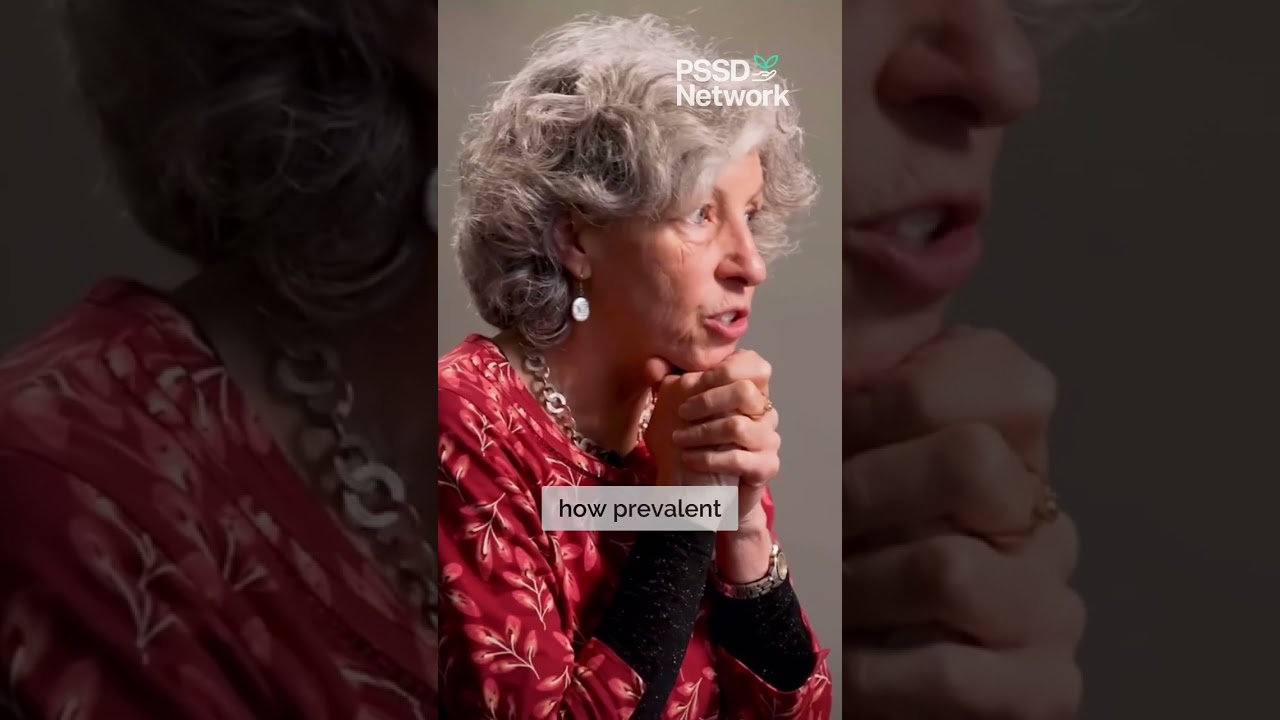
No reliable figure exists for how often emotional numbness lasts after any of these medicines. That’s why reports matter.
What can I do?
Tell a GP about numbness that lasts, whatever you think the cause is.
“I can't cry any more”, “music does nothing for me”.
“Slowly, since last winter”, or “three weeks after my last tablet”.
“Sertraline 50 mg from January 2023, last tablet March 2024.” Include ones you've stopped.
Your mood, a loss, stress at work or at home.
These medicines help many people. If you have side effects, that’s a decision for you and your prescriber. The NHS says not to stop an antidepressant suddenly, or without talking to your doctor first. For finasteride and isotretinoin, follow what the leaflet says.
Many people say it took time to be taken seriously. You can report numbness without a doctor agreeing.
Report it: it helps everyone
A doctor’s note helps you. A report to the medicines regulator helps everyone else: it is how patterns get noticed.
- No proof needed. A suspicion is enough, even years after stopping.
- Where: the Yellow Card scheme in the UK, MedWatch in the US.
- Use the right words. Write “emotional numbness” and say when it began. If sexual symptoms also continued after stopping, add Post-SSRI sexual dysfunction (MedDRA 10086208) for an SSRI or SNRI, or Post 5-alpha-reductase inhibitor syndrome (MedDRA 10082430) for finasteride. For isotretinoin there’s no term yet.
Our reporting guide walks you through it
What else do people ask?
Is it depression, or my medicine? It can be either, or both. Timing is a clue: did it start before the medicine, on it, or after it? In one survey of people taking antidepressants for depression, almost half felt blunted, and more so when their depression was worse. PSSD or depression? goes through it.
Does emotional numbness go away? It can. A low mood may improve after a short time, the NHS says, and PTSD usually gets better for most people. After a medicine, nobody can say yet. Benjamin took an antidepressant for a month. His blunting was “nearly gone”, he says, after five or six years.
Can other medicines cause it? The researchers behind the 2022 criteria note that emotional numbing also happens on antipsychotics. A pharmacist or GP can check your leaflets with you. Our page on post-drug syndromes has more.
Matt later learnt, he says, that the feeling had a name: emotional blunting. If your feelings have gone flat, tell your GP when it began and what you were taking. If it began on a medicine, or after one, you can report it too.
Sources
- NHS, Antidepressants, page last reviewed 12 June 2025. Common side effects include “mood changes – like feeling more angry or emotionally numb”. Withdrawal symptoms include “feeling low, suicidal, emotionally numb or like things are not real”; “it’s common to get them and they often stop within a few weeks”. For some people they can “start weeks or months later, and last for months or longer”. “Do not stop taking an antidepressant suddenly or without talking to your doctor first.” The page is about antidepressants in general, SSRIs among them.
- NHS, Symptoms: depression in adults, page last reviewed 5 July 2023. “If you’re depressed, you may feel sad, hopeless and lose interest in things you used to enjoy.” Psychological symptoms include “having no motivation or interest in things” and “not getting any enjoyment out of life”. “A low mood may improve after a short time.” NHS, Low mood, sadness and depression, reviewed 29 July 2026: see a GP if “you’ve had a low mood for more than 2 weeks”. The NHS pages do not use the words “emotional numbness” for depression.
- NHS, Get help with grief after bereavement or loss, page last reviewed 14 July 2026. Signs of grief can include “shock and numbness – this is usually the first reaction to loss, and people often talk about ‘being in a daze’”.
- NHS, PTSD (post-traumatic stress disorder), page last reviewed 8 April 2026. Symptoms in adults can include “finding it difficult to control your feelings and emotions, or not experiencing emotions at all”. PTSD “usually gets better for most people, but symptoms can be more severe and last longer for some”.
- Mental Health UK, Burnout, read on 12 October 2026. “Prolonged stress can lead to burnout and whilst momentary stress can leave you feeling exhausted, burnout can make you feel empty and hollow.” The page says burnout is not a medical or mental health condition.
- NHS, Where to get urgent help for mental health, page last reviewed 26 April 2023: “Get advice from 111 or ask for an urgent GP appointment”; “call 111 and select the mental health option”; “call 116 123 to talk to Samaritans”. Samaritans, Contact a Samaritan, read on 12 October 2026: 116 123 is free from any phone, “any time, day or night”, and calls reach volunteers across the UK and Ireland. NHS 111 runs in England, Scotland and Wales.
- Cipramil (citalopram) 20 mg film-coated tablets, patient leaflet, Electronic Medicines Compendium (EMC 992), last revised January 2025. Section 4, common side effects (may affect up to 1 in 10 people): “Reduced emotions, indifference (apathy)”. We also read four other SSRI leaflets, and none has this line. Lustral (sertraline, EMC 2835, December 2025) lists “feeling strange” as common. Fluoxetine 20 mg (EMC 15755, September 2022) lists “feeling detached from yourself” as uncommon. Cipralex (escitalopram, EMC 7718, May 2025) lists “depersonalisation” as rare. Seroxat (paroxetine, EMC 7592, October 2024) lists “feeling detached from yourself (depersonalisation)” as rare. All five carry the line that sexual symptoms have in some cases “continued after stopping treatment”. The differences are in wording only; they say nothing about which medicine does this more.
- Propecia (finasteride) 1 mg film-coated tablets, patient leaflet, EMC 2194, last revised May 2026. Section 2: “Mood alterations such as depressed mood, depression and, less frequently, suicidal thoughts have been reported in patients treated with Propecia. If you experience any of these symptoms stop taking Propecia and contact your doctor for further medical advice as soon as possible.” Section 4 lists depression, and anxiety under “frequency unknown”. The leaflet does not mention emotional numbness or blunting.
- Roaccutane (isotretinoin) 10 mg and 20 mg soft capsules, patient leaflet, EMC 100633, last revised April 2026. Section 4, “Mental problems”, frequency not known: “Depression or related disorders. Signs of this include sad or altered mood, anxiety, feelings of emotional discomfort”. “Contact your doctor straight away if you get signs of any of these mental problems.” Section 4 also says side effects are “generally reversible after changing the dose or stopping treatment, however some may continue after treatment has stopped”. The leaflet does not mention emotional numbness or blunting. The Commission on Human Medicines’ 2023 report on isotretinoin, which we searched for those words, does not list emotional numbness or blunting either. One patient comment in its section on orgasm says “everything feels kind of numb and disconnected”.
- Healy D, Le Noury J, Mangin D. Enduring sexual dysfunction after treatment with antidepressants, 5α-reductase inhibitors and isotretinoin: 300 cases. Int J Risk Saf Med 2018;29(3-4):125-134. Reports sent to RxISK.org, a drug safety website set up by the authors and colleagues. Tables 3a and 3b, emotional blunting: 46 of 245 men (35 of 171 after a serotonin reuptake inhibitor, 5 of 49 after isotretinoin, 6 of 25 after a 5α-reductase inhibitor such as finasteride) and 14 of 55 women, all 14 after a serotonin reuptake inhibitor. That is 60 of 300. Everyone in the study had lasting sexual problems and chose to report them, and there was no comparison group. So the figures count what people described; they cannot give a rate, compare the medicines or show cause.
- Healy D, Bahrick A, Bak M and colleagues. Diagnostic criteria for enduring sexual dysfunction after treatment with antidepressants, finasteride and isotretinoin. Int J Risk Saf Med 2022;33(1):65-76. An expert consensus. PSSD: “Ancillary non-sexual symptoms may include: emotional numbing, depersonalization, other sensory problems involving skin, smell, taste or vision, cognitive impairment.” “Emotional and genital numbing commonly go together. But emotional numbing also happens on antipsychotics without sexual dysfunction of this sort”. “Emotional numbing or depersonalization may be a person’s main complaint in primary care”. Criterion 6: “The problem is present for ≥3 months after stopping treatment”. For finasteride, effects that can occur with or without sexual difficulties are listed as cognitive impairment, depression and suicidality. For isotretinoin the list adds skin, joint and bowel changes. Neither list names emotional numbing, though the paper’s summary says ancillary symptoms “can include emotional blunting and cognitive impairment”. “The incidence of these conditions is unknown.”
- Goodwin GM, Price J, De Bodinat C, Laredo J. Emotional blunting with antidepressant treatments: a survey among depressed patients. J Affect Disord 2017;221:31-35. Read as an abstract. An internet survey of 669 people on treatment for depression and 150 recovered controls. 46% of those on treatment reported emotional blunting, and blunting scores rose with depression scores. The authors conclude that blunting “cannot be described simply as a side-effect of antidepressants, but also as a symptom of depression”. Limits: self-report.
- Moral Medicine, This Year I’m turning 30 years old, and I haven’t felt an orgasm since I was 24, Matt’s film, 6 April 2026 (17 minutes), embedded here as an extract from 5:26 to 6:45. From the YouTube auto-captions: three years on finasteride “without any issues” (4:24). After a lower dose and a topical form, he “came off the drug entirely” (5:24). “Toward the end of that 3-week period… I began to feel very emotionally numb” (5:32 to 5:37). “I was very emotional my entire life up until this point, so at first this feeling actually felt like somewhat of a relief” (5:40 to 5:44). “I wasn’t just not feeling sad, I wasn’t feeling any emotions at all” (5:55). “I would later learn that this feeling had a name, anhedonia and emotional blunting” (6:20 to 6:22). Five years later, “my emotions are still completely blunted” (9:25, outside the extract). His story on our site: Matt’s story: 3 years on finasteride.
- PSSD Network, Professor Joanna Moncrieff discusses Post-SSRI Sexual Dysfunction (PSSD), 25 June 2026 (89 seconds), embedded here from 1:04 to the end. Paraphrased, not quoted, from the auto-captions at 1:13 to 1:28: many people say their emotional functioning is affected as well as their sexual functioning, and that they feel generally numbed; doctors may well not be aware of it. Joanna Moncrieff is a professor of psychiatry at UCL.
- Moral Medicine interviews quoted but not embedded here, from the YouTube auto-captions. Katie, 26 May 2026: fluoxetine at 21 (0:43); “my mood initially lifted… I also couldn’t feel excited or happy or enjoy anything properly” (2:48 to 3:06). Elliot, 28 January 2025: Roaccutane at 17 (3:45); “I still haven’t had an emotion land” (about 1:14:55). Benjamin, 16 July 2024: an antidepressant for a month (3:55); “the emotional blunting, it started off really, really, really bad, but I would say that it’s nearly gone now… it took about five or six years” (5:53 to 6:07). Katie’s and Elliot’s stories on our site: Katie, Elliot. Benjamin’s account is in What does PSSD feel like?
This information does not replace medical advice. Talk to your doctor before you make any decision about your treatment.
610+ people have joined the community.
Join them, then report your side effects.
Free. Sign up takes 2 minutes.