Accutane and depression after stopping
Accutane (isotretinoin) can cause depression, its UK leaflet says, and stopping may not be enough to end it. Low mood that stays is a symptom of PAS.
SIDEfxHUB is a patient charity. We are not health professionals, and this does not replace medical advice. Don't start, stop or change any medicine because of what you read here. Talk to your doctor first.
If you are in crisis:116 123 Samaritans (UK)988 Lifeline (US)Find a helpline
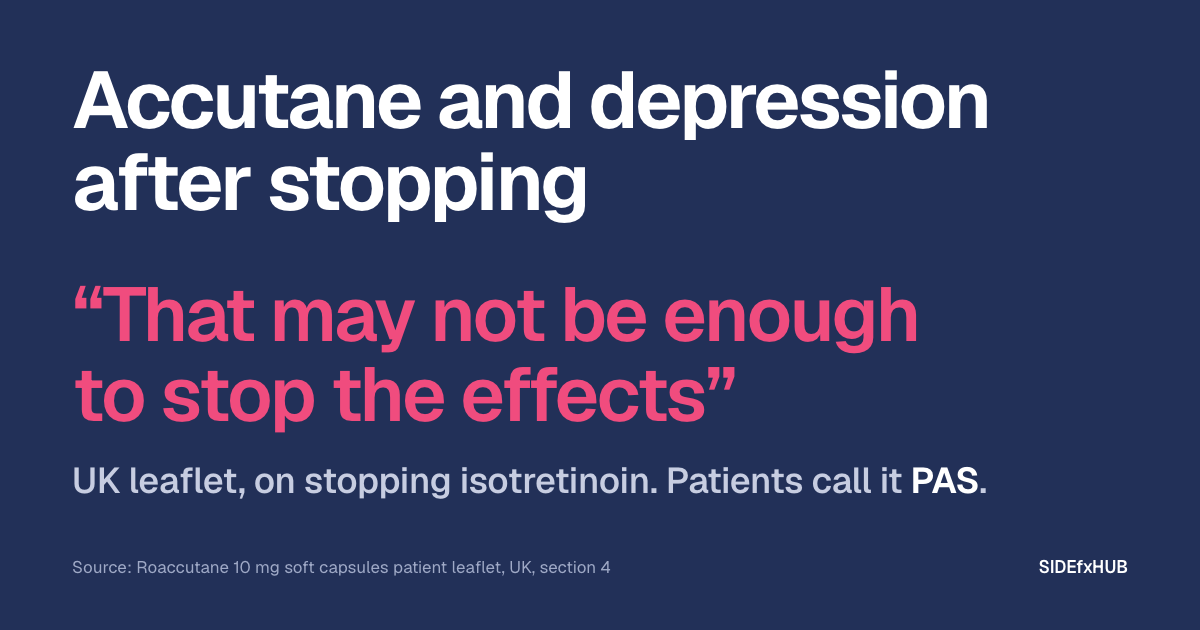
Accutane (isotretinoin, sold in the UK as Roaccutane) can cause depression and other changes in mood, its UK leaflet says. It warns that stopping it “may not be enough to stop the effects”, and low mood that stays is one of the symptoms of post-Accutane syndrome, or PAS.
The NHS page on isotretinoin lists mental health problems among its serious side effects, but doesn’t say they can continue after stopping. If your mood dropped during or after your course and hasn’t lifted, that’s worth knowing, and worth reporting.
The story in 3 lines
- The UK leaflet lists depression and mood changes as possible side effects of isotretinoin.
- If your doctor stops it, the leaflet warns, “That may not be enough to stop the effects”. The US label says stopping “may be insufficient”.
- Nobody has measured how often low mood lasts. A 2023 UK expert review heard of mental health side effects that were “long term”. Patients call it PAS.
Press: contact@sidefxhub.com
Joseph was 13 when he took isotretinoin for acne. He felt fine in himself during the course, he says. Then, months after it ended, severe anxiety and panic attacks began.

He describes losing his joy and his emotional balance, and years of doctors telling him the medicine couldn’t be responsible. “There are days when I get up and everything is black,” he says. Things have got better since, with time and support, though he says it’s still far from perfect.
Does Accutane cause depression?
Its labels say it may. The UK leaflet counts “sad or altered mood” and anxiety as signs of depression or related disorders. The US label says isotretinoin “may cause depression”.
Big studies don’t settle it. A 2024 review pooled research on more than a million and a half people. On average, people who took isotretinoin were no more likely to have a mental health condition.
Averages can hide people, though. Experts who reviewed isotretinoin in 2023 for the MHRA, the UK medicines regulator, suggested how. As some people’s skin clears, their mood lifts, and on paper that can cancel out harm in others.
Can depression last after stopping Accutane?
For some people, it seems to. After its warning that stopping may not be enough, the UK leaflet goes on: “you may need more help, and your doctor can arrange this”.
The UK experts warned that this line could sound reassuring, as if more help will always end it. That “may not be the case for all patients”, they wrote.
They also heard from patients and families, and wrote of the “devastating impact” of severe psychiatric side effects, “some of which were long term”. One person told them that “the depression alone has stuck”.
Some reports to the MHRA’s Yellow Card scheme describe mental health problems that went on for months or years after stopping. Nobody has measured how often this happens. Nobody knows yet who will be affected, or whether it will ease.
How long after Accutane should I watch my mood?
Swedish researchers advised close checks for up to a year after the last capsule. They had looked at the hospital records of thousands of people in Sweden who took isotretinoin.
Admissions for suicide attempts were higher than expected during treatment and for six months after it. The risk was already rising before treatment began, so the researchers couldn’t say whether the drug or the acne was behind it.
If you’re having thoughts of suicide, call the Samaritans free on 116 123, at any hour. In the US, call or text 988.
The drug itself leaves the body much sooner: the UK prescribing information says it’s “completely eliminated” within a month of the last dose. Going by that, low mood months or years later isn’t leftover medicine. Joseph’s anxiety didn’t start until months after his course.
Isotretinoin and mood after the last capsule
What can I do?
These medicines help many people. If you have side effects, that’s a decision for you and your prescriber. During a course, the UK leaflet asks you to contact your doctor straight away if you notice signs of mental problems.
It also asks you to tell friends and family you’re taking it. They may spot changes in your mood that you don’t.
If your mood hasn’t lifted since your course ended, tell your GP and give your dates: “Isotretinoin 40 mg a day from March 2024, last capsule August 2024. Low mood since June 2024, still there now.”
Many people say it took time to be taken seriously. Miriam, who leads an association in Spain for people affected by the drug, talks about that disbelief.
Bring the leaflet line. You can report it without a doctor agreeing.
Report it: it helps everyone
A doctor’s note helps you. A report to the medicines regulator helps everyone else: it is how patterns get noticed.
- No proof needed. A suspicion is enough, even years after stopping.
- Where: the Yellow Card scheme in the UK, MedWatch in the US.
- Use the right words. PAS has no medical term yet, so name each symptom, such as low mood or anxiety, and say it continued after stopping. The MHRA asks for detail “particularly if a side effect continued or started after treatment was stopped”.
Our reporting guide walks you through it
What else do people ask?
Is it PAS if I have no sexual problems? It can be. The researchers who wrote 2022 criteria for lasting sexual problems after isotretinoin say the name PAS is often used for mental health and cognitive effects “without sexual difficulties”. Depression is on their list of effects that can come without them. Our page on post-Accutane syndrome covers what’s known so far.
Could it be my acne, or something else? It might be. Severe acne can lower mood on its own, and the UK experts said gaps in the data stopped them proving what isotretinoin caused. A doctor will ask how you felt before you started, so note when your mood changed: before, during or after the course.
Does it get better? For some people, yes. The US label notes that some people’s depression lifted when they stopped and came back when they started again. Joseph says his symptoms have eased with time. For others it has lasted years. Nobody can tell yet who will get better.
Joseph was told for years that the medicine couldn’t be the cause. If your mood dropped on isotretinoin and hasn’t recovered, a Yellow Card report puts your dates on record for the people who check this medicine’s safety.
Sources
- Roaccutane 10 mg soft capsules, patient leaflet, Electronic Medicines Compendium (EMC 100633), revised April 2026. Section 2, “Mental health problems” (tell friends and family, as you may not notice changes in your mood). Section 4: side effects are “generally reversible after changing the dose or stopping treatment, however some may continue after treatment has stopped”. Section 4, “Mental problems”, frequency not known: depression or related disorders, with signs including “sad or altered mood, anxiety”; “That may not be enough to stop the effects”.
- Roaccutane 10 mg soft capsules, summary of product characteristics, EMC 100633, revised 27 April 2026. Section 4.4, psychiatric disorders: “Discontinuation of isotretinoin may be insufficient to alleviate symptoms and therefore further psychiatric or psychological evaluation may be necessary”. Section 4.4, pregnancy: the drug is “completely eliminated” within one month of the end of treatment.
- Absorica and Absorica LD (isotretinoin), US prescribing information and Medication Guide, revised August 2026. DailyMed, US National Library of Medicine. Section 5.4: “may cause depression”; “Discontinuation of ABSORICA/ABSORICA LD may be insufficient; further evaluation may be necessary”. Section 6, from clinical trials and postmarketing reports: some patients reported that depression “subsided with discontinuation of treatment and recurred with reinstitution of treatment”.
- NHS, Isotretinoin (Roaccutane), page last reviewed 26 June 2026. Serious side effects include “mental health problems”.
- Commission on Human Medicines, Report of the Isotretinoin Expert Working Group, 26 April 2023, published by the MHRA. Executive summary: data limits “prevented the establishment of causal associations”, and the balance of benefits and risks “remains favourable”. Section 4.3.1: acne itself can be associated with anxiety and depression. Section 4.2.5.1: depression is the most commonly reported psychiatric side effect (516 UK Yellow Card reports in the depression group to 20 May 2021), and the comment “the depression alone has stuck”. Section 4.2.5.3 (the report’s section on psychosis, discussing the leaflet’s line for all mental problems): the line “could be perceived by some as reassuring … which may not be the case for all patients”. Section 4.2.5.4.1: some reports of suicidal behaviour persisting “for months and years after stopping”. Section 4.6: psychiatric side effects “some of which were long term”, and why population studies may not show a raised risk.
- MHRA, Drug Safety Update: isotretinoin, introduction of new safety measures, 31 October 2023. Reporting advice, including historic reactions.
- Tan NKW, Tang A, MacAlevey NCYL and colleagues. Risk of suicide and psychiatric disorders among isotretinoin users: a meta-analysis. JAMA Dermatol 2024;160(1):54-62. 25 studies, 1,625,891 participants. No raised risk of psychiatric disorders overall, and a lower risk of suicide attempts 2 to 4 years after treatment, “at a population level”.
- Sundström A, Alfredsson L, Sjölin-Forsberg G and colleagues. Association of suicide attempts with acne and treatment with isotretinoin: retrospective Swedish cohort study. BMJ 2010;341:c5812. 5,756 people. Raised risk during treatment and up to six months after; the risk was rising before treatment, so an added risk from the drug “cannot be established”. Advises close monitoring “for up to a year after treatment has ended”.
- Healy D, Bahrick A, Bak M and colleagues. Diagnostic criteria for enduring sexual dysfunction after treatment with antidepressants, finasteride and isotretinoin. Int J Risk Saf Med 2022;33(1):65-76. Depression and suicidality listed among isotretinoin effects that can occur without sexual difficulties; the name PAS “equally often appears to include suicidality and other cognitive effects without sexual difficulties”.
- Moral Medicine, French Patient Shares His Long-Term Struggle After Accutane (isotretinoin), interview with Joseph, 17 November 2025, in French. The quote is our translation (about 8:13). His story on our site: Joseph’s story: isotretinoin at 13.
- Miriam’s story on our site: Miriam’s story: 2 courses of isotretinoin, from her interview with Moral Medicine.
This information does not replace medical advice. Talk to your doctor before you make any decision about your treatment.
590+ people have joined the community.
Join them, then report your side effects.
No diagnosis needed. Researchers never see your name.