Accutane dry eyes: can they last?
Accutane (isotretinoin) often dries the eyes. The UK leaflet says some cases didn't clear up after stopping. Patients call lasting symptoms PAS.
SIDEfxHUB is a patient charity. We are not health professionals, and this does not replace medical advice. Don't start, stop or change any medicine because of what you read here. Talk to your doctor first.
If you are in crisis:116 123 Samaritans (UK)988 Lifeline (US)Find a helpline
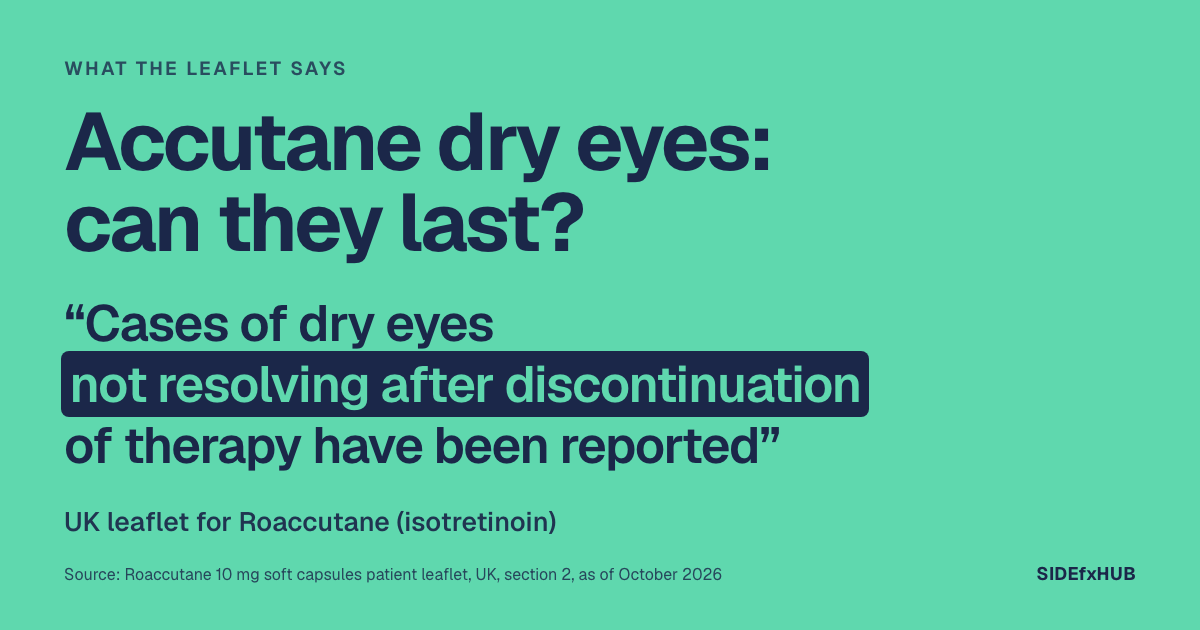
Accutane (isotretinoin) very often dries the eyes, and the UK leaflet says there have been reports of dry eyes that didn’t clear up after stopping. Patients call symptoms that carry on after the medicine post-Accutane syndrome, or PAS, a name with no official definition.
The NHS page on isotretinoin lists “sore eyes” and doesn’t say they can stay dry after the course. So if yours still feel dry months after the last capsule, it’s easy not to connect the two.
The story in 3 lines
- The UK leaflet lists dry, irritated eyes as a very common side effect of isotretinoin: it may affect more than 1 in 10 people.
- The same leaflet says, as of October 2026: “Cases of dry eyes not resolving after discontinuation of therapy have been reported.”
- A 2026 review says changes to the eyelid oil glands may persist in some patients. No reliable figure exists for how often.
Press: contact@sidefxhub.com
Miriam had worn contact lenses since she was a little girl. In her thirties she took two low-dose courses of isotretinoin (Roaccutane in the UK). On the first, she says, she noticed “some episodes of dryness in the eyes”.

She finished the second course in January 2023, and by May she couldn’t wear lenses at all. It took three eye doctors to get a diagnosis, she says: in April 2024 a dry eye specialist told her she had lost most of the oil glands in her eyelids. He didn’t say why, and she made the link to isotretinoin herself.
How common are dry eyes on Accutane?
Very common, says the UK leaflet: eyes that “feel dry and irritated” may affect more than 1 in 10 people.
Its warnings say Roaccutane may also cause “intolerance to contact lenses and visual difficulties including decreased night vision”. Long-term side effects of Accutane goes through the night-vision warning.
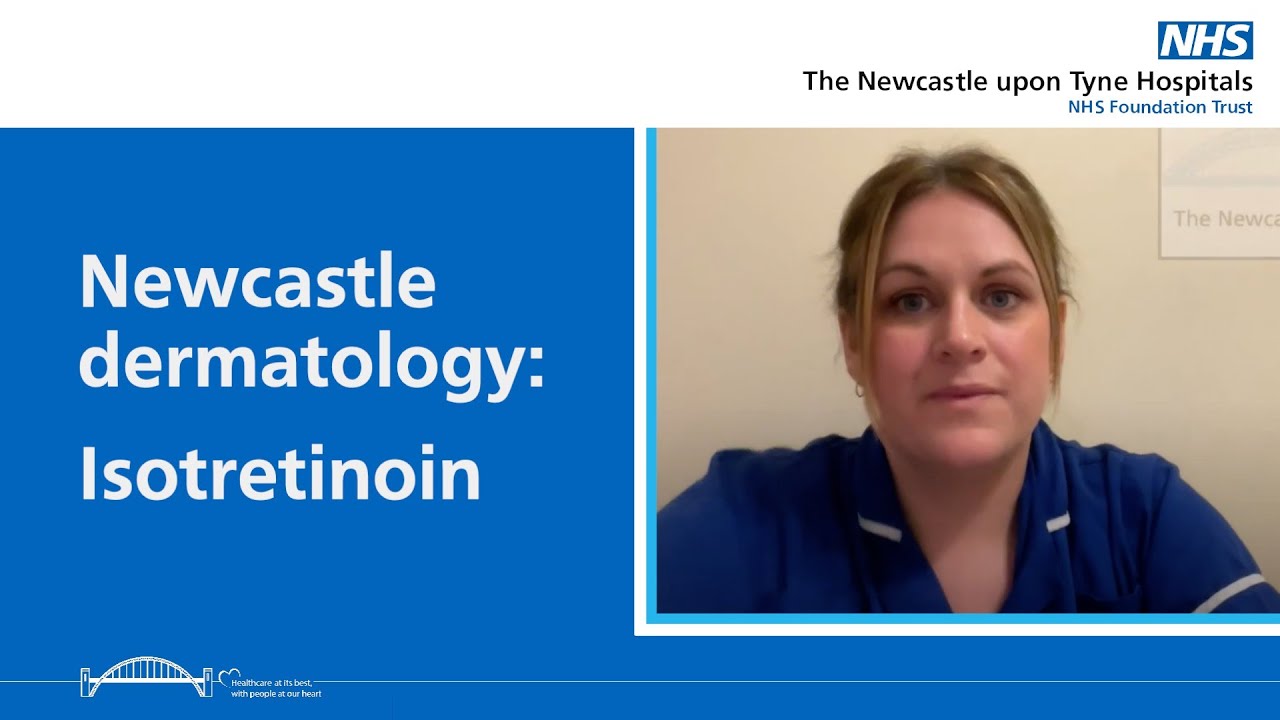
Newcastle Hospitals’ film for its acne patients names dry eyes among the most common effects.
Can Accutane dry eyes be permanent?
For some people dry eyes have lasted years after stopping. Nobody knows yet who will be affected, or whether it will ease.
The UK prescribing information, written for doctors, says dry eyes “usually resolve” once the course ends. Like the leaflet, it adds that cases “not resolving” have been reported. As of October 2026, neither says how many.
No reliable figure exists for how often it lasts. The nearest is from 1994, when doctors in Leeds checked on 720 patients years after their isotretinoin. They called dry eye syndrome an “infrequent but probable” long-term side effect, and described every lasting symptom they found as mild.
A review by Pan and colleagues puts dry eye lasting over two years at about 1 in 100 patients, citing that 1994 study, whose summary has no such figure and whose full text we couldn’t open to check.
Eye specialists who went through case reports in 2001 graded how likely each eye effect was to come from the medicine. Dry eye was “certain”. Permanent dry eye was “possible”, two grades lower.
What does Accutane do to the eyelid oil glands?
On scans the glands looked changed during a course, in each of three small studies. The research disagrees on how fully they recover.
Your eyelids hold rows of tiny oil glands, called meibomian glands. Their oil coats your tears and slows their drying.
A 1991 study imaged the glands of 11 patients before and during treatment, with no check afterwards. On the medicine they looked less dense.
A Polish study examined 24 people one month after the last capsule. Gland loss had started to reverse but hadn’t returned to where it began, and its authors call the changes reversible.
One Turkish study examined 88 people a year after. Its summary reports gland and tear scores still worse than before treatment, and says some changes “may persist for a long time”. Patients’ own symptom ratings were only slightly higher.
An earlier Turkish study followed 40 people on a two-month course. It didn’t image the glands, and found every abnormal finding gone a month after.
None of the four reports a comparison group.
How far studies of the eyelid glands have looked
A 2026 review of 43 studies concludes that the changes may persist in some patients. How far, it says, is still uncertain.
What can I do?
Isotretinoin helps many people with severe acne. If you have side effects, that’s a decision for you and your prescriber.
If your eyes are dry during a course, the UK leaflet says to tell your doctor. On blurred vision it is firmer: “stop taking Roaccutane straight away and contact your doctor”.
If they’ve stayed dry since the course ended, the NHS page on dry eyes points you to an optician or GP, who may refer you to an eye specialist.
Name the medicine and give your dates: “Isotretinoin 30 mg a day from June 2023, last capsule January 2024. Eyes dry and gritty since March 2024. I can’t wear contact lenses any more.”
Many people say it took time to be taken seriously. Bring the leaflet line on dry eyes “not resolving”. You can report it without a doctor agreeing.
Report it: it helps everyone
A doctor’s note helps you. A report to the medicines regulator helps everyone else: it is how patterns get noticed.
- No proof needed. A suspicion is enough, even years after stopping.
- Where: the Yellow Card scheme in the UK, MedWatch in the US.
- Use the right words. PAS has no reporting term yet, so name each symptom, dry eyes included, and say it continued after stopping.
Our reporting guide walks you through it
What else do people ask?
Can I wear contact lenses after Accutane? The UK leaflet says lens wearers “may be advised to wear glasses during the treatment”, and doesn’t say what happens afterwards. The US label says wearers may have trouble with their lenses during treatment “and afterwards”.
Could it be isotretinoin still in my body? The UK prescribing information says the drug is completely eliminated within one month of the end of treatment. Miriam’s lenses became unwearable four months after hers. How long does Accutane stay in your system? explains why “is it out of my system?” and “have the side effects gone?” are two different questions.
Is dry eye part of post-Accutane syndrome? The criteria researchers proposed in 2022 cover lasting sexual symptoms and don’t mention the eyes. Patients use the name more widely. Miriam, who speaks up for PAS to be recognised, says “dry eye illness is the worst thing that has happened to me”. What does post-Accutane syndrome feel like? has other people’s words. Our page on post-Accutane syndrome has the rest.
Miriam’s first eye doctor didn’t ask which medicines she had taken, she says, and she didn’t think to mention one she’d already finished. If your eyes have stayed dry since isotretinoin, say so: to your optician, and in a report.
Sources
- Roaccutane 10 mg soft capsules (isotretinoin), patient leaflet, Electronic Medicines Compendium (EMC 100633), UK. Last revised April 2026; read 12 October 2026. Section 2, warnings: “Roaccutane may cause dry eyes, intolerance to contact lenses and visual difficulties including decreased night vision”. The next sentence: “Cases of dry eyes not resolving after discontinuation of therapy have been reported”. Then: “Tell your doctor if you have any of these symptoms”. It goes on to say the doctor may ask you to use a lubricating eye ointment or tear replacement. Lens wearers “may be advised to wear glasses during the treatment”. If you develop visual difficulties, you may be referred to a specialist and asked to stop taking the medicine. Section 2, driving: “You may not see as well at night during your treatment. This can happen suddenly”. It adds: “In rare cases this has continued after the treatment has stopped”. Section 4, eye disorders, very rare: “If you get blurred vision, stop taking Roaccutane straight away and contact your doctor”. Section 4, very common (may affect more than 1 in 10 people): “Inflammation of the eye (conjunctivitis) and eyelid area; eyes feel dry and irritated”. The same entry tells readers to ask a pharmacist about eye drops, and that lens wearers may need glasses instead. Section 4, very rare: seeing less well at night, colour vision, sensitivity to light and other sight problems.
- Roaccutane 10 mg soft capsules, summary of product characteristics, EMC 100633, UK. Revised 27 April 2026; read 12 October 2026. Section 4.4, eye disorders: “Dry eyes, corneal opacities, decreased night vision and keratitis usually resolve after discontinuation of therapy”. The next sentence: “Cases of dry eyes not resolving after discontinuation of therapy have been reported”. It adds that intolerance to contact lenses may mean wearing glasses during treatment. Section 4.7: decreased night vision has “in rare instances” persisted after therapy. Section 4.8 lists blepharitis, conjunctivitis, dry eye and eye irritation as very common. Section 4.4, pregnancy warning: the drug is “completely eliminated” within one month following the end of treatment.
- Absorica and Absorica LD (isotretinoin), US prescribing information and Medication Guide, DailyMed, US National Library of Medicine. Revised August 2026; read 12 October 2026. Section 5.13, dry eyes: “Dry eyes has been reported in patients during isotretinoin use”. Contact lens wearers “may have trouble wearing them” during treatment “and afterwards”. Medication Guide: “Some patients get dry eyes during treatment”. Section 5.13 also says decreased night vision has in some instances persisted after treatment was discontinued. As of October 2026, the label does not say that dry eyes themselves can continue after stopping.
- NHS, Isotretinoin (Roaccutane), page last reviewed 26 June 2026. Side effects include “sore eyes, nose or throat”. As of October 2026, the page does not mention dry eyes, contact lenses or eye problems that continue after stopping.
- NHS, Dry eyes, page last reviewed 6 January 2025. It says to see an optician or GP if “you still have dry eyes after trying home treatments for a few weeks”, or if the shape of your eyelids changes. If no cause is found, they may refer you to an eye specialist (ophthalmologist) for tests. The page describes oil “produced by the glands around your eyes”. It also says not to stop a prescribed medicine without medical advice.
- Goulden V, Layton AM, Cunliffe WJ. Long-term safety of isotretinoin as a treatment for acne vulgaris. British Journal of Dermatology, 1994; 131(3): 360–3. General Infirmary at Leeds. Read as an abstract only. 720 patients, mean follow-up 4.9 years (range 2 to 12). 52 of them (7.2%) reported persistent symptoms, mostly of the skin and mucous membranes, “mild in all cases”. Dry eye syndrome was among those “considered to be infrequent but probable long-term side-effects”. The abstract gives no separate figure for dry eye. These were one hospital’s patients, more than 30 years ago.
- Pan JT, Daniel BS, Tan B, and colleagues. Highlighting ophthalmic adverse effects associated with isotretinoin. Life (Basel), 2026; 16(9): 1441. A narrative review, read in full. It says dry eye symptoms lasting more than two years after stopping have “been reported to occur in 1% of patients”, citing Goulden 1994, whose abstract gives no figure for dry eye. It also notes that few studies account for the effect of acne itself on the glands. It says few studies examined people after stopping, so whether the changes reverse is uncertain, and that long-term evidence is limited.
- Fraunfelder FT, Fraunfelder FW, Edwards R. Ocular side effects possibly associated with isotretinoin usage. American Journal of Ophthalmology, 2001; 132(3): 299–305. Read as an abstract only. 1,741 case reports graded on the World Health Organization’s causality scale: certain, probable or likely, possible, unlikely, or unclassifiable. “Certain” includes ocular sicca (dry eye), decreased tolerance to contact lenses and meibomian gland atrophy. “Possible” includes permanent keratoconjunctivitis sicca (dry eye). Case reports show what was reported. They cannot show how often it happens.
- Mathers WD, Shields WJ, Sachdev MS, and colleagues. Meibomian gland morphology and tear osmolarity: changes with Accutane therapy. Cornea, 1991; 10(4): 286–90. Read as an abstract only. 11 patients examined before and during treatment. On imaging, the glands “appeared significantly less dense and atrophic”. No examination after stopping.
- Fineide FA, Reppe S, Mantaka P, and colleagues. Isotretinoin and dry eye disease: a systematic review. Current Eye Research, 2026, online 5 August. Read as an abstract only. 43 articles. Worsening of symptoms and signs was frequently reported, particularly for meibomian gland structure and function. Its conclusion: the drug “may cause persistent alterations” to the glands in some patients, and the long-term extent and clinical significance “remain uncertain”. The abstract calls the meibomian glands the sebaceous (oil) glands of the eyelids, and says the drug that acts on those of the skin can also affect them.
- Zakrzewska A, Wiącek MP, Słuczanowska-Głąbowska S, and colleagues. The effect of oral isotretinoin therapy on meibomian gland characteristics in patients with acne vulgaris. Ophthalmology and Therapy, 2023; 12(4): 2187–97. Szczecin, Poland. Read in full. 24 patients (48 eyes), treated for 24 to 32 weeks. They were examined before treatment, 3 months in, and 1 month after the end. Meibomian gland loss rose during treatment and fell after it, but still exceeded the pretreatment level. The quality of the gland oil did not return to the pretreatment level either. Symptom scores (OSDI) were higher than before treatment at both later visits. There was no comparison group. The authors call the changes reversible and say they had started to subside.
- Tanriverdi C, Nurozler Tabakci B, Donmez S. Longitudinal assessment of meibomian glands and tear film layer in systemic isotretinoin treatment. European Journal of Ophthalmology, 2022; 32(2): 885–93 (online May 2021). Istanbul, Turkey. Read as an abstract only. 88 patients, mean age 21, treated for 4 to 8 months and examined before, during and after treatment. Twelve months after the end, the scores for gland dysfunction, gland imaging, tear break-up time, corneal staining and the eyelid margin all differed from the pretreatment values, each for the worse. The mean symptom score (OSDI, a questionnaire scored from 0 to 100) was 0.54 before treatment and 1.90 twelve months after. The abstract does not mention a comparison group. Its conclusion: some changes “may persist for a long time” after treatment.
- Bozkurt B, Irkeç MT, Atakan N, and colleagues. Lacrimal function and ocular complications in patients treated with systemic isotretinoin. European Journal of Ophthalmology, 2002; 12(3): 173–6. Ankara, Turkey. Read as an abstract only. 40 patients treated for two months, examined before, during the second month and at least one month after the end. Tear tests and an eye examination, with no imaging of the glands. “All abnormal findings disappeared one month after the cessation of treatment”. The abstract does not mention a comparison group.
- Healy D, Bahrick A, Bak M, and colleagues. Diagnostic criteria for enduring sexual dysfunction after treatment with antidepressants, finasteride and isotretinoin. International Journal of Risk & Safety in Medicine, 2022; 33(1): 65–76. Read in full. The criteria for isotretinoin cover lasting sexual symptoms, which the paper calls post-retinoid sexual dysfunction. Neither the criteria nor the paper’s list of other effects reported after isotretinoin mentions the eyes. The paper says the name post-Accutane syndrome is “in widespread use”.
- Moral Medicine on YouTube, interview with Miriam, 13 October 2025, embedded here as an extract from 13:13 to 14:01. Her first course in 2020, when she turned 30, at 5:31. Contact lenses “since I was a little girl” and “some episodes of dryness in the eyes” on that course, at 8:49 to 9:12. A second low-dose course at 10:51. Inside the extract: trouble with her lenses just after the second course, “worse and worse”, finished in January 2023, no lenses from May. Her first eye doctor “didn’t ask me if I had taken any prior medications”, at 14:05. She adds that she didn’t suspect the medicine herself, because she was no longer taking it. She says a dry eye specialist diagnosed evaporative dry eye disease in April 2024, with a loss of 75 to 90% of the glands, at 17:05. He didn’t tell her the cause and she researched it herself, at 18:08. Her life revolves around managing the symptoms, at 24:18. It took three eye doctors to get the diagnosis, at 26:44. “Dry eye illness is the worst thing that has happened to me”, at 35:44. Her association’s goal is recognition of post-Accutane syndrome, at 1:53. This is her account, and we have not seen her records. Quotes are from YouTube’s automatic captions. Her story on our site: Miriam’s story: 2 courses of isotretinoin.
- Newcastle Hospitals, Newcastle dermatology - Isotretinoin, 29 November 2024, embedded here as an extract from 1:23 to 1:38: “Most commonly patients will experience dry lips, dry skin and dry eyes”.
This information does not replace medical advice. Talk to your doctor before you make any decision about your treatment.
610+ people have joined the community.
Join them, then report your side effects.
Free. Sign up takes 2 minutes.