Long-term side effects of Accutane
Most Accutane (isotretinoin) side effects ease once you stop. Its labels say some, like sexual problems and poor night vision, can last. That's called PAS.
SIDEfxHUB is a patient charity. We are not health professionals, and this does not replace medical advice. Don't start, stop or change any medicine because of what you read here. Talk to your doctor first.
If you are in crisis:116 123 Samaritans (UK)988 Lifeline (US)Find a helpline
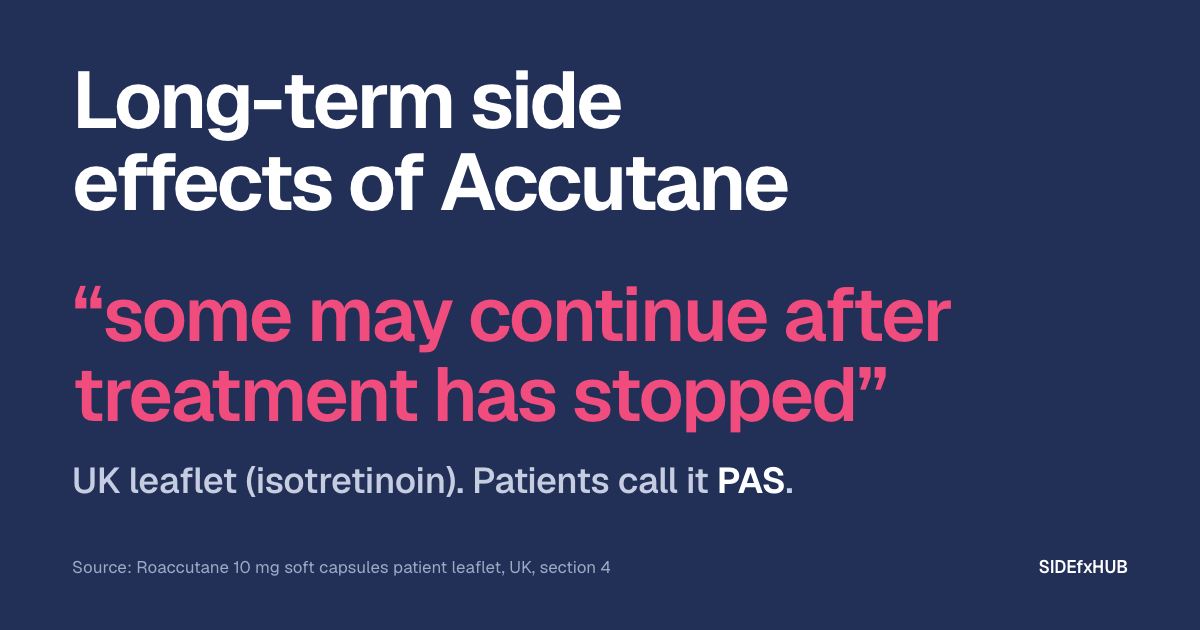
Most side effects of Accutane (isotretinoin, sold in the UK as Roaccutane) ease once the course ends. Its UK and US labels warn that some, including sexual problems and poorer night vision, have continued after stopping, a condition patients call post-Accutane syndrome, or PAS.
The NHS page on isotretinoin lists problems with sex among its side effects but doesn’t say that any can continue after stopping. If something changed during your course and hasn’t gone back to normal, the leaflet in your pack may already describe it.
The story in 3 lines
- Most isotretinoin side effects ease after the course, says the UK leaflet.
- The same leaflet warns that some “may continue after treatment has stopped”. It names sexual problems and poorer night vision, as does the US label.
- Nobody has measured how often. A 2023 UK expert review called for research into side effects that continue long term. Patients call it PAS.
Press: contact@sidefxhub.com
Miriam took two courses of isotretinoin for what she says was mild acne. She describes her life before it as vibrant, active and full of energy.

Since then, she says, she has had severe dry eyes and hair loss, as well as joint pain and lower bone density. She now leads an association in Spain for people affected by the drug. Patients aren’t warned that side effects may be permanent, she says.
What are the long-term side effects of Accutane?
For most people, side effects stop when the course does. The UK leaflet says they are “generally reversible” after stopping, “however some may continue after treatment has stopped”.
That sentence doesn’t say which ones. A UK expert review made the same point in 2023: the general warning “does not indicate which side effects are prolonged or for how long”. Look further into the UK leaflet and the US label, though, and they do name some:
- Sexual problems. The UK leaflet mentions reports of “long-lasting sexual problems where the symptoms have continued despite stopping treatment”. Our article on Accutane’s sexual side effects covers them.
- Poorer night vision. “In rare cases this has continued after the treatment has stopped,” says the UK leaflet.
- Dry eyes. It adds that cases “not resolving” after stopping have been reported.
- Mental health problems. If your doctor tells you to stop, the leaflet warns, “that may not be enough to stop the effects”.
- Hearing and bowel problems. The US label says both have been reported to persist after stopping.
- Hair loss. The UK leaflet calls it usually temporary, but the US label says it “in some cases persisted”.
Could it be isotretinoin still in my body?
Not after the first month. The UK label says isotretinoin is “completely eliminated” within one month of the last capsule. That’s why the pregnancy rules end a month after stopping.
So a problem that’s still there months or years later isn’t leftover medicine.
In 2022, the psychiatrist David Healy and colleagues proposed criteria for diagnosing lasting sexual problems after isotretinoin. The problems must have lasted at least three months after stopping. The name PAS is often used more widely, they note, including for mental health and cognitive changes with no sexual problems at all.
Isotretinoin after the last capsule
How long can Accutane side effects last?
For some people, years. Experts advising the UK medicines regulator, the MHRA, went through the sexual side effects reported to its Yellow Card scheme. Some men described problems still there more than 20 years after their last capsule.
Nobody has measured how long, or how often. In their 2023 review, the experts said more research is needed “to establish the extent of the risk of side effects continuing long term”. Nobody knows yet who will be affected, or whether the problems will ease.
Elliot took Accutane when he was 17. Moral Medicine, who interviewed him, says he has lived with PAS ever since. You can read Elliot’s story on our site.

What can I do?
These medicines help many people. If you have side effects, that’s a decision for you and your prescriber. During treatment, the UK leaflet asks you to tell your doctor about any sexual problems or eye symptoms.
If something hasn’t lifted since your course ended, tell your GP. Give your dates: “Isotretinoin 40 mg a day from January 2024, last capsule June 2024.”
Many people say it took time to be taken seriously. Bring the leaflet line: “some may continue after treatment has stopped”. You can report it without a doctor agreeing.
Report it: it helps everyone
A doctor’s note helps you. A report to the medicines regulator helps everyone else: it is how patterns get noticed.
- No proof needed. A suspicion is enough, even years after stopping.
- Where: the Yellow Card scheme in the UK, MedWatch in the US.
- Use the right words. PAS has no medical term yet, so name each symptom and say it continued after stopping. The MHRA asks for detail “particularly if a side effect continued or started after treatment was stopped”.
Our reporting guide walks you through it
What else do people ask?
Can Accutane cause permanent damage? The US patient guide says some effects may be. Poorer night vision usually goes away after stopping, “but it may be permanent”, it says, and so may hearing loss. A 2001 review by eye specialists rated a permanent loss of night vision as a “probable” side effect.
Can side effects start after the course ends? Sometimes, reports suggest. The UK review found a few cases of erection problems or low sex drive that began only after the last capsule. Joseph took isotretinoin at 13, and he says severe anxiety began months after his course ended.
What about teenagers? Isotretinoin is commonly used by teenagers, the UK review notes, and the NHS says it can suit some young people from the age of 12. The UK experts said more data are needed on under-18s, “including the study of any potential long-term effects in adulthood”. Our page on post-Accutane syndrome covers what is known so far.
Miriam says everything changed after two courses. If something never went back to normal after your course, report it and say how long it has lasted: nobody has counted that yet.
Sources
- Roaccutane 10 mg soft capsules, patient leaflet, Electronic Medicines Compendium (EMC 100633), revised April 2026. Section 2, eyes, night vision and sexual problems; section 4, side effects “generally reversible” but “some may continue”, mental health problems, hair loss.
- Roaccutane 10 mg soft capsules, summary of product characteristics, EMC 100633, revised 27 April 2026. Section 4.4 (sexual dysfunction; dry eyes; the drug “completely eliminated” within one month), section 4.7 (night vision), section 4.8, section 5.2 (endogenous retinoid levels within about two weeks).
- Absorica and Absorica LD (isotretinoin), US prescribing information and Medication Guide, revised August 2026. DailyMed, US National Library of Medicine. Sections 5.9 (hearing), 5.11 (inflammatory bowel disease) and 5.13 (night vision). Section 6: sexual dysfunction “that may continue after discontinuation of treatment”, and alopecia “which in some cases persisted”. Medication Guide: night vision and hearing loss “may be permanent”.
- NHS, Isotretinoin (Roaccutane), page last reviewed 26 June 2026.
- Commission on Human Medicines, Report of the Isotretinoin Expert Working Group, 26 April 2023, published by the MHRA. Section 5.3: 184 Yellow Card reports of sexual side effects to 20 May 2021. Erectile dysfunction was reported for up to 24 years after stopping, and reduced libido for up to 25 years. A few cases began after stopping. Section 6.4: the general warning. Sections 8.2 and 8.5: further research, including long-term effects in adulthood.
- MHRA, Drug Safety Update: isotretinoin, introduction of new safety measures, 31 October 2023. Reporting advice.
- Healy D, Bahrick A, Bak M and colleagues. Diagnostic criteria for enduring sexual dysfunction after treatment with antidepressants, finasteride and isotretinoin. Int J Risk Saf Med 2022;33(1):65-76. Post-retinoid sexual dysfunction criteria, including problems present for 3 months or more after stopping; the wider use of the term PAS.
- Fraunfelder FT, Fraunfelder FW, Edwards R. Ocular side effects possibly associated with isotretinoin usage. Am J Ophthalmol 2001;132(3):299-305. A review of 1,741 case reports; permanent loss of dark adaptation rated “probable/likely”.
- Moral Medicine, From Mild Acne to Severe Dry Eyes, Hair Loss and Infertility: Miriam’s Nightmare After Isotretinoin, interview with Miriam, 13 October 2025. Her story on our site: Miriam’s story: 2 courses of isotretinoin.
- Moral Medicine, He Took Accutane at 17. His Life Never Returned to Normal., interview with Elliot, 28 January 2025. His story on our site: Elliot’s story: Accutane at 17.
- Joseph’s story on our site: Joseph’s story: isotretinoin at 13, from his interview with Moral Medicine.
This information does not replace medical advice. Talk to your doctor before you make any decision about your treatment.
590+ people have joined the community.
Join them, then report your side effects.
No diagnosis needed. Researchers never see your name.