Permanent erectile dysfunction from medicine?
Leaflets for SSRIs, finasteride and isotretinoin warn erectile dysfunction has continued after stopping: PSSD, PFS and PAS. None calls it “permanent”.
SIDEfxHUB is a patient charity. We are not health professionals, and this does not replace medical advice. Don't start, stop or change any medicine because of what you read here. Talk to your doctor first.
If you are in crisis:116 123 Samaritans (UK)988 Lifeline (US)Find a helpline
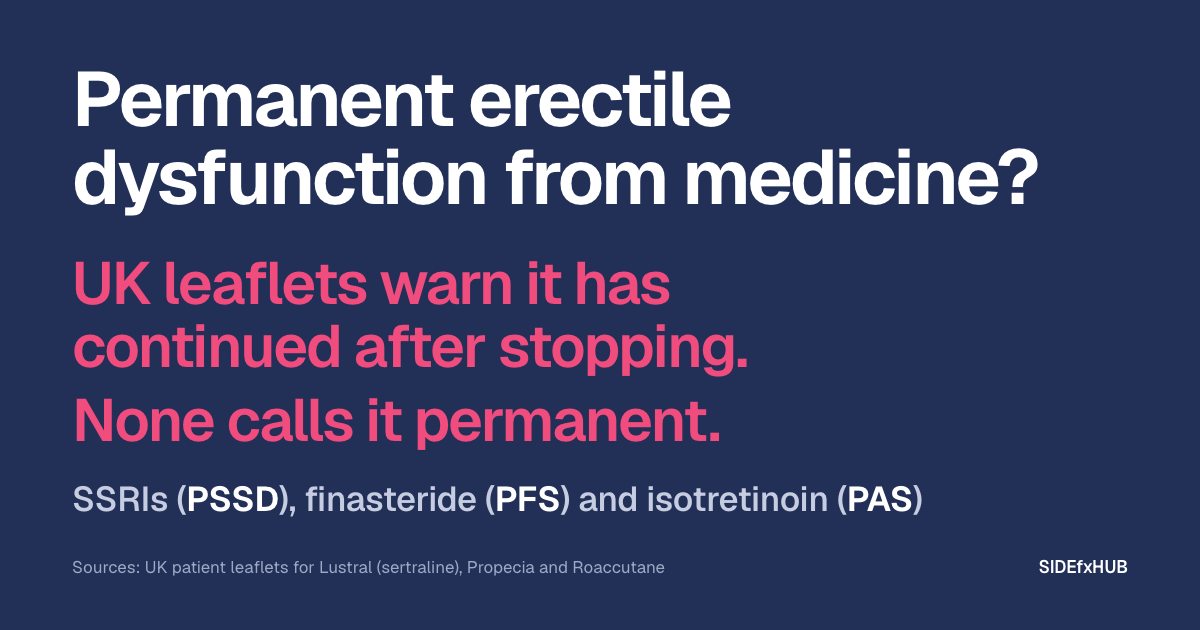
UK leaflets for SSRI antidepressants, finasteride and isotretinoin warn that sexual problems such as erectile dysfunction have continued after stopping. None calls it “permanent”, but for some people it has lasted years, a condition known as post-SSRI sexual dysfunction (PSSD), post-finasteride syndrome (PFS) or post-Accutane syndrome (PAS).
The NHS page on erection problems says a doctor may switch your medicine if it’s the cause. It doesn’t cover what happens when the problem stays, and how many people recover has never been properly studied.
The story in 3 lines
- The UK finasteride leaflet lists “persistent difficulty having an erection after discontinuation of treatment”.
- The leaflets for sertraline (an SSRI) and isotretinoin say sexual problems “have continued” after stopping. None of the three calls them “permanent”.
- How many people get their sexual function back “has never been properly investigated”, say the authors of the 2022 diagnostic criteria. Patients call it PSSD, PFS or PAS.
Press: contact@sidefxhub.com
Daryl had been on antidepressants and other medicines since he was a child. He was a young man when, he says, “my erections had stopped working”.

After he came off them, he kept asking his doctors when things would go back to normal. A few weeks, they told him, then a few months, then a year or more. “It didn’t go away,” he says, “and it hasn’t gone away in 13 years.”
Which medicines can cause erectile dysfunction that lasts?
At least three kinds of medicine have a warning about it in their UK leaflets: SSRI antidepressants, finasteride and isotretinoin. Each leaflet lists erection problems as a side effect, then has a line about what happened after stopping.
- SSRI antidepressants, such as sertraline. The sertraline leaflet says of its sexual side effects: “In some cases, these symptoms have continued after stopping treatment.”
- Finasteride, the hair-loss tablet sold as Propecia. Its leaflet lists “persistent difficulty having an erection after discontinuation of treatment”.
- Isotretinoin, the acne capsule sold as Roaccutane in the UK and Accutane in the US. Its leaflet mentions “long-lasting sexual problems where the symptoms have continued despite stopping treatment”. Our article on Accutane and erectile dysfunction has the detail.
Look at the words: continued, persistent, long-lasting. “Permanent” isn’t one of them.
The UK medicines regulator writes the same way. Its 2024 reminder about finasteride says sexual side effects “may persist” after treatment stops. A warning like this describes what patients have reported. It can’t say how things will turn out.
Is erectile dysfunction from medication permanent?
For some people it has lasted years after stopping. Nobody knows yet who will be affected, or whether it will ease.
One doctor put the question in the title of a study: “could they be permanent?” Michael Irwig, a US doctor who specialises in hormones, was writing in 2012 about sexual side effects that lasted after finasteride.
He went back to young men who already had them. About 14 months later, nearly all still did.

The study was small, and every man in it already had the problem. It can’t show how often this happens, or how it ends. Fourteen months is a long way short of a lifetime.
In 2022 a group of doctors and researchers wrote diagnostic criteria for PSSD, PFS and PAS, a checklist for recognising them. Trials, they point out, don’t routinely check whether sexual side effects clear afterwards. They say these conditions can remain “for months, years or indefinitely”, and the checklist sets no upper limit.
How far has anyone looked?
What else can cause erectile dysfunction?
Plenty of everyday things. Most men sometimes can’t get or keep an erection, says the NHS, and that’s usually down to stress, tiredness or too much alcohol.
When it happens often, the NHS lists conditions such as high blood pressure, diabetes, depression or anxiety, and hormone problems. It says to see a GP or go to a sexual health clinic if it keeps happening, because it “might be a sign of a health condition that can be treated”.
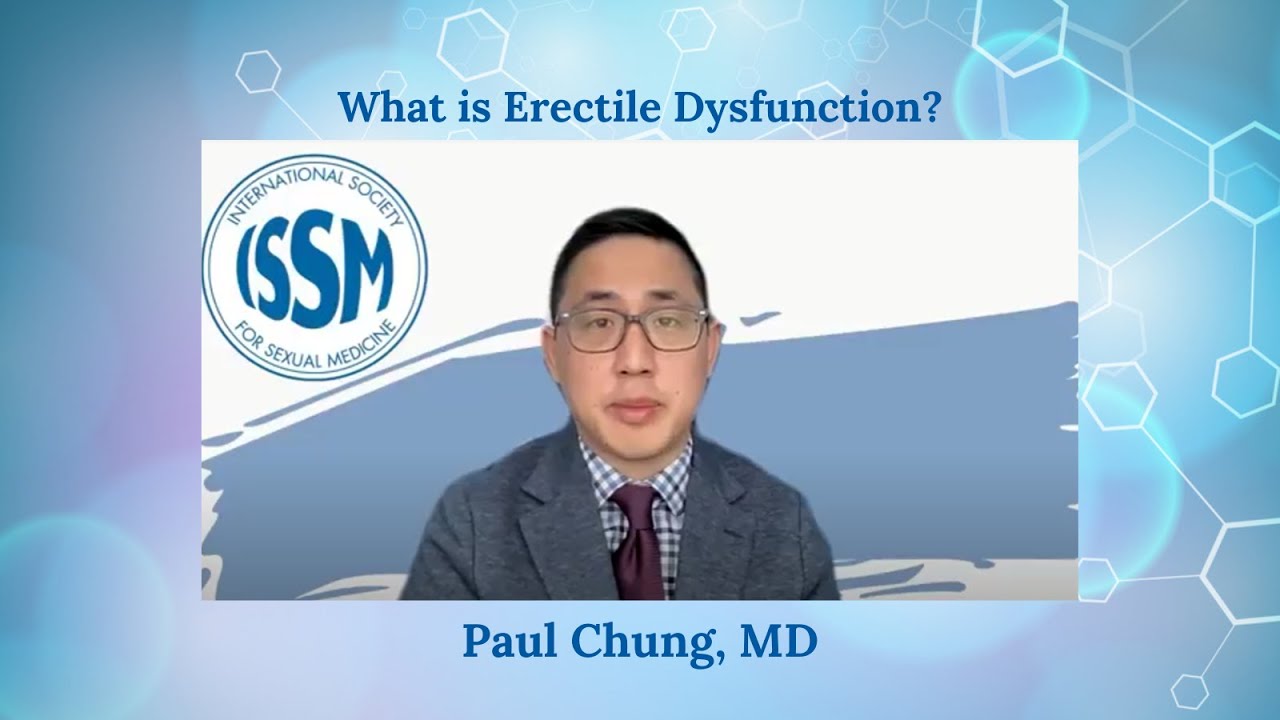
Other medicines can affect erections too. In the film below, from the International Society for Sexual Medicine, a speaker says some medicines for high blood pressure, heart disease, insomnia and depression can.
So timing matters. The 2022 criteria say there should be no sign of the same problem before the medicine, and no other condition or medicine to explain it.
What can I do?
These medicines help many people. If you have side effects, that’s a decision for you and your prescriber.
Don’t stop an antidepressant suddenly. For finasteride and isotretinoin, follow what the leaflet says.
If your erections changed on one of these medicines, or haven’t come back since you stopped, see your GP or a sexual health clinic. Give your dates: “Sertraline 50 mg from January 2023, last tablet March 2024.” Say what sex was like before.
Many people say it took time to be taken seriously. Bring the leaflet line. You can report it without a doctor agreeing.
Report it: it helps everyone
A doctor’s note helps you. A report to the medicines regulator helps everyone else: it is how patterns get noticed.
- No proof needed. A suspicion is enough, even years after stopping.
- Where: the Yellow Card scheme in the UK, MedWatch in the US.
- Use the right words. If symptoms continued after stopping, write Post-SSRI sexual dysfunction (MedDRA 10086208) for an SSRI or SNRI, or Post 5-alpha-reductase inhibitor syndrome (MedDRA 10082430) for finasteride. For isotretinoin there’s no term yet, so say the symptoms continued after stopping.
Our reporting guide walks you through it
What else do people ask?
Does it ever get better? It can. The 2022 criteria note that sexual side effects sometimes improve a lot once an antidepressant is stopped, while leaving some symptoms behind. Nobody has counted how many people recover. Our article on whether PSSD goes away has more.
I’m in my twenties. Could it be a medicine? It could, though an occasional problem usually has an everyday cause at any age. Our article on erectile dysfunction at 20 goes through the common causes in young men, and where the three medicines fit.
Is it only erections? No. The same leaflets list a lower sex drive, and the isotretinoin leaflet adds reduced feeling in the genitals. For PSSD, the key sign in the 2022 criteria is a lasting change in how the genitals feel. Our article on antidepressant sexual problems covers the rest. For the other two, see PFS and PAS.
When Daryl was filmed, nobody had been able to tell him when it would go away. If nobody can tell you either, report it and give your dates.
Sources
- Lustral (sertraline) 50 mg and 100 mg film-coated tablets, patient leaflet, Electronic Medicines Compendium (EMC 2835), last revised December 2025. Section 2, “Sexual problems”: “Medicines like Lustral (so called SSRIs) may cause symptoms of sexual dysfunction (see section 4). In some cases, these symptoms have continued after stopping treatment.” Section 4: erectile dysfunction and decreased sexual interest are common (may affect up to 1 in 10 people). The word “permanent” does not appear in the leaflet.
- Propecia (finasteride) 1 mg film-coated tablets, patient leaflet, Electronic Medicines Compendium (EMC 2194), last revised May 2026. Section 4, uncommon (may affect up to 1 in 100 people): “you may be unable to have an erection (impotence)”, “you may have less desire to have sex”. Frequency unknown: “persistent difficulty having an erection after discontinuation of treatment”, with the same wording for sex drive and ejaculation. The only use of “permanently” is about hair that has been lost.
- Roaccutane (isotretinoin) 10 mg and 20 mg soft capsules, patient leaflet, Electronic Medicines Compendium (EMC 100633), last revised April 2026. Section 2: “Isotretinoin has been associated with sexual problems. These include problems getting or maintaining an erection, lower libido, vaginal dryness, orgasm difficulties and reduced sensation in the genitals. There have been reports of long-lasting sexual problems where the symptoms have continued despite stopping treatment with isotretinoin.” Section 4, unknown frequency: “Problems getting or maintaining an erection”. The only use of “permanent” is about acne scarring.
- NHS, Erectile dysfunction (impotence), page last reviewed 28 July 2023. “Most men occasionally fail to get or keep an erection. This is usually caused by stress, tiredness or drinking too much alcohol, and it’s nothing to worry about. It can also be a side effect of some medicines.” When it happens often: high blood pressure or high cholesterol, diabetes, depression or anxiety, hormone problems. “See a GP or go to a sexual health clinic if: erection problems keep happening. It might be a sign of a health condition that can be treated.” Under treatments: “your doctor may switch you to a different medicine if it’s causing your erectile dysfunction”. The page does not say what happens if the problem continues after a medicine is stopped.
- MHRA, Finasteride: reminder of the risk psychiatric side effects and of sexual side effects (which may persist after discontinuation of treatment), Drug Safety Update, 29 April 2024. Its advice for healthcare professionals says “patients have reported that sexual dysfunction (including decreased libido and erectile dysfunction) has persisted even after treatment was stopped”. Based on a review of Yellow Card reports, published studies and actions by other regulators.
- Irwig MS. Persistent sexual side effects of finasteride: could they be permanent? J Sex Med 2012;9(11):2927-32. Center for Andrology and Division of Endocrinology, The George Washington University. 54 otherwise healthy young men with sexual side effects that had persisted for at least 3 months after stopping finasteride for hair loss, reassessed after 9 to 16 months (mean 14 months); participation rate 81%. Persistent sexual side effects were still present in 96%. Read as the abstract only. It describes a follow-up of men who already had the problem and mentions no comparison group, so it cannot give a rate or show cause.
- Healy D, Bahrick A, Bak M and colleagues. Diagnostic criteria for enduring sexual dysfunction after treatment with antidepressants, finasteride and isotretinoin. Int J Risk Saf Med 2022;33(1):65-76. How many patients “regain 100% of their original sexual function” after stopping these three kinds of medicine “has never been properly investigated”. “These enduring conditions can remain for months, years or indefinitely after the causative drug is stopped.” The criteria “provide no upper limit” on duration. Ordinary sexual side effects of an antidepressant “may linger for some days or weeks” after stopping. The criteria cover PSSD, PFS and post-retinoid sexual dysfunction, their name for the isotretinoin condition. Each lists, as an additional criterion, a problem present for 3 months or more after stopping. Each says there should be no evidence of a matching sexual problem before the drug, and no current medical condition, medicine or substance misuse that could account for the symptoms. “Clinical trials do not routinely include follow-up to assess the resolution of adverse sexual effects.” For PSSD, an enduring change in genital sensation is a necessary criterion. Sexual side effects “can sometimes improve significantly upon stopping the drug but still leave residual symptoms”. An expert consensus, not a follow-up study.
- Moral Medicine, 13 Years of Post SSRI Sexual Dysfunction (PSSD), interview with Daryl, 17 October 2024 (about 20 minutes), embedded here as an extract from 6:33 to 9:26. From the YouTube auto-captions: on antidepressants and other medicines since childhood, with a third medicine added at about 19 (2:21 to 3:02). “My erections had stopped working” (5:09). “It didn’t go away and it hasn’t gone away in 13 years” (6:39 to 6:43). A few weeks, then a few months, then a year or more (9:10 to 9:21). Moral Medicine describes his condition as PSSD. His story on our site: Daryl’s story: 13 years, and little support.
- PFS Foundation, Persistent sexual side effects of finasteride (Propecia) for male pattern hair loss, interview with Michael Irwig, posted 28 August 2012 (4 minutes), embedded here as an extract from 3:09 to the end. Paraphrased, not quoted, from the YouTube auto-captions at 3:25 to 3:42: he says how long the problems had lasted in some of the men he interviewed made him wonder whether they could be permanent. The film is about his earlier interviews with 71 men, not the 2012 follow-up in source 6.
- International Society for Sexual Medicine, What is Erectile Dysfunction?, posted 28 December 2022 (under 4 minutes). Paraphrased from the YouTube auto-captions at 2:01 to 2:16: medicines prescribed for high blood pressure, heart disease, insomnia and depression can affect erections, though not all of them do.
This information does not replace medical advice. Talk to your doctor before you make any decision about your treatment.
590+ people have joined the community.
Join them, then report your side effects.
No diagnosis needed. Researchers never see your name.