Antidepressant sexual problems: can they last?
Antidepressants often lower sex drive or make orgasm and erections difficult. The NHS warns this can last after stopping. When it does, it's called PSSD.
SIDEfxHUB is a patient charity. We are not health professionals, and this does not replace medical advice. Don't start, stop or change any medicine because of what you read here. Talk to your doctor first.
If you are in crisis:116 123 Samaritans (UK)988 Lifeline (US)Find a helpline
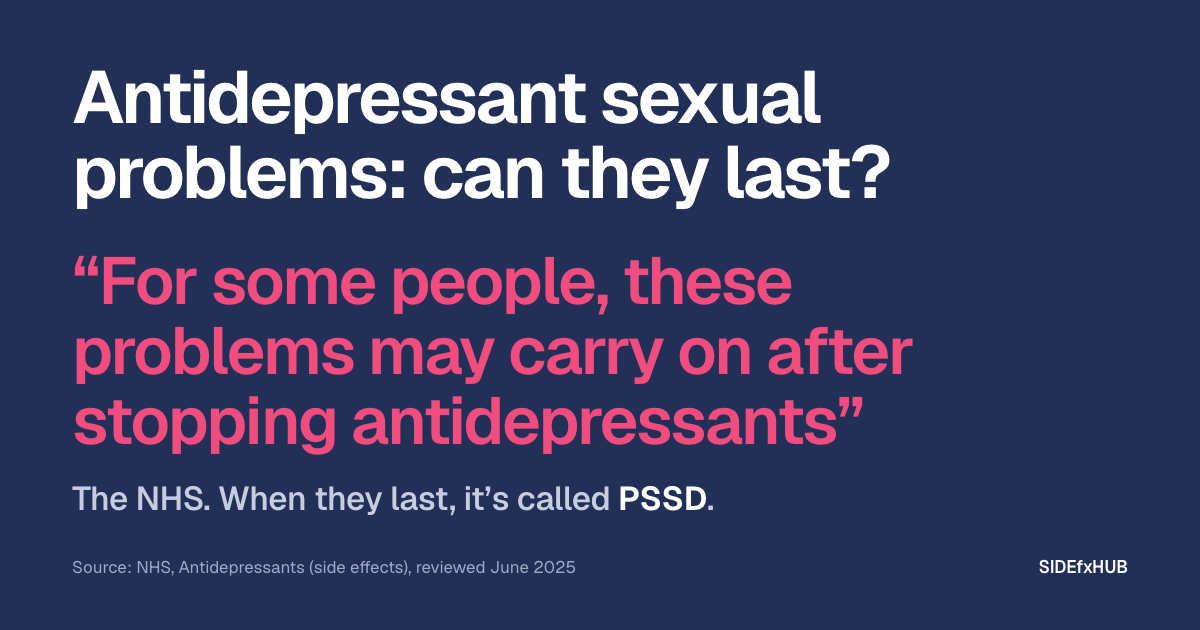
Antidepressants often cause sexual problems, such as low sex drive, difficulty reaching orgasm, vaginal dryness or erection problems. The NHS warns these can carry on after stopping; when they last, it’s called post-SSRI sexual dysfunction (PSSD).
The symptom at the heart of PSSD, genital numbness, isn’t on the NHS list at all. And in one study, most people with sexual problems didn’t mention them until a doctor asked.
The story in 3 lines
- Sexual problems on antidepressants are common, but in one study most people only mentioned them when a doctor asked (study).
- The NHS warns they can carry on after stopping (NHS).
- Nobody has measured how often. When they last, it's called PSSD, and a change in genital sensation is its core sign (criteria).
Press: contact@sidefxhub.com
Emily came off an SSRI quickly, on her doctor’s advice. About three weeks later, she woke to find all sexual sensation gone.

More than a year on, the feeling hadn’t come back, and the doctors she saw couldn’t explain it. Even raising it was hard. She calls it “such an embarrassing thing to bring up”.
What sexual problems can antidepressants cause?
They can affect each stage of sex: desire, arousal, orgasm and, in men, ejaculation. The UK leaflet for sertraline lists failure to ejaculate as very common, and lower sexual interest and erectile dysfunction as common.
Patients describe two more changes. Orgasm can still happen but bring little pleasure. And the genitals can feel numb, as if anaesthetised.
The doctors and researchers who wrote the 2022 diagnostic criteria for PSSD put it like this: touch there can feel like touch anywhere else on the body.
In a Mayo Clinic film, the psychologist and sex therapist Jordan Rullo explains the effects on women in under a minute.

Why do so few people mention them?
Often, nobody asks. In one Spanish study of people taking SSRIs, fewer than 2 in 10 mentioned a sexual problem on their own. When doctors asked the same people direct questions, nearly 6 in 10 had one.
Embarrassment is one reason, say the researchers David Healy and Dee Mangin. People also use different words: men sometimes call it erectile dysfunction, while women often describe a loss of libido. And people don’t always mention a change in genital sensation, or in how orgasm feels, unless someone asks directly.
Some people don’t link it to the tablets at all. Katie started fluoxetine at 21. She only realised the medicine was behind her symptoms more than a decade later, and spent years believing something was wrong with her.

Can sexual problems last after stopping antidepressants?
Yes, for some people. In 2019 the EU medicines regulator asked for a warning on every SSRI and SNRI. The UK sertraline leaflet now says: “In some cases, these symptoms have continued after stopping treatment.”
Patients and researchers call this PSSD. Some people’s symptoms only begin after the last tablet, as Emily’s numbness did.
The 2022 criteria require a lasting change in genital sensation. Their authors expect some lingering for days or weeks. If problems are still there three months after stopping, PSSD is more likely.
Nobody has measured how often this happens. Two questionnaires that researchers use don’t even ask about genital sensation, Healy and Mangin point out.
The psychiatrist Jonathan Alpert told PolitiFact the research is “small and of variable quality”. Another psychiatrist, Michael Ziffra, said that in his experience the side effects fade for most people within a few weeks or months of stopping.
For some people it has lasted years after stopping. Nobody knows yet who will be affected, or whether it will ease.
After the last tablet: when lasting problems point to PSSD
What can I do?
These medicines help many people. If you have side effects, that’s a decision for you and your prescriber. Don’t stop suddenly.
Raise any change, however awkward, and name the exact symptom. If you’ve stopped and it hasn’t lifted, show your GP the leaflet line about symptoms continuing after stopping.
Before the appointment, write down these five things:
"Sertraline 50 mg from January 2023, last tablet March 2024."
"Touch feels numb", "orgasm with no pleasure".
Before, while taking it, or after stopping.
"No problems before 2023."
Other medicines, contraception, alcohol, diabetes, the menopause.
Many people say it took time to be taken seriously. You can report it without a doctor agreeing.
Report it: it helps everyone
A doctor’s note helps you. A report to the medicines regulator helps everyone else: it is how patterns get noticed.
- No proof needed. A suspicion is enough, even years after stopping.
- Where: the Yellow Card scheme in the UK, MedWatch in the US.
- Use the right words. If symptoms continued after stopping, write Post-SSRI sexual dysfunction (MedDRA 10086208).
Our reporting guide walks you through it
What else do people ask?
Could it be the depression instead? Depression itself often lowers sex drive. In one small study of people with depression who weren’t taking an antidepressant, nearly half had less interest in sex. Genital numbness looks different: in a survey of people from a PSSD forum, it didn’t track depression or anxiety scores.
How do I know if it’s PSSD? The 2022 criteria need a lasting change in genital sensation after stopping, with other causes ruled out. Partial recovery counts too: if orgasm returns but “no longer feels the same”, the authors still class it as PSSD. Our guide to how PSSD is diagnosed explains more.
Does it happen to women too? Yes. In reports of lasting problems sent to the drug-safety website RxISK, women described the same core symptoms as men, including genital numbness and trouble reaching orgasm. Our page on PSSD in women explains why their symptoms can be missed, or mistaken for low libido.
Emily spoke on camera about something she thinks many people keep to themselves. If what she describes sounds familiar, write down what changed and when, and take that list to your prescriber.
Sources
- NHS, Antidepressants: common side effects, including problems with sex that “may carry on after stopping antidepressants”. Page last reviewed 12 June 2025.
- Lustral (sertraline), UK patient information leaflet, sections 2 (“Sexual problems”) and 4, last revised December 2025. Electronic Medicines Compendium.
- European Medicines Agency, PRAC, recommendations on signals adopted at the 13-16 May 2019 meeting, EMA/PRAC/265212/2019, section 1.3: warning text for six SSRIs (citalopram, escitalopram, fluoxetine, fluvoxamine, paroxetine, sertraline) and four SNRIs (duloxetine, venlafaxine, desvenlafaxine, milnacipran), adopted 16 May 2019.
- Montejo-González AL, Llorca G, Izquierdo JA and colleagues. SSRI-induced sexual dysfunction: fluoxetine, paroxetine, sertraline, and fluvoxamine in a prospective, multicenter, and descriptive clinical study of 344 patients. J Sex Marital Ther 1997;23(3):176-94. Outpatients in Spain with normal sexual function before treatment; 14% reported a sexual problem spontaneously, 58% when asked direct questions. No placebo group; the questionnaire was the authors’ own.
- Healy D, Mangin D. Post-SSRI sexual dysfunction: barriers to quantifying incidence and prevalence. Epidemiol Psychiatr Sci 2024;33:e40. On how men and women describe it, embarrassment, and the Arizona Sexual Experience Scale and Changes in Sexual Functioning Questionnaire not asking about genital sensation.
- Healy D, Bahrick A, Bak M and colleagues. Diagnostic criteria for enduring sexual dysfunction after treatment with antidepressants, finasteride and isotretinoin. Int J Risk Saf Med 2022;33(1):65-76. An expert consensus. Necessary criteria: prior treatment with a serotonin reuptake inhibitor, and an enduring change in genital sensation after it stops; lingering for days or weeks is expected, and at three months PSSD is more likely.
- Healy D, Le Noury J, Mangin D. Enduring sexual dysfunction after treatment with antidepressants, 5α-reductase inhibitors and isotretinoin: 300 cases. Int J Risk Saf Med 2018;29(3-4):125-134. Reports sent to RxISK; among 50 women after a serotonin reuptake inhibitor, 30 described genital numbness and 30 difficulty reaching orgasm. A count of descriptions, not a rate.
- Kennedy SH, Dickens SE, Eisfeld BS, Bagby RM. Sexual dysfunction before antidepressant therapy in major depression. J Affect Disord 1999;56(2-3):201-8. 134 people with major depression, not on medication: over 40% of men and 50% of women reported decreased sexual interest. No comparison group without depression.
- Ben-Sheetrit J, Aizenberg D, Csoka AB and colleagues. Post-SSRI sexual dysfunction: clinical characterization and preliminary assessment of contributory factors and dose-response relationship. J Clin Psychopharmacol 2015;35(3):273-8. Online survey recruited through a PSSD forum; genital anaesthesia did not correlate with depression or anxiety.
- PolitiFact, What we know about sexual function after antidepressants, 31 July 2026, by Grace Abels. Dr Jonathan Alpert (Albert Einstein College of Medicine), by email: “The existing body of literature is small and of variable quality”. Dr Michael Ziffra (Northwestern University), in PolitiFact’s words: sexual side effects disappear for most people within weeks or months of stopping, based on his clinical experience.
- MHRA, Suspect you have experienced a side effect or incident from a healthcare product?, 6 November 2023: “You don’t have to prove” the medicine caused it.
- Videos: PSSD Canada, Emily’s experience with PSSD, 27 February 2022; Mayo Clinic, Dr. Jordan Rullo discusses antidepressants and sexual dysfunction, 5 October 2016; Moral Medicine, I Lost My Sexual Identity After Prozac, 26 May 2026.
This information does not replace medical advice. Talk to your doctor before you make any decision about your treatment.
590+ people have joined the community.
Join them, then report your side effects.
No diagnosis needed. Researchers never see your name.