PSSD in women: genital numbness that can last
PSSD in women can mean genital numbness, low desire and weak orgasms that continue after stopping an antidepressant. It can be mistaken for low libido.
SIDEfxHUB is a patient charity. We are not health professionals, and this does not replace medical advice. Don't start, stop or change any medicine because of what you read here. Talk to your doctor first.
If you are in crisis:116 123 Samaritans (UK)988 Lifeline (US)Find a helpline
Women can get post-SSRI sexual dysfunction (PSSD): genital numbness, low desire and weak or absent orgasms that continue after stopping an SSRI or SNRI antidepressant. The UK leaflets warn that sexual problems have sometimes continued after the last tablet.
In women, it’s easy to put these changes down to low libido, or to depression or the menopause. The clue that points to PSSD, a numb or changed feeling in the genitals, can go unsaid unless someone asks.
The story in 3 lines
- UK antidepressant leaflets warn that sexual problems have sometimes continued after stopping (leaflet).
- The only study we know of that counted PSSD from medical records looked at men alone (study).
- Women often describe it as lost desire, and the numbness can go unmentioned unless someone asks (Healy and Mangin).
Press: contact@sidefxhub.com
Rosie developed PSSD after taking Lexapro (escitalopram). When she gave this interview, she was president of the PSSD Network, a patient group.

At the time, her symptoms had lasted about four years. She describes how hard it was to get doctors to acknowledge them, and the toll on her life.
What does PSSD feel like for women?
The change that defines it is in how the genitals feel. Some women describe numbness, as if after an anaesthetic. For others, touch still registers but no longer feels sexual.
A group of experts agreed diagnostic criteria for PSSD in 2022. This lasting change after the medicine stops is the one symptom they require.
Desire can fade too. Orgasms can become weak or bring no pleasure, and some women notice less lubrication or less feeling in their nipples.
In one collection of reports sent to RxISK, a drug-safety website, women named genital numbness almost as often as lost desire. They chose to write in, so it can’t tell us how often this happens.
What 50 women reported: numbness almost as often as lost desire
Why are women’s symptoms missed?
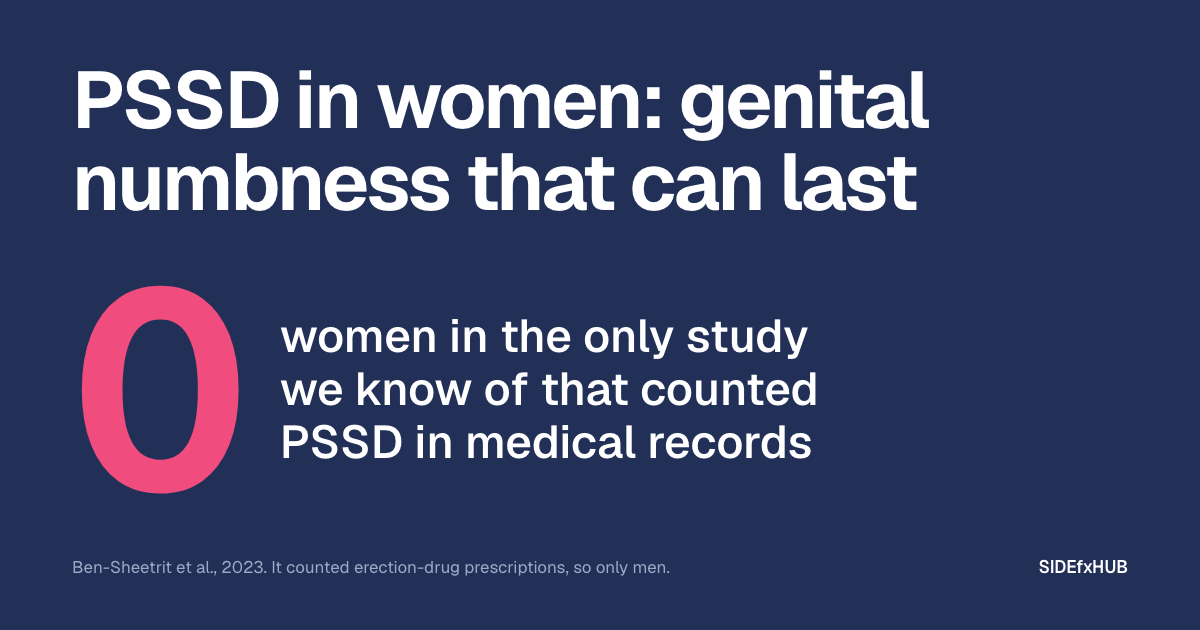
Partly because nobody has measured how often it happens in women. The only study we know of that estimated PSSD from medical records, by Ben-Sheetrit and colleagues, looked at men alone. It found cases through prescriptions for erection drugs such as sildenafil, and the authors list leaving out women as a limitation.
Women also tend to describe it differently. Men sometimes call it erectile dysfunction, while women “commonly frame it as a loss of libido”, write two doctors, David Healy and Dee Mangin. Changes in genital sensation, they add, are “not always volunteered unless asked about directly”.
Two tested questionnaires that researchers use to measure sexual problems don’t ask about genital sensation at all. Even the UK leaflet’s line for women is short: “women may experience difficulties achieving orgasm”. It doesn’t mention numbness.

Could it be the menopause or depression?
It could, and a careful doctor will check. The NHS lists reduced sex drive, vaginal dryness and low mood among the symptoms of the menopause and perimenopause. Depression can lower desire too.
The criteria ask doctors to rule out any medical condition or other medicine that could explain the symptoms. Depression doesn’t rule PSSD out, though. Someone with a current mental health diagnosis can still be diagnosed with PSSD.
Numbness points somewhere else. Healy and Mangin write that “no mental health disorder causes anaesthesia of the genitals”.
Katie took Prozac (fluoxetine) for about three years. She describes years of believing something was fundamentally wrong with her, before she linked the changes to the medicine. She has lived with them for about 14 years.

What can I do?
These medicines help many people. If you have side effects, that’s a decision for you and your prescriber. Don’t stop suddenly.
If you think you have PSSD, mention the numbness first, as well as any low desire. Many people say it took time to be taken seriously.
Bring the leaflet line. It’s the warning that sexual problems have sometimes continued after stopping, and every SSRI and SNRI on our page about which antidepressants are linked to PSSD carries it. Write down notes like these too:
- Your medicine: “Sertraline 50 mg from January 2023, last tablet March 2024.”
- What changed: “Touch feels numb”, “orgasm with no pleasure”, “less lubrication”.
- When it started: before, while taking it, or after stopping.
- How it was before: “No problems before 2023.”
- What else they will ask about: other medicines, contraception, alcohol, diabetes, the menopause.
Our page on how PSSD is diagnosed goes through the criteria.
Report it: it helps everyone
A doctor’s note helps you. A report to the medicines regulator helps everyone else: it is how patterns get noticed.
- No proof needed. A suspicion is enough, even years after stopping.
- Where: the Yellow Card scheme in the UK, MedWatch in the US.
- Use the right words. If symptoms continued after stopping, write Post-SSRI sexual dysfunction (MedDRA 10086208).
Our reporting guide walks you through it
Questions women ask about PSSD
How long does PSSD last?
For some people it has lasted years after stopping. Nobody knows yet who will be affected, or whether it will ease. Whether people get their old sexual function back “has never been properly investigated”, Healy and Mangin write.
Can PSSD start after stopping the tablets?
Yes, in some cases. The experts behind the 2022 criteria say these problems may only appear once the medicine stops, typically within a couple of weeks. A mild problem on the tablets can also get worse after stopping. That makes the link easy to miss.
Is PSSD the same as PGAD?
No. Persistent genital arousal disorder (PGAD) is unwanted genital arousal that feels painful or altered rather than pleasurable. The 2022 criteria describe it as almost a mirror image of PSSD’s numbness. A few women in the RxISK reports described it after antidepressants.
Rosie found it hard to get her symptoms acknowledged. If this sounds like you, name the numbness when you see your prescriber and when you report it, so that PSSD in women starts to be counted.
Sources
- Escitalopram 10 mg and 20 mg film-coated tablets, patient information leaflet, electronic medicines compendium (UK), revised September 2025. Section 2: “In some cases, these symptoms have continued after stopping treatment.” Section 4: “women may experience difficulties achieving orgasm”.
- European Medicines Agency, PRAC, new product information wording, signals adopted 13 to 16 May 2019: the warning on persistent sexual dysfunction for SSRIs and SNRIs.
- Healy D, Bahrick A, Bak M, et al. Diagnostic criteria for enduring sexual dysfunction after treatment with antidepressants, finasteride and isotretinoin. International Journal of Risk & Safety in Medicine, 2022;33(1):65–76. Expert consensus built on case reports. Source of the genital sensation criterion, the ancillary symptoms (vaginal lubrication, nipple sensitivity), the exclusions, onset after stopping, and the PGAD criteria.
- Ben-Sheetrit J, Hermon Y, Birkenfeld S, et al. Estimating the risk of irreversible post-SSRI sexual dysfunction (PSSD) due to serotonergic antidepressants. Annals of General Psychiatry, 2023;22:15. Records of 12,302 men in one district of Israel’s largest health service; erectile dysfunction defined by PDE-5 inhibitor prescriptions; 4 of 866 men who had taken a serotonergic antidepressant met the PSSD definition. The authors list the men-only focus as a limitation and say the estimate may be low.
- Healy D, Mangin D. Post-SSRI sexual dysfunction: barriers to quantifying incidence and prevalence. Epidemiology and Psychiatric Sciences, 2024. Source of the quotes on how women describe PSSD, sensation not being volunteered, genital anaesthesia, the Arizona Sexual Experience Scale and the Changes in Sexual Functioning Questionnaire, and recovery never having been properly investigated.
- Healy D, Le Noury J, Mangin D. Enduring sexual dysfunction after treatment with antidepressants, 5α-reductase inhibitors and isotretinoin: 300 cases. International Journal of Risk & Safety in Medicine, 2018;29(3-4):125–134. Reports sent to RxISK, a website run by the authors; table 3b, women after serotonin reuptake inhibitors (SSRIs, SNRIs and related antidepressants): loss of libido 36 of 50, genital anaesthesia 30 of 50, PGAD 4 of 50. Table 2 gives 49 women; the table 3b percentages use 50. Self-selected reports, so no rate can be drawn.
- NHS, Symptoms of menopause and perimenopause, reviewed 19 May 2026; Symptoms of depression in adults, reviewed 5 July 2023.
- MHRA, Suspect you have experienced a side effect or incident from a healthcare product?, 6 November 2023: “just a suspicion is enough for you to submit a report.”
- Reporting: MHRA Yellow Card scheme; FDA MedWatch. MedDRA term: Post-SSRI sexual dysfunction, 10086208.
- Videos: Moral Medicine, Interview with PSSD Network President Rosie, 9 July 2024; PSSD Canada, Emily’s experience with PSSD, 26 February 2022; Moral Medicine, I Lost My Sexual Identity After Prozac, 26 May 2026. Details of Rosie’s and Katie’s stories are from Moral Medicine’s own descriptions of the interviews.
This information does not replace medical advice. Talk to your doctor before you make any decision about your treatment.
610+ people have joined the community.
Join them, then report your side effects.
Free. Sign up takes 2 minutes.