Which antidepressants are linked to PSSD?
Every SSRI and SNRI carries the same warning: sexual problems can continue after stopping. That's called PSSD. The ten medicines, and what nobody knows.
SIDEfxHUB is a patient charity. We are not health professionals, and this does not replace medical advice. Don't start, stop or change any medicine because of what you read here. Talk to your doctor first.
If you are in crisis:116 123 Samaritans (UK)988 Lifeline (US)Find a helpline
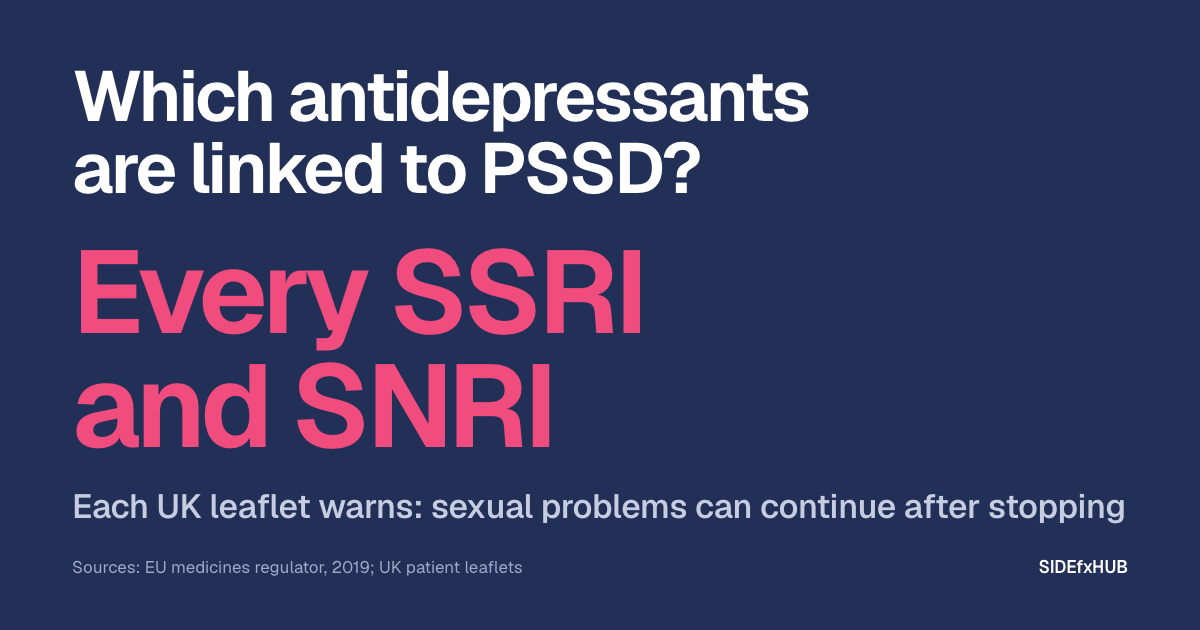
Every SSRI and SNRI antidepressant carries the same warning in its UK leaflet: sexual problems can continue after you stop taking it. That lasting form is called PSSD, and the EU medicines regulator asked for the warning on ten medicines, from sertraline to venlafaxine.
People often search for one name: the drug that did it, or the one that won’t. The leaflets don’t single any of them out, and the line is the same whichever one you were given.
The story in 3 lines
- In 2019 the EU medicines regulator asked for a warning on every SSRI and SNRI (its recommendation).
- UK leaflets now say sexual problems "have continued after stopping treatment" in some cases (sertraline leaflet).
- Nobody has measured how often this happens (a 2024 paper). Patients call it PSSD.
Press: contact@sidefxhub.com
Cael was a healthy, sociable teenager when he was prescribed antidepressants for mild anxiety. For years he was moved from one drug to the next: Lexapro, Effexor, Zoloft, Pristiq, Seroquel and Cymbalta. He now lives with PSSD, Moral Medicine says, and nobody explained the risks to him.

Five of the six medicines Cael took are on the warning list below. The sixth, Seroquel, is an antipsychotic. If you’ve taken several, like him, you may never know which one to name. You don’t have to: one report to the medicines regulator can list them all.
Which antidepressants carry the PSSD warning?
Ten medicines carry it: six SSRIs and four SNRIs. The EU medicines regulator named all ten in its 2019 recommendation, and asked for the same words in each leaflet.
- SSRIs
- Sertraline (Lustral, Zoloft) · Citalopram (Cipramil, Celexa) · Escitalopram (Cipralex, Lexapro) · Fluoxetine (Prozac) · Paroxetine (Seroxat, Paxil) · Fluvoxamine (Faverin, Luvox)
- SNRIs
- Venlafaxine (Efexor, Effexor) · Duloxetine (Cymbalta, Yentreve) · Desvenlafaxine (Pristiq) · Milnacipran
The UK sertraline leaflet says sexual problems can happen, and “in some cases, these symptoms have continued after stopping treatment” (Lustral leaflet). The leaflet for venlafaxine uses exactly the same words. PSSD stands for post-SSRI sexual dysfunction, but the name is too narrow. SNRIs like venlafaxine carry the warning too.

Can other antidepressants cause PSSD?
Some can, say the researchers who wrote the 2022 diagnostic criteria for PSSD. They write that it can follow any medicine that blocks the reuptake of serotonin, as SSRIs do. That includes some older antidepressants called tricyclics.
The same paper mentions reports of something similar after mirtazapine. It says there isn’t enough data yet to know whether that’s the same condition.
The regulator’s 2019 review also looked at vortioxetine and clomipramine, a tricyclic. It didn’t ask for the warning on either, and the document doesn’t say why.
How common is PSSD?
Nobody has measured how often it happens after any of these medicines. Estimates run from fewer than 1 in 100 to about half, says a 2024 paper. The low figure came from health records and counted only men. The high one came from a small survey of former users, found through adverts and flyers.
The paper’s authors explain why there’s no real number. A trial set up to measure it would be unethical, because it could harm the people taking part. Doctors don’t routinely ask whether sexual side effects have gone after someone stops. And embarrassment can stop people raising it.
Dr Josef Witt-Doerring is a psychiatrist. In this film he explains what PSSD is, and why, in his view, so few patients are warned about it.

What can I do?
These medicines help many people. If you have side effects, that’s a decision for you and your prescriber. Don’t stop suddenly.
If something has changed, write it down before your appointment. List every medicine, with doses and dates: “Sertraline 50 mg from January 2023, last tablet March 2024.” Bring the leaflet line too.
Many people say it took time to be taken seriously. You can report it without a doctor agreeing.
Report it: it helps everyone
A doctor’s note helps you. A report to the medicines regulator helps everyone else: it is how patterns get noticed.
- No proof needed. A suspicion is enough, even years after stopping.
- Where: the Yellow Card scheme in the UK, MedWatch in the US.
- Use the right words. If symptoms continued after stopping, write Post-SSRI sexual dysfunction (MedDRA 10086208). It’s the right term after an SNRI too.
Our reporting guide walks you through it
If you’re struggling with your mental health, Samaritans are free on 116 123, at any hour.
What else do people ask?
Is one antidepressant more likely to cause PSSD? The leaflets don’t say so. The 2019 recommendation gave all ten the same words, and nobody has measured how often PSSD follows any of them. So nobody can rank them. The choice of medicine belongs with you and your prescriber.
Can PSSD start after stopping? Yes. The 2022 criteria say PSSD sometimes only appears once the medicine is stopped, usually within a couple of weeks. To fit the criteria, the problems have to last at least three months after the last dose.
Is it only antidepressants? No. The same criteria cover any medicine that blocks serotonin reuptake, including the painkiller tramadol. The paper also describes related conditions after finasteride, used for hair loss, and isotretinoin, used for acne. Patients know them as post-finasteride syndrome and post-Accutane syndrome.
Cael was moved through six medicines. If your story looks like his, write every one down with its dates, and put them all in one report.
Sources
- European Medicines Agency, Pharmacovigilance Risk Assessment Committee (PRAC). PRAC recommendations on signals adopted at the 13-16 May 2019 PRAC meeting. EMA/PRAC/265212/2019, section 1.3 (SNRIs and SSRIs: persistent sexual dysfunction after drug withdrawal), adopted 16 May 2019. Names citalopram, escitalopram, fluoxetine, fluvoxamine, paroxetine and sertraline (SSRIs) and desvenlafaxine, duloxetine, milnacipran and venlafaxine (SNRIs). Footnote 6: clomipramine and vortioxetine were part of the assessment but not included in the change.
- Viatris Products Limited. Lustral (sertraline) package leaflet, section 2, “Sexual problems”. Last revised December 2025. Electronic medicines compendium.
- Viatris Products Limited. Efexor XL (venlafaxine) package leaflet, section 2, “Sexual problems”. Last revised October 2025. Electronic medicines compendium.
- Healy D, Mangin D. Post-SSRI sexual dysfunction: barriers to quantifying incidence and prevalence. Epidemiol Psychiatr Sci 2024;33:e40 (an editorial). The estimates it discusses run from 0.46% (Ben-Sheetrit and colleagues, 2023: a 19-year review of health records that excluded women) to 52.6% (Lüning, 2019: a survey of 76 former antidepressant users recruited through online adverts and flyers).
- Healy D, Bahrick A, Bak M and colleagues. Diagnostic criteria for enduring sexual dysfunction after treatment with antidepressants, finasteride and isotretinoin. Int J Risk Saf Med 2022;33(1):65-76.
- Videos: Moral Medicine, Cael’s story (18 August 2025); BBC News, Antidepressants: should we talk about side-effects? (11 August 2023); Dr Josef Witt-Doerring, The #1 worst side effect from antidepressants (19 August 2026).
This information does not replace medical advice. Talk to your doctor before you make any decision about your treatment.
610+ people have joined the community.
Join them, then report your side effects.
Free. Sign up takes 2 minutes.