Lexapro sexual side effects: can they last?
Lexapro (escitalopram) commonly lowers sex drive and delays orgasm. The UK leaflet warns this has sometimes continued after stopping. That is called PSSD.
SIDEfxHUB is a patient charity. We are not health professionals, and this does not replace medical advice. Don't start, stop or change any medicine because of what you read here. Talk to your doctor first.
If you are in crisis:116 123 Samaritans (UK)988 Lifeline (US)Find a helpline
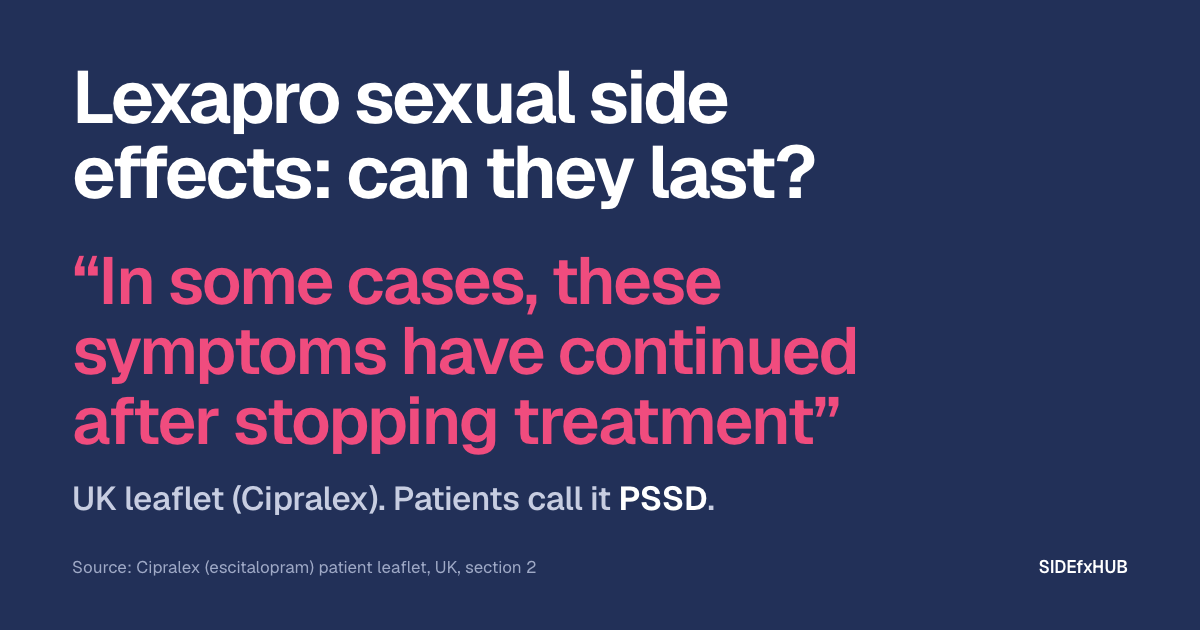
Lexapro (escitalopram) commonly lowers sex drive and makes orgasm harder to reach. The UK leaflet warns that these problems have sometimes continued after stopping: a condition called post-SSRI sexual dysfunction, or PSSD.
The NHS page on escitalopram doesn’t mention that warning, so you could start the tablets without ever hearing it. If your sex life hasn’t come back since you stopped, the leaflet line is something you can show a doctor.
The story in 3 lines
- Sexual problems, such as a low sex drive, are a common side effect of escitalopram (NHS).
- The UK leaflet warns they have sometimes continued after stopping (leaflet).
- No reliable figure exists for how often. Patients call it PSSD (Healy and Mangin, 2024).
Press: contact@sidefxhub.com
Victoria was a student when she was prescribed Lexapro for stress and sleepless nights. She says she asked more than once whether it was safe, and was told it was.

She took it for about three months and felt fairly normal, even while coming off it slowly. It was after she stopped, she says, that her desire faded and her genitals went numb.
What are the sexual side effects of Lexapro?
The leaflet for Cipralex, the UK name for Lexapro, lists a lower sex drive, delayed ejaculation and erection problems among the common side effects.
Two trials asked everyone directly about their sex life. At week 8, about 3 in 10 people on escitalopram had problems with orgasm, against about 1 in 10 on a dummy tablet (Clayton and colleagues).
Some people on the dummy tablet had problems too, and the leaflet notes that many side effects may also be symptoms of the illness. The trials stopped at week 8. They say nothing about life after the last tablet.
Can Lexapro sexual side effects last after stopping?
They can. The UK leaflet warns that in some cases these symptoms “have continued after stopping treatment”. The UK prescribing information for doctors mentions reports of “long-lasting sexual dysfunction”.
For some people it has lasted years after stopping. Nobody knows yet who will be affected, or whether it will ease.
Rosie was president of the PSSD Network when Moral Medicine interviewed her in 2024. She’d been prescribed Lexapro, and her symptoms had lasted about four years. In the interview, she talks about how hard it was to get doctors to acknowledge them.

How common is PSSD after Lexapro?
No reliable figure exists for how often it happens after Lexapro. Stories like Rosie’s and Victoria’s show what it can be like. They can’t show how often.
Counting it is hard, say two researchers who study PSSD (Healy and Mangin). Some people feel embarrassed raising sex with a doctor. Others never link their symptoms to a medicine they’ve already stopped.
That’s why reports matter. In 2019 the EU medicines regulator weighed side-effect reports alongside published research. Then it asked for a warning on ten SSRI and SNRI antidepressants, escitalopram among them (EMA).
What can I do?
These medicines help many people. If you have side effects, that’s a decision for you and your prescriber. Don’t stop suddenly.
If the changes haven’t lifted since you stopped, tell your doctor. Take the leaflet line and notes like these:
- Your medicine: “Escitalopram 10 mg from March 2023, last tablet January 2024.”
- What changed: “Touch feels numb”, “orgasm with no pleasure”.
- When it started: before, while taking it, or after stopping.
- How it was before: “No problems before 2023.”
- What else they’ll ask about: other medicines, contraception, alcohol, diabetes, the menopause.
Report it: it helps everyone
A doctor's note helps you. A report to the medicines regulator helps everyone else: it is how patterns get noticed.
- No proof needed. A suspicion is enough, even years after stopping.
- Where: the Yellow Card scheme in the UK, MedWatch in the US.
- Use the right words. If symptoms continued after stopping, write Post-SSRI sexual dysfunction (MedDRA 10086208).
What else do people ask?
Does Lexapro affect women’s sex life too? Yes. The UK leaflet says women may find it harder to reach orgasm, and a lower sex drive can affect anyone. Victoria and Rosie are both women. PSSD in women has its own page.
How is PSSD different from the usual side effects? The usual side effects happen while you take the tablets. PSSD is when your sex life doesn’t return to how it was after you stop. Researchers say it most often means genital numbness and orgasms that feel weak or bring no pleasure (Healy and Mangin).
What if my doctor doesn’t believe me? Many people say it took time to be taken seriously. Bring the leaflet line. You can report it without a doctor agreeing. How PSSD is diagnosed explains what to take with you.
Victoria asked more than once whether Lexapro was safe, and says she was never told the symptoms could last after stopping. If you’re about to start it, you can ask your prescriber about the leaflet line, and about PSSD, before your first tablet.
Sources
- Cipralex 5 mg, 10 mg and 20 mg film-coated tablets, patient information leaflet, section 2 (warnings and precautions) and section 4 (possible side effects), last revised May 2025. Electronic Medicines Compendium.
- Cipralex film-coated tablets, summary of product characteristics, section 4.4 (sexual dysfunction), text revised May 2025. Electronic Medicines Compendium.
- NHS, Escitalopram, common side effects, page last reviewed 18 June 2026.
- European Medicines Agency, Pharmacovigilance Risk Assessment Committee, recommendations on signals adopted at the 13-16 May 2019 meeting, EMA/PRAC/265212/2019, section 1.3: persistent sexual dysfunction after drug withdrawal. The wording is for ten medicines: citalopram, escitalopram, fluoxetine, fluvoxamine, paroxetine, sertraline, desvenlafaxine, duloxetine, milnacipran and venlafaxine. Evidence weighed: EudraVigilance reports, the literature, social media and the companies’ cumulative reviews.
- Clayton AH, Croft HA, Horrigan JP and colleagues. Bupropion extended release compared with escitalopram: effects on sexual functioning and antidepressant efficacy in 2 randomized, double-blind, placebo-controlled studies. J Clin Psychiatry 2006;67(5):736-46. Adults with depression and normal sexual function at the start; pooled data at week 8: orgasm problems in 30% on escitalopram and 9% on placebo (281 and 273 people randomised).
- Healy D, Mangin D. Post-SSRI sexual dysfunction: barriers to quantifying incidence and prevalence. Epidemiol Psychiatr Sci 2024;33:e40.
- Videos: Moral Medicine, She Took Lexapro for 3 Months. Then Everything Changed | Victoria’s PSSD Story, 10 August 2026, and Interview with PSSD Network President Rosie: Share Your Story to Raise Awareness!, 9 July 2024.
This information does not replace medical advice. Talk to your doctor before you make any decision about your treatment.
610+ people have joined the community.
Join them, then report your side effects.
Free. Sign up takes 2 minutes.
Escitalopram: what the official texts say, country by country
For the SSRI antidepressant escitalopram (Lexapro, Cipralex), the product information we read in the United Kingdom says there have been reports of long-lasting sexual dysfunction where symptoms continued after SSRIs or SNRIs were stopped. This is known as post-SSRI sexual dysfunction (PSSD). The EU medicines regulator set the wording of this warning in 2019 for ten medicines, escitalopram among them, and a government answer in Parliament says UK product information for all SSRIs was updated in 2019 to carry it.
This is a record of what each text says and of the date it prints. A text is quoted in its own words, or summarised where the row says so. It is not a comparison of countries. All medicines and countries
| Country or region | What the text says | Document | Dates |
|---|---|---|---|
| United Kingdom | Sexual side effects that continue after stopping4.4 Special warnings and precautions for use · Sexual dysfunction Sexual side effects, as listed4.8 Undesirable effects · Psychiatric disorders · Common Sexual side effects, as listed4.8 Undesirable effects · Reproductive system and breast disorders · Common Sexual side effects, as listed4.8 Undesirable effects · Reproductive system and breast disorders · Not known The same text also says4.8 Undesirable effects A table cell or list line is shown whole, as the text prints it. Some of them also name side effects that are not sexual. | Text for professionals Summary of Product Characteristics (SmPC): Cipralex 10 mg film-coated tabletsCipralex 5 mg, 10 mg and 20 mg film-coated tablets, Lundbeck Limited · Read in a compendium of product information: emcAlso on record: patients' leaflet, with such a sentence; related document, with such a sentence | Text revisedChecked |
| European Union | Sexual side effects that continue after stopping3. Serotonin and noradrenaline reuptake inhibitors (SNRI); selective serotonin reuptake inhibitors (SSRI) – Persistent sexual dysfunction after drug withdrawal (EPITT no 19277) · Summary of product characteristics · 4.4. Special warnings and precautions for use · Sexual dysfunction Sexual side effects that continue after stopping3. Serotonin and noradrenaline reuptake inhibitors (SNRI); selective serotonin reuptake inhibitors (SSRI) – Persistent sexual dysfunction after drug withdrawal (EPITT no 19277) · Package leaflet · 2. What you need to know before you take [Invented name] · Warnings and precautions The wording is for ten medicines: citalopram, escitalopram, fluoxetine, fluvoxamine, paroxetine, sertraline, desvenlafaxine, duloxetine, milnacipran and venlafaxine. This is wording for national product texts. There is no single EU product text for this medicine. | Document from the regulator New product information wording – Extracts from PRAC recommendations on signals. Adopted at the 13-16 May 2019 PRACRead on the regulator's site: European Medicines AgencyAlso on record: 1 more related document, with such a sentence | PublishedChecked |
| United States | Sexual side effects, as listed5 WARNINGS AND PRECAUTIONS · 5.11 Sexual Dysfunction The same text also says5 WARNINGS AND PRECAUTIONS · 5.11 Sexual Dysfunction This text has no sentence about sexual side effects continuing after the medicine is stopped. This text names sexual side effects in several places that this row does not show. Together those passages are too long to reproduce here. The document link in this row opens the text. That they are not shown says nothing about how common these side effects are. On 14 October 2026 we searched the labels in openFDA, the FDA's open database. A sentence about sexual dysfunction continuing after stopping stood on none of the 332 labels in that database that name escitalopram. | Text for professionals Lexapro® (escitalopram) tablets, for oral use; Lexapro® (escitalopram) oral solution: Full Prescribing InformationLexapro film-coated tablets 5 mg, 10 mg and 20 mg, and oral solution 1 mg per mL, Allergan, Inc. · Read in the government's medicines database: DailyMedAlso on record: patients' leaflet, with no such sentence | Text revisedChecked |
| Canada | Sexual side effects that continue after stopping7 WARNINGS AND PRECAUTIONS · Reproductive Health: Female and Male Potential · Function Sexual side effects that continue after stopping8 ADVERSE REACTIONS · 8.2 Clinical Trial Adverse Reactions · Male and Female Sexual Dysfunction with SSRIs The same text also says8 ADVERSE REACTIONS · 8.2 Clinical Trial Adverse Reactions · Male and Female Sexual Dysfunction with SSRIs This text names sexual side effects in several places that this row does not show. Together those passages are too long to reproduce here. The document link in this row opens the text. That they are not shown says nothing about how common these side effects are. | Text for professionals PRODUCT MONOGRAPH INCLUDING PATIENT MEDICATION INFORMATION: CIPRALEX, escitalopram oxalate (as escitalopram), TabletsCipralex tablets 5, 10, 15 and 20 mg escitalopram (base), Lundbeck Canada Inc. · Read in the regulator's own database: Drug Product DatabaseAlso on record: patients' leaflet, with such a sentence; 2 related documents, with such a sentence | Text revisedChecked |
| Australia | Sexual side effects that continue after stoppingSection 4.4 · Sexual DysfunctionSection 4.4 of Australia's product information for Lexapro has a warning headed sexual dysfunction. It says there are reports of sexual dysfunction that lasted a long time, with symptoms going on after SSRIs or SNRIs were stopped.Summarised, not quoted, because of the TGA's access terms.In this product's text since 2023, according to the text for professionals, 23 August 2023. The regulator's site asks readers to accept its terms before it shows this text. | Text for professionals AUSTRALIAN PRODUCT INFORMATION – LEXAPRO (ESCITALOPRAM OXALATE) FILM-COATED TABLETS AND ORAL SOLUTIONLEXAPRO, Lundbeck Australia Pty Ltd · Read in the regulator's own database: TGA eBSAlso on record: patients' leaflet, with such a sentence | Text revisedChecked |
| New Zealand | Sexual side effects that continue after stopping4.4 Special warnings and precautions for use · Warnings · Sexual dysfunction This text names sexual side effects in several places that this row does not show. Together those passages are too long to reproduce here. The document link in this row opens the text. That they are not shown says nothing about how common these side effects are. | Text for professionals New Zealand Data Sheet, LexaproLexapro 10 mg and 20 mg film-coated tablets, Pharmacy Retailing t/a Healthcare Logistics · Read in the regulator's own database: MedsafeAlso on record: patients' leaflet, with such a sentence; 2 related documents, with such a sentence | Text revisedChecked |
| Germany | Sexual side effects that continue after stopping2. Was sollten Sie vor der Einnahme von Cipralex beachten? · Warnhinweise und Vorsichtsmaßnahmen Sexual side effects, as listed4. Welche Nebenwirkungen sind möglich? · Häufig (kann bis zu 1 von 10 Behandelten betreffen): Sexual side effects, as listed4. Welche Nebenwirkungen sind möglich? · Nicht bekannt (Häufigkeit auf Grundlage der verfügbaren Daten nicht abschätzbar): The same text also says4. Welche Nebenwirkungen sind möglich? This is the copy in a compendium of product information. The regulator's database asks visitors to accept its terms first, which we did not do. | Patient leaflet Gebrauchsinformation: Information für AnwenderCipralex 10 mg Filmtabletten, H. Lundbeck A/S · Read in a compendium of product information: PatientenInfo-ServiceAlso on record: text for professionals, with such a sentence; text for professionals, could not be opened; related document, with such a sentence | Text revisedChecked |
| France | Sexual side effects that continue after stopping4.4. Mises en garde spéciales et précautions d'emploi · Dysfonction sexuelle Sexual side effects, as listed4.8. Effets indésirables · Affections psychiatriques · Fréquent Sexual side effects, as listed4.8. Effets indésirables · Affections des organes de reproduction et du sein · Fréquent Sexual side effects, as listed4.8. Effets indésirables · Affections des organes de reproduction et du sein · Fréquence indéterminée The same text also says4.8. Effets indésirables The text itself prints no date of revision. Texts for other products in this country do not all say the same. We searched them for sentences about sexual side effects continuing after stopping and did not read them whole. This row shows the product named, and no other. A table cell or list line is shown whole, as the text prints it. Some of them also name side effects that are not sexual. | Text for professionals Résumé des Caractéristiques du ProduitSEROPLEX 10 mg, comprimé pelliculé sécable, H. LUNDBECK A/S · Read in the government's medicines database: Base de données publique des médicamentsAlso on record: patients' leaflet, with such a sentence | Updated by the regulatorChecked |
| Italy | Sexual side effects that continue after stopping4.4 Avvertenze speciali e precauzioni di impiego · Disfunzione sessuale Sexual side effects, as listed4.8 Effetti indesiderati · Disturbi psichiatrici · Comune Sexual side effects, as listed4.8 Effetti indesiderati · Patologie del sistema riproduttivo e della mammella · Comune Sexual side effects, as listed4.8 Effetti indesiderati · Patologie del sistema riproduttivo e della mammella · Non nota The same text also says4.8 Effetti indesiderati The text itself prints no date of revision. A table cell or list line is shown whole, as the text prints it. Some of them also name side effects that are not sexual. | Text for professionals Riassunto delle caratteristiche del prodottoCipralex 5 mg, 10 mg, 15 mg e 20 mg compresse rivestite con film, H. Lundbeck A/S · Read in the regulator's own database: Banca Dati FarmaciAlso on record: patients' leaflet, with such a sentence | Made available by the regulatorChecked |
| Spain | Sexual side effects that continue after stopping4.4. Advertencias y precauciones especiales de empleo · Disfunción sexual Sexual side effects, as listed4.8. Reacciones adversas · Trastornos psiquiátricos · Frecuente Sexual side effects, as listed4.8. Reacciones adversas · Trastornos del aparato reproductor y de la mama · Frecuente Sexual side effects, as listed4.8. Reacciones adversas · Trastornos del aparato reproductor y de la mama · Desconocida The same text also says4.8. Reacciones adversas A table cell or list line is shown whole, as the text prints it. Some of them also name side effects that are not sexual. | Text for professionals Ficha técnicaCipralex 10 mg comprimidos recubiertos con película, Lundbeck España, S.A. · Read in the regulator's own database: CIMAAlso on record: patients' leaflet, with such a sentence; related document, with such a sentence | Text revisedChecked |
| Brazil | Sexual side effects, as listed9. REAÇÕES ADVERSAS · Distúrbios psiquiátricos · Comum Sexual side effects, as listed9. REAÇÕES ADVERSAS · Distúrbios do sistema reprodutor e mama · Comum Sexual side effects, as listed9. REAÇÕES ADVERSAS · Distúrbios do sistema reprodutor e mama · Desconhecido The same text also says9. REAÇÕES ADVERSAS This text has no sentence about sexual side effects continuing after the medicine is stopped. This is the holder's own copy. The regulator's database refused our requests (it blocks by country; we asked from Denmark). The originator product's text could not be opened. This is the text of another product, the one named in this row. A table cell or list line is shown whole, as the text prints it. Some of them also name side effects that are not sexual. | Text for professionals Escena® oxalato de escitalopram: bula para o profissional de saúdeEscena comprimidos revestidos 10 mg e 20 mg, Cristália Produtos Químicos Farmacêuticos Ltda. · Read on the holder's own site: Cristália Produtos Químicos Farmacêuticos Ltda.Also on record: 1 more text for professionals, could not be opened; 2 patients' leaflets, with no such sentence; patients' leaflet, could not be opened | Last change listedChecked |
| India | This text has no sentence about sexual side effects continuing after the medicine is stopped. This is the holder's own copy. This regulator publishes no database of such texts. This text names sexual side effects in several places that this row does not show. Together those passages are too long to reproduce here. The document link in this row opens the text. That they are not shown says nothing about how common these side effects are. | Text for professionals S-CITADEP TabletsS-CITADEP tablets, Cipla Ltd. · Read on the holder's own site: Cipla (ciplamed.com)Also on record: 1 more text for professionals, could not be opened | Text revisedChecked |
Brand names
These are the brand names of escitalopram we saw in the official lists, compendia and regulators' pages we opened on or after 14 October 2026. A country may have more.
- Lexapro
- United States, New Zealand, Brazil
- Cipralex
- United Kingdom, Canada, Germany, Italy, Spain
- Seroplex
- France
- Enalto
- United Kingdom
- Balansya
- Canada
- Loxalate
- New Zealand
- Giachela
- Italy
- Prameffex
- Italy
- Gomeisa
- Italy
- Entact
- Italy
- Sosecit
- Italy
- Amasci
- Italy
- Escertal
- Italy
- Xipram
- Italy
- Esertia
- Spain
- Diprex
- Spain
- Essential
- Spain
- Heipram
- Spain
- Deciprax
- Brazil
- Esc
- Brazil
- Esc ODT
- Brazil
- Escena
- Brazil
- Escilex
- Brazil
- Escip
- Brazil
- Espran
- Brazil
- Eudok
- Brazil
- Exodus
- Brazil
- Felissa
- Brazil
- Fusor
- Brazil
- Lexaprass
- Brazil
- Mind
- Brazil
- Reconter
- Brazil
- Reconter ODT
- Brazil
- Sytoc
- Brazil
- Unitram
- Brazil
What is not known
- No reliable figure exists for how often PSSD happens. (source)
- One study of health records gives an estimate for men, counted through prescriptions for erection medicines. (source)
- It is not known how many people fully recover. (source)
- None of the product texts we read says how long the sexual dysfunction can last. (source)
Code and reporting
In a report to a medicines regulator, the term is Post-SSRI sexual dysfunction (MedDRA code 10086208). Where to report, country by country
Every row in this table was checked on or after . To quote this record, name SIDEfxHUB and give this page's address. All medicines and countries · The whole record as a file: JSON · CSV
You may reuse this record under CC BY 4.0 if you credit SIDEfxHUB and give this page's address. The licence covers our compilation, not the texts quoted in it, in the original or in our translation, and not the article above.