How to report PSSD on the Yellow Card
You can report PSSD to the UK Yellow Card scheme yourself, with no proof needed. Choose the term Post-SSRI sexual dysfunction so it's recorded as PSSD.
SIDEfxHUB is a patient charity. We are not health professionals, and this does not replace medical advice. Don't start, stop or change any medicine because of what you read here. Talk to your doctor first.
If you are in crisis:116 123 Samaritans (UK)988 Lifeline (US)Find a helpline
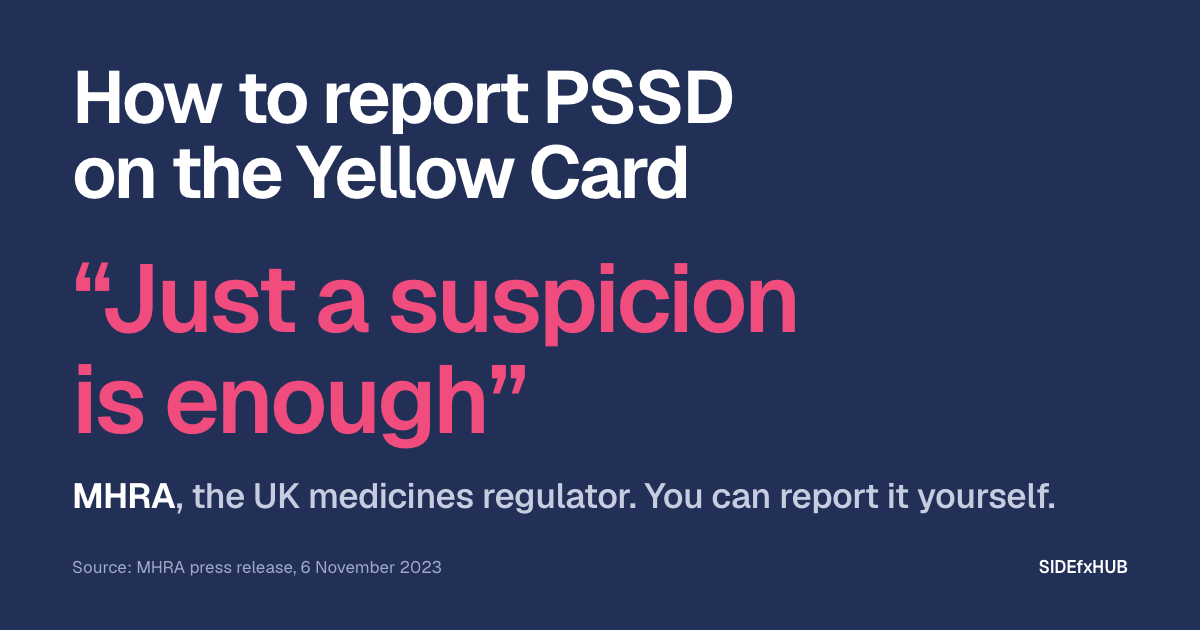
If sexual problems carried on after you stopped an SSRI antidepressant, you can report them to the UK’s Yellow Card scheme yourself. You don’t need proof, and the form has a term for it: Post-SSRI sexual dysfunction, or PSSD.
If you choose that term, the MHRA, the UK medicines regulator, records your report as PSSD. A report keeps the terms it was sent with, so pick the term when you send yours.
The story in 3 lines
- Anyone can report a suspected side effect to the Yellow Card scheme. “Just a suspicion is enough,” says the UK regulator (MHRA).
- UK leaflets for SSRIs warn that sexual problems have sometimes continued after stopping (sertraline leaflet).
- The government says the form has offered the term Post-SSRI sexual dysfunction since February 2022, and that a report is recorded as PSSD when the person reporting uses it (UK Parliament).
Press: contact@sidefxhub.com
Daryl has lived with PSSD for 13 years, Moral Medicine says. In his interview he talks about doctors who, he says, didn’t take him seriously.

He also says he has had little support from the medical system as a whole. A Yellow Card report is something you can make on your own.
Can I report PSSD to the Yellow Card scheme myself?
Yes. Anyone can report to the Yellow Card scheme, which the MHRA runs.
You don’t have to prove the medicine caused the problem, the MHRA says. The form asks for the side effects you think it caused.
The leaflet in your pack says the same. The UK leaflet for sertraline says you can report side effects “directly via Yellow Card Scheme”. It also warns that sexual problems have, in some cases, “continued after stopping treatment”. SSRI leaflets have carried that line since 2019.
Your own words count. A study of the scheme found that patients gave more detail in their reports than doctors and other health professionals did. They also said more often how the side effect had affected their lives.
You can report on the website or in the free Yellow Card app. You don’t need an account. You can report as a guest.
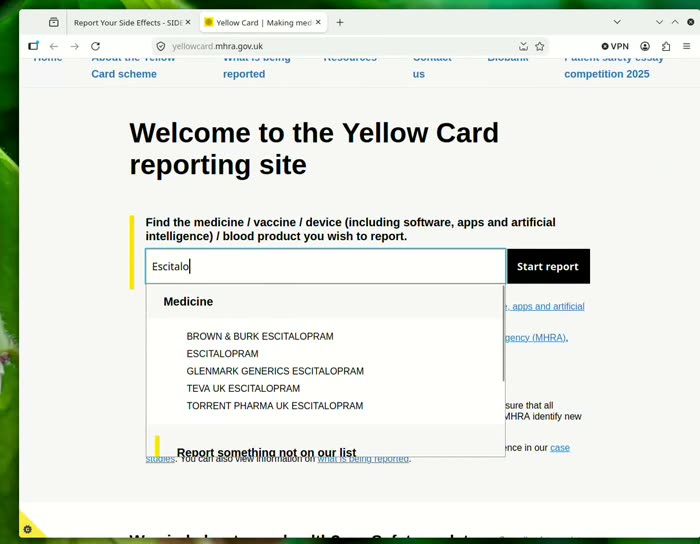
How do I fill in the Yellow Card form for PSSD?
Have your dates to hand. Our reporting guide takes you through the same steps, with the term to copy.
-
Search for your medicine. Type its name, for example “Sertraline”, and choose Start report.
-
Say who it’s about. Choose “Member of the public”, then “A suspected side effect”, then “You”.
-
Pick the term. If the problems carried on after stopping, type “Post-SSRI sexual” in the Side effect box. Choose Post-SSRI sexual dysfunction from the list: this is the term the MHRA records as PSSD.
-
Give the start date. Under “Reaction start date”, put the month it began, for example 2023/02.
-
Say whether it’s still there. Answer “Is the reaction still occurring, or has it resolved?”, then choose Add.
-
Describe it in your own words. In the description box, write what changed and when: “Since February 2023, touch feels numb and orgasm has no pleasure. No change since my last tablet in March 2024.” Leave your name out.
-
Add the dose and dates. On the medicine page, write the dose, for example “50 mg once a day”, and when you started and stopped.
-
Say what happened with the medicine. The form asks “What action was taken with this medicine as a result of the side effect(s)?” Pick the answer that matches what actually happened.
-
Send it and keep a record. Choose Submit and screenshot the confirmation page.
Reporting finasteride instead? The steps are the same with a different term, in our finasteride guide.

Does it matter which words I use?
Yes. The MHRA files every report under the terms in MedDRA, the dictionary of medical terms that regulators share.
The authors of a 2018 study of lasting sexual problems said more detailed studies would need coding systems that recognise the condition. MedDRA added the term Post-SSRI sexual dysfunction in 2021.
The government told Parliament in 2025 that the Yellow Card form has offered the term since February 2022. It said the MHRA records a report as PSSD if the person reporting used that term at the time. The MHRA doesn’t go back and change the terms on older reports, it said.
The optional boxes matter too. In the MHRA’s count of UK reports of sexual problems on SSRIs up to September 2022, nearly 2 in 3 didn’t say whether the problem carried on after stopping.
Some of those people were still taking the medicine, the MHRA says. In other reports, the boxes about stopping were left blank. Steps 5 and 8 above are the ones to fill in.
What can I do if I think I have PSSD?
These medicines help many people. If you have side effects, that’s a decision for you and your prescriber. Don’t stop suddenly.
If you think you have PSSD, tell your GP. Many people say it took time to be taken seriously.
Bring the leaflet line. You can report it without a doctor agreeing.
Report it: it helps everyone
A doctor’s note helps you. A report to the medicines regulator helps everyone else: it is how patterns get noticed.
- No proof needed. A suspicion is enough, even years after stopping.
- Where: the Yellow Card scheme in the UK, MedWatch in the US.
- Use the right words. If symptoms continued after stopping, write Post-SSRI sexual dysfunction (MedDRA 10086208).
Our reporting guide walks you through it
What else do people ask?
What happens after I send it? You’ll see a confirmation page with your report ID, and an email should follow. The MHRA says it doesn’t write to you about the outcome: reports are assessed together, to spot patterns. Reports like these were part of the evidence behind the 2019 leaflet warning. Our page on why reporting matters has more.

Can I report for someone else? Yes, with their permission, the MHRA says. Parents and carers can report too, and the form asks who had the side effect. You don’t have to give their name: their initials, sex or age is enough. Your own contact details let the MHRA ask you for more if it needs to.
I reported before 2022. Does that count? Yes, it’s on the record, filed under the symptoms you described, and still used to spot patterns. The government says the MHRA doesn’t change the terms on older reports, so it won’t be recorded as PSSD. If something has changed since, you can send a new report and choose the term.
Daryl says doctors didn’t take him seriously. A Yellow Card report doesn’t need them to: our guide opens the form, with Post-SSRI sexual dysfunction ready to copy.
Sources
- MHRA, Yellow Card scheme: “Anyone can report an issue with a medicine”; reports can be submitted as a guest user. Its page How to report: “You can report for yourself or for someone else, with their permission.” Accessed 10 October 2026.
- MHRA, Suspect you have experienced a side effect or incident from a healthcare product? Submit a Yellow Card report to improve safety for everyone, press release for #MedSafetyWeek, 6 November 2023: “just a suspicion is enough for you to submit a report”; the free Yellow Card app.
- Lustral (sertraline) 50 mg and 100 mg film-coated tablets, patient leaflet, Viatris, Electronic Medicines Compendium (EMC 2835), last revised December 2025. Section 2, “Sexual problems”; section 4, “Reporting of side effects”.
- UK Parliament, written question HL11843, asked by Lord Alton of Liverpool on 12 November 2025 and answered by Baroness Merron on 25 November 2025. The term was added to MedDRA as a lower-level term in version 24.1 and made available on the Yellow Card website in February 2022. Reports “remain as reported with the terms selected by the original reporter”, and “PSSD is recorded if the reporter has specifically used this term at the time of the report”. Earlier reports are not recoded; their symptoms are coded as separate terms and remain available for signal detection.
- UK Parliament, written question HL7363, asked by Lord Alton of Liverpool on 12 May 2025 and answered by Baroness Merron on 16 May 2025. The term was added to the regulatory dictionary in 2021, which “will help with the recording and retrieval of Yellow Card data”; SSRI product information was updated in 2019.
- MHRA, FOI 22/938, letter dated 28 September 2022, published 17 January 2024. Up to 7 September 2022: 1,762 UK spontaneous suspected reports of sexual dysfunction with an SSRI, of which 1,135 were “Unknown whether the reaction continued after drug withdrawn”, 389 continued after the drug was withdrawn and 232 did not. The “unknown” group includes people still taking the SSRI; “action taken with drug” and reaction outcomes are not mandatory fields. Report counts cannot show how common a reaction is.
- Avery AJ, Anderson C, Bond CM and colleagues. Evaluation of patient reporting of adverse drug reactions to the UK ‘Yellow Card Scheme’. Health Technol Assess 2011;15(20):1-234. Reports from 5,180 patients and 20,949 health professionals, October 2005 to September 2007.
- Healy D, Le Noury J, Mangin D. Enduring sexual dysfunction after treatment with antidepressants, 5α-reductase inhibitors and isotretinoin: 300 cases. Int J Risk Saf Med 2018;29(3-4):125-134. Built from reports to RxISK.org.
- European Medicines Agency, PRAC, recommendations on signals adopted at the 13–16 May 2019 meeting, EMA/PRAC/265212/2019. Evidence from EudraVigilance (the EU database of side effect reports), the literature, social media and the companies’ cumulative reviews.
- Yellow Card Centre Wales, All Wales Therapeutics and Toxicology Centre, Yellow Card reporting for patients, carers and the public: reporting for someone else; a name is not required; “it does not matter if you cannot complete all sections”.
- The names of the boxes and options on the form come from our own screen recording of a PSSD report on the Yellow Card site, September 2026. The Yellow Card confirmation page (yellowcard.mhra.gov.uk/confirmation) reads “Here is your Yellow Card report ID”. MHRA, FOI 22/1105, 6 December 2022: each reporter “should receive an automated email confirming receipt”, and reporters “do not receive further correspondence regarding the outcome”.
- Videos: Moral Medicine, 13 Years of Post SSRI Sexual Dysfunction (PSSD), interview with Daryl, 17 October 2024, embedded here as an extract from 1:11 to 9:26 (his story on our site: Daryl’s story); MHRA, Yellow Card - How to report, 12 November 2024; MHRA, Yellow Card - What happens after you report, 12 November 2024.
This information does not replace medical advice. Talk to your doctor before you make any decision about your treatment.
Lasting side effects after an antidepressant?
Make them count.
Our step-by-step guide finds the form for your country.