Yellow Card: report a side effect years later
You can report a side effect to the Yellow Card scheme years after stopping, and a suspicion is enough. That includes lasting PSSD, PFS and PAS.
SIDEfxHUB is a patient charity. We are not health professionals, and this does not replace medical advice. Don't start, stop or change any medicine because of what you read here. Talk to your doctor first.
If you are in crisis:116 123 Samaritans (UK)988 Lifeline (US)Find a helpline
Yes, you can report a side effect to the UK’s Yellow Card scheme years after stopping the medicine, and in the US, MedWatch’s form and pages set no deadline. A suspicion is enough, including for problems that lasted after an antidepressant, finasteride or isotretinoin (PSSD, PFS and PAS).
It’s easy to think you’ve left it too late, or that you need proof first. If you’ve only just linked an old problem to a medicine, you can still report it.
The story in 3 lines
- The UK regulator takes reports of reactions “experienced at any time, including historic adverse experiences” (MHRA).
- You don't need proof: “just a suspicion is enough” (MHRA).
- Lasting cases have changed labels. In 2012 the US regulator added sexual problems that continued after stopping to the finasteride label, after reviewing reports (FDA).
Press: contact@sidefxhub.com
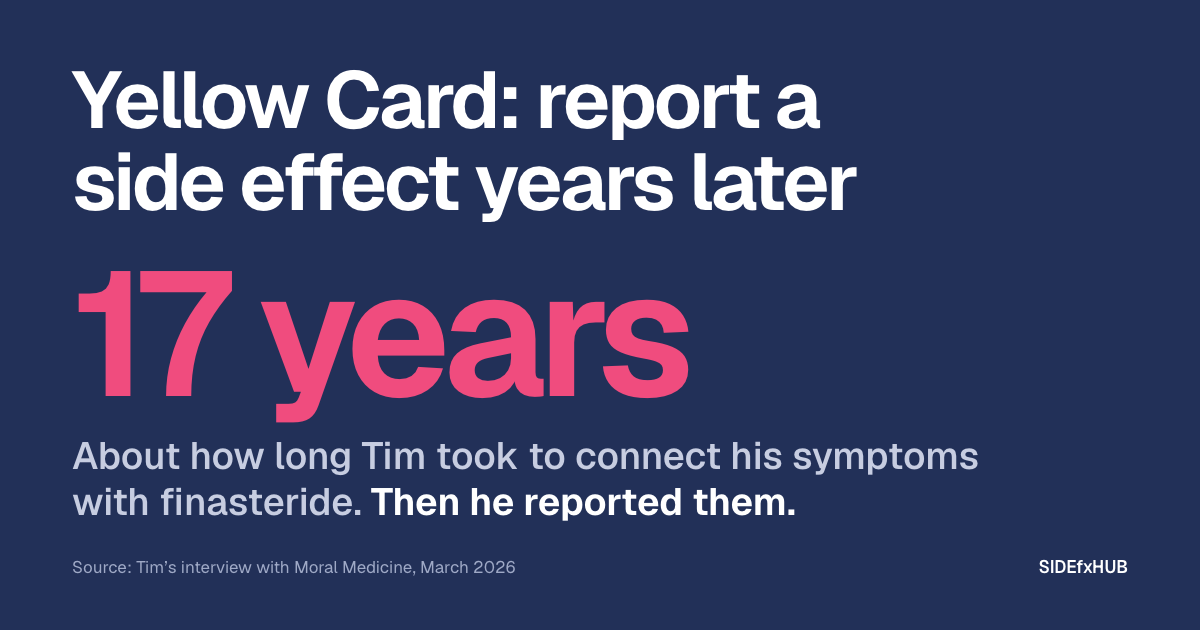
Tim was prescribed finasteride 5 mg a day for a prostate problem in 2008. He lost his sex drive and his erections soon after he started, he says. He only linked them to the tablets about 17 years later, when a warning card appeared in his pack.

He stopped taking it. Almost a year on, he says, “nothing has changed”. He has reported it to the Yellow Card scheme three times.
When he complained to a hospital trust, he says, he was told he’d left it too late. “How can I be too late to complain?” he asks.
Is it too late to report a side effect?
No. The UK medicines regulator, the MHRA, runs the Yellow Card scheme and accepts reports of reactions from any time in the past. It doesn’t matter how long ago you took your last tablet.
You don’t need proof either. “You don’t have to prove that the healthcare product caused the side effect,” the MHRA says. Nor do you need a diagnosis, or a doctor who agrees with you.
A complaint about your care can have a time limit. A Yellow Card report has none. Tim’s symptoms began many years before he reported them, and the scheme still took all three of his reports.
Researchers use old cases too. A 2018 study of lasting sexual problems after antidepressants, finasteride and isotretinoin was built from reports to RxISK, a website that collects them. Some people in it had stopped more than 20 years before.
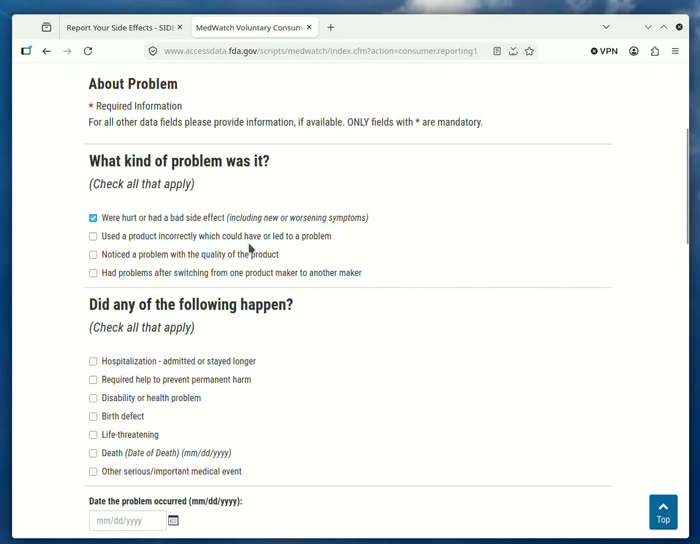
In the US, MedWatch takes reports straight from patients. The US regulator, the FDA, encourages people to report problems they think they’ve had, and your doctor doesn’t have to be involved. Its form for patients and its web pages set no deadline.
Why do lasting side effects matter to regulators?
They can change what the label says. In 2012 the US regulator added lasting sexual problems to the label of Propecia, the 1 mg finasteride tablet for hair loss. It had reviewed reports, and in 59 of them the problems had lasted at least three months after stopping.
No new clinical studies were behind that change. The reports were the evidence.
The UK regulator asks about it too. When you report a side effect of finasteride or isotretinoin, it wants as much detail as you can give, “particularly if a side effect continued or started after treatment was stopped”.
UK leaflets for SSRI antidepressants, finasteride and isotretinoin now all warn that sexual problems have sometimes continued after stopping. Nobody has counted how often it happens yet. That’s why reports matter.
Lasting cases and the warnings that followed
What should I write if I stopped years ago?
Write what you remember, in plain words. Rough dates are fine: the Yellow Card form takes a year on its own. “It does not matter if you cannot complete all sections,” says NHS Wales’s Yellow Card centre.
Give the medicine, its dose and your dates. Then say what changed and whether it’s still there. The finasteride leaflet gives similar advice: make a note of when it started and how long it lasted.
Something like this is enough, with your own details: “Finasteride 1 mg a day from June 2015 to March 2016. Low sex drive and genital numbness began in February 2016. Still the same in October 2026.”
Say clearly that you’ve stopped, and when. Our guides take you through a Yellow Card report, for PSSD and for finasteride.

What can I do?
These medicines help many people. If you still take one and have side effects, that’s a decision for you and your prescriber. Don’t stop an antidepressant suddenly. For finasteride and isotretinoin, follow what the leaflet says.
If you think you have PSSD, PFS or PAS, tell your GP and give your dates. Many people say it took time to be taken seriously. Bring the leaflet line. You can report it without a doctor agreeing.
Report it: it helps everyone
A doctor’s note helps you. A report to the medicines regulator helps everyone else: it is how patterns get noticed.
- No proof needed. A suspicion is enough, even years after stopping.
- Where: the Yellow Card scheme in the UK, MedWatch in the US.
- Use the right words. If symptoms continued after stopping, write Post-SSRI sexual dysfunction (MedDRA 10086208) for an SSRI or SNRI, or Post 5-alpha-reductase inhibitor syndrome (MedDRA 10082430) for finasteride. For isotretinoin there’s no term yet, so say the symptoms continued after stopping.
Our reporting guide walks you through it
What else do people ask?
Will a report get me any help? Not directly. The Yellow Card site says the MHRA can’t give medical advice, and Tim says he only got an acknowledgement. Your report joins the others the regulator looks at for patterns. For your own care, see your GP.
Can I report for someone else? Yes, with their permission, says the Yellow Card site. A parent can report for a child, and friends can report for you, as Tim’s friends did for him. Give as much detail as you can, even if you leave their name out.
Does one report make a difference? Each one counts, because so few are made. A 2006 review estimated that more than 9 in 10 side effects go unreported. Patients’ reports also carry detail: a study of the Yellow Card scheme found they more often described how a side effect had changed someone’s life.
It took Tim about 17 years to connect his symptoms with finasteride, and then he reported them. If you’ve only just made the link yourself, report it and say when you stopped.
Sources
- MHRA, Isotretinoin (Roaccutane▼): introduction of new safety measures, including additional oversight of the initiation of treatment for patients under 18 years of age, Drug Safety Update volume 17 issue 3, 31 October 2023. “Reports can be made of suspected reactions experienced at any time, including historic adverse experiences with medicines”. Reporters are asked for detail, “particularly if a side effect continued or started after treatment was stopped”. The April 2023 review by the Commission on Human Medicines “considered all the available evidence, including information from patients and their families”, and new warnings on sexual function side effects were added to the product information.
- MHRA, Suspect you have experienced a side effect or incident from a healthcare product? Submit a Yellow Card report to improve safety for everyone, press release for #MedSafetyWeek, 6 November 2023. “You don’t have to prove that the healthcare product caused the side effect or incident - just a suspicion is enough for you to submit a report”. The release also asks people to report as soon as they suspect a side effect.
- MHRA, Finasteride: reminder of the risk of psychiatric side effects and of sexual side effects (which may persist after discontinuation of treatment), Drug Safety Update, 29 April 2024. The review followed concerns from patients and looked at evidence including Yellow Card reports. A patient card was to be introduced in all finasteride packs. Reporters are asked for onset timing, treatment dates “and particularly if a side effect continued or started after treatment was stopped”. The MHRA’s Drug Safety Update of 11 May 2026 says the cards were introduced in 2024 and are supplied in the 1 mg and 5 mg packs.
- US Food and Drug Administration, Questions and Answers: Finasteride Label Changes, announced 11 April 2012 (archived copy; the original fda.gov address no longer works). For Propecia, the FDA reviewed 421 postmarketing reports of sexual dysfunction in its Adverse Event Reporting System, 1998 to 2011; 59 described sexual dysfunction lasting at least three months after stopping. “No new clinical studies were reviewed”; the FDA was not aware of controlled studies of the cause or duration. The 2012 change added libido, ejaculation and orgasm disorders that continued after stopping; erectile dysfunction that continued after stopping had been added in 2011. The Proscar (5 mg) label was changed to include decreased libido that continued after stopping. The FDA said clear causal links “have NOT been established”.
- MHRA, Yellow Card scheme: “Anyone can report an issue with a medicine”; How to report: “You can report for yourself or for someone else, with their permission”; “We are unable to provide medical advice”. Accessed 10 October 2026. On the report form, the reaction start date and the medicine’s start and stop dates are marked optional and can be given as “YYYY, YYYY/MM, YYYY/MM/DD” (read from our own screen recording of the form, 2 September 2026).
- Yellow Card Centre Wales, All Wales Therapeutics and Toxicology Centre, Yellow Card reporting for patients, carers and the public. Some side effects appear “even after stopping a medicine”. Give as much information as you can, “even if you prefer not to include a name”. “It does not matter if you cannot complete all sections”. You can report for yourself, your child, or someone who asks you to “with their agreement”; the section about your doctor is “optional”. Accessed 10 October 2026.
- US Food and Drug Administration, MedWatch: The FDA Safety Information and Adverse Event Reporting Program. FDA 101: How to Use the Consumer Complaint System and MedWatch: “the FDA encourages people to report problems they think they’ve experienced”. Reporting Serious Problems to FDA: “Your health care provider is NOT required to report to the FDA”, and you may complete the online form yourself. Form FDA 3500B, the consumer form (version 09/2025), asks for the date the problem occurred and states no time limit: “send in the report even if you do not have all the information”. Form FDA 3500 says “Report even if: You’re not certain the product caused the event”, and its instructions say that if the day and month are unknown, “year is acceptable”. No FDA page we found states a time limit for patient reports, and none says in so many words that there is no limit.
- Lustral (sertraline) 50 mg and 100 mg film-coated tablets, patient leaflet, Viatris, Electronic Medicines Compendium (EMC 2835), last revised December 2025. Section 2, “Sexual problems”: “In some cases, these symptoms have continued after stopping treatment”. Section 4: you can report side effects directly via the Yellow Card scheme.
- Propecia 1 mg film-coated tablets, patient leaflet (UK, EMC 2194), Organon, last revised May 2026. Section 4, frequency unknown: persistent difficulty having an erection, persistent decrease in sex drive and persistent problems with ejaculation “after discontinuation of treatment”. Also: “It will help if you make a note of what happened, when it started and how long it lasted”. Section 2: a patient card is provided with the pack.
- Roaccutane 10 mg soft capsules, patient leaflet (UK, EMC 100633), last revised April 2026. Section 2: “There have been reports of long-lasting sexual problems where the symptoms have continued despite stopping treatment with isotretinoin.”
- European Medicines Agency, PRAC, recommendations on signals adopted at the 13–16 May 2019 meeting, EMA/PRAC/265212/2019, section 1.3, adopted 16 May 2019. Persistent sexual dysfunction after stopping SSRIs and SNRIs, considered on “the available evidence from EudraVigilance, literature, social media and cumulative reviews provided by MAHs”. EudraVigilance is the EU database of suspected side effect reports.
- Healy D, Le Noury J, Mangin D. Enduring sexual dysfunction after treatment with antidepressants, 5α-reductase inhibitors and isotretinoin: 300 cases. Int J Risk Saf Med 2018;29(3-4):125-134. Built from reports to RxISK.org from 37 countries. Seventeen people reported the condition at least 10 years after stopping; five said it had been more than 20 years since they stopped isotretinoin (four) or fluoxetine (one).
- Hazell L, Shakir SA. Under-reporting of adverse drug reactions: a systematic review. Drug Saf 2006;29(5):385-96. The median under-reporting rate across 37 studies in 12 countries was 94% (interquartile range 82 to 98%). Most studies measured reporting by health professionals.
- Avery AJ, Anderson C, Bond CM and colleagues. Evaluation of patient reporting of adverse drug reactions to the UK ‘Yellow Card Scheme’. Health Technol Assess 2011;15(20):1-234. Reports from 5,180 patients and 20,949 health professionals, October 2005 to September 2007. Patient reports were richer in their descriptions and more often noted the effects on patients’ lives.
- MedDRA terms as listed in our reporting data: Post-SSRI sexual dysfunction (10086208) and Post 5-alpha-reductase inhibitor syndrome (10082430). There is no term yet for lasting effects after isotretinoin.
- Moral Medicine, He Took Finasteride for 17 Years… Then His Doctor Refused to Help, interview with Tim, 23 March 2026 (the title is the channel’s). Our page plays an extract, 3:07 to 5:21; the views are his own. Finasteride 5 mg from 2008 to 2025; “nothing has changed” (5:00); reported to the Yellow Card scheme three times (6:34); “How can I be too late to complain?” (7:12); friends reported for him (11:03). Quotes from the YouTube captions. His story on our site: Tim’s story: nearly 17 years on finasteride.
- MHRA, Yellow Card - How to report, 12 November 2024.
- Picture: the MedWatch consumer reporting form (Form FDA 3500B online), a still from our own screen recording, 2026.
- NHS England, Feedback and complaints about NHS services. “Complaints should normally be made within 12 months of an incident or of it coming to your attention. This time limit can be extended provided you have good reasons”. Accessed 10 October 2026.
This information does not replace medical advice. Talk to your doctor before you make any decision about your treatment.
Side effects that did not go away?
Make them count.
Our step-by-step guide finds the form for your country.