Suicidal thoughts with PSSD, PFS or PAS
If PSSD, PFS or PAS makes you think about ending your life, you are not alone. Call Samaritans free on 116 123, any time. In the US, call or text 988.
SIDEfxHUB is a patient charity. We are not health professionals, and this does not replace medical advice. Don't start, stop or change any medicine because of what you read here. Talk to your doctor first.
If you are in crisis:116 123 Samaritans (UK)988 Lifeline (US)Find a helpline
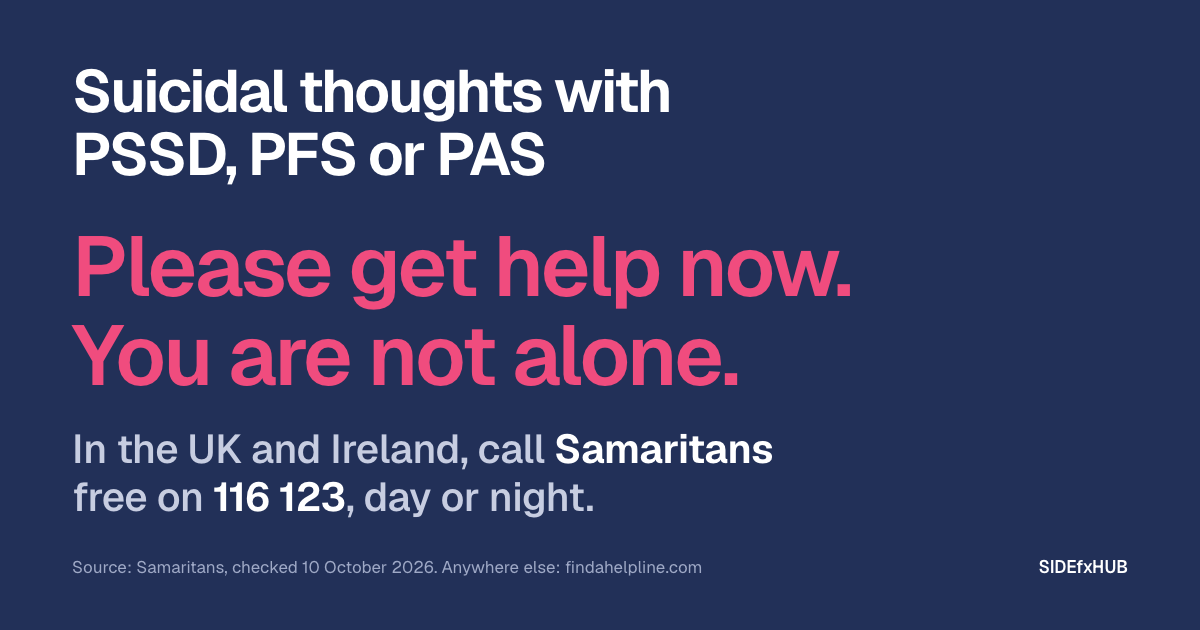
If the lasting effects of PSSD, PFS or PAS make you think about ending your life, please get help now. You are not alone. In the UK and Ireland, call Samaritans free on 116 123, day or night; in the US, call or text 988.
We can't advise you here.
SIDEfxHUB is a patient charity. We are not a crisis service or a medical service, and we can't and mustn't tell you what to do about your health or your medicine.
The people on the lines below can help you today, and so can a doctor. Please contact them.
Thoughts like these are very common, says the Royal College of Psychiatrists. A huge number of people “get through them with the right support”. You deserve that support, wherever these thoughts come from.
The story in 3 lines
- The UK leaflet for finasteride 1 mg, updated in May 2026, says sexual problems may contribute to mood changes, including suicidal thoughts, in some patients.
- The isotretinoin leaflet warns that if your mood changes, stopping the medicine “may not be enough to stop the effects”. Your doctor can arrange more help.
- Help is free, at any hour: Samaritans on 116 123 in the UK and Ireland, 988 in the US.
Press: contact@sidefxhub.com
Yassie Pirani is a therapist who supports people living with PSSD and PFS. At the end of a Moral Medicine interview, she spoke to anyone watching who was struggling.

“If you are out there and you’re suffering, know that you’re not alone,” she says. “Your suffering is real. It’s not your fault, and it’s not a reflection of weakness or personal failing.”
Who can I talk to right now?
You can talk to someone tonight, for free. The Samaritans volunteer can’t see your number, and you don’t have to give your name.
- UK and Ireland: call Samaritans on 116 123, from any phone, at any hour.
- If talking feels too hard: in the UK, text SHOUT to 85258. It’s free and silent, at any hour.
- Northern Ireland: call Lifeline free on 0808 808 8000, at any hour.
- US and Canada: call or text 988.
- Anywhere else: Find A Helpline lists free lines in more than 175 countries.
- Not sure what you need? In England, Scotland or Wales, call NHS 111, at any hour.
- If you’ve hurt yourself, or feel you’re about to: call 999 or go to A&E. In the US or Canada, call 911.

You don’t need the right words. The volunteers won’t judge you or tell you what to do, Samaritans says, and you can call about anything at all.

If you’d rather see a face, some Samaritans branches offer visits in person.
Will these thoughts pass?
They can. The Royal College of Psychiatrists says suicidal thoughts can last days or weeks, or come and go, even several times in one day. Its guide says to focus on getting through right now.
Think about today, the NHS says, and leave the future for later. It also says to be around other people, or go somewhere safe, like a friend’s house, and to stay away from alcohol and recreational drugs.
In Yassie Pirani’s experience, PSSD itself can change, too. She has seen people get some emotional or sensory feeling back “even after several years”, though she’s clear there’s no guarantee. “I’ve also seen improvements. I really have,” she says.
What do the leaflets say about mood and suicidal thoughts?
The UK leaflets for SSRIs, finasteride and isotretinoin all list suicidal thoughts. All three say to get help quickly.
Finasteride. The Propecia leaflet says low mood, depression and, less often, suicidal thoughts have been reported. Since May 2026 it adds that sexual problems may contribute to these mood changes in some patients. Sexual problems have also been reported with no change in mood.
Isotretinoin. The Roaccutane leaflet says you may not notice changes in your own mood, and some people with suicidal thoughts may not seem depressed. It says to tell family and friends you’re taking it, and to contact your doctor straight away if you get signs. Stopping it, the leaflet adds, “may not be enough to stop the effects: you may need more help, and your doctor can arrange this”.
SSRIs. The sertraline leaflet says depression and anxiety can bring thoughts of harming yourself, and these may increase when you first start an antidepressant. If you have them at any time, it says, contact your doctor or go to a hospital straight away.
What can I do?
The Royal College of Psychiatrists suggests speaking to someone. You don’t have to share everything at once, it says. You could just say you’re feeling very low and need some company.
Your GP can help too, even if you stopped the medicine years ago.
“I need an emergency appointment about my mental health.”
“For the past month I've had thoughts of ending my life.”
“Finasteride 1 mg from March 2022, last tablet June 2024.”
“The sexual problems didn't go away when I stopped.”
We can’t tell you what to do about your medicine. That is for you and your prescriber, and these medicines help many people.
If you still take one and have thoughts like these, all three leaflets say to contact your doctor, “straight away” or “as soon as possible”. What each leaflet says about the medicine itself is different, so ask your doctor or a pharmacist today, with your leaflet in your hand.
Other people living with PSSD, PFS or PAS can help as well. Our small WhatsApp groups are where members bring their hard days. They aren’t a crisis service, and nobody there can give medical advice, so in a crisis call 116 123, or 999 if you’re in danger.
Report it: it helps everyone
A doctor’s note helps you. A report to the medicines regulator helps everyone else: it is how patterns get noticed.
- No proof needed. A suspicion is enough, even years after stopping.
- Mood counts too. You can report low mood and suicidal thoughts, as well as sexual problems.
- Where: the Yellow Card scheme in the UK, MedWatch in the US.
Our reporting guide walks you through it
What else do people ask?
What if I’m worried about someone else? Get them talking, says the NHS. Ask open questions, such as “How do you feel about…?”, and take what they say seriously. You don’t need to have the answers. You can call the helplines above for advice about someone else, too.
Can I get help when I’m not in crisis? Yes. The best time to get help is when you aren’t in crisis, says the Royal College of Psychiatrists, so you have tools ready if things get bad again. Your GP may refer you for talking therapy.
“There really is change happening,” says Yassie Pirani, of how much more openly these conditions are now talked about. We can’t advise you. The people on these lines can help you now. Please don’t wait: call Samaritans free on 116 123, or text SHOUT to 85258. In the US, call or text 988.
Sources
- Propecia 1 mg film-coated tablets, patient leaflet, Electronic Medicines Compendium (EMC 2194), last revised May 2026. Section 2, “Mood alterations and depression”. Mood alterations, depression and, less frequently, suicidal thoughts have been reported; stop taking it and contact a doctor as soon as possible. “Impaired sexual function that may contribute to mood alterations, including suicidal thoughts, has been reported in some patients.” “Impaired sexual function has also been reported without mood alterations or suicidal thoughts.” The previous revision (August 2024) did not carry the two sentences on impaired sexual function. A patient card comes with the pack. Section 4: depression and suicidal thoughts under “Stop taking Propecia and talk to your doctor”. Suicidal thoughts and anxiety under “Frequency unknown”.
- Roaccutane 10 mg and 20 mg soft capsules, patient leaflet, EMC 100633, last revised April 2026. Section 2, “Mental health problems”: you may not notice changes in your mood and behaviour, so tell friends and family. Section 4, “Mental problems”, frequency not known: depression, existing depression getting worse, suicidal thoughts. “These people may not appear to be depressed.” “Contact your doctor straight away if you get signs of any of these mental problems.” Stopping “may not be enough to stop the effects: you may need more help, and your doctor can arrange this.”
- Lustral (sertraline) 50 mg and 100 mg film-coated tablets, patient leaflet, EMC 2835, last revised December 2025. Section 2, “Thoughts of suicide and worsening of your depression or anxiety disorder”. These thoughts may be increased when first starting antidepressants, and are more likely in adults under 25. If they happen at any time, contact your doctor or go to a hospital straight away. It may help to tell a relative or close friend. The same section appears in the UK leaflets for fluoxetine (EMC 15755) and Cipralex (escitalopram, EMC 7718).
- MHRA, Finasteride and dutasteride: updated safety warnings for psychiatric side effects and sexual dysfunction, Drug Safety Update, 11 May 2026. The finasteride 1 mg leaflet is being updated to warn that sexual dysfunction may contribute to mood disorders. Patient cards stay in 1 mg and 5 mg packs. Patients on finasteride 1 mg who develop depression or suicidal thoughts should stop it and contact their doctor as soon as possible; patients on finasteride 5 mg or dutasteride should contact their doctor as soon as possible.
- Royal College of Psychiatrists, Suicidal thoughts, published September 2026, written with people who have had suicidal thoughts. “What are suicidal thoughts?”: they can last days or weeks, or come and go. “Speaking to someone”: you do not have to share everything straight away. “No obvious reason”: “suicidal thoughts are very common”. “A huge number of people experience suicidal thoughts and get through them with the right support.” “Getting professional help”: the best time to get help is when you aren’t in crisis, and a GP may refer you for talking therapy.
- NHS, Help for suicidal thoughts, page last reviewed 26 April 2024. Helplines: NHS 111, Samaritans 116 123, Shout 85258. Call a GP and ask for an emergency appointment; call 999 or go to A&E if your life is in danger. Tips for coping right now, and advice if you are worried about someone else. NHS 111 runs in England, Scotland and Wales; the NHS page When to use 111 sends people in Northern Ireland to nidirect.
- Samaritans, Contact a Samaritan, checked 10 October 2026. 116 123 is free from any phone, day or night, and calls reach volunteers across the UK and Ireland. Your number is not shown to the volunteer. Some branches offer visits in person. The UK email service has closed.
- 988 Suicide and Crisis Lifeline, 988lifeline.org: in the US, call, text or chat, free and confidential, at any hour. In Canada, 988.ca: call or text 988, 24 hours a day. Find A Helpline, run by ThroughLine, lists free, confidential helplines in more than 175 countries.
- Lifeline, lifelinehelpline.info: Northern Ireland’s crisis response helpline, 0808 808 8000. Calls are free and answered by trained counsellors, 24 hours a day, 7 days a week. Read on Lifeline’s own site as archived on 22 January 2026, and on nidirect, Mental health emergency: if you’re in crisis or despair, checked 10 October 2026.
- Moral Medicine, interview with Yassie Pirani, YouTube, 28 July 2025, 52 minutes. Quotes from the auto-captions, 50:20 to 52:12. Cited without a link and not embedded: its opening lines do not suit a page for people in crisis.
- Samaritans, What happens when you call Samaritans?, 14 July 2023.
- Shout, How Shout works, 29 April 2024. Shout’s own page, Get help, checked 10 October 2026: a free, confidential, 24/7 text service for anyone in the UK.
- Samaritans, It’s never too late to talk, 1 March 2022.
This information does not replace medical advice. Talk to your doctor before you make any decision about your treatment.
590+ people have joined the community.
Join them, then report your side effects.
No diagnosis needed. Researchers never see your name.