What does PFS feel like?
People with post-finasteride syndrome (PFS) describe numb genitals, no sex drive, flat emotions and foggy cognition that continued after stopping.
SIDEfxHUB is a patient charity. We are not health professionals, and this does not replace medical advice. Don't start, stop or change any medicine because of what you read here. Talk to your doctor first.
If you are in crisis:116 123 Samaritans (UK)988 Lifeline (US)Find a helpline
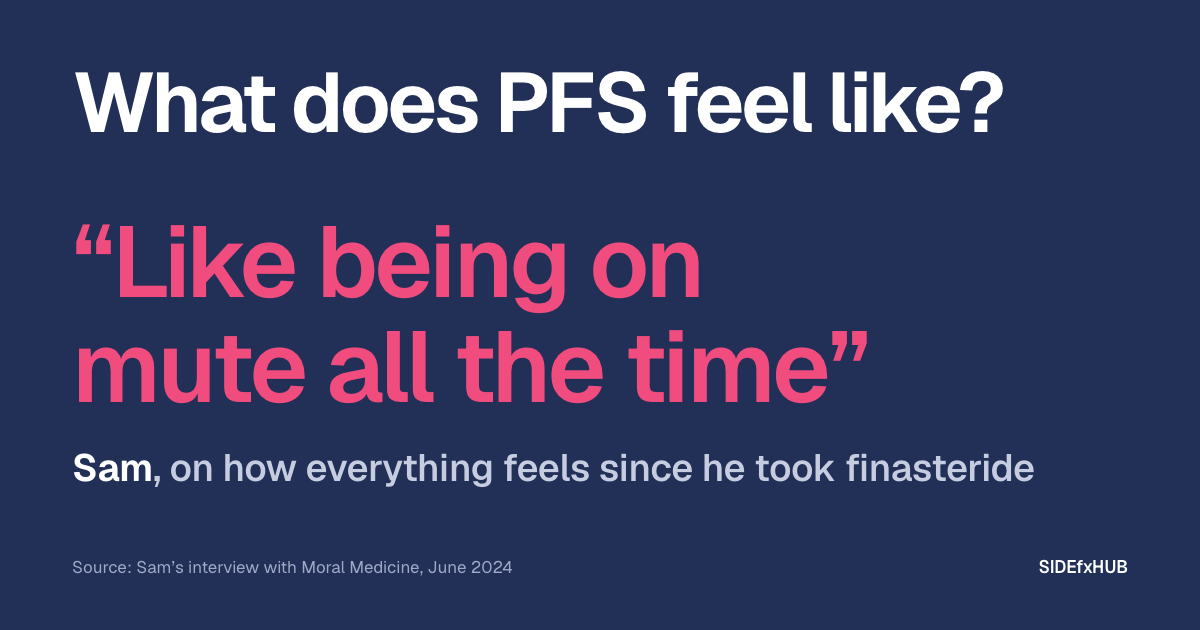
People with post-finasteride syndrome (PFS) describe numb genitals, no sex drive, flat emotions and foggy cognition. The symptoms began while they took finasteride or soon after their last tablet, and continued after stopping.
The NHS page on finasteride lists erection problems, less interest in sex and low mood. It doesn’t mention numbness, flat emotions or cognition, which makes them harder to recognise and harder to explain to a doctor.
The story in 3 lines
- The UK leaflet lists erection, sex drive and ejaculation problems that persisted after stopping finasteride.
- The 2022 diagnostic criteria for PFS add less feeling in the genitals and at orgasm, and say cognitive problems and depression can come with it.
- Nobody has measured how often PFS happens. The clearest descriptions come from the people who have it.
Press: contact@sidefxhub.com
Matt took finasteride for three years with no problems. Then one day he woke with what he calls a “strange dead sensation” in his genitals.

“It felt numb, it felt dry, and it felt dead,” he says. He came off finasteride, and within weeks his emotions went flat, his body ached and he found it hard to form a sentence. Five years on, he says nothing has changed.
What does PFS feel like sexually?
The feeling goes, people say, even when the body still works. Matt could still get an erection and ejaculate, but he says he felt “absolutely nothing”. In the film he says he turns 30 this year and hasn’t felt an orgasm since he was 24.
How Matt says it unfolded
The UK leaflet lists difficulty having an erection, a lower sex drive and ejaculation problems that persisted after stopping. It doesn’t mention numbness. Diagnostic criteria that researchers published in 2022 do: they include a lasting “reduction in genital and orgasmic sensation”.
A US hormone specialist interviewed men whose sexual problems had lasted at least three months after they stopped finasteride. Nearly all had a low sex drive, and about 7 in 10 had problems with orgasm. These were men who came forward, so the study can’t show how often this happens.
What does PFS feel like emotionally?
Flat is the word people use. Sam was 25 when he took finasteride for about a week, stopped, then took it for a few more days.
He was filmed ten weeks after his symptoms began. That’s short of the three months the diagnostic criteria ask for, so his is an early account.
In it he describes a hug from his mum, who told him he was going to be all right. “I just couldn’t feel that,” he says.
Everything, he says, is “like being on mute all the time”.

The UK leaflet warns of depressed mood, depression and anxiety. It has no line for feeling nothing at all.
Matt spells out the difference himself: “I didn’t feel depressed, I didn’t feel sad.” His ability to feel had gone, he says.
Low mood can be part of it too. Researchers in Boston compared men who had lasting symptoms after finasteride with men who had none, and those with symptoms scored higher for depression. The study couldn’t show what caused it.
What does PFS brain fog feel like?
People describe slow, muddled cognition. Matt says he was “unable to string one thought to the next”.
Sam’s mind used to be busy, with songs always playing in his head. Now, he says, “there’s nothing”. He doesn’t know whether he’ll be able to go back to work.
Connor took finasteride for six months and wrote his story for us five years later. His list includes “short-term memory loss”, confusion and slurred speech.
The criteria for PFS say cognitive problems can come with the sexual ones. In the Boston study, men with lasting symptoms reported slightly more memory complaints, the researchers wrote. The difference was unclear when the groups were compared in pairs.
Standard cognitive tests found no sign of a deficit. The researchers said larger studies are needed.
What can I do?
Finasteride helps many men keep their hair. If you have side effects, that’s a decision for you and your prescriber.
If you feel low or have suicidal thoughts, the UK leaflet says to stop taking it and contact your doctor as soon as possible. The Samaritans are on 116 123, free, at any hour.
Symptoms like these are hard to put into words in a ten-minute appointment. Write them down first, in plain language.
“Finasteride 1 mg from March 2023, last tablet June 2025.”
“My penis feels numb”, “orgasm with no pleasure”, “I can't feel affection”, “I lose my thread mid-sentence”.
While taking it, or after stopping.
“No problems before 2023.”
Many people say it took time to be taken seriously. Bring the leaflet line on problems that persisted after stopping. You can report it without a doctor agreeing.
Report it: it helps everyone
A doctor’s note helps you. A report to the medicines regulator helps everyone else: it is how patterns get noticed.
- No proof needed. A suspicion is enough, even years after stopping.
- Where: the Yellow Card scheme in the UK, MedWatch in the US.
- Use the right words. If symptoms continued after stopping, write Post 5-alpha-reductase inhibitor syndrome (MedDRA 10082430).
Our reporting guide walks you through it
What else do people ask?
Are there physical symptoms too? Some people describe them. Connor lists “loss of strength”, “body twitches”, “severe fatigue” and “joint and muscle pain”. Sam talks about twitching muscles and running without sweating. The UK leaflet doesn’t list these. In an online survey, men who reported lasting symptoms described physical problems too.
What is it like for a partner? Thammika was married for five years to a man with lasting sexual problems after finasteride. He had no cognitive or emotional symptoms, she says. She describes deep loneliness, and says it wasn’t his fault. The marriage ended. They’re still best friends, and they bring up their daughter together.
Does PFS go away? For some people it has lasted years after stopping. Nobody knows yet who will be affected, or whether it will ease. Ten weeks in, Sam could sleep a little again, though he said everything else was worse. Matt says nothing had changed after five years. Our page on post-finasteride syndrome sets out what is known.
Matt says he would never have believed this could happen to anyone, had it not happened to him. If you recognise yourself in his words, write down your own and report it.
Sources
- Propecia 1 mg film-coated tablets, patient information leaflet, electronic medicines compendium (emc), last revised May 2026. Section 4, under “Frequency unknown”: “persistent difficulty having an erection after discontinuation of treatment”, “persistent decrease in sex drive after discontinuation of treatment”, “persistent problems with ejaculation after discontinuation of treatment”, and anxiety. Section 2: “Mood alterations such as depressed mood, depression and, less frequently, suicidal thoughts have been reported”; stop taking it and contact your doctor “for further medical advice as soon as possible”. The leaflet does not mention numbness, emotional numbness, memory or concentration, fatigue, or muscle symptoms.
- NHS, Side effects of finasteride, page last reviewed 2 August 2023. Lists problems getting an erection, less interest in sex, ejaculation problems and low mood, and says the sexual side effects “can sometimes carry on even after you stop taking finasteride”.
- Healy D, Bahrick A, Bak M, et al. Diagnostic criteria for enduring sexual dysfunction after treatment with antidepressants, finasteride and isotretinoin. International Journal of Risk & Safety in Medicine, 2022; 33(1): 65–76. PFS criteria: enduring sexual dysfunction after stopping a 5-alpha-reductase inhibitor; additional criteria include “enduring reduction in genital and orgasmic sensation” and a problem present 3 months or more after stopping. Cognitive impairment, depression and suicidality are listed as effects that may accompany the sexual problems. “In some cases, an enduring sexual dysfunction may only appear when the drug is stopped.” “The incidence of these conditions is unknown.”
- Irwig MS, Kolukula S. Persistent sexual side effects of finasteride for male pattern hair loss. Journal of Sexual Medicine, 2011; 8(6): 1747–53. Standardised interviews with 71 otherwise healthy men aged 21 to 46 whose sexual side effects had lasted at least 3 months after stopping: 94% low libido, 92% erectile dysfunction, 92% decreased arousal, 69% problems with orgasm. Mean duration of the persistent side effects: 40 months at interview. Limitations stated by the authors: selection bias, recall bias, no hormone levels.
- Basaria S, Jasuja R, Huang G, et al. Characteristics of men who report persistent sexual symptoms after finasteride use for hair loss. Journal of Clinical Endocrinology & Metabolism, 2016; 101(12): 4669–80. Brigham and Women’s Hospital, Boston. 25 men with persistent symptoms, 13 finasteride users without symptoms and 18 men who had never used it. Median depression score (PHQ-9) 11 in the symptomatic group, in the moderate range, against 1 in each of the other groups. Memory complaint scores (MAC-Q) differed overall across the three groups after adjusting for education, but “between-group differences were not significant”; the authors describe “a slightly greater number of subjective cognitive complaints” and write “we found no objective evidence of cognitive deficits”. “These findings need confirmation in larger prospective studies.” Cross-sectional, so it cannot show cause.
- Ganzer CA, Jacobs AR, Iqbal F. Persistent sexual, emotional, and cognitive impairment post-finasteride: a survey of men reporting symptoms. American Journal of Men’s Health, 2015; 9(3): 222–8. Read as an abstract only. A pilot internet survey, emailed to men who had reported side effects of finasteride; responses from 131 men (mean age 24) on effects at least 3 months after stopping. “Adverse effects persisted in each of the domains” asked about, which included physical, sexual, cognitive and psychological symptoms.
- Moral Medicine on YouTube. Matt, 6 April 2026, embedded here as an extract from 4:24 to 10:32: turning 30 and no orgasm since 24 at 0:09. Three years with no problems, the “strange dead sensation” and “It felt numb, it felt dry, and it felt dead” from 4:24. “Absolutely nothing” at 4:50, then a change of dose, a topical and stopping from 5:10. Emotional numbness about three weeks after stopping at 5:30, and “I didn’t feel depressed, I didn’t feel sad” at 6:40. Pain and fatigue from 7:00, and “unable to string one thought to the next” at 8:50. Five years later, “nothing has changed” at 9:14. “I would have never believed this could happen to anyone” at 11:10. Sam, 12 June 2024, embedded here as an extract from 7:10 to 9:45: 25 years old at 1:14. About a week on finasteride, a break, then a few more days from 4:40. Twitching muscles at 7:16, “it’s been 10 weeks now” at 7:23 and the hug from his mum at 7:47. Brain fog and work at 9:07, and sleeping a little at 9:35. Songs in his head and “there’s nothing” at 10:30. Running without sweating at 13:35 and “like being on mute all the time” at 13:55. Thammika, interview of 30 April 2025: “This is definitely not this man’s fault” at 3:30 and married for five years at 4:00. No cognitive or emotional symptoms at 4:15, best friends and co-parents at 9:15, loneliness at 14:00.
- Their stories on our site: Matt, Sam, Thammika and Connor, who wrote his own account in August 2024.
This information does not replace medical advice. Talk to your doctor before you make any decision about your treatment.
590+ people have joined the community.
Join them, then report your side effects.
No diagnosis needed. Researchers never see your name.