When do finasteride side effects start?
In finasteride's trials, sexual side effects mostly began in the first year. Reports range from one day to years in, and some persist after stopping: PFS.
SIDEfxHUB is a patient charity. We are not health professionals, and this does not replace medical advice. Don't start, stop or change any medicine because of what you read here. Talk to your doctor first.
If you are in crisis:116 123 Samaritans (UK)988 Lifeline (US)Find a helpline
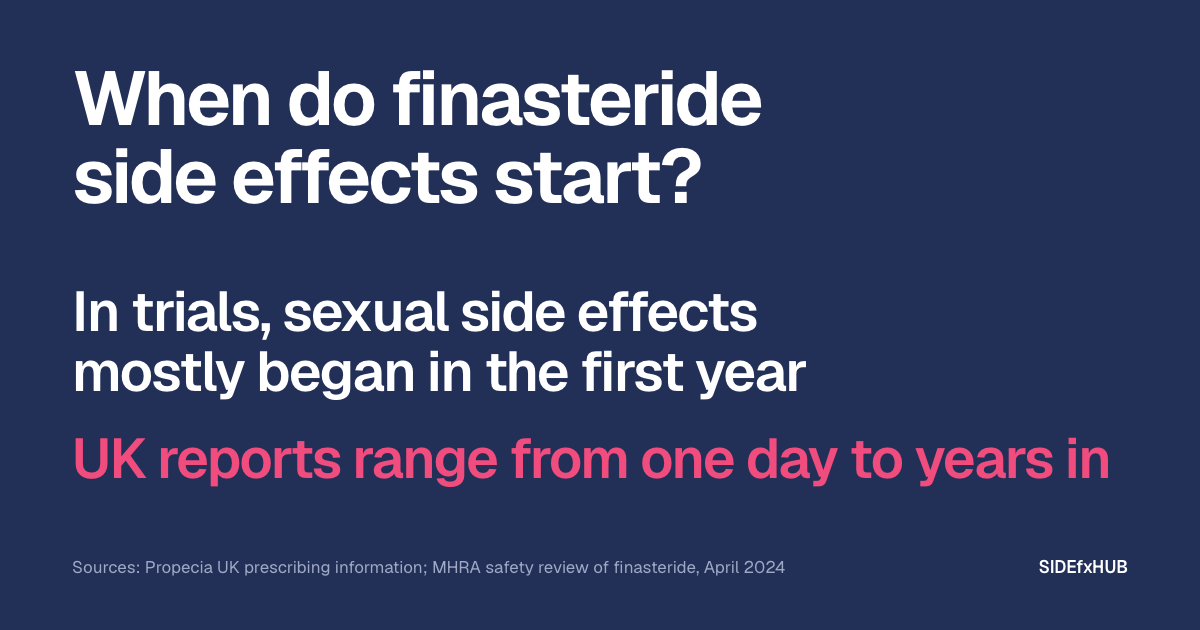
In finasteride’s trials, sexual side effects were mostly reported in the first year, but reports to the UK regulator run from one day to more than 16 years in. The UK leaflet lists sexual problems that persisted after stopping, a condition known as post-finasteride syndrome, or PFS.
The leaflet doesn’t say when side effects tend to start. If you’re about to start, or a few weeks in and wondering whether you’re in the clear, neither it nor the prescribing information names a point after which side effects can’t begin.
The story in 3 lines
- In the first trial year, about 4 in 100 men on finasteride reported a sexual side effect, against about 2 in 100 on a dummy pill. Later years brought fewer (UK prescribing information).
- In UK reports, symptoms began anywhere from one day to more than 16 years in (MHRA review).
- The UK leaflet lists sexual problems that persisted after stopping, and gives no timing. Patients call it PFS.
Press: contact@sidefxhub.com
Ardalan took finasteride for hair loss from 2009 to 2018. Did he notice side effects straight away? “No, I actually didn’t,” he says, apart from one change in his semen that didn’t affect his life.

The side effects that changed his life began three or four years in, he says. He’d been a big reader, and bit by bit he found he couldn’t get through a page. For years he didn’t connect it to finasteride: “I couldn’t figure it out.”
When do finasteride side effects usually start?
In the trials, it was the first year. The men were followed for up to five years, and the UK prescribing information says sexual side effects were reported less often after the first year. Those later years counted only men who chose to stay in the trials, so anyone who had already left isn’t in those figures.
The NHS says some people may notice the serious side effects, such as low mood, “after taking finasteride for a few months”.
The UK medicines regulator, the MHRA, has reviewed the Yellow Card reports it received about sexual and mood side effects. Fewer than half said when the symptoms began. In those that did, it was about 11 months after starting, on average.
The patient leaflet names no week or month. It does say it will help if you “make a note of what happened, when it started and how long it lasted”.
Can finasteride side effects start in the first week?
Some people report that theirs did. The earliest symptoms in the MHRA’s review began one day after starting.
Lucas started at 18. By the third day, he says, he “felt something that I have never felt before”: his erections had changed. His story runs through our article on finasteride in your teens and twenties.
Finasteride lowers a hormone called DHT within a day of the first tablet, as our article on PFS after a few pills explains. Nobody knows yet whether that’s why some people notice changes so soon.
For Shaun, it was the first month. He took 1 mg every other day and noticed nothing for three or four weeks. Then came what he calls a “muted orgasm” and genital numbness, and he stopped.


Can side effects start after years on finasteride?
They’ve been reported years in. The latest in the MHRA’s review began more than 16 years after the person started.
The trials say little about those later years. A 2015 analysis of finasteride’s hair-loss trials found that most had checked safety for a year or less.
Ardalan’s trouble with reading began around his fourth year. Matt says he took finasteride for three years “without any issues”, then woke one day with numb genitals. Our article What does PFS feel like? follows what came next for him.
When finasteride side effects have been reported to start
What can I do?
Finasteride helps many men keep their hair. If you have side effects, that’s a decision for you and your prescriber.
If your mood drops or you have suicidal thoughts, the UK leaflet says to stop taking it and contact your doctor as soon as possible. The Samaritans are on 116 123, free, at any hour.
Do what the leaflet suggests and write the timing down: “Finasteride 1 mg from 3 March 2026. Lower sex drive from about 20 March. Still taking it.” Your GP can work from dates like these.
Many people say it took time to be taken seriously. Bring the leaflet line. You can report it without a doctor agreeing.
Report it: it helps everyone
A doctor’s note helps you. A report to the medicines regulator helps everyone else: it is how patterns get noticed.
- No proof needed. A suspicion is enough, even years after stopping.
- Where: the Yellow Card scheme in the UK, MedWatch in the US.
- Use the right words. If symptoms continued after stopping, write Post 5-alpha-reductase inhibitor syndrome (MedDRA 10082430).
Our reporting guide walks you through it
What else do people ask?
Can side effects start after I stop? The 2022 diagnostic criteria for PFS say a lasting problem may only appear after stopping, possibly up to a couple of weeks later, or a mild one may get worse. Some men in a 2018 series of patient reports described just that. Shaun says he got much worse on 1 February, weeks after he stopped. See our article on stopping finasteride.
What should I expect in my first month on finasteride? Nobody can tell you in advance. The NHS says many people take it for months or even years without any problems, and that hair takes three to six months to improve. Side effects have also begun in the first month, as Shaun’s did. If something changes, note the date.
How do I know it’s the finasteride? The 2022 criteria look at more than timing. Other explanations, such as another medicine or a health condition, have to be ruled out. A dated note of what changed gives your GP something to check. How long the drug itself lasts is in How long does finasteride stay in your system?
Ardalan was about four years in when reading a page became hard, and it took him years more to link it to his tablets. If something changes for you, on the tablets or after them, write the date down and report it.
Sources
- Propecia 1 mg film-coated tablets, summary of product characteristics, electronic medicines compendium (emc), text revised 29 June 2026. Section 4.8: “Drug-related sexual undesirable effects were more common in the finasteride 1 mg-treated men than the placebo-treated men, with frequencies during the first 12 months of 3.8% vs 2.1%, respectively. The incidence of these effects decreased to 0.6% in finasteride 1 mg-treated men over the following four years.” About 1% of men in each group stopped because of them in the first 12 months, “and the incidence declined thereafter”. Section 5.1: the two vertex hair-loss studies ran for five years; 290 men completed five years on Propecia.
- Propecia 1 mg film-coated tablets, patient information leaflet, emc, last revised May 2026. Section 4, frequency unknown: “persistent difficulty having an erection after discontinuation of treatment”, a persistent decrease in sex drive and persistent problems with ejaculation. Section 4 also says: “It will help if you make a note of what happened, when it started and how long it lasted.” Section 2, on depressed mood, depression or suicidal thoughts: “stop taking Propecia and contact your doctor for further medical advice as soon as possible”. For impaired sexual function, it says to contact your doctor, who “may consider stopping the treatment”. The leaflet gives no time of onset for any side effect.
- MHRA, Safety review of finasteride: public assessment report, April 2024. Section 5.2: Yellow Card reports up to 5 January 2023 of finasteride with sexual dysfunction (375) or depressed mood and suicidal behaviour (231), 606 in all, both doses. Time to onset was documented in 252 reports (42%): average 330 days (about 10.8 months), range 1 to 5,923 days. The MHRA says the limits of spontaneous reports mean no firm conclusions can be drawn from them.
- NHS, Side effects of finasteride, page last reviewed 2 August 2023: “Some people may notice these side effects after taking finasteride for a few months”, said of the serious side effects, which include low mood. NHS, Common questions about finasteride, page last reviewed 2 August 2023: “Many people take it for many months or even years without any problems”; for hair loss, “some improvement after 3 to 6 months”.
- Propecia (finasteride 1 mg), US prescribing information, DailyMed, US National Library of Medicine. Section 14: the later years were extension studies of men who had completed the first 12 months and “elected to continue”. Section 6.1: sexual side effects in 36 of 945 men on Propecia (3.8%) and 20 of 934 on placebo (2.1%) in the 12-month trials; the incidence of each fell to 0.3% or less by the fifth year. Section 12.2: serum DHT falls by 65% within 24 hours of a 1 mg tablet.
- Belknap SM, Aslam I, Kiguradze T and colleagues. Adverse event reporting in clinical trials of finasteride for androgenic alopecia: a meta-analysis. JAMA Dermatol 2015;151(6):600-6. “Duration of drug safety evaluation was 1 year or less for 26 of 34 trials (76%).”
- Healy D, Bahrick A, Bak M and colleagues. Diagnostic criteria for enduring sexual dysfunction after treatment with antidepressants, finasteride and isotretinoin. Int J Risk Saf Med 2022;33(1):65-76. Section 9: “an enduring sexual dysfunction may only appear when the drug is stopped, or a mild dysfunction on treatment may worsen on stopping”. It adds: “There is a suggestion that a delay can sometimes occur between the last dose of the drug and the onset of dysfunction ie. typically up to a couple of weeks”. Section 5, PFS: no current medical conditions, medication or substance misuse that could account for the symptoms.
- Healy D, Le Noury J, Mangin D. Enduring sexual dysfunction after treatment with antidepressants, 5α-reductase inhibitors and isotretinoin: 300 cases. Int J Risk Saf Med 2018;29(3-4):125-134. Reports to RxISK.org; 25 involved finasteride (24) or dutasteride (1). In 7 of those 25, the sexual problem “only appeared or became significantly worse when treatment was stopped”. Self-selected reports, with no comparison group.
- Moral Medicine interviews on YouTube, all from the automatic captions. Ardalan, 23 December 2024 (21 minutes), embedded as an extract from 3:51 to 7:08. “No, I actually didn’t” at 3:59, a change in his semen that did not affect his life at 4:09, started in 2009 and stopped in 2018 at 4:37. Not thinking it was finasteride at 5:01, “I couldn’t figure it out” at 5:18, three or four years at 5:33, a big reader who could no longer read a page from 6:00. Shaun, 14 September 2024 (32 minutes), embedded as an extract from 4:30 to 5:13. 1 mg every other day at 4:44, nothing for three or four weeks at 4:50, “muted orgasm” and genital numbness at 4:58, stopping at 5:10. Outside the extract: the crash on 1 February at 6:58; off the drug for about eight and a half months, and the crash seven months before the interview, at 12:29. Lucas, 16 June 2026: started at 18 and the third day at 3:22 to 4:04. Matt, 6 April 2026: three years “without any issues” and the morning it changed from 4:24.
- Their stories on our site: Ardalan, Shaun, Lucas and Matt.
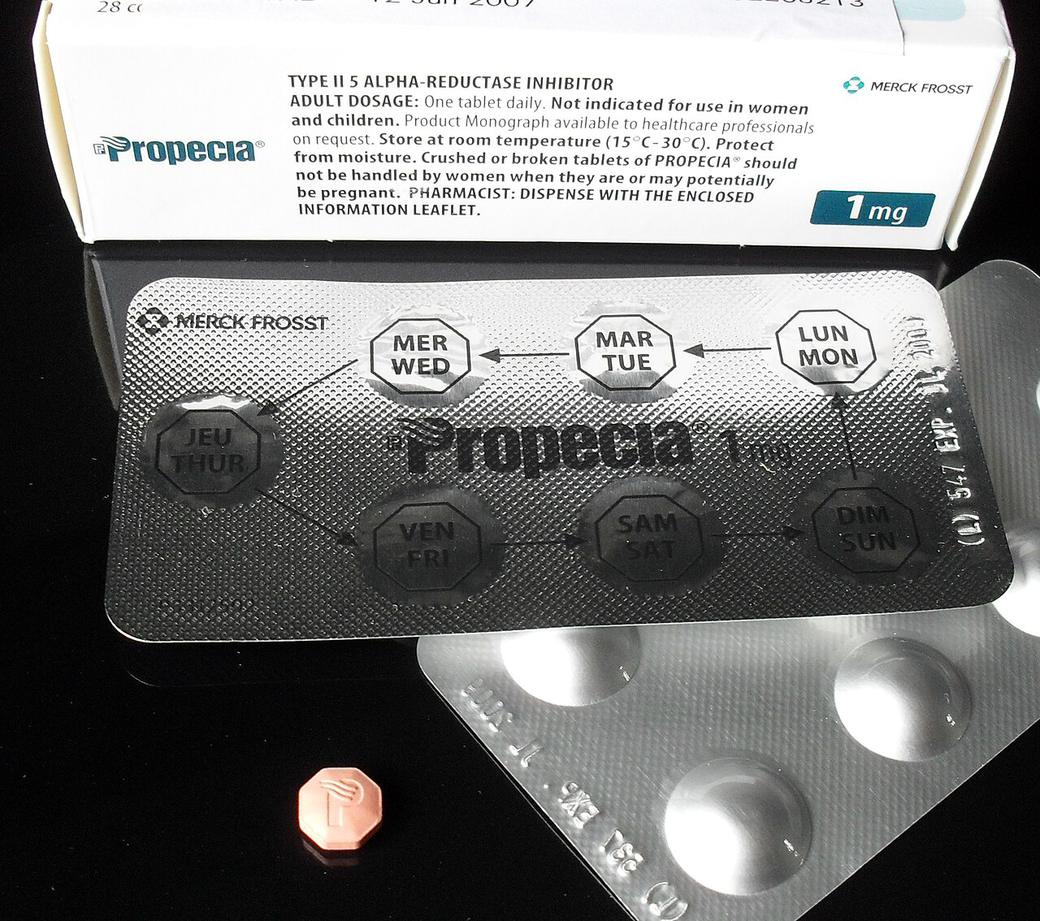
- Photo: Propecia box and tablet, Kristoferb, 2010, public domain, via Wikimedia Commons.
This information does not replace medical advice. Talk to your doctor before you make any decision about your treatment.
610+ people have joined the community.
Join them, then report your side effects.
Free. Sign up takes 2 minutes.