How long does finasteride stay in your system?
Finasteride's half-life is five to six hours, and DHT recovers in about two weeks. The UK leaflet lists sexual problems that persisted after stopping: PFS.
SIDEfxHUB is a patient charity. We are not health professionals, and this does not replace medical advice. Don't start, stop or change any medicine because of what you read here. Talk to your doctor first.
If you are in crisis:116 123 Samaritans (UK)988 Lifeline (US)Find a helpline
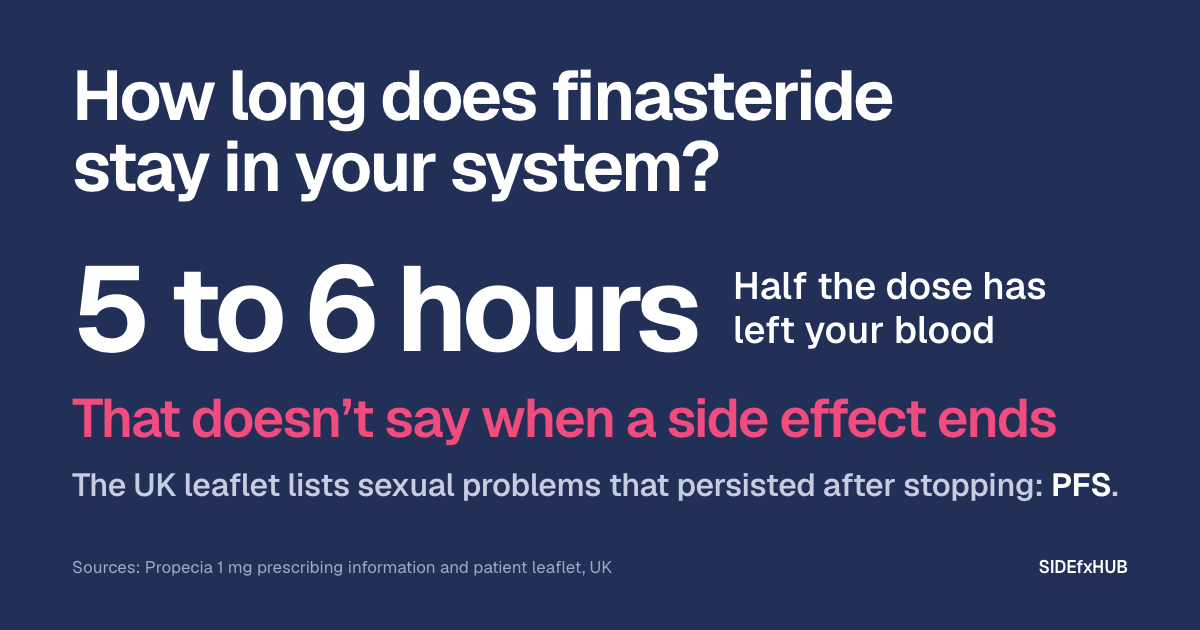
Half of each finasteride dose leaves your blood in five to six hours, and the hormone DHT recovers in about two weeks, the official documents say. Neither figure says when a side effect ends: the UK leaflet lists sexual problems that persisted after stopping, known as post-finasteride syndrome (PFS).
The NHS’s common questions page says how long finasteride takes to work, but not how long it stays in your body. If you’ve stopped and something still feels wrong, “is it out of my system?” and “have the side effects gone?” are two different questions.
The story in 3 lines
- In men aged 18 to 60, half of each finasteride dose leaves the blood in five to six hours (UK prescribing information).
- The hormone DHT stays low for longer. In healthy men, it had recovered about two weeks after a 14-day course (Proscar US label).
- The UK leaflet lists erection, sex drive and ejaculation problems that persisted after stopping. It doesn't say how long. Patients call it PFS.
Press: contact@sidefxhub.com
Nathan took finasteride twice, half a tablet each time. He thought it was going to be “super safe”, he says, and that any side effects would just stop.

He took the second half tablet at night. An hour after going to bed, he says, he woke drenched in sweat and “felt like an old man”. For about a month he could barely leave his bed. A year and four months later a lot had improved, but he still felt “hung over every day”.
How long does finasteride stay in your blood?
Hours, going by the documents. The UK prescribing information gives finasteride a half-life of about five to six hours in men aged 18 to 60, and about eight hours in men over 70. A half-life is the time it takes for the amount in your blood to halve.
So the level halves several times a day, and most of a tablet has left your blood a day later. That sum is ours: the document names no day when none is left.
The liver breaks finasteride down, and it leaves the body in urine and stools, says Propecia’s US label.
These timings are for blood. The UK prescribing information says finasteride has also been found in the fluid around the brain, where it doesn’t appear to build up, and in small amounts in semen. It gives no timings for those. If that matters to you, ask your prescriber.
How long does finasteride keep DHT low?
Longer than the drug stays in your blood. Finasteride blocks the enzyme that turns testosterone into DHT, a hormone linked to male hair loss. The label for Proscar, a 5 mg finasteride tablet, describes healthy men who took it for 14 days. It says their DHT was back to its old level about two weeks after they stopped.
Why the gap? A 1996 review found that even one dose held DHT down for days, longer than its time in the blood would suggest. It says this is probably because finasteride binds tightly to the enzyme. Propecia’s US label says that bond breaks down slowly.
That makes two clocks: hours for the drug, weeks for the hormone. What finasteride does to a blood test is in our article Does finasteride lower testosterone?
The drug, the hormone and the side effects
Can side effects last after finasteride has gone?
They can. The UK leaflet lists “persistent difficulty having an erection after discontinuation of treatment”, and the same for sex drive and ejaculation. It doesn’t say for how long.
Nobody knows yet why they last. A small Harvard study tested men with lasting sexual symptoms, typically years after their last tablet. Their blood tests gave no sign that the enzyme that makes DHT was still blocked. Their DHT was in the normal range, and the symptoms were still there.
Neither clock can tell you when a side effect will end.
In 2022, a panel of doctors and researchers published criteria for PFS. One of their markers is sexual problems still there at least three months after stopping. In the clip below, Cobi Reisman, a urologist and sexologist in the Netherlands, describes that marker and says the cause isn’t known yet.

For some people it has lasted years after stopping. Nobody knows yet who will be affected, or whether it will ease. It has been reported after short courses too, as our article on PFS after a few pills explains.
What can I do?
Finasteride helps many men keep their hair. If you have side effects, that’s a decision for you and your prescriber. The UK leaflet says that if you have low mood or depression, you should stop taking it and contact your doctor as soon as possible.
If something has lasted since you stopped, tell your GP and give your dates: “Finasteride 1 mg from May 2024, last tablet 3 February 2026. Low sex drive since March 2026.” The date of your last tablet shows your GP how long the problem has outlasted the drug.
Many people say it took time to be taken seriously. Bring the leaflet line. You can report it without a doctor agreeing.
Report it: it helps everyone
A doctor’s note helps you. A report to the medicines regulator helps everyone else: it is how patterns get noticed.
- No proof needed. A suspicion is enough, even years after stopping.
- Where: the Yellow Card scheme in the UK, MedWatch in the US.
- Use the right words. If symptoms continued after stopping, write Post 5-alpha-reductase inhibitor syndrome (MedDRA 10082430).
Our reporting guide walks you through it
What else do people ask?
Can I give blood after taking finasteride? As of September 2026, the UK blood services’ guidelines say a person must not donate if they’ve taken finasteride in the last four weeks. Their reason is pregnancy: finasteride can cause abnormal development of a male baby’s sex organs in the womb, and a donation might go to a pregnant woman. The blood service decides: tell them what you took and when.
Does dutasteride stay in your system longer? Yes, much longer. Dutasteride is a related medicine that blocks the same enzyme. Its US label says it can still be found in the blood for months after the last capsule.
Can side effects start after you stop? The 2022 criteria say that in some cases a lasting problem may only appear when the drug is stopped. The UK medicines regulator asks anyone reporting a side effect to say whether it “continued or started after treatment was stopped”. Our article on stopping finasteride covers this.
Nathan took two half tablets. Sixteen months later, he says, he still felt sick and tired. If your last tablet was long ago and something still isn’t right, read about post-finasteride syndrome and report it.
Sources
- Propecia 1 mg film-coated tablets, summary of product characteristics, electronic medicines compendium (emc), text revised 29 June 2026. Section 5.2: “Mean terminal half-life is approximately 5-6 hours in men 18-60 years of age and 8 hours in men more than 70 years of age”. Plasma clearance is approximately 165 ml/min. Of a dose, 39% was excreted in the urine as metabolites and 57% in the faeces. Finasteride “has been recovered in the cerebrospinal fluid (CSF), but the drug does not appear to concentrate preferentially to the CSF”, and “a small amount” has been detected in the seminal fluid of men taking it. Section 4.6: that amount is less than 0.001% of the 1 mg dose per ejaculation, and studies in rhesus monkeys “have indicated that this amount is unlikely to constitute a risk to the developing male foetus”. Section 4.8: post-marketing reports of “persistence of sexual dysfunction (decreased libido, erectile dysfunction and ejaculation disorder) after discontinuation of treatment”. The document gives a half-life, not a time by which the drug has fully left the blood.
- Propecia 1 mg film-coated tablets, patient information leaflet, emc, last revised May 2026. Section 4, frequency unknown: “persistent difficulty having an erection after discontinuation of treatment”, “persistent decrease in sex drive after discontinuation of treatment”, “persistent problems with ejaculation after discontinuation of treatment”. Section 2: for mood alterations such as depressed mood or depression, “stop taking Propecia and contact your doctor for further medical advice as soon as possible”.
- Proscar (finasteride 5 mg), US prescribing information, revised March 2026. DailyMed, US National Library of Medicine. Section 12.2: “In healthy male volunteers treated with PROSCAR for 14 days, discontinuation of therapy resulted in a return of DHT levels to pretreatment levels in approximately 2 weeks.” Section 12.1: finasteride “slowly forms a stable enzyme complex”; turnover from the complex “is extremely slow”. The two-week figure comes from the 5 mg tablet taken for 14 days by healthy volunteers; the label gives no recovery time for the 1 mg tablet or for longer use.
- Propecia (finasteride 1 mg), US prescribing information, revised August 2022. DailyMed. Section 12.1: “The turnover for the enzyme complex is slow” (half-life about 30 days for the type II enzyme complex). Section 12.3: “extensively metabolized in the liver”; excreted in urine and faeces as metabolites; mean terminal half-life about 5 to 6 hours in men aged 18 to 60.
- Steiner JF. Clinical pharmacokinetics and pharmacodynamics of finasteride. Clin Pharmacokinet 1996;30(1):16-27. A review: terminal half-life 4.7 to 7.1 hours; “a single dose of finasteride suppresses serum DHT levels for up to 4 days, longer than would be expected” from the half-life; “this is probably due to the high affinity that finasteride has for the 5 alpha-reductase enzyme”. The review is about finasteride as used for an enlarged prostate.
- Basaria S, Jasuja R, Huang G and colleagues. Characteristics of men who report persistent sexual symptoms after finasteride use for hair loss. J Clin Endocrinol Metab 2016;101(12):4669-80. Brigham and Women’s Hospital, Harvard Medical School. 25 men with persistent symptoms, a median of 3.5 years after their last dose, compared with 13 users without symptoms and 18 men who had never used it. Testosterone and DHT did not differ between the groups; the blood markers of the enzyme’s activity were similar too, “providing no evidence of persistent inhibition of peripheral SRD5A activity by prior finasteride use” (SRD5A is the enzyme; these markers were measured in blood). The men with symptoms had been off finasteride for at least four months. The men with symptoms had higher depression scores, and brain scans showed differences in circuits linked to sexual arousal and depression. Measured once, so it cannot show cause; the authors say the findings need confirming in larger studies. Funded in part by the Post-Finasteride Syndrome Foundation.
- Healy D, Bahrick A, Bak M and colleagues. Diagnostic criteria for enduring sexual dysfunction after treatment with antidepressants, finasteride and isotretinoin. Int J Risk Saf Med 2022;33(1):65-76. Section 5, PFS: “The problem is present for ≥3 months after stopping treatment” is an additional criterion; sexual dysfunction that clears after stopping is not PFS. Section 9: “an enduring sexual dysfunction may only appear when the drug is stopped”.
- Joint UK Blood Transfusion and Tissue Transplantation Services Professional Advisory Committee (JPAC), Whole Blood and Components Donor Selection Guidelines, Anti-androgens, edition 203, release 82, 17 September 2026. Must not donate if finasteride was “taken in the last 4 weeks”. Reason given: dutasteride and finasteride “can cause abnormal development of the sexual organs of a male baby within the womb”, and a donation may go to a pregnant woman. So donations cannot be taken from people “who may have one of these drugs in their blood”. The separate Alopecia entry accepts donors who have only used finasteride on the skin.
- Avodart (dutasteride), US prescribing information, revised October 2023. DailyMed. Section 12.3: half-life about 5 weeks; serum concentrations “remain detectable” for up to 4 to 6 months after stopping.
- MHRA, Finasteride: reminder of the risk of psychiatric side effects and of sexual side effects (which may persist after discontinuation of treatment). Drug Safety Update, volume 17, issue 9, 29 April 2024. Asks reporters to say “if a side effect continued or started after treatment was stopped”.
- NHS, Common questions about finasteride, page last reviewed 2 August 2023. Covers how long it takes to work, and says some men’s sexual side effects continued after they stopped. It does not say how long the medicine stays in the body.
- Moral Medicine, This Man Took Finasteride Twice: His Life Has Never Been the Same, interview with Nathan, 31 March 2025, 14 minutes. Half a tablet per dose at 4:47, and “super safe” at 5:04. The second dose and waking in a sweat at 5:32, and “felt like an old man” at 5:56. Bed-bound, and a month before it eased, at 6:27 to 6:57. What improved at 7:06, a year and four months off the drug at 7:35, and “hung over every day” at 10:13. Embedded from 4:43 to 7:41. His story on our site: Nathan’s story: 2 half doses of finasteride.
- ISSM International Society for Sexual Medicine, What is post finasteride syndrome, and how do you treat it?, video, 5 May 2023, three minutes. Speaker, as named on screen: Cobi Reisman, urologist and certified sexologist, the Netherlands. The three-month marker at about 0:44; the cause not known at about 1:33. Embedded to stop at 1:46. ISSM’s description says speakers give their own views, which are not necessarily the society’s.
This information does not replace medical advice. Talk to your doctor before you make any decision about your treatment.
590+ people have joined the community.
Join them, then report your side effects.
No diagnosis needed. Researchers never see your name.