Can PFS happen after a few pills?
Most reports of post-finasteride syndrome (PFS) follow months of finasteride. Some people say symptoms began after a few pills and lasted after stopping.
SIDEfxHUB is a patient charity. We are not health professionals, and this does not replace medical advice. Don't start, stop or change any medicine because of what you read here. Talk to your doctor first.
If you are in crisis:116 123 Samaritans (UK)988 Lifeline (US)Find a helpline
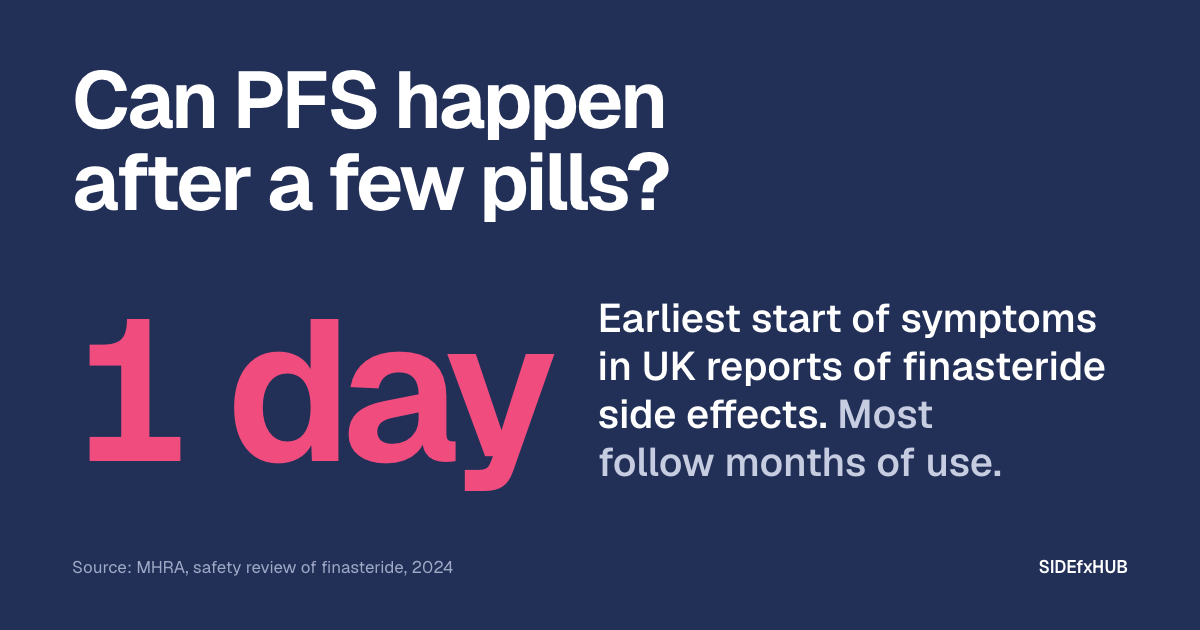
Most reports of post-finasteride syndrome (PFS) follow months of finasteride. Some people, though, say symptoms such as numbness and a low sex drive began after a few tablets and continued after they stopped.
The UK leaflet lists “persistent difficulty having an erection after discontinuation of treatment”, and it doesn’t say this takes months of use. We found no study that followed people who took only a few tablets, so the clearest picture comes from reports, and from people like Marko.
The story in 3 lines
- In UK reports of finasteride's sexual and mood side effects, symptoms began about 11 months after starting on average, and the earliest after one day (MHRA review).
- The UK leaflet lists erection, sex drive and ejaculation problems that persisted after stopping.
- The 2022 diagnostic criteria for PFS set no minimum time on the drug (criteria). Nobody has counted how often it follows a few tablets.
Press: contact@sidefxhub.com
Marko was prescribed 1 mg of finasteride a day after a brief appointment with a private dermatologist. After three days he noticed numbness, so he stopped straight away.

“The next day, I crashed,” he says. For a year he couldn’t work. Five years on he still sleeps badly and has a lower sex drive, and he compares it to “an old injury that has healed as much as it possibly can”.
Can one finasteride pill do anything?
Yes, and quickly. Finasteride blocks an enzyme that turns testosterone into DHT, a hormone linked to male hair loss. Propecia’s US label says a single 1 mg tablet cuts the DHT in your blood by about two thirds within a day.
The drug itself leaves the blood within hours. Its hold on the enzyme lasts much longer. The label says that hold breaks down slowly, over weeks.
Nobody knows yet whether this explains PFS. It does mean your hormones change from the first tablet, while the leaflet says the hair benefit can take months to show.
Can PFS start after only a few days?
Some reports say it can, though most describe longer use. The UK medicines regulator, the MHRA, reviewed its Yellow Card reports of finasteride’s sexual and mood side effects. On average, symptoms began about 11 months after people started taking it. The earliest began after one day, the latest after more than 16 years.
A 2018 study looked at reports to RxISK, a website where people report side effects. A few people with lasting sexual problems had taken finasteride, or the similar drug dutasteride, for less than two weeks.
The diagnostic criteria for PFS, published in 2022, don’t set a minimum time on the drug either.
Sumair used a finasteride spray four times. Almost straight away, he says, he felt burning in his genitals. It eased once he stopped, but after a week or so things “started to really go downhill”.

He describes genital numbness and erection problems. His sex drive has gone completely. Music, which he loved, now “does absolutely nothing” for him.
Is a short course of finasteride less risky?
It may be, but it isn’t risk-free. Researchers at Northwestern University in Chicago went through the medical records of young men on the hair-loss dose. About 12 in 1,000 who’d taken it for longer than about seven months had erection problems that lasted after stopping, against about 2 in 1,000 with shorter use.
Records only show what doctors wrote down, and this study counted only lasting erection problems.
Once problems have lasted, a shorter course may not make recovery more likely. In a 2012 US study of men whose sexual side effects carried on after stopping, how long they’d taken finasteride wasn’t linked to whether things got better.
Konrad chose a spray because he thought it was the safer option. After 10 days he noticed sexual changes and had a panic attack, so he stopped. The sexual problems and poor sleep cleared within four or five days, he says.
About three weeks after stopping, he woke with another panic attack. Then came ringing in his ears and sleepless nights. Now he has to read a page twice to remember what it says.


What can I do?
Finasteride helps many men keep their hair. If you have side effects, that’s a decision for you and your prescriber. If you feel low or have suicidal thoughts, the UK leaflet says to stop taking it and contact your doctor as soon as possible. The Samaritans are on 116 123, free, at any hour.
Write your dates down, however short the course: “Finasteride 1 mg, three tablets from 2 June 2026, last one 4 June. Numbness since 4 June.” When the MHRA reviewed its reports, only about 4 in 10 said when the symptoms began.
Many people say it took time to be taken seriously. Bring the leaflet line. You can report it without a doctor agreeing.
Report it: it helps everyone
A doctor’s note helps you. A report to the medicines regulator helps everyone else: it is how patterns get noticed.
- No proof needed. A suspicion is enough, even years after stopping.
- Where: the Yellow Card scheme in the UK, MedWatch in the US.
- Use the right words. If symptoms continued after stopping, write Post 5-alpha-reductase inhibitor syndrome (MedDRA 10082430).
Our reporting guide walks you through it
What else do people ask?
I felt odd after a few pills. Is it PFS? Not necessarily. Sexual problems that clear after stopping aren’t PFS, say the 2022 criteria. They count a problem still there three months after stopping as support for the diagnosis. Other causes, such as another medicine or a health condition, should be ruled out first.
Can symptoms start after I stop? They can. The same criteria say a lasting problem may only appear once the drug is stopped, or a mild one may get worse. Marko’s crash came the day after his last tablet. Our article on stopping finasteride explains more.
Is a spray safer for a short course? Nobody knows yet. In a 2022 trial, a spray put much less finasteride into the blood than a tablet, but some still got there. The FDA has had reports of side effects after pharmacy-made topical finasteride, and most said they continued after stopping. Our article on topical finasteride has more.
Marko took three tablets, and five years later he says he still isn’t fully back to his old self. If a short course changed something for you, report it: a report counts even years later.
Sources
- Propecia 1 mg film-coated tablets, patient information leaflet, electronic medicines compendium (emc), last revised May 2026. Section 4, under “Frequency unknown”: “persistent difficulty having an erection after discontinuation of treatment”, a persistent decrease in sex drive and persistent problems with ejaculation. None of these lines gives a length of use. Section 2: for low mood or suicidal thoughts, stop taking it and contact your doctor as soon as possible. Section 3: the full effect on hair may take 3 to 6 months.
- Propecia (finasteride), US prescribing information, DailyMed, US National Library of Medicine. Section 12.2: serum DHT falls by 65% within 24 hours of a 1 mg tablet. Section 12.1: “The turnover for the enzyme complex is slow” (half-life about 30 days for the type II enzyme complex). Section 12.3: plasma half-life about 5 to 6 hours in men aged 18 to 60. Section 6.2: post-marketing reports of sexual dysfunction that continued after stopping.
- MHRA, Safety review of finasteride: public assessment report, April 2024. Section 5.2: Yellow Card reports up to 5 January 2023 of finasteride with sexual dysfunction (375) or depressed mood and suicidal behaviour (231). Time to onset was recorded in 252 reports (42%): average 330 days (about 10.8 months), range 1 to 5,923 days. The report covers the MHRA’s review of the safety data in 2023.
- Healy D, Bahrick A, Bak M, et al. Diagnostic criteria for enduring sexual dysfunction after treatment with antidepressants, finasteride and isotretinoin. International Journal of Risk & Safety in Medicine, 2022; 33(1): 65–76. Section 5: the necessary criteria for PFS are prior treatment with a 5-alpha-reductase inhibitor and enduring sexual dysfunction after stopping, with no minimum length of treatment. A problem present 3 months or more after stopping is an additional criterion; other causes must be ruled out; sexual dysfunction that clears after stopping is not PFS. Section 9: a lasting problem may only appear when the drug is stopped, or a mild one may worsen on stopping.
- Healy D, Le Noury J, Mangin D. Enduring sexual dysfunction after treatment with antidepressants, 5α-reductase inhibitors and isotretinoin: 300 cases. International Journal of Risk & Safety in Medicine, 2018; 29(3–4): 125–134. Reports to RxISK.org; 25 involved finasteride (24) or dutasteride (1). Where the length of treatment was known (226 reports), it ranged from a single dose to over 16 years. Three people on finasteride or dutasteride reported less than two weeks of treatment. Self-selected reports, with no comparison group.
- Kiguradze T, Temps WH, Yarnold PR, et al. Persistent erectile dysfunction in men exposed to the 5α-reductase inhibitors, finasteride, or dutasteride. PeerJ, 2017; 5: e3020. Northwestern Medicine electronic records. Men aged 16 to 42 on finasteride 1.25 mg a day or less: 34 of 4,284 had erectile dysfunction that lasted at least 90 days after stopping and was treated with a PDE5 inhibitor. With more than 205 days of use: 30 of 2,587 (1.16%). With 205 days or fewer: 4 of 1,697 (0.24%), calculated from table 3C.
- Irwig MS. Persistent sexual side effects of finasteride: could they be permanent? Journal of Sexual Medicine, 2012; 9(11): 2927–32. 54 men whose sexual side effects had lasted at least 3 months after stopping were reassessed 9 to 16 months later. Neither the length of finasteride use nor how long the side effects had lasted correlated with changes in their sexual dysfunction scores.
- Piraccini BM, Blume-Peytavi U, Scarci F, et al. Efficacy and safety of topical finasteride spray solution for male androgenetic alopecia: a phase III, randomized, controlled clinical trial. Journal of the European Academy of Dermatology and Venereology, 2022; 36(2): 286–294. Peak blood levels of finasteride more than 100 times lower with the spray than the tablet; serum DHT fell by 34.5% with the spray and 55.6% with the tablet.
- US Food and Drug Administration, FDA alerts health care providers, compounders and consumers of potential risks associated with compounded topical finasteride products, 22 April 2025. Compounded (pharmacy-made) topical products only: 32 reports from 2019 to 2024; most said the side effects continued after stopping.
- Moral Medicine interviews on YouTube. Marko, 9 March 2026: the brief private dermatology appointment at 0:48, three days at 1:01, “The next day, I crashed” at 1:16, a year unable to work at 1:26, not fully back to his old self and “an old injury” at 1:36, sleep and libido at 2:50. Sumair, 6 April 2023: four applications and the burning at 3:34, “started to really go downhill” at 4:43, no libido at 8:12, music at 9:38. Konrad, 4 August 2025: the spray chosen as safer at 2:41, memory at 3:38, “invisible glass” at 4:11, 10 days at 6:28. Sexual changes and a panic attack at 7:42, the sexual problems and insomnia gone after four or five days at 7:59, another panic attack about three weeks after stopping at 8:20, tinnitus and insomnia from 8:53, three months and two weeks off it at 10:15. Their stories on our site: Marko, Sumair, Konrad.
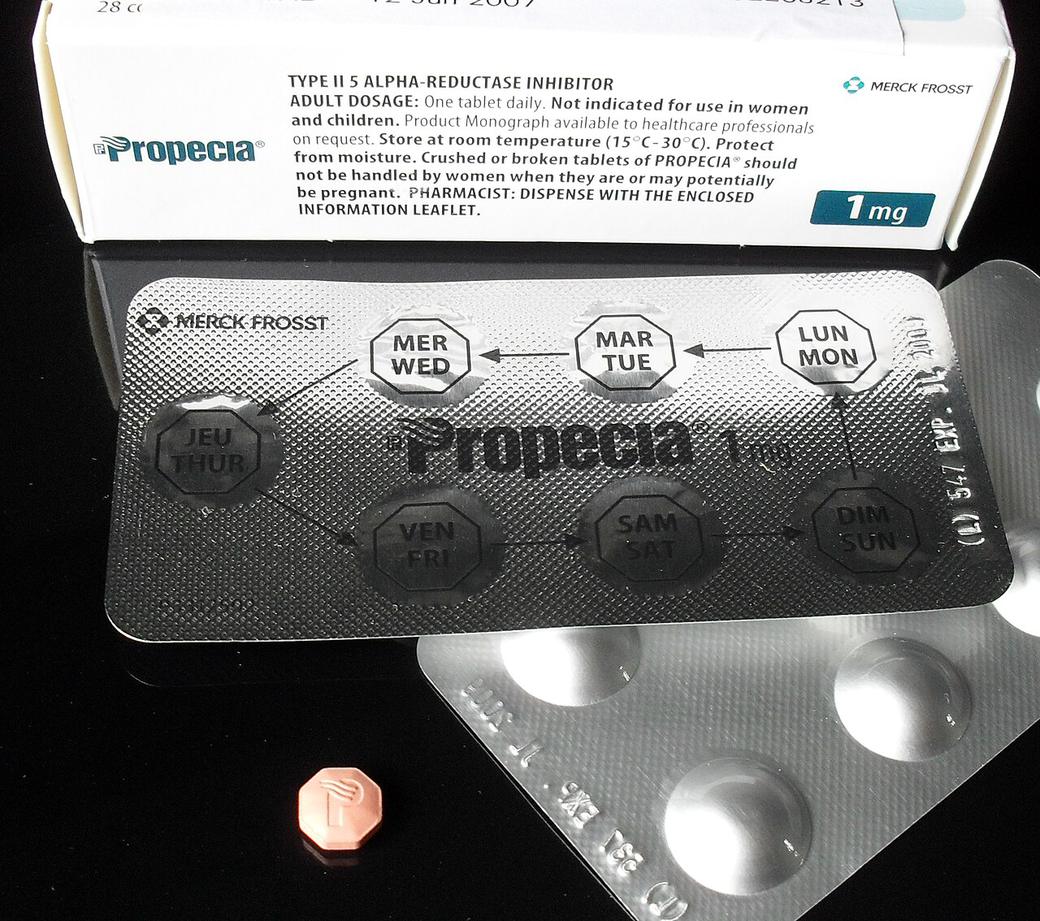
- Photo: Propecia box and tablet, Kristoferb, 2010, public domain, via Wikimedia Commons.
This information does not replace medical advice. Talk to your doctor before you make any decision about your treatment.
590+ people have joined the community.
Join them, then report your side effects.
No diagnosis needed. Researchers never see your name.