PSSD and PFS codes: MedDRA and ICD
PSSD and PFS each have a MedDRA term for side effect reports. In October 2026 we found neither by name in ICD-10 or ICD-11. PAS has no MedDRA term yet.
SIDEfxHUB is a patient charity. We are not health professionals, and this does not replace medical advice. Don't start, stop or change any medicine because of what you read here. Talk to your doctor first.
If you are in crisis:116 123 Samaritans (UK)988 Lifeline (US)Find a helpline
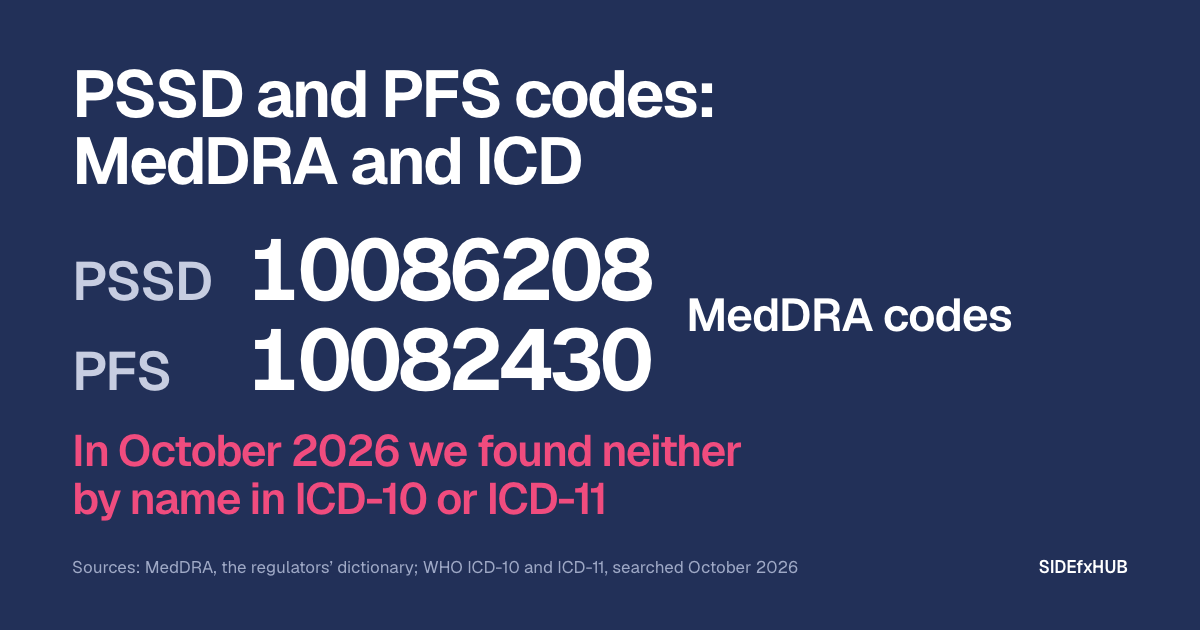
PSSD and post-finasteride syndrome (PFS) each have a term in MedDRA, the dictionary regulators use to file side effect reports: 10086208 for PSSD and 10082430 for PFS. In October 2026 we found neither by name in ICD-10 or ICD-11, and post-Accutane syndrome (PAS) has no MedDRA term yet.
All three are names for symptoms that continue after stopping a medicine: an SSRI or SNRI antidepressant, finasteride or isotretinoin (Accutane). ICD is the list of codes for diseases and injuries kept by the WHO, the UN’s health agency, and a code is how a condition gets counted.
The story in 3 lines
- MedDRA has had the term Post-SSRI sexual dysfunction since 2021. The UK regulator records a report as PSSD only if the reporter used it (UK government, 2025).
- The PFS term, Post 5-alpha-reductase inhibitor syndrome, is in use: the US regulator's public data lists reports under it (FDA data).
- We found no entry for PSSD, PFS or PAS by name in the WHO's ICD-10 or ICD-11, as of October 2026 (ICD-11).
Press: contact@sidefxhub.com
Francis is a nurse practitioner in the US who’d had PSSD for nine years when he was interviewed. He sees the code lists from both sides.

“We still don’t have an ICD-10 code for it,” he says. So he can’t diagnose a patient with it, he explains, and what can’t be tracked can’t be recognised. In October 2026 we found no ICD entry for PSSD by name. MedDRA has one.
What are the MedDRA codes for PSSD and PFS?
PSSD is 10086208 and PFS is 10082430. Side effect reports are filed under MedDRA’s terms, and those terms are what gets counted.
The PSSD term is Post-SSRI sexual dysfunction. It was added in September 2021, and the UK’s Yellow Card reporting form has offered it since February 2022, the government told Parliament in 2025.
A report is recorded as PSSD only if the reporter used the term, the same answer says. Our guide to reporting PSSD on a Yellow Card shows where to pick it.
For PFS, MedDRA doesn’t use the patients’ name. The term is Post 5-alpha-reductase inhibitor syndrome, after the family of medicines finasteride and dutasteride belong to.
The FDA is the US regulator. Its public data held about 250 reports under the PFS term as of July 2026. That counts reports, not people: a report is a suspicion someone sent in, and it can’t show how often something happens. Our guide to reporting finasteride side effects to the FDA shows where to write the term.
A search of the same US data for the PSSD term finds no match. The field searched holds one level of the dictionary, which MedDRA calls “preferred terms”, and the PFS term is one. The UK answer calls the PSSD term a “lower-level term”: a more specific wording, linked to a preferred term.
Does post-Accutane syndrome have a MedDRA code?
Not yet. PAS is the name patients use for problems that last after isotretinoin, and it has no MedDRA term yet.
A 2018 paper described 300 cases of lasting sexual problems after antidepressants, 5-alpha-reductase inhibitors and isotretinoin. More detailed studies, its authors wrote, would need “coding systems that recognise the condition(s)”.
MedDRA is updated twice a year, and its users, who include regulators and drug companies, can propose new terms, the UK government’s answer says. MedDRA’s own training film says nearly all new terms start as a user’s request, which a panel of doctors reviews.

Until there’s a term, a report about isotretinoin has to name each symptom and say it continued after stopping. Our guide to reporting isotretinoin side effects shows how.
Three conditions and their codes, October 2026
Is there an ICD-10 or ICD-11 code for PSSD or PFS?
We found none, as of October 2026. We searched the WHO’s ICD-10 and ICD-11 and the US edition, ICD-10-CM, and found no entry for any of the three by name.

Orphanet, a rare disease database, ties two of them to a code. It lists PSSD and PFS, and gives each the ICD-10 code F52.8, “Other sexual dysfunction, not caused by organic disorder or disease”.
Orphanet’s coding data says the code is “assigned by Orphanet” and marks the link “Not yet validated”. It gives no ICD-11 code for either. We found no Orphanet entry for PAS.
ICD-11, the newest edition, has a code for sexual problems that gives SSRIs as an example. It applies when a medicine’s direct effects are “an important contributing factor”. Its description doesn’t mention problems that continue after stopping.
What can I do?
These medicines help many people. If you still take one and have side effects, that’s a decision for you and your prescriber. Don’t stop an antidepressant suddenly. For finasteride and isotretinoin, follow what the leaflet says.
If you think you have one of these conditions, tell your GP and give your dates. Many people say it took time to be taken seriously. Bring the leaflet’s sentence on sexual problems that continued after stopping: the UK leaflets we checked for an SSRI, finasteride and isotretinoin each have one. You can report it without a doctor agreeing.
Report it: it helps everyone
A doctor’s note helps you. A report to the medicines regulator helps everyone else: it is how patterns get noticed.
- No proof needed. A suspicion is enough, even years after stopping.
- Where: the Yellow Card scheme in the UK, MedWatch in the US.
- Use the right words. If symptoms continued after stopping, write Post-SSRI sexual dysfunction (MedDRA 10086208) for an SSRI or SNRI, or Post 5-alpha-reductase inhibitor syndrome (MedDRA 10082430) for finasteride. For isotretinoin there’s no term yet, so say the symptoms continued after stopping.
Our reporting guide walks you through it
What else do people ask?
Does a code mean the condition is officially recognised? The documents treat a code and recognition as separate things. In 2025 the UK government said the PSSD term “will help with the recording and retrieval” of reports, and that clinical recognition of PSSD is “outside the remit of the MHRA”, its medicines regulator. MedDRA says the most important reason to code data “is to analyse it”. See Is PSSD real?, Is post-Accutane syndrome real? and what regulators say about PSSD.
Is there an NHS code for PSSD? There’s one in SNOMED, which the UK government calls “the electronic health records system”. Persistent sexual dysfunction after stopping an SSRI was added to it in October 2024, the same answer says. The answer covers PSSD only.
Is the MedDRA code the same in every language? Yes. MedDRA says every term has a unique 8-digit code, and the same code goes with the translated term in each of its languages. In French the PSSD term is Dysfonction sexuelle après ISRS, still 10086208.
Francis asks how anyone can fix what isn’t being tracked. Side effect reports can now be tracked by name for PSSD and PFS. If one of them is yours, report it and use the term.
Sources
- UK Parliament, written question HL11843, asked by Lord Alton of Liverpool on 12 November 2025 and answered by Baroness Merron on 25 November 2025. The MHRA “uses the Medical Dictionary for Regulatory Activities (MedDRA) to code suspected adverse drug reactions”; MedDRA is “used by regulatory authorities and the biopharmaceutical industry”, “is updated twice annually, and new terms can be proposed by any MedDRA users”. The PSSD term was added “as a lower-level term in version 24.1” and made available on the Yellow Card website in February 2022. “PSSD is recorded if the reporter has specifically used this term at the time of the report”; earlier reports are not recoded.
- MedDRA, support documentation, read 12 October 2026. It lists version 24.1 as September 2021 and the latest version, 29.1, as September 2026. Three more MedDRA pages were read the same day. Hierarchy: “Lowest Level Terms” are the most specific level and “reflect how an observation might be reported in practice”. “Each LLT is linked to only one PT” (Preferred Term). Languages: “All MedDRA terms are assigned a unique, 8-digit numeric code; the code is assigned to the translated term in each MedDRA language”. Basics: “The most important reason to ‘code’ data into a standardised terminology is to analyse it.”
- MedDRA terms as listed in our reporting data: Post-SSRI sexual dysfunction (10086208) and Post 5-alpha-reductase inhibitor syndrome (10082430). The level of each term is given only as a document shows it: source 1 for PSSD, source 4 for PFS. There is no term yet for lasting effects after isotretinoin. We could not confirm at a MedDRA source which version added the PFS term.
- US Food and Drug Administration, openFDA drug adverse event data, searched 12 October 2026 (data last updated 30 July 2026). 254 reports carry the reaction term Post 5-alpha-reductase inhibitor syndrome. The same search for Post-SSRI sexual dysfunction returns “No matches found!”. The field searched, reactionmeddrapt, is defined in the reporting standard the FDA uses (ICH E2B) as the “Reaction/event MedDRA term (PT)”, the preferred term. The FDA’s notes on the data say a causal relationship “cannot be established” from a report and that the data “cannot be used to estimate the incidence of these events”; its dashboard questions and answers say there are duplicate reports.
- Healy D, Le Noury J, Mangin D. Enduring sexual dysfunction after treatment with antidepressants, 5α-reductase inhibitors and isotretinoin: 300 cases. Int J Risk Saf Med 2018;29(3-4):125-134. Cases were reports to RxISK.org, “a global adverse event reporting website”.
- WHO, ICD-10 Version:2019, searched 12 October 2026 for PSSD, post-SSRI, post-finasteride, finasteride, 5-alpha-reductase inhibitor, post-Accutane and retinoid: “No results found”. F52.8 is “Other sexual dysfunction, not caused by organic disorder or disease”.
- WHO, ICD-11 for Mortality and Morbidity Statistics, 2026-01 release, searched 12 October 2026 for PSSD, post-SSRI sexual dysfunction, post-finasteride syndrome, 5-alpha-reductase inhibitor syndrome and post-Accutane syndrome: no matching entities. HA40.2, “Aetiological considerations associated with use of psychoactive substance or medication”, is assigned when a medicine’s direct effects are “an important contributing factor” to a sexual dysfunction; “Examples include selective serotonin reuptake inhibitors”.
- US Centers for Disease Control and Prevention, ICD-10-CM files for fiscal year 2027, in force from 1 October 2026, searched 12 October 2026 through the CDC’s own ICD-10-CM browser. We found no code title or index entry that names PSSD, PFS or PAS. The list has general codes, such as T43.225, “Adverse effect of selective serotonin reuptake inhibitors”, and N52.2, “Drug-induced erectile dysfunction”. We found no official document that says which code to use for these conditions.
- Orphanet, Post-selective serotonin reuptake inhibitor sexual dysfunction (ORPHA:686475) and Post 5-alpha-reductase inhibitors treatment syndrome (ORPHA:686468), read 12 October 2026, with Orphanet’s coding data dated 2 July 2026. For both: ICD-10 F52.8; “Attributed code (ICD-10/ICD-11: The targeted code is assigned by Orphanet)”; “ORPHAcode is narrower than the targeted code used to represent it”; “Not yet validated”. No ICD-11 code is given for either. A name search found no entry for lasting effects after isotretinoin.
- UK Parliament, written question HL7363, asked by Lord Alton of Liverpool on 12 May 2025 and answered by Baroness Merron on 16 May 2025. The term “will help with the recording and retrieval of Yellow Card data”. “Persistent sexual dysfunction following withdrawal of an SSRI as a disorder was added to the electronic health records system, known as SNOMED, in October 2024”. Clinical recognition is “outside the remit of the MHRA”.
- Moral Medicine, Nurse Practitioner Speaks Out on PSSD, interview with Francis, 11 August 2025 (70 minutes), embedded here as an extract from 10:50 to 11:03. His story on our site: Francis’s story: a nurse practitioner on PSSD.
- MedDRA MSSO, What is MedDRA and How is it Used?, training webinar, 1 May 2026, embedded here as an extract from 50:44 to 51:49.
- WHO, Release of International Classification of Diseases. ICD-11, 18 June 2018.
- UK patient leaflets on the Electronic Medicines Compendium, read 12 October 2026. Cipralex (escitalopram, an SSRI), last revised May 2025: “In some cases, these symptoms have continued after stopping treatment.” Propecia (finasteride 1 mg), last revised May 2026: “persistent difficulty having an erection after discontinuation of treatment”. Roaccutane (isotretinoin), last revised April 2026: “There have been reports of long-lasting sexual problems where the symptoms have continued despite stopping treatment with isotretinoin.”
This information does not replace medical advice. Talk to your doctor before you make any decision about your treatment.
590+ people have joined the community.
Join them, then report your side effects.
No diagnosis needed. Researchers never see your name.