PSSD or withdrawal: what's the difference?
Withdrawal symptoms like brain zaps usually last a few weeks, the NHS says. Sexual problems that stay after stopping an SSRI have another name: PSSD.
SIDEfxHUB is a patient charity. We are not health professionals, and this does not replace medical advice. Don't start, stop or change any medicine because of what you read here. Talk to your doctor first.
If you are in crisis:116 123 Samaritans (UK)988 Lifeline (US)Find a helpline
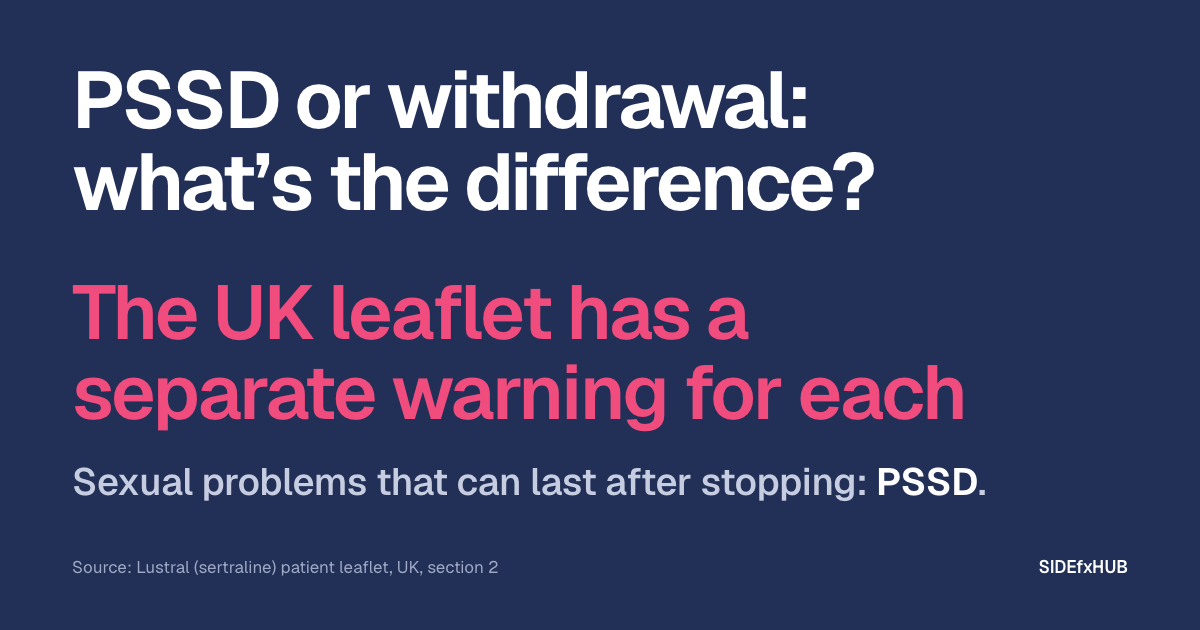
Withdrawal symptoms such as dizziness and brain zaps start when an SSRI is reduced or stopped, and the NHS says they usually last a few weeks. Sexual problems that can last after stopping have their own warning in the UK leaflet, and a name: post-SSRI sexual dysfunction, or PSSD.
The two can arrive together, and the word “withdrawal” gets used for both. Knowing what each means helps you tell your GP what changed, and report it.
The story in 3 lines
- Withdrawal symptoms usually last a few weeks, says the NHS. For some people they can last months or longer.
- The UK sertraline leaflet has a separate warning: sexual problems “have continued after stopping treatment” in some cases.
- In 2019 the EU medicines regulator asked for that warning on every SSRI and SNRI. Patients call it PSSD.
Press: contact@sidefxhub.com
Francis is a nurse practitioner in the US. He took sertraline (Zoloft) for a couple of months. Sex changed while he was on it: he couldn’t reach orgasm, and he says, “I was numb.”

Coming off brought something else, three weeks of brain zaps: “It’s like a lightning bolt hits you in the head,” he says. Then the zaps went. The sexual problems eased a little, but nine years later he says, “I’ve never been the same.”
What is antidepressant withdrawal?
It’s what coming off an antidepressant can bring: dizziness, feeling sick, sleep problems, or a jolt like an electric shock in the head, the brain zap. All are on the NHS list of withdrawal symptoms.
Francis’s zaps came at work. He also felt sick, worn out and close to fainting. “That was withdrawal,” he says.
Withdrawal usually begins within a few days of starting to come off and lasts a few weeks, the NHS says. For some people, it adds, symptoms can be severe, start weeks or months later, and last for months or longer.
Nobody can yet predict who that will be, says the Royal College of Psychiatrists. So there’s no date by which withdrawal is supposed to be over.
Katie Thistleton, a BBC Radio 1 presenter, came off her antidepressant and talked about it in a 2023 film. “I cannot go through this withdrawal again,” she says. Nearly four months after stopping, she was having panic attacks at night.

How is PSSD different from withdrawal?
PSSD is about sex. The problems can start while the tablets are still being taken, say the doctors and researchers who wrote the 2022 criteria for PSSD. Francis’s started on sertraline. They’re the part that stayed.
The criteria insist on one thing: a lasting change in how the genitals feel, such as numbness, after the medicine is stopped. Brain zaps and dizziness aren’t on their list.
The UK sertraline leaflet keeps them apart too. “Withdrawal reactions” is one warning. “Sexual problems” is another, and it says that in some cases these symptoms “have continued after stopping treatment”.
In 2019 the EU medicines regulator asked for a warning on every SSRI and SNRI. Its heading was “Persistent sexual dysfunction after drug withdrawal”.
There, “withdrawal” just means stopping the medicine. No wonder the two get mixed up.
For some people PSSD has lasted years after stopping. Nobody knows yet who will be affected, or whether it will ease.
Francis has taken other medicines in the years since. Sertraline, he says, is what started it.
Can withdrawal cause sexual problems too?
One study counted them as withdrawal symptoms. In that 2020 study of forum posts about long withdrawal, two of the 69 people mentioned sexual symptoms. The NHS list of withdrawal symptoms doesn’t mention sex.
The doctors behind the PSSD criteria see overlap too. Ordinary sexual side effects can linger “for some days or weeks” after the last tablet, they say. Sexual problems can also first appear, or get worse, once the medicine is stopped.
The sertraline leaflet lists “numbness” among the things stopping suddenly can bring. It doesn’t say where.
So in the first weeks, not every symptom fits one box. Once sexual problems have lasted three months after stopping, the criteria say it’s more likely to be PSSD. More in do SSRI sexual side effects go away? and no sex drive after stopping antidepressants.
Coming off an SSRI: what the sources say
What can I do?
These medicines help many people. If you have side effects, that’s a decision for you and your prescriber. Don’t stop suddenly.
You don’t need to know which one it is before you see your GP. Write down what changed and when:
- Your medicine: “Sertraline 50 mg from January 2023, last tablet March 2024.”
- What began when you came off: “Brain zaps and dizziness since the week after my last tablet.”
- What changed in sex, and when: “Touch has felt numb since spring 2023, while I was still taking it.”
- How it was before: “No problems before 2023.”
Many people say it took time to be taken seriously. Bring the leaflet line. You can report it without a doctor agreeing.
Withdrawal can be reported too: the NHS says the Yellow Card scheme takes any suspected side effect. If low mood is part of it, read PSSD or depression: how to tell.
Report it: it helps everyone
A doctor’s note helps you. A report to the medicines regulator helps everyone else: it is how patterns get noticed.
- No proof needed. A suspicion is enough, even years after stopping.
- Where: the Yellow Card scheme in the UK, MedWatch in the US.
- Use the right words. If symptoms continued after stopping, write Post-SSRI sexual dysfunction (MedDRA 10086208).
Our reporting guide walks you through it
What else do people ask?
Are brain zaps a sign of PSSD? They’re on the NHS list of withdrawal symptoms, and the PSSD criteria don’t list them. You can have both at once, as Francis did: zaps from coming off, and sexual problems that began earlier.
What is protracted withdrawal? It’s a name some researchers use for withdrawal that carries on long after the first weeks. The NHS page doesn’t use the term. In the 2020 study, some people described symptoms that had gone on for years.
Is a PSSD “crash” the same as withdrawal? “Crash” is patients’ word for symptoms that arrive, or get sharply worse, after stopping or cutting down an SSRI. It isn’t a medical term, and it can cover either. We describe it in understanding the PSSD crash.
Francis’s brain zaps were gone in three weeks. Nine years on, he says he has never been the same. If sex has felt different since your last tablet, you can report it without knowing what to call it.
Sources
- NHS, Antidepressants, page last reviewed 12 June 2025. “Withdrawal symptoms of antidepressants”: the list of symptoms, including feeling like “an electric shock in your head (sometimes described as ‘brain zaps’)”. “How long antidepressant withdrawal symptoms last”: they “usually begin within a few days of starting to come off antidepressants and last for a few weeks”; for some people they can be severe, “start weeks or months later, and last for months or longer”. Side effects: problems with sex “may carry on after stopping antidepressants” for some people. “You can report any suspected side effect using the Yellow Card safety scheme.”
- Royal College of Psychiatrists, Stopping antidepressants, published March 2024. Citing NICE: for some, withdrawal symptoms “can be mild and go away relatively quickly”; other people “can have more severe symptoms which last much longer (sometimes months or more than a year)”. “At the moment we cannot predict who will get the more serious withdrawal symptoms.”
- Lustral (sertraline) 50 mg and 100 mg film-coated tablets, patient leaflet, Viatris, Electronic Medicines Compendium (EMC 2835), last revised December 2025. Section 2, “Withdrawal reactions”: such symptoms in general “wear off within 2 weeks”, and in some patients “may last longer (2-3 months or more)”. Section 2, “Sexual problems”: “In some cases, these symptoms have continued after stopping treatment.” Section 3, “If you stop taking Lustral”: “dizziness, numbness, sleep disturbances, agitation or anxiety, headaches, feeling sick, being sick and shaking”.
- European Medicines Agency, PRAC, recommendations on signals adopted at the 13-16 May 2019 PRAC meeting, EMA/PRAC/265212/2019, section 1.3, “Persistent sexual dysfunction after drug withdrawal”, adopted 16 May 2019. Warning text for six SSRIs and four SNRIs.
- Healy D, Bahrick A, Bak M and colleagues. Diagnostic criteria for enduring sexual dysfunction after treatment with antidepressants, finasteride and isotretinoin. Int J Risk Saf Med 2022;33(1):65-76. An expert consensus. The necessary criterion is an enduring change in genital sensation after treatment stops. Ordinary sexual side effects “may linger for some days or weeks”; once dysfunction lasts three months, “it is more likely to be PSSD”. “In some cases, an enduring sexual dysfunction may only appear when the drug is stopped, or a mild dysfunction on treatment may worsen on stopping.”
- Hengartner MP, Schulthess L, Sorensen A, Framer A. Protracted withdrawal syndrome after stopping antidepressants: a descriptive quantitative analysis of consumer narratives from a large internet forum. Ther Adv Psychopharmacol 2020;10:2045125320980573. 69 reports from a peer support forum, with symptoms lasting beyond six weeks; duration from 5 to 166 months. Persistent sexual symptoms were mentioned by two people. The authors note that people may have left out sensitive symptoms. Forum posts: a count of what people wrote, not a rate.
- Moral Medicine, interview with Francis, 11 August 2025. His story on our site: Francis’s story: a nurse practitioner on PSSD.
- BBC News, Antidepressants: Should we talk about side-effects?, 11 August 2023.
- MedDRA lowest level term Post-SSRI sexual dysfunction, code 10086208.
This information does not replace medical advice. Talk to your doctor before you make any decision about your treatment.
590+ people have joined the community.
Join them, then report your side effects.
No diagnosis needed. Researchers never see your name.