PSSD or depression? How to tell
Depression can lower sex drive. Genital numbness that began on an SSRI and stayed after stopping, once your mood lifted, is the key sign of PSSD.
SIDEfxHUB is a patient charity. We are not health professionals, and this does not replace medical advice. Don't start, stop or change any medicine because of what you read here. Talk to your doctor first.
If you are in crisis:116 123 Samaritans (UK)988 Lifeline (US)Find a helpline
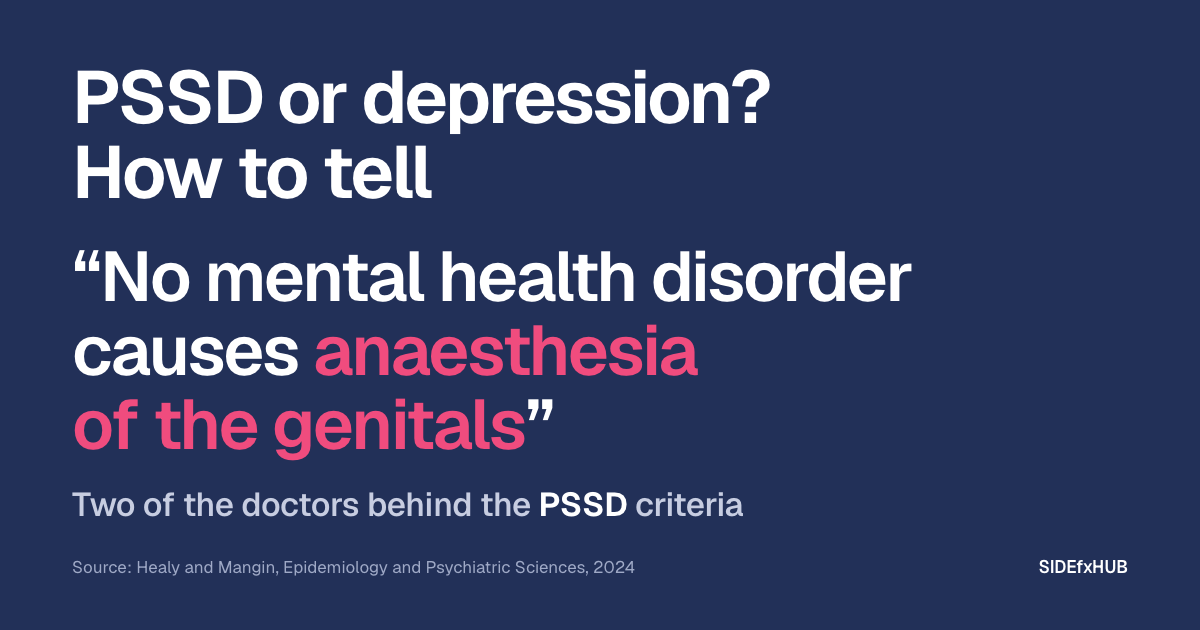
Depression often lowers sex drive, but researchers say it doesn’t cause genital numbness. Numbness that began on an SSRI and stayed after stopping, even once your mood lifted, is the key sign of post-SSRI sexual dysfunction, or PSSD, which UK leaflets warn about.
Your doctor may say it’s the depression, and some psychiatrists do think so. Knowing what sets the two apart helps you explain what changed, and when.
The story in 3 lines
- Depression often lowers sex drive. In one study, nearly half of people with depression who weren't on an antidepressant had less interest in sex.
- The UK sertraline leaflet warns that sexual problems “have continued after stopping treatment” in some cases.
- The researchers who wrote the PSSD criteria say lasting changes in genital feeling “seem distinctive to PSSD” (criteria).
Press: contact@sidefxhub.com
Anthony was prescribed sertraline (Zoloft) for mild insomnia. He took 11 tablets of 25 mg in all.
Within days, he says, his feelings went numb, and so did his genitals. The genital numbness stayed after he stopped. He’d taken the tablets to help him sleep. Had he taken them for depression, the same numbness would have been easy to put down to the illness.
Can depression cause sexual problems?
Yes, and mostly it lowers desire, says a 2026 paper by New Zealand’s medicines regulator. The NHS list of depression symptoms includes “low sex drive (loss of libido)”. It says nothing about numbness.
It shows up without any tablets, too. In a Canadian study of people with depression who weren’t on medication, nearly half had less interest in sex.
So some psychiatrists start there. “I think it’s depression recurring. Until proven otherwise, that’s what it is,” Dr Anita Clayton, then chief of psychiatry at the University of Virginia, told the New York Times in 2023. She did some of the earliest research showing that SSRIs often cause sexual side effects.
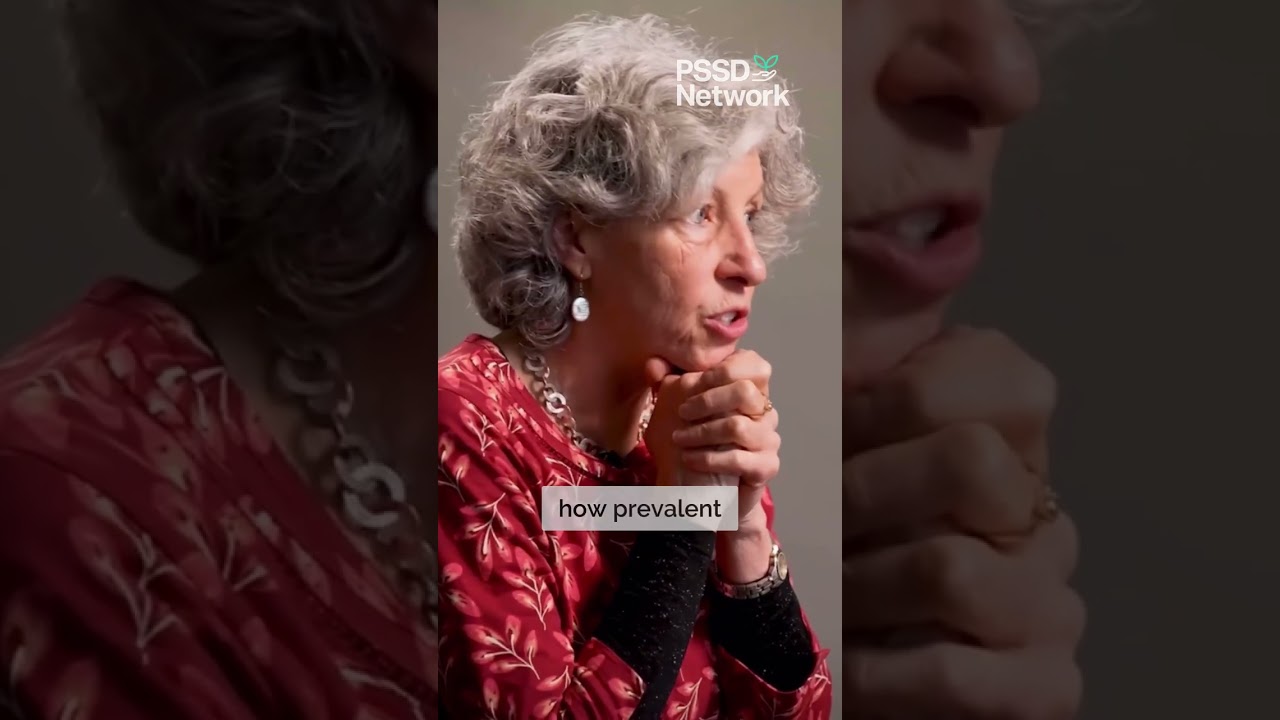
Others think PSSD is being missed. Joanna Moncrieff, a professor of psychiatry at UCL, says lasting sexual problems have been reported for months and even years after these medicines. Many doctors may not know about them, she says.
How is PSSD different from depression?
PSSD changes how the genitals feel. Some people say it’s as if they’d had an anaesthetic there. Others say touch still registers, but feels no different from being touched anywhere else.
That change in feeling is the one symptom the 2022 criteria for PSSD require. “No mental health disorder causes anaesthesia of the genitals,” write two of the doctors behind them, David Healy and Dee Mangin.
In one survey of people from a PSSD forum, numbness showed no link with how depressed people were. Orgasms with little pleasure did, so they’re less help in telling the two apart.
Numbness is easy to leave out. People don’t always mention it unless they’re asked, Healy and Mangin note, so say it even if your GP only asks about desire. Our article on genital numbness after SSRIs describes it in more detail.
Is it my depression or the antidepressant?
Timing is the second clue. Look at three stretches of time.
How was sex? Low desire that was already there may be the depression.
Did your genitals start to feel different? A change in feeling points towards the medicine.
Did it stay, even once your mood lifted? The PSSD criteria look for three months or more.
The criteria also ask that the problem wasn’t there before the medicine. For some people, that’s easy to see.
In reports to Lareb, the Dutch side effects centre, several people said their depression had lifted but their sex life hadn’t recovered. “I’ve had depression before (without medication) and then my libido was good,” one woman wrote. New Zealand’s regulator, looking back at those reports, said such cases “may point towards a medicine cause”.
It isn’t always clear-cut. PSSD can flatten feelings too, which looks a lot like depression. The criteria list emotional numbing as a symptom, and say it often goes with the genital kind.
What can I do?
These medicines help many people. If you have side effects, that’s a decision for you and your prescriber. Don’t stop suddenly.
Write down your timeline before you see your GP, so they can see what changed and when:
- Your medicine: “Sertraline 50 mg from January 2023, last tablet March 2024.”
- What changed: “Touch feels numb”, “orgasm with no pleasure”.
- When it started: before, while taking it, or after stopping.
- How it was before, and your mood now: “No problems before 2023. My mood has been good since last summer.”
- What else they will ask about: other medicines, contraception, alcohol, diabetes, the menopause.
Our guide to how PSSD is diagnosed explains the criteria.
Many people say it took time to be taken seriously. Bring the leaflet line: sexual problems “have continued after stopping treatment” in some cases. You can report it without a doctor agreeing.
Report it: it helps everyone
A doctor’s note helps you. A report to the medicines regulator helps everyone else: it is how patterns get noticed.
- No proof needed. A suspicion is enough, even years after stopping.
- Where: the Yellow Card scheme in the UK, MedWatch in the US.
- Use the right words. If symptoms continued after stopping, write Post-SSRI sexual dysfunction (MedDRA 10086208).
Our reporting guide walks you through it
What else do people ask?
Can I have depression and PSSD at the same time? Yes. A current mental health diagnosis “does not prevent” a diagnosis of PSSD, the criteria say. The link can run the other way too: a 2012 review found that people with sexual problems were more likely to become depressed later. So feeling low now doesn’t settle the question.
Is low libido after stopping always PSSD? No. Low desire on its own has many causes, such as depression, stress, hormones or other medicines, and your GP may check for them. The change PSSD requires is in genital feeling. Lost desire supports the diagnosis, but isn’t enough on its own.
Could it just be withdrawal? In the first weeks, it could. The sertraline leaflet says withdrawal symptoms usually wear off within two weeks, though some people have them for two to three months or more. The PSSD criteria add that ordinary sexual side effects can linger for days or weeks after the last tablet.
Anthony took 11 tablets to help him sleep, and he says the numbness never went away. If yours began on an SSRI and stayed after your mood lifted, report it: a report counts even years later.
Sources
- Lustral (sertraline) 50 mg and 100 mg film-coated tablets, patient leaflet, Viatris, Electronic Medicines Compendium (EMC 2835), last revised December 2025. Section 2, “Sexual problems”: “In some cases, these symptoms have continued after stopping treatment.” Section 2, “Withdrawal reactions”: symptoms generally wear off within 2 weeks, and in some patients last 2 to 3 months or more. Section 4: decreased sexual interest and erectile dysfunction listed as common, ejaculation failure as very common.
- NHS, Depression in adults: symptoms, page last reviewed 5 July 2023. Physical symptoms include “low sex drive (loss of libido)”.
- Kennedy SH, Dickens SE, Eisfeld BS, Bagby RM. Sexual dysfunction before antidepressant therapy in major depression. J Affect Disord 1999;56(2-3):201-8. 134 people with major depression, not on medication, in Toronto: over 40% of men and 50% of women reported decreased sexual interest; orgasm or ejaculation difficulties 15 to 20%. No comparison group without depression.
- Medsafe, Update on sexual dysfunction (post-SSRI sexual dysfunction, PSSD) following discontinuation of serotonin reuptake inhibitors, paper for New Zealand’s Medicines Adverse Reactions Committee, 11 June 2026. Section 2.2.1.2: sexual dysfunction due to depression “predominantly” means low sex drive. Section 3.3.1: summary of the Lareb reports, with patient quotes, and the comment that cases where depression had recovered but sexual symptoms had not “may point towards a medicine cause”.
- Chinchilla Alfaro K, van Hunsel F, Ekhart C. Persistent sexual dysfunction after SSRI withdrawal: a scoping review and presentation of 86 cases from the Netherlands. Expert Opin Drug Saf 2022;21(4):553-61. Reports to the Netherlands Pharmacovigilance Centre Lareb, 1992 to 2021; the quote is from a woman aged 21 to 30, as given in the Medsafe paper.
- Ghorayshi A. After Antidepressants, a Loss of Sexuality. The New York Times, 9 November 2023. Quote from Dr Anita Clayton, then chief of psychiatry at the University of Virginia School of Medicine, whom the article describes as having published some of the earliest research showing that SSRIs come with widespread sexual side effects.
- Healy D, Bahrick A, Bak M and colleagues. Diagnostic criteria for enduring sexual dysfunction after treatment with antidepressants, finasteride and isotretinoin. Int J Risk Saf Med 2022;33(1):65-76. Section 3. The necessary criterion is a lasting change in genital sensation after treatment stops. There should be no pre-drug sexual dysfunction matching the current profile. Among the additional criteria, the problem is present for 3 months or more after stopping. Sensory changes “seem distinctive to PSSD”. Emotional and genital numbing “commonly go together”. “A current diagnosis of a mental health disorder does not prevent a diagnosis.”
- Healy D, Mangin D. Post-SSRI sexual dysfunction: barriers to quantifying incidence and prevalence. Epidemiol Psychiatr Sci 2024;33:e40. On genital anaesthesia, and on changes in genital sensation not always being volunteered unless asked about directly.
- Ben-Sheetrit J, Aizenberg D, Csoka AB and colleagues. Post-SSRI sexual dysfunction: clinical characterization and preliminary assessment of contributory factors and dose-response relationship. J Clin Psychopharmacol 2015;35(3):273-8. Online survey of 532 people recruited through a PSSD forum. Genital anaesthesia did not correlate with depression or anxiety scores; pleasureless orgasm predicted depression.
- Atlantis E, Sullivan T. Bidirectional association between depression and sexual dysfunction: a systematic review and meta-analysis. J Sex Med 2012;9(6):1497-507. Six studies of sexual dysfunction and later depression, 11,171 people followed for 1 to 10 years.
- Moral Medicine, interview with Anthony, 20 October 2025. His story on our site: Anthony’s story: 11 pills of sertraline.
- PSSD Network, Professor Joanna Moncrieff discusses Post-SSRI Sexual Dysfunction, June 2026.
- MedDRA lowest level term Post-SSRI sexual dysfunction, code 10086208.
This information does not replace medical advice. Talk to your doctor before you make any decision about your treatment.
590+ people have joined the community.
Join them, then report your side effects.
No diagnosis needed. Researchers never see your name.