Genital numbness after SSRIs: can it last?
SSRIs and SNRIs can numb the genitals, and this can continue after stopping. Researchers say depression doesn't. When it lasts, it's the main sign of PSSD.
SIDEfxHUB is a patient charity. We are not health professionals, and this does not replace medical advice. Don't start, stop or change any medicine because of what you read here. Talk to your doctor first.
If you are in crisis:116 123 Samaritans (UK)988 Lifeline (US)Find a helpline
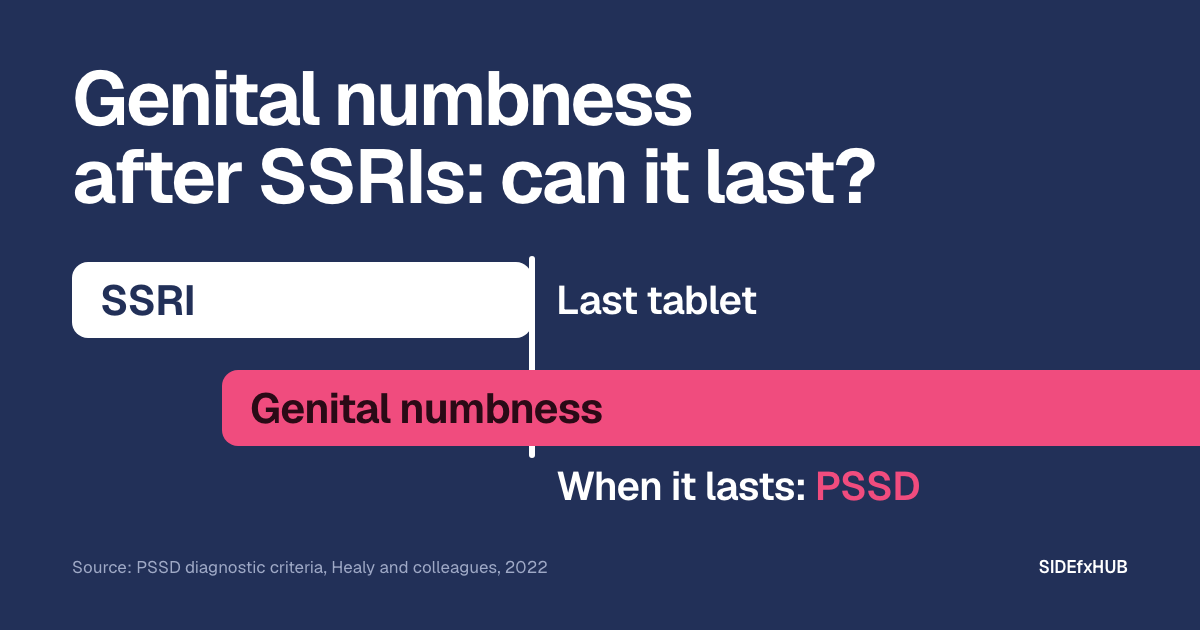
Genital numbness is a known effect of SSRI and SNRI antidepressants, and for some people it continues after stopping. When it lasts, it’s the main sign of post-SSRI sexual dysfunction (PSSD).
It’s easy to blame depression or stress, and your doctor may too. Researchers say depression doesn’t numb the genitals, so the word “numb” can point your doctor to the medicine.
The story in 3 lines
1. Antidepressants like sertraline can change genital feeling within an hour of the first tablet (2022 criteria).
2. The UK leaflet warns that sexual problems have sometimes continued after stopping (leaflet).
3. No mental illness causes genital numbness, say two researchers who wrote the criteria (paper). Nobody has measured how often it lasts.
Press: contact@sidefxhub.com

Connor, also in the film, has a different story. A year after he stopped taking sertraline, his genitals were still numb.
What does genital numbness from antidepressants feel like?
People describe two kinds of change. Either the genitals feel as if they’ve had an anaesthetic, or touch still registers but feels like being touched anywhere else.
In 2022, a group of doctors and researchers wrote criteria for diagnosing PSSD. They say almost everyone on an SSRI or SNRI has some change in genital feeling within an hour of starting. Not everyone notices it.
In PSSD, they add, the numbness becomes much stronger, and emotional numbing often comes with it. Grant, who took Lexapro (escitalopram), describes feeling emotionally numb and losing his sex drive.

Is it depression or the medicine?
If the change is numbness, researchers point to the medicine. “No mental health disorder causes anaesthesia of the genitals,” write David Healy and Dee Mangin, two of the researchers who wrote the criteria. It is, they add, “a documented effect” of these antidepressants.
Desire is different. Low desire is common in depression even before any tablet, as one study found. So a doctor who hears “I’ve gone off sex” has good reason to think of the illness first.
Numbness still gets missed. People don’t always mention it unless they’re asked, Healy and Mangin note. A standard questionnaire for sexual side effects doesn’t ask about genital feeling either.
One survey compared young people who had stopped an antidepressant with young people who had stopped other psychiatric medicines. About 13 in 100 in the first group reported lasting numbness, against about 1 in 100 in the second. The gap held after the researchers allowed for how depressed people were.
Lasting genital numbness, out of every 100 who had stopped
Can genital numbness last after stopping?
It can. The UK leaflet for sertraline has a line on this: in some cases, sexual problems “have continued after stopping treatment”. In 2019 the EU medicines regulator asked for this warning on every SSRI and SNRI.
Genital numbness isn’t on the leaflet’s list of side effects, which names lower sexual interest and erection problems.
For some people the problems only start after stopping, the criteria say. Once a change has lasted three months, they add, PSSD is more likely. Nobody has measured how often this happens.
Emily had lived with PSSD for almost three years when she recorded this film.

What can I do if my genitals feel numb?
These medicines help many people. If you have side effects, that’s a decision for you and your prescriber. Don’t stop suddenly.
Tell your doctor, and use the word “numb”. Have these ready:
- Which change it is: “touch feels dulled”, or “touch feels like touch anywhere else”.
- Your medicine: “Sertraline 50 mg from January 2023, last tablet March 2024.”
- When it started: on the tablets, or after stopping.
- How it was before: “No problems before 2023.”
Many people say it took time to be taken seriously. Bring the leaflet line. You can report it without a doctor agreeing.
Report it: it helps everyone
A doctor’s note helps you. A report to the medicines regulator helps everyone else: it is how patterns get noticed.
- No proof needed. A suspicion is enough, even years after stopping.
- Where: the Yellow Card scheme in the UK, MedWatch in the US.
- Use the right words. If symptoms continued after stopping, write Post-SSRI sexual dysfunction (MedDRA 10086208).
Our reporting guide walks you through it
Common questions
Does the feeling come back after stopping? Numbness that starts on the tablets normally lifts once they stop, researchers say. For some people it has lasted years. Nobody knows yet who will be affected, or whether it will ease. Do SSRI sexual side effects go away? looks at what is known.
Can women get genital numbness from antidepressants? Yes. Researchers note that women often describe it as low desire, and men sometimes as an erection problem, so the numbness itself can go unsaid. If touch feels different, say so. PSSD in women covers what else women describe.
Is there a treatment? Not yet: Healy and Mangin write of a “lack of available treatment”. Healy has also written that, over several years, some people recover to a degree on their own. Nobody has counted how often it happens yet. That’s why reports matter.
A year after his last tablet, Connor’s numbness hadn’t lifted. If your feeling has changed, say “numb” at your next appointment: that one word can point your doctor towards PSSD.
Sources
- Healy D, Bahrick A, Bak M and colleagues (37 authors). Diagnostic criteria for enduring sexual dysfunction after treatment with antidepressants, finasteride and isotretinoin. Int J Risk Saf Med 2022;33(1):65-76. Section 3: the change within an hour of starting, the two kinds of numbness, and the three-month mark. An enduring change in genital sensation is the one symptom the PSSD criteria require. “Emotional and genital numbing commonly go together.” Problems can “persist or emerge upon stopping”; an enduring dysfunction “may only appear when the drug is stopped”.
- Healy D, Mangin D. Post-SSRI sexual dysfunction: barriers to quantifying incidence and prevalence. Epidemiol Psychiatr Sci 2024;33:e40. The quotes on genital anaesthesia and treatment. Changes in genital sensation are “not always volunteered unless asked about directly”. The Arizona Sexual Experience Scale has no question on genital sensation.
- Healy D. Post-SSRI sexual dysfunction & other enduring sexual dysfunctions. Epidemiol Psychiatr Sci 2020;29:e55, published online 23 September 2019. Effects that start on treatment “ordinarily lift when treatment stops”; “a degree of spontaneous recovery happens in some cases” over several years.
- Healy D, Le Noury J, Mangin D. Enduring sexual dysfunction after treatment with antidepressants, 5α-reductase inhibitors and isotretinoin: 300 cases. Int J Risk Saf Med 2018;29(3-4):125-134. Genital anaesthesia is not a feature of depression or anxiety.
- Pirani Y, Delgado-Ron JA, Marinho P and colleagues. Frequency of self-reported persistent post-treatment genital hypoesthesia among past antidepressant users: a cross-sectional survey of sexual and gender minority youth in Canada and the US. Soc Psychiatry Psychiatr Epidemiol 2025;60(7):1771-1779, published online 20 September 2024. 93 of 707 past antidepressant users (13.2%) against 1 of 102 past users of other psychiatric medicines (0.9%); adjusted odds ratio 14.2 (95% CI 2.92 to 257), allowing for age, sex assigned at birth, hormone treatment and depression severity. Participants aged 15 to 29. The lead author is from the Canadian Post-SSRI/SNRI Sexual Dysfunction Society, a patient group.
- Kennedy SH, Dickens SE, Eisfeld BS, Bagby RM. Sexual dysfunction before antidepressant therapy in major depression. J Affect Disord 1999;56(2-3):201-8. 134 people with depression, not yet on medication; no comparison group without depression.
- Lustral (sertraline) 50 mg and 100 mg, patient information leaflet, last revised December 2025, section 2 “Sexual problems” and section 4. Electronic Medicines Compendium.
- Lustral (sertraline), summary of product characteristics, section 4.4, text revised December 2025. Electronic Medicines Compendium.
- European Medicines Agency, PRAC, new product information wording, signals adopted at the meeting of 13 to 16 May 2019, EMA/PRAC/265221/2019. Persistent sexual dysfunction after SSRI and SNRI withdrawal.
- Videos: BBC News, Antidepressants: should we talk about side-effects?, 11 August 2023, from the BBC Scotland series Disclosure, reported by Anton Ferrie; PSSD Network, BBC Disclosure: Are My Antidepressants Worth It? (Connor’s segment); Moral Medicine, Life Altered by Lexapro, Grant’s interview, 24 June 2024; PSSD Canada, Emily’s experience with PSSD, 26 February 2022.
This information does not replace medical advice. Talk to your doctor before you make any decision about your treatment.
610+ people have joined the community.
Join them, then report your side effects.
Free. Sign up takes 2 minutes.