PSSD warnings around the world
The UK, EU, New Zealand, Canada, Australia and Malaysia warn that SSRI sexual problems can last after stopping. That's PSSD. The US warns on one medicine.
SIDEfxHUB is a patient charity. We are not health professionals, and this does not replace medical advice. Don't start, stop or change any medicine because of what you read here. Talk to your doctor first.
If you are in crisis:116 123 Samaritans (UK)988 Lifeline (US)Find a helpline
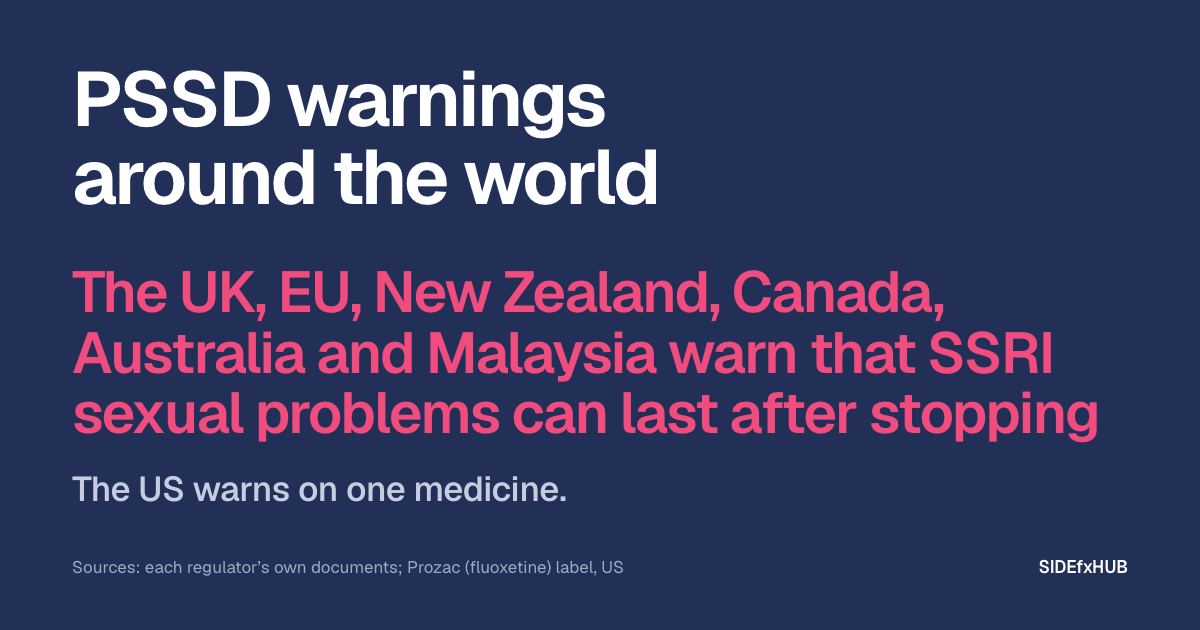
The UK, the EU, New Zealand, Canada, Australia and Malaysia warn that the sexual side effects of SSRI and SNRI antidepressants can continue after stopping, a condition known as post-SSRI sexual dysfunction, or PSSD. In the US, only one medicine’s label says so: fluoxetine (Prozac).
The same medicine, escitalopram, comes with the warning in the UK, where it’s sold as Cipralex, and without it in the US, where it’s Lexapro. What you’re told depends on where you live.
The story in 3 lines
- In 2019 the EU medicines regulator asked for a warning on every SSRI and SNRI: in some cases, sexual problems “have continued after stopping treatment”.
- Canada, Australia and Malaysia have followed since (Malaysia’s regulator).
- In the US, only fluoxetine labels have carried a line like it, since 2011 (Prozac label).
Press: contact@sidefxhub.com
In March 2019, Emily woke up one morning and all sexual sensation had gone. It was about three weeks after she’d come off an SSRI quickly, on her doctor’s instructions.

“I was not told that it could remove my sexuality,” she says. Her numbness began two months before Europe’s warning.
Which countries warn about PSSD?
The EU and the UK since 2019, then New Zealand, Canada, Australia and Malaysia. Those are the ones we’ve confirmed in each regulator’s own documents.
It started with one sentence. In May 2019 the EU medicines regulator asked every company selling an SSRI or SNRI to add it to the leaflet: “In some cases, these symptoms have continued after stopping treatment.” The UK, still in the EU then, did the same.
New Zealand’s medicines safety committee advised a warning later that year. Health Canada and Australia’s regulator followed.
The most recent of them is Malaysia. Its order to drug companies in 2025 puts Europe’s sentence into Malaysian patient leaflets, word for word.
Where SSRI labels warn the problems can last
Does the US warn about PSSD?
On one medicine. Since 2011, the US label for Prozac has said that sexual symptoms “occasionally persist after discontinuation”. Prozac’s maker asked to add the line, and the FDA approved it.
That was eight years before Europe’s warning, but the line stayed on fluoxetine. We searched the FDA’s label database and found nothing like it on any other SSRI or SNRI we checked, sertraline and venlafaxine among them. New Zealand’s regulator checked three of those US labels and didn’t find it either.
In 2018 doctors and researchers asked the FDA in a petition to warn on all of them. An FDA memo from March 2026, the most recent FDA document we could find in October 2026, lists the petition as pending. Our article on what regulators say about PSSD tells that story.

Do the warnings use the name PSSD?
Mostly not. Europe’s sentence, which most of these countries use, describes the problem without naming it.
New Zealand looked at adding the name in June 2026. Its leaflets for patients already carry Europe’s sentence.
The committee that advises Medsafe, the country’s medicines regulator, was not in favour of adding the name PSSD “at this time”. It said the term covers many symptoms and has no agreed definition, and asked for a review of the specific symptoms at a future meeting.
Malaysia’s regulator does use the name, though not in the leaflet. Its 2025 safety alert for health professionals calls the condition post-SSRI sexual dysfunction (PSSD), and asks them to talk to patients about it.
What can I do?
These medicines help many people. If you have side effects, that’s a decision for you and your prescriber. Don’t stop suddenly.
If sex has felt different since you stopped, tell your GP and give your dates: “Sertraline 50 mg from January 2023, last tablet March 2024.”
Many people say it took time to be taken seriously. Bring the leaflet line. You can report it without a doctor agreeing.
Report it: it helps everyone
A doctor’s note helps you. A report to the medicines regulator helps everyone else: it is how patterns get noticed.
- No proof needed. A suspicion is enough, even years after stopping.
- Where: the Yellow Card scheme in the UK, MedWatch in the US.
- Use the right words. If symptoms continued after stopping, write Post-SSRI sexual dysfunction (MedDRA 10086208).
Our reporting guide walks you through it
What else do people ask?
Does the UK warn about PSSD? Yes. Since 2019, UK leaflets such as the one for Cipralex (escitalopram) have carried Europe’s line. In December 2025 the MHRA, the UK regulator, said its expert advisers had recommended updating some leaflets to better reflect what patients reported. When we checked in October 2026, we couldn’t find the new wording.
Is PSSD real? Regulators warn about it. Health Canada asked for a warning on every SSRI and SNRI after its review judged 43 of 58 case reports possibly linked. The review couldn’t prove that the medicines cause it, or rule it out. Our article Is PSSD real? looks at what the leaflets say.
Can PSSD be permanent? Australia’s regulator says the effects “can persist for weeks to years”. For some people it has lasted years after stopping. Nobody knows yet who will be affected, or whether it will ease. Our page on PSSD explains more.
Emily said she hoped the word would get out, so other people wouldn’t suffer the way she has. If your symptoms continued after your last tablet, a report is how a regulator hears about it.
Sources
- European Medicines Agency, PRAC. New product information wording: extracts from PRAC recommendations on signals, adopted at the 13 to 16 May 2019 meeting, EMA/PRAC/265221/2019, 11 June 2019. Item 3, EPITT 19277. Summary of product characteristics, section 4.4: “There have been reports of long-lasting sexual dysfunction where the symptoms have continued despite discontinuation of SSRIs/SNRI.” Package leaflet, section 2: “In some cases, these symptoms have continued after stopping treatment.” SSRIs: citalopram, escitalopram, fluoxetine, fluvoxamine, paroxetine, sertraline. SNRIs: desvenlafaxine, duloxetine, milnacipran, venlafaxine.
- Cipralex (escitalopram) patient information leaflet, UK, Electronic Medicines Compendium, last revised May 2025, section 2. UK leaflets for the SNRIs carry the same line: Venlafaxine Dexcel XL, last revised November 2025, and Duloxetine Zentiva, last revised August 2024.
- UK Parliament, written question 50758, answered 13 May 2025: the MHRA updated the product information for all SSRIs in 2019. MHRA, Patient and family experiences inform antidepressant safety information review, 1 December 2025: updates recommended to the leaflets for certain antidepressants. We found no later MHRA announcement of the new wording on GOV.UK on 10 October 2026.
- Medsafe, minutes of the 179th meeting of the Medicines Adverse Reactions Committee, 12 September 2019, item 3.2.2, recommendation 5: Medsafe to ask sponsors to update New Zealand data sheets.
- Medsafe, Update on sexual dysfunction (post SSRI sexual dysfunction, PSSD) following discontinuation of serotonin reuptake inhibitors, paper for the committee, 11 June 2026. Sections 2.3.1 (all SSRI and venlafaxine data sheets except fluoxetine carry the warning in section 4.4, following the 2019 advice; fluoxetine lists persistence in section 4.8) and 2.3.2 (the US Prozac label; no similar line in the US citalopram, sertraline or venlafaxine labels).
- Medsafe, minutes of the 206th meeting, 11 June 2026, item 3.2.3: “not in favour of including the term PSSD in data sheets at this time”; recommendation 3, a review of specific symptoms at a future meeting. Examples of current wording: Celapram (citalopram) data sheet, section 4.4, revised 26 November 2025, and consumer medicine information. The consumer leaflets we checked on 10 October 2026 for citalopram, escitalopram, fluoxetine, paroxetine, sertraline and venlafaxine all carry the line “In some cases, these symptoms have continued after stopping treatment.”
- Health Canada, Summary Safety Review: SSRIs and SNRIs, assessing the potential risk of sexual dysfunction despite treatment discontinuation, issued 6 January 2021. Could “not confirm, nor rule out, a causal link”; 43 of 58 case reports (16 Canadian, 27 international) possibly linked; “possibly weeks to years”. Health Canada, Health Product InfoWatch, December 2021: product monographs for SSRIs and SNRIs “has been, or will be, updated” with “reports of long-lasting sexual dysfunction where the symptoms have continued despite treatment discontinuation”. The term PSSD is not used.
- Therapeutic Goods Administration, Australia, Updated warnings about persistent sexual dysfunction for antidepressants, Medicines Safety Update, 23 May 2024. Product information for all SSRIs and SNRIs aligned; desvenlafaxine, sertraline and venlafaxine already carried the warning, six others were updated with the EU wording; “can persist for weeks to years”.
- National Pharmaceutical Regulatory Agency, Malaysia, SSRIs and SNRIs: risk of persistent sexual dysfunction, safety alert, 14 November 2025: names PSSD; learned of the risk from the TGA; 22 local reports of sexual dysfunction, none describing persistence. Directive 23 of 2025, NPRA.600-1/9/13(70) Jld.1, issued 7 October 2025: the EU wording for the package insert and for the patient leaflet (RiMUP).
- Prozac (fluoxetine), US prescribing information, DailyMed, section 6.1: “Symptoms of sexual dysfunction occasionally persist after discontinuation of fluoxetine treatment.” US Food and Drug Administration, supplement approval letter, NDA 18-936/S-096, 15 June 2011; Eli Lilly’s application was dated 8 April 2011.
- Our search of US labels: openFDA drug label database, 10 October 2026. The persistence line appears only in fluoxetine labels (Prozac, its generics and Symbyax). No such line was found in the labels checked for sertraline, paroxetine, escitalopram, citalopram, fluvoxamine, venlafaxine, duloxetine, desvenlafaxine, vortioxetine, vilazodone or levomilnacipran. Example: the Lexapro (escitalopram) label, DailyMed, version of October 2023, section 5.11, warns of sexual dysfunction during treatment and has no line about symptoms after stopping.
- Healy D and 21 co-signatories. Citizen petition: sexual side effects of SSRIs and SNRIs, 2018, FDA docket FDA-2018-P-1846. US Food and Drug Administration, memorandum of the listening session with SSRI and SNRI petitioners, 23 March 2026: one of “four pending citizen petitions”. The most recent FDA document on the petition we could find on 10 October 2026.
- Videos: PSSD Canada, Emily’s experience with PSSD, 26 February 2022 (the description dates her symptoms from March 2019; her quote at 1:08); Dr. Josef, SSRIs & SNRIs: Persistent Sexual Dysfunction Risk!, 7 January 2026; PSSD Hilfe Deutschland, We explain post-SSRI sexual dysfunction, 24 July 2023.
This information does not replace medical advice. Talk to your doctor before you make any decision about your treatment.
590+ people have joined the community.
Join them, then report your side effects.
No diagnosis needed. Researchers never see your name.