Report antidepressant side effects to the FDA
In the US you can report to the FDA yourself, on MedWatch, if sexual problems lasted after an SSRI. Name the condition, PSSD, in your own description.
SIDEfxHUB is a patient charity. We are not health professionals, and this does not replace medical advice. Don't start, stop or change any medicine because of what you read here. Talk to your doctor first.
If you are in crisis:116 123 Samaritans (UK)988 Lifeline (US)Find a helpline
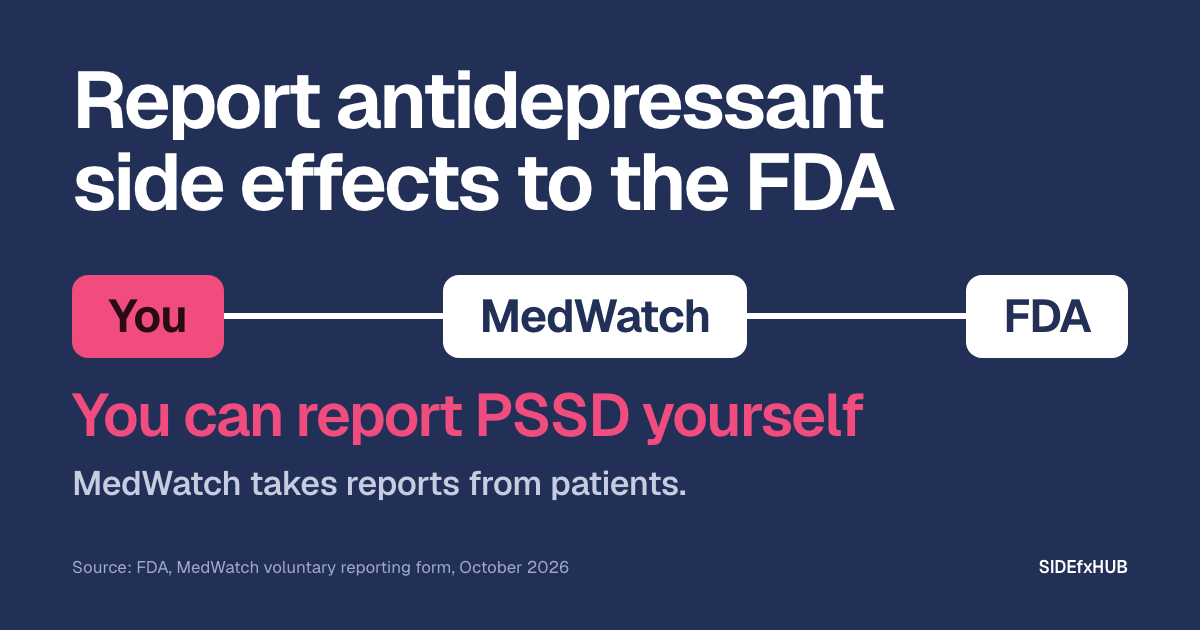
If sexual problems continued after you stopped an SSRI antidepressant, you can report them yourself to the FDA, the US medicines regulator. Its MedWatch form has no list of conditions to pick from, so name yours in the description: Post-SSRI sexual dysfunction, or PSSD.
FDA staff turn what you write into terms from MedDRA, the dictionary of medical terms that regulators share. So the words you choose matter, and most of the other boxes are optional.
The story in 3 lines
- You can report a suspected side effect to the FDA yourself. Your doctor “is NOT required to report” (FDA).
- Prozac's US label says sexual symptoms “occasionally persist” after stopping (US label).
- When a report comes straight from the public, FDA staff choose its MedDRA terms from the description (FDA staff guide, 2025).
Press: contact@sidefxhub.com
Francis is a nurse practitioner in the US. He took sertraline for a couple of months, he says, and found he could no longer orgasm.

He stopped the tablets. It improved a little, he says, but nine years on, “I’ve never been the same.”
Can I report antidepressant side effects to the FDA myself?
Yes. MedWatch, the FDA’s reporting programme, takes reports from patients as well as health professionals. Its website says you can report side effects you’ve “observed or suspected”.
The FDA suggests taking the form to your doctor, who can add details from your medical record. “Your health care provider is NOT required to report to the FDA,” its MedWatch page adds. You may fill in the online form yourself.
Prozac’s US label says sexual symptoms “occasionally persist” after people stop taking it, as our article on Prozac’s sexual side effects explains. Its patient guide says you may report side effects to the FDA.
The FDA calls the online form the quickest route. You can also post or fax the paper version, Form FDA 3500B, or phone 1-800-FDA-1088.
How do I fill in the MedWatch form for PSSD?
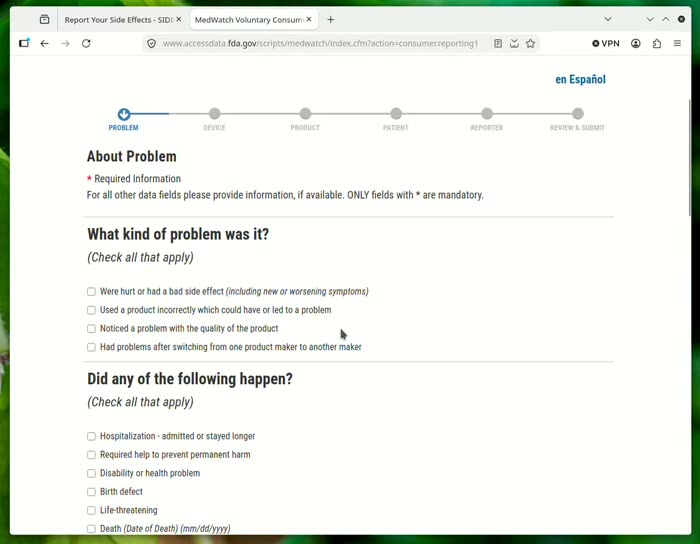
Have your dates to hand. On the MedWatch reporting site, choose Consumer/Patient (FDA Form 3500B).
-
Say what kind of problem it was. The first question has an option for side effects: “Were hurt or had a bad side effect”.
-
Answer the question about outcomes. “Did any of the following happen?” lists what the problem led to. It has no star. Tick only what happened to you.
-
Give the date it began. The date box wants the month first: 02/01/2023 is 1 February 2023.
-
Describe it in your own words. “Tell us what happened and how it happened” has a star. Name the condition and its MedDRA code there, in English: “Post-SSRI sexual dysfunction (MedDRA 10086208). Since February 2023, touch feels numb and orgasm has no pleasure. No change since my last tablet in March 2024. No sexual problems before sertraline.”
-
Choose product or device. “Please select the cause of the problem” has a star. The option “For a problem with a product” covers prescription medicines. Then choose Next.
-
Name the medicine. Type the name as it appears on the pack, for example “Sertraline 50 mg tablets”.
-
Give your dates of use. Enter when you started and stopped, for example 01/15/2023 and 03/20/2024. The form takes a best estimate.
-
Answer the two questions about stopping. The form asks whether the problem stopped after you reduced the dose or stopped the medicine, and whether it returned if you started again. Answer with what happened to you.
-
Add your details and send. The Patient page has no starred box. The Reporter page needs your first and last name. A tick box there keeps your identity from the company that makes the medicine. Choose Submit, then save the PDF copy.
In the UK? Use our Yellow Card guide instead.

Does it matter what I write in the description?
Yes, because your description is what gets coded. FDA safety staff set out the process in a 2025 guide. The MedDRA codes are how they find reports again when they look into a safety question.
MedDRA has a term for PSSD: Post-SSRI sexual dysfunction, code 10086208. We found no FDA document that says how a report naming it is coded. Writing the dictionary’s own words makes plain which condition you mean.
Detail counts too. The guide says very short descriptions are unlikely to give enough for a meaningful review. Its list of useful details includes when symptoms began and what happened after stopping.
It also says reports of individual cases, most sent in by companies, were the basis for more than half of the safety changes made to US labels after approval.
A 2018 petition asking the FDA for a warning on every SSRI and SNRI was still pending in March 2026. Our article on what regulators say about PSSD follows it.
FDA staff enter the report.
A safety evaluator looks for similar reports.
The FDA watches the data for patterns.
This can mean a new warning on the label.
What can I do if I think I have PSSD?
These medicines help many people. If you have side effects, that’s a decision for you and your prescriber. Don’t stop suddenly.
If you think you have PSSD, tell your doctor and give your dates: “Sertraline 50 mg from January 2023, last tablet March 2024.”
Many people say it took time to be taken seriously. You can report it without a doctor agreeing.
Report it: it helps everyone
A doctor’s note helps you. A report to the medicines regulator helps everyone else: it is how patterns get noticed.
- No proof needed. A suspicion is enough, even years after stopping.
- Where: the Yellow Card scheme in the UK, MedWatch in the US.
- Use the right words. If symptoms continued after stopping, write Post-SSRI sexual dysfunction (MedDRA 10086208).
Our reporting guide walks you through it
What else do people ask?
Will the FDA write back? The form says you’ll get a reply once your report arrives, and that the FDA will contact you personally only if it needs more information. MedWatch doesn’t give medical advice, the FDA says. For your own care, see your doctor.
Is it too late if I stopped years ago? As of October 2026, the MedWatch form and pages set no deadline. The form tells you to send the report even if you don’t have all the information. Our article on reporting a side effect years later has more.
Can I look up reports like mine? Yes. As of March 2026 the FDA’s AEMS public dashboard, long known as FAERS, lets anyone search reports by medicine. A report doesn’t prove the medicine caused the problem, the FDA cautions, and counts can’t show how often it happens.
“Most clinicians I talk to, they have no idea this even exists,” Francis says. The FDA’s form doesn’t ask whether your doctor agrees. Report it in your own words, and name the condition.
Sources
- US Food and Drug Administration, Reporting Serious Problems to FDA, content current as of 26 September 2025. “You are encouraged to take the reporting form to your doctor.” “Your health care provider is NOT required to report to the FDA. In these situations, you may complete the Online Reporting Form yourself.” The page lists Form FDA 3500B as the consumer version of the form.
- US Food and Drug Administration, MedWatch Online Voluntary Reporting Form, opened 10 October 2026. “Health professionals, consumers and patients can voluntarily report observed or suspected adverse events.” It offers two routes: Health Professional (FDA Form 3500) and Consumer/Patient (FDA Form 3500B). Its Frequently Asked Questions page gives the minimum needed: a description of the problem, the name of the product and the reporter’s name. A copy can be saved as a PDF from the confirmation page.
- US Food and Drug Administration, Form FDA 3500B, MedWatch Consumer Voluntary Reporting, version 09/2025, eight pages (OMB No. 0910-0291, expires 30 September 2027). “Fill in as much information as possible and send in the report even if you do not have all the information.” “You will receive a reply from the FDA after we receive your report. We will personally contact you only if we need additional information.” Your name and contact information may be shared with the company that makes the product “unless you request otherwise”. Section A asks for the date the problem occurred and sets no deadline. The paper form goes by post or fax, to the address and fax number on its last page.
- The online form’s wording. We read the first page (“About Problem”) on the live form on 10 October 2026, entering nothing; the form opens its later pages only once the starred boxes on that page are filled. The later pages were read from our own screen recording of a PSSD report on MedWatch, committed 2 September 2026, and checked against Form FDA 3500B (09/2025). Starred fields: “Tell us what happened and how it happened”, the cause of the problem, the name of the product, the reporter’s first and last name, and the reCAPTCHA. The “About Patient” page has no starred field. Dates are entered as mm/dd/yyyy. Dates of use may be a “best estimate”.
- US Food and Drug Administration, FDA 101: How to Use the Consumer Complaint System and MedWatch, content current as of 9 November 2020. “FDA encourages online reporting because it is the quickest and most direct route.” Fax and phone (1-800-FDA-1088) are the alternatives. MedWatch is for reporting problems and does not provide medical advice. The four steps in our graphic come from “What Happens After a Report Is Made to MedWatch?”. Possible FDA actions include “updating the product labeling to reflect new warnings”.
- Prozac (fluoxetine), US prescribing information and Medication Guide, revised August 2023. DailyMed, US National Library of Medicine. Section 6.1: “Symptoms of sexual dysfunction occasionally persist after discontinuation of fluoxetine treatment.” Medication Guide: “You may report side effects to the FDA at 1-800-FDA-1088.”
- Potter E, Reyes M, Naples J, Dal Pan G. FDA Adverse Event Reporting System (FAERS) Essentials: a guide to understanding, applying, and interpreting adverse event data reported to FAERS. Clin Pharmacol Ther 2025;118(3):567-582. The authors work in the FDA’s Office of Surveillance and Epidemiology. “For reports that the public submits directly to the FDA, FDA staff abstract and code AE terms.” FDA staff “retrieve ICSRs coded with the MedDRA term signifying the AE term(s) of interest”. “Very short narratives are unlikely to contain sufficient details for a meaningful review.” The most useful elements of a report include time to onset and the response to stopping the drug. Individual case safety reports “form the basis for more than half of the postmarketing safety-related labeling changes in the United States”. Those reports include the ones companies send in; reports straight from the public are about 5% of submissions. The paper also says reports cannot give the incidence of a side effect, and that not every report is read individually.
- US Food and Drug Administration, FDA Adverse Event Monitoring System (AEMS), content current as of 11 March 2026. “Adverse events and medication errors are coded using terms in the Medical Dictionary for Regulatory Activities (MedDRA) terminology.” The FDA “is implementing” AEMS to bring its reporting systems together. AEMS Public Dashboard, same date: “Existence of a report does not establish causation”; “Rates of occurrence cannot be established with reports”. The FDA’s old address for the FAERS Public Dashboard led to this page on 10 October 2026, and the AEMS page still describes “the FAERS database”.
- MedDRA term as listed in our reporting data: Post-SSRI sexual dysfunction (10086208), a lower-level term under the preferred term Sexual dysfunction. As of 10 October 2026 we found no FDA document that says how a report naming this term is coded.
- US Food and Drug Administration, memorandum of the listening session with SSRI and SNRI petitioners, 23 March 2026. Docket FDA-2018-P-1846 is one of the “pending citizen petitions”. “Once completed, FDA will post responses to the citizen petitions in the public docket.” It is the most recent FDA document on the petition we could find on 10 October 2026.
- Moral Medicine, Nurse Practitioner Speaks Out on PSSD: 9 Years of Suffering, Medical Insight & Fight for Recognition, interview with Francis, 11 August 2025 (the title is the channel’s). Our page plays an extract, 4:58 to 6:15; the views are his own. Sertraline “for a couple months” and “I couldn’t orgasm” (5:00). “It improved a little bit, but ever since … nine years, I’ve never been the same” (6:09). “Most clinicians I talk to, they have no idea this even exists” (15:00). Quotes from the YouTube captions. His story on our site: Francis’s story: a nurse practitioner on PSSD.
- US Food and Drug Administration, MedWatch Minute for Consumers, 20 January 2022, 80 seconds: “details matter”.
- Picture: the first page of the MedWatch consumer reporting form (Form FDA 3500B online), a still from our own screen recording, committed 2 September 2026. No box is ticked.
This information does not replace medical advice. Talk to your doctor before you make any decision about your treatment.
Lasting side effects after an antidepressant?
Make them count.
Our step-by-step guide finds the form for your country.