Prozac sexual side effects: can they last?
Prozac (fluoxetine) often lowers sex drive and affects orgasm. The UK leaflet warns this has sometimes continued after stopping. That is called PSSD.
SIDEfxHUB is a patient charity. We are not health professionals, and this does not replace medical advice. Don't start, stop or change any medicine because of what you read here. Talk to your doctor first.
If you are in crisis:116 123 Samaritans (UK)988 Lifeline (US)Find a helpline
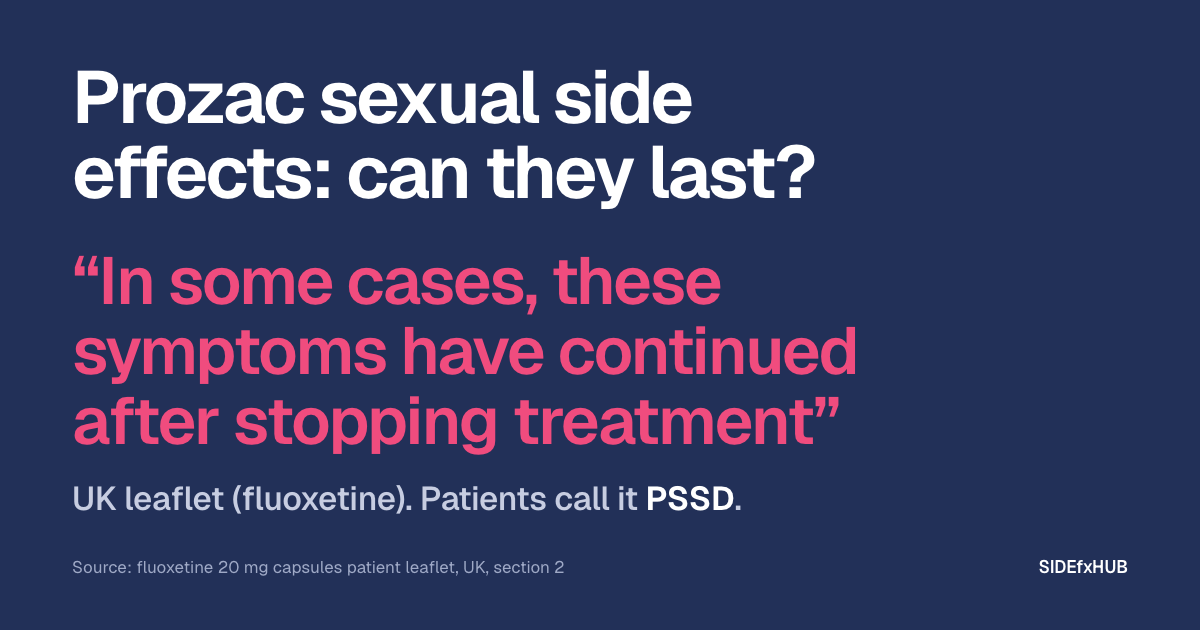
Prozac (fluoxetine) often lowers sex drive and can cause erection and orgasm problems. The UK leaflet warns these problems have sometimes continued after stopping, a condition known as post-SSRI sexual dysfunction, or PSSD.
The NHS page on fluoxetine lists low sex drive but doesn’t mention that it can continue after stopping. That’s worth knowing before your first capsule, and worth reporting if you’ve stopped and sex still feels different.
The story in 3 lines
- The UK leaflet lists a lower sex drive and erection problems as common side effects of fluoxetine.
- Prozac’s own US label has said since 2011 that these symptoms “occasionally persist” after stopping.
- Nobody has measured how often (2023 review). Patients call it PSSD.
Press: contact@sidefxhub.com
Katie was 21 and going through a difficult time when she was prescribed Prozac. She took it for about three years.

She describes emotional blunting and sexual problems, and losing the ability to feel attraction. It took her a long time to see that it began with the medicine. She has lived with it for about 14 years, most of them after her last capsule.
How common are Prozac’s sexual side effects?
Common, says the UK leaflet, and they seem to turn up more often when someone actually asks. Prozac’s US label says its own figures probably undercount them, partly because patients and doctors may be reluctant to talk about sex.
One trial did ask. Trained staff checked sexual function at every weekly visit. In the published results, about 3 in 10 people on fluoxetine had orgasm problems after eight weeks, against about 1 in 10 on a dummy pill.
These side effects can mean wanting sex less. For some, it’s an erection that won’t last, or an orgasm that takes much longer or never comes.
Can Prozac’s sexual side effects last after stopping?
Yes, for some people. The UK leaflet says that in some cases, these symptoms “have continued after stopping treatment”.
The warning isn’t new. Prozac’s maker asked to add a line to its US label in 2011, and the US regulator approved it. The label still says the symptoms “occasionally persist after discontinuation”.
Nobody has measured how often it happens. A 2023 review of the research couldn’t find a reliable estimate.
For some people it has lasted years after stopping. Nobody knows yet who will be affected, or whether it will ease.
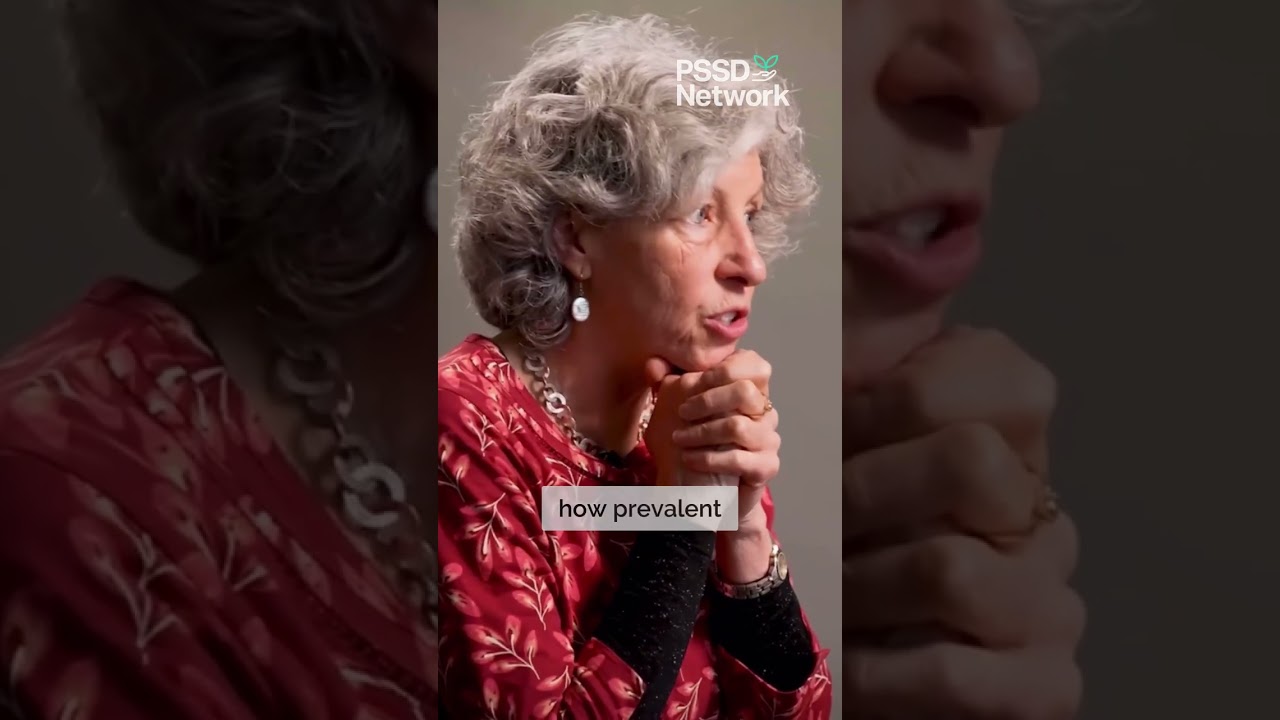
Joanna Moncrieff, a professor of psychiatry at UCL, says these effects have been reported for months and even years, and that many doctors may not know about them.
Could it just be fluoxetine still in my body?
For the first few weeks, it could be. Fluoxetine leaves the body slowly. Prozac’s US label says the active drug “will persist in the body for weeks” after the last dose, so side effects can carry on for a while.
Months or years are a different matter. Doctors and researchers who proposed criteria for PSSD in 2022 say that once problems last three months after stopping, it’s more likely to be PSSD. Their key symptom is a lasting change in how the genitals feel, such as numbness.
Numbness was reported early on. In 1991 a doctor wrote to the American Journal of Psychiatry about a numb penis in a man taking fluoxetine.
Fluoxetine after the last capsule
What can I do?
These medicines help many people. If you have side effects, that’s a decision for you and your prescriber. Don’t stop suddenly.
If the problems haven’t lifted since you stopped, tell your GP and give your dates: “Fluoxetine 20 mg from January 2023, last capsule March 2024.”
Many people say it took time to be taken seriously. Bring the leaflet line. You can report it without a doctor agreeing.
Report it: it helps everyone
A doctor’s note helps you. A report to the medicines regulator helps everyone else: it is how patterns get noticed.
- No proof needed. A suspicion is enough, even years after stopping.
- Where: the Yellow Card scheme in the UK, MedWatch in the US.
- Use the right words. If symptoms continued after stopping, write Post-SSRI sexual dysfunction (MedDRA 10086208).
Our reporting guide walks you through it
What else do people ask?
Could it be my depression? It can play a part: a 2026 paper by New Zealand’s medicines regulator notes that depression itself often lowers sex drive. The PSSD criteria ask what sex was like before the medicine. Prozac’s US label also tells doctors to ask when the problems began.
Does Prozac affect women too? Yes, Prozac’s US label says it can cause sexual problems in women as well as men. An early report, a 1993 letter to a psychiatry journal, described vaginal numbness on fluoxetine. Our article on PSSD in women covers what is known so far.
What about teenagers? The UK leaflet says fluoxetine can be used for depression from the age of 8. For under-18s, it adds that it “may slow growth or possibly delay sexual maturity”. As the 2022 criteria point out, someone who starts before puberty may have no “before” to compare with, which is a reason to talk about sex with the prescriber from the start.
Katie spent years believing something was wrong with her. If sex has felt different ever since your last capsule, report it: a report counts even years later.
Sources
- Fluoxetine 20 mg Capsules, patient leaflet, Electronic Medicines Compendium (EMC 15755), revised September 2022. Section 1, use in children and adolescents aged 8 and above; section 2, “Sexual dysfunction”; section 4, common and uncommon side effects, and side effects in children and adolescents aged 8 to 18.
- Prozac (fluoxetine), US prescribing information and Medication Guide, revised August 2023. DailyMed, US National Library of Medicine. Section 6.1 (persistence after discontinuation; figures likely to underestimate actual incidence), section 5.17 (sexual dysfunction in male and female patients; history including timing of symptom onset), sections 5.14 and 12.3 (elimination half-lives; active drug persists for weeks after dosing stops).
- US Food and Drug Administration, supplement approval letter, NDA 18-936/S-096, 15 June 2011. Eli Lilly’s application was dated 8 April 2011.
- NHS, Fluoxetine, page last reviewed 1 June 2026.
- Coleman CC, King BR, Bolden-Watson C and colleagues. A placebo-controlled comparison of the effects on sexual functioning of bupropion sustained release and fluoxetine. Clin Ther 2001;23(7):1040-58. Results summary: GSK study register, AK1A4007. Orgasm dysfunction at day 56: 45 of 146 people on fluoxetine (31%), 16 of 145 on placebo (11%). Sponsored by the maker of bupropion; eight weeks, during treatment only.
- Tarchi L, Merola GP, Baccaredda-Boy O and colleagues. Selective serotonin reuptake inhibitors, post-treatment sexual dysfunction and persistent genital arousal disorder: a systematic review. Pharmacoepidemiol Drug Saf 2023;32(10):1053-67.
- Healy D, Bahrick A, Bak M and colleagues. Diagnostic criteria for enduring sexual dysfunction after treatment with antidepressants, finasteride and isotretinoin. Int J Risk Saf Med 2022;33(1):65-76.
- Neill JR. Penile anesthesia associated with fluoxetine use. Am J Psychiatry 1991;148(11):1603.
- King VL Jr, Horowitz IR. Vaginal anesthesia associated with fluoxetine use. Am J Psychiatry 1993;150(6):984-5.
- Medsafe, Update on sexual dysfunction following discontinuation of serotonin reuptake inhibitors, paper for the Medicines Adverse Reactions Committee, 11 June 2026. Section 2.2.1, sexual dysfunction in depression.
- Moral Medicine, I Lost My Sexual Identity After Prozac, interview with Katie, May 2026. Her story on our site: Katie’s story: 14 years after Prozac.
- PSSD Network, Professor Joanna Moncrieff discusses Post-SSRI Sexual Dysfunction, June 2026.
This information does not replace medical advice. Talk to your doctor before you make any decision about your treatment.
590+ people have joined the community.
Join them, then report your side effects.
No diagnosis needed. Researchers never see your name.