Is PSSD real? What the leaflets say
PSSD isn't in the diagnostic manuals yet. But since 2019, UK and EU leaflets have warned that SSRI sexual side effects can continue after stopping.
SIDEfxHUB is a patient charity. We are not health professionals, and this does not replace medical advice. Don't start, stop or change any medicine because of what you read here. Talk to your doctor first.
If you are in crisis:116 123 Samaritans (UK)988 Lifeline (US)Find a helpline
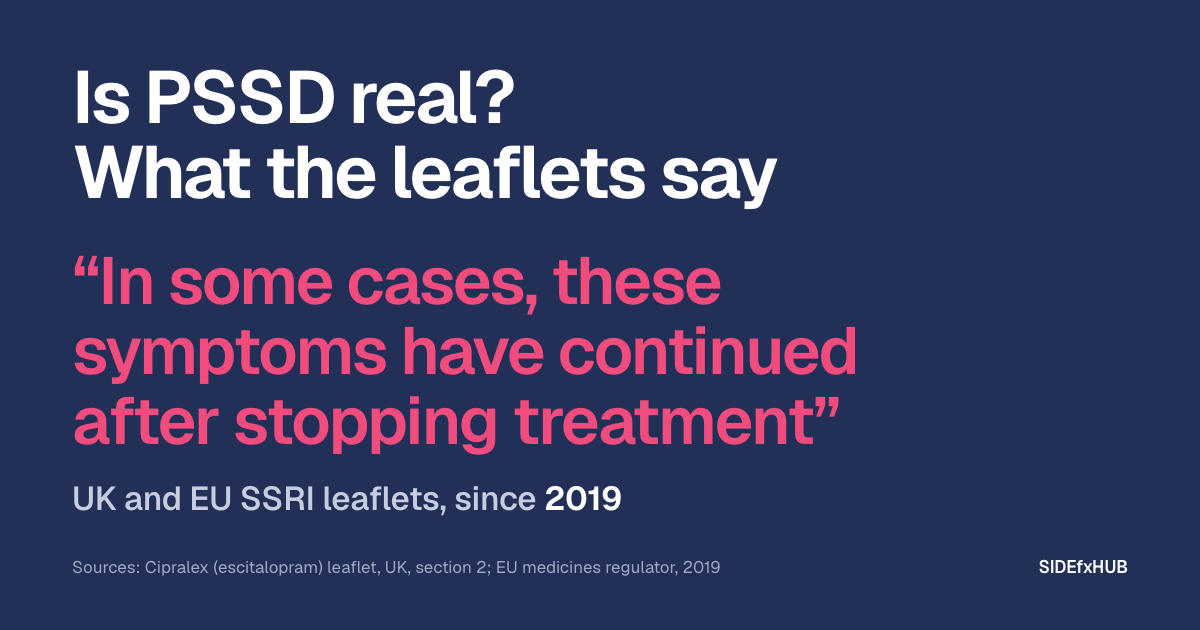
PSSD isn’t in the diagnostic manuals doctors use, at least not yet. But since 2019, UK and EU leaflets have warned that the sexual side effects of SSRI antidepressants can continue after stopping, and regulators have a term for it: post-SSRI sexual dysfunction.
If anyone has told you PSSD isn’t real, you can show them that warning. In the UK it’s in the leaflet of every SSRI, such as sertraline or citalopram, so it’s easy to take to your GP.
The story in 3 lines
- PSSD isn't in the DSM or the ICD, the two main diagnostic manuals, PolitiFact found in 2026.
- Since 2019, UK and EU leaflets have warned that SSRI sexual side effects have sometimes continued after stopping (EU regulator).
- Its name has been in MedDRA, the dictionary regulators use, since 2021 (UK government).
Press: contact@sidefxhub.com
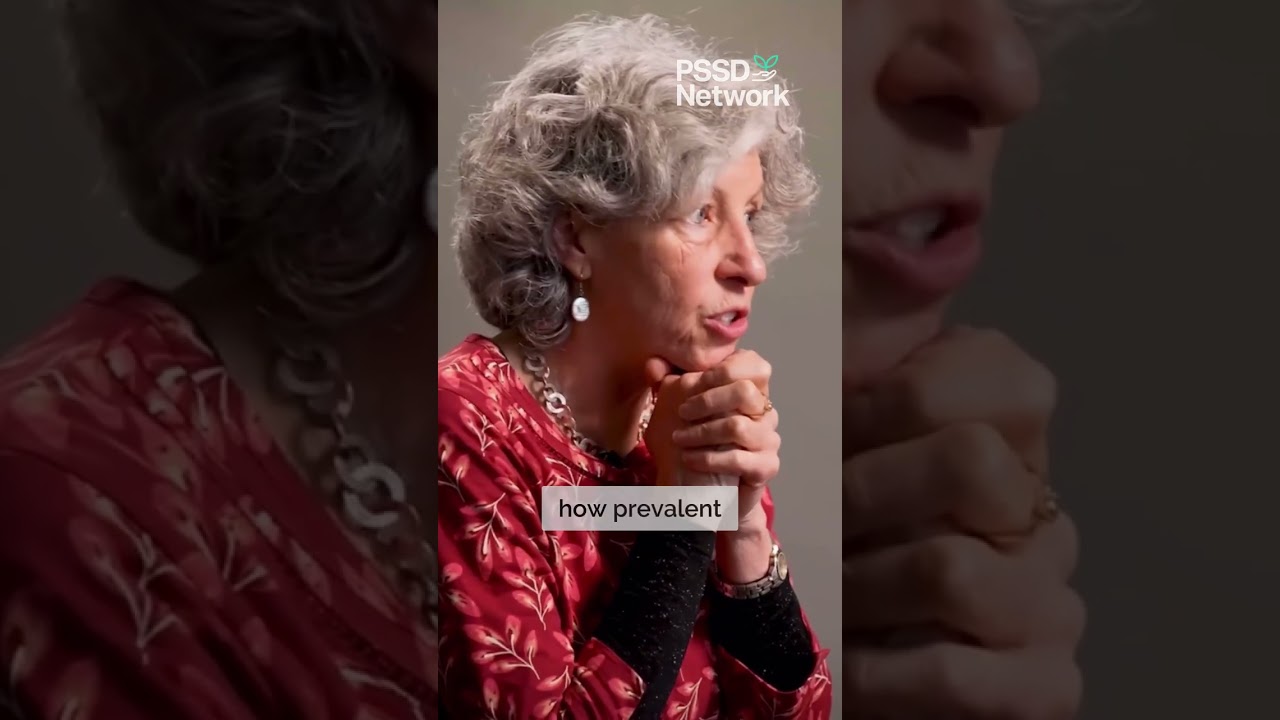
Rosie took escitalopram, sold as Lexapro, for a few months in 2020. In 2024, as president of the PSSD Network, a patient group, she told the YouTube channel Moral Medicine she had never recovered.

In the interview she talks about how hard it was to get doctors to acknowledge her symptoms. Writing for the PSSD Network, she described feeling “stuck behind a glass jar”.
What do the leaflets say about PSSD?
They say the sexual side effects have sometimes carried on after people stopped. Cipralex is a UK brand of escitalopram, the medicine Rosie took as Lexapro. Its UK leaflet puts it in one line: “In some cases, these symptoms have continued after stopping treatment.”
That line came from Europe. In 2019 the EU medicines regulator asked for a warning on every SSRI and SNRI, and the UK made the same change for every SSRI.
The NHS says it too. Its page on antidepressant side effects says that for some people, sexual problems “may carry on after stopping antidepressants”. Neither the NHS page nor the leaflet uses the name PSSD.
Is PSSD a recognised diagnosis?
Not yet. PolitiFact, a US fact-checking site, looked into it in July 2026. It found PSSD isn’t in the DSM, the American psychiatry manual, or in the ICD, the WHO’s list of diseases.
The DSM comes close. Its 2013 edition says that in some cases, sexual problems caused by SSRIs “may persist after the agent is discontinued”. It just doesn’t give them a name.
Two coding systems do have an entry for it. Since 2021, MedDRA, the dictionary regulators use to sort side effect reports, has had the term Post-SSRI sexual dysfunction. NHS records got a code of their own in October 2024, for lasting sexual problems after stopping an SSRI.
In 2025 a member of the House of Lords asked the government whether it planned to recognise PSSD as a condition. The answer listed the leaflet warning and both codes. It added that recognising PSSD in the clinic isn’t the job of the MHRA, the UK medicines regulator.
PSSD on the record
Why do some people say PSSD isn’t real?
Mainly because the research is thin. PolitiFact found that most of the evidence comes from case reports, which describe what happened to individual patients. Little is known about the cause.
A 2023 review by researchers in Italy and the UK looked for every study it could find. It couldn’t work out how often PSSD happens, or prove that the medicines cause it. Nor could it rule out that the problems carry on after stopping.
“The existing body of literature is small and of variable quality,” Jonathan Alpert, a US psychiatrist, told PolitiFact.
The doctors and researchers who wrote the 2022 criteria for diagnosing PSSD point to a different gap. Conditions like PSSD are “little known and poorly understood by healthcare professionals”, they write. Our article on how PSSD is diagnosed explains the criteria.
What can I do?
These medicines help many people. If you have side effects, that’s a decision for you and your prescriber. Don’t stop suddenly.
If you think you have PSSD, tell your GP and give your dates: “Escitalopram 10 mg from January 2023, last tablet March 2024.” You can ask for PSSD to go on your record with its NHS code.
Many people say it took time to be taken seriously. Bring the leaflet line. You can report it without a doctor agreeing.
Report it: it helps everyone
A doctor’s note helps you. A report to the medicines regulator helps everyone else: it is how patterns get noticed.
- No proof needed. A suspicion is enough, even years after stopping.
- Where: the Yellow Card scheme in the UK, MedWatch in the US.
- Use the right words. If symptoms continued after stopping, write Post-SSRI sexual dysfunction (MedDRA 10086208).
Our reporting guide walks you through it

What else do people ask?
Can PSSD be permanent? For some people it has lasted years after stopping. Nobody knows yet who will be affected, or whether it will ease. Rosie’s symptoms had lasted about four years when she spoke in 2024. The 2022 criteria set no time limit on how long PSSD can last.
Is PSSD recognised in the US? Partly. Prozac’s US label has said since 2011 that sexual symptoms “occasionally persist after discontinuation”. The US regulator, the FDA, hasn’t asked for the warning on every SSRI and SNRI. Our article on what regulators say about PSSD has the details.
Isn’t it just depression? Depression itself is linked to sexual problems, a 2012 review found. The 2022 criteria allow for that: they ask what sex was like before the medicine, and rule out other causes. Their key sign is a change in how the genitals feel, such as numbness, that stays after stopping.
For Rosie, getting doctors to acknowledge her symptoms was a struggle. You can start with two lines: the leaflet’s warning for your GP, and the MedDRA term for your report.
Sources
- PolitiFact. Abels G. What we know about sexual function after antidepressants, 31 July 2026. An explainer, not a rated fact-check. PSSD is not in the DSM, the American Psychiatric Association’s manual, or the ICD, the WHO’s. It quotes Dr Jonathan Alpert, psychiatrist and professor at the Albert Einstein College of Medicine, New York.
- Lundbeck Limited. Cipralex (escitalopram) patient information leaflet, UK, electronic Medicines Compendium (EMC 7718), last revised May 2025. Section 2, “Warnings and precautions”.
- European Medicines Agency, PRAC. Recommendations on signals adopted at the 13–16 May 2019 PRAC meeting, adopted 16 May 2019 (EPITT 19277). SSRIs: citalopram, escitalopram, fluoxetine, fluvoxamine, paroxetine, sertraline. SNRIs: duloxetine, venlafaxine, desvenlafaxine, milnacipran. Evidence reviewed: EudraVigilance, the published literature, social media and the companies’ cumulative reviews.
- NHS. Side effects of antidepressants, page last reviewed 12 June 2025.
- UK Parliament. Written question HL7363, asked by Lord Alton of Liverpool on 12 May 2025 and answered for the Department of Health and Social Care by Baroness Merron on 16 May 2025. Product information for all SSRIs updated in 2019; the term added to “the regulatory dictionary” in 2021; a SNOMED code for persistent sexual dysfunction after stopping an SSRI added in October 2024; clinical recognition “outside the remit of the MHRA”.
- MedDRA lowest level term Post-SSRI sexual dysfunction, code 10086208, under the preferred term Sexual dysfunction (MedDRA version 28.0).
- American Psychiatric Association. Diagnostic and Statistical Manual of Mental Disorders, fifth edition (DSM-5), 2013, substance/medication-induced sexual dysfunction: “In some cases, serotonin reuptake inhibitor-induced sexual dysfunction may persist after the agent is discontinued.” As quoted in Healy D, Le Noury J, Mangin D. Enduring sexual dysfunction after treatment with antidepressants, 5α-reductase inhibitors and isotretinoin: 300 cases. Int J Risk Saf Med 2018;29(3-4):125-34, and by PolitiFact (source 1).
- Tarchi L, Merola GP, Baccaredda-Boy O and colleagues. Selective serotonin reuptake inhibitors, post-treatment sexual dysfunction and persistent genital arousal disorder: a systematic review. Pharmacoepidemiol Drug Saf 2023;32(10):1053-67. Universities of Florence and Southampton. Two retrospective interventional studies, six observational studies and 11 case reports; no reliable estimate of prevalence; cause and effect “could not be ascertained”; persistence “could not be entirely ruled out”.
- Healy D, Bahrick A, Bak M and colleagues. Diagnostic criteria for enduring sexual dysfunction after treatment with antidepressants, finasteride and isotretinoin. Int J Risk Saf Med 2022;33(1):65-76. The criteria set no upper limit on how long these conditions can last.
- Prozac (fluoxetine), US prescribing information, DailyMed, US National Library of Medicine: “Symptoms of sexual dysfunction occasionally persist after discontinuation of fluoxetine treatment.” The line was approved by the FDA in a supplement approval letter, 15 June 2011.
- Atlantis E, Sullivan T. Bidirectional association between depression and sexual dysfunction: a systematic review and meta-analysis. J Sex Med 2012;9(6):1497-507.
- Moral Medicine. Interview with PSSD Network President Rosie, YouTube, 9 July 2024. Rosie took escitalopram from August to December 2020; in the interview she says she has never recovered. Rosie’s own account: PSSD Network, patient spotlight: Rosie. Our page on the interview: Interview with Rosie, PSSD Network President.
- PSSD Network. Professor Joanna Moncrieff discusses Post-SSRI Sexual Dysfunction, YouTube, June 2026.
- NHS Black Country Integrated Care Board. What is the Yellow Card Scheme?, Medicine Safety Week, YouTube, 4 November 2021.
This information does not replace medical advice. Talk to your doctor before you make any decision about your treatment.
590+ people have joined the community.
Join them, then report your side effects.
No diagnosis needed. Researchers never see your name.