How long does sertraline stay in your system?
Sertraline's half-life in the blood is about 26 hours. The UK leaflet warns sexual problems have sometimes continued after stopping. That is called PSSD.
SIDEfxHUB is a patient charity. We are not health professionals, and this does not replace medical advice. Don't start, stop or change any medicine because of what you read here. Talk to your doctor first.
If you are in crisis:116 123 Samaritans (UK)988 Lifeline (US)Find a helpline
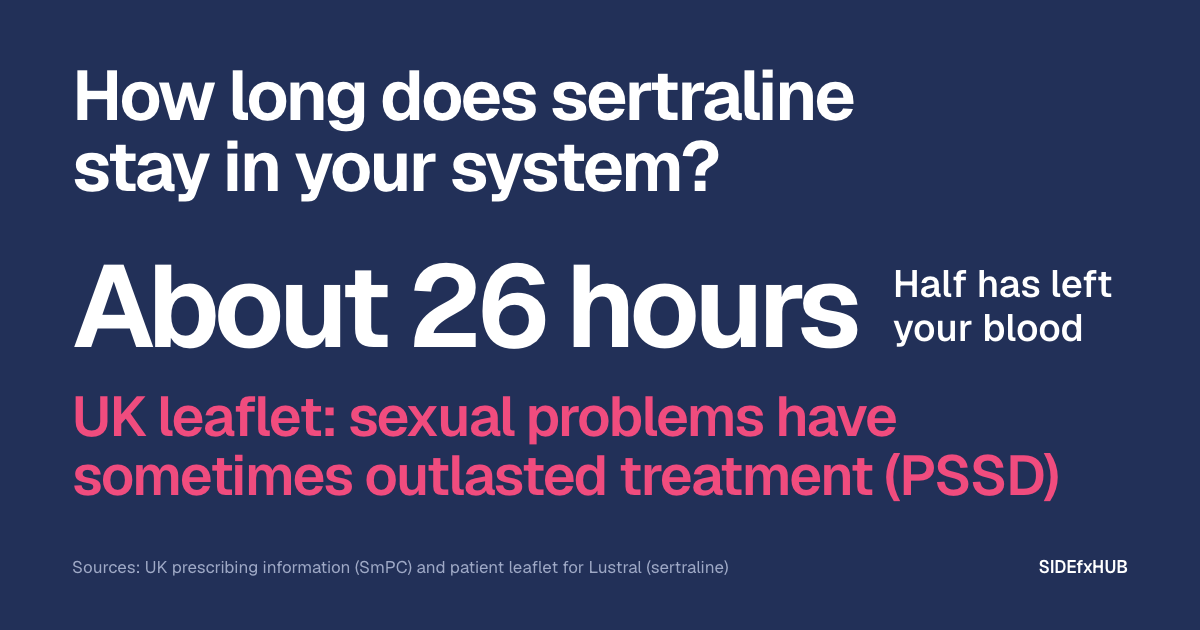
Sertraline’s half-life is about 26 hours, the UK prescribing information says, so we estimate nearly all of it leaves your blood in five to six days. Neither figure says when side effects end: the UK leaflet warns sexual problems have sometimes continued after stopping, called post-SSRI sexual dysfunction (PSSD).
What your liver turns sertraline into leaves more slowly: two to three weeks, by the same estimate. If you’ve stopped and something still feels wrong, “is it out of my system?” is one question and “have the side effects gone?” is another.
The story in 3 lines
- The amount of sertraline in the blood halves in about 26 hours, on average (UK prescribing information).
- What the liver turns it into stays longer: that substance has a half-life of 62 to 104 hours (the same document).
- The UK leaflet says sexual symptoms have in some cases “continued after stopping treatment”. It doesn't say for how long. Patients call it PSSD.
Press: contact@sidefxhub.com
Hugo says he took sertraline for “exactly two months”, then stopped from one day to the next. The leaflet says not to stop unless your doctor tells you to. He’d expected to feel terrible.

For about two weeks, he says, he felt “really, really good” instead. Then one evening, in his words, “this grey cloud” came over him and he had no emotions left. Six months after his last tablet, when he was filmed, he described no sexual attraction and “complete erectile dysfunction”.
How long does sertraline stay in your blood?
Days, going by its half-life. The UK prescribing information gives sertraline an average half-life of about 26 hours. A half-life is the time it takes for the amount in your blood to halve.
A rule of thumb in pharmacology is that after five half-lives almost all of a drug has left the blood. For sertraline, that works out at five to six days. That sum is ours: the prescribing information names no day when none is left.
It isn’t the same for everyone. The prescribing information says the half-life is longer in people with liver damage. In one study of volunteers, the half-life was shorter in young men than in young women or older people.
These timings are for blood. The prescribing information gives none for the brain or the rest of the body. The NHS page on sertraline doesn’t say how long it stays.
How long until sertraline is out of your system?
Two to three weeks after the last tablet, by our sum from the blood figures. That’s later than sertraline’s own half-life suggests, because your liver turns it into a second substance, desmethylsertraline, which leaves more slowly.
The UK prescribing information gives that substance a half-life of 62 to 104 hours. Five of those half-lives come to roughly two to three weeks.
Does it do anything? Less than sertraline: Zoloft’s US label says tests have shown it to be substantially less active. A 2002 review calls it weakly active, and says that during treatment it builds up in the blood to a higher level than sertraline itself.
The drug, what it turns into, and the side effects
Can side effects last after sertraline has gone?
They can. The UK leaflet says medicines like sertraline may cause sexual problems, and adds: “In some cases, these symptoms have continued after stopping treatment.” It doesn’t say for how long.
The prescribing information, which gives doctors the half-life, also says there have been reports of “long-lasting sexual dysfunction where the symptoms have continued despite discontinuation of SSRIs”. Sertraline is an SSRI, a type of antidepressant. Our article on sertraline’s sexual side effects describes what they are.
In 2022, a panel of doctors and researchers published criteria for PSSD. They say ordinary sexual side effects may linger for days or weeks after the last tablet. Once the problems have lasted three months, they say, PSSD is more likely.
A half-life tells you when the drug has left your blood. It doesn’t tell you when a side effect ends.
Why PSSD happens is unclear, a 2022 review says. It lists several theories. In the clip below, Cobi Reisman, a urologist and sexologist in the Netherlands, describes PSSD and the three-month marker.
For some people it has lasted years after stopping. Nobody knows yet who will be affected, or whether it will ease. Our article Do SSRI sexual side effects ever go away? sets out what has been published.
Finasteride, a hair-loss tablet, raises the same two questions: see how long finasteride stays in your system.
What can I do?
These medicines help many people. If you have side effects, that’s a decision for you and your prescriber. Don’t stop suddenly: the NHS explains withdrawal symptoms and how doctors lower a dose.
If something has lasted since you stopped, tell your GP and give your dates: “Sertraline 50 mg from March 2025, last tablet 14 June 2026. Numb to touch since July 2026.” The date of your last tablet lets your GP count how long the problem has gone on without the drug.
Many people say it took time to be taken seriously. Bring the leaflet line. You can report it without a doctor agreeing.
Report it: it helps everyone
A doctor’s note helps you. A report to the medicines regulator helps everyone else: it is how patterns get noticed.
- No proof needed. A suspicion is enough, even years after stopping.
- Where: the Yellow Card scheme in the UK, MedWatch in the US.
- Use the right words. If symptoms continued after stopping, write Post-SSRI sexual dysfunction (MedDRA 10086208).
Our reporting guide walks you through it
What else do people ask?
How long do other SSRIs stay in your system? It differs from one medicine to the next. Fluoxetine stays longer than sertraline: Prozac’s US label says the active drug “will persist in the body for weeks” after the last dose. Our article on Prozac’s sexual side effects covers it.
Will sertraline show up on a drug test? The UK prescribing information says some urine screening tests have wrongly read sertraline as a benzodiazepine, a type of sedative, that this may happen for several days after the last tablet, and that a laboratory test can tell the two apart.
Can problems start after the last tablet? The 2022 criteria say that in some cases a lasting problem may only appear when the medicine is stopped. There’s a suggestion, they add, that a gap can sometimes follow the last dose, typically up to a couple of weeks. PSSD has been reported after short courses too, as our article on PSSD after a few pills explains.
Hugo can say to the day how long he took sertraline. Nobody can say how long the rest will last. If you’re counting the weeks since your own last tablet, start with our page on post-SSRI sexual dysfunction.
Sources
- Lustral 50 mg film-coated tablets (sertraline), summary of product characteristics, Viatris, electronic medicines compendium (emc 1070), text revised December 2025. Section 5.2: “The mean half‑life of sertraline is approximately 26 hours (range 22-36 hours)”. Also: “The half‑life of N‑desmethylsertraline is in the range of 62 to 104 hours”. And: “In patients with liver damage, the half life of sertraline is prolonged”. Section 4.2 rounds the first figure to a “24-hour elimination half life”. Section 4.4: “There have been reports of long-lasting sexual dysfunction where the symptoms have continued despite discontinuation of SSRIs”. The same section: “False-positive urine immunoassay screening tests for benzodiazepines have been reported in patients taking sertraline”. They “may be expected for several days following discontinuation of sertraline therapy”, and confirmatory tests “will distinguish sertraline from benzodiazepines”. The document gives half-lives measured in blood plasma. It names no time by which the drug has fully left the body. Our sums: five half-lives of 26 hours are 130 hours, about five and a half days (4.6 to 7.5 days across the document’s range). Five half-lives of 62 to 104 hours are 310 to 520 hours, about 13 to 22 days.
- Lustral 50 mg and 100 mg film-coated tablets, patient information leaflet, Viatris, emc 2835, last revised December 2025. Section 2, “Sexual problems”: “Medicines like Lustral (so called SSRIs) may cause symptoms of sexual dysfunction (see section 4). In some cases, these symptoms have continued after stopping treatment.” Section 3: “Do not stop taking Lustral unless your doctor tells you to.”
- Zoloft (sertraline), US prescribing information, revised August 2023. DailyMed, US National Library of Medicine. Section 12.3: “The average terminal elimination half-life of plasma sertraline is about 26 hours”; “N‑desmethylsertraline has a plasma terminal elimination half‑life of 62 to 104 hours”; tests “have shown N‑desmethylsertraline to be substantially less active than sertraline”. In a study of two healthy men given labelled sertraline, about 40 to 45% of the dose was recovered in urine in nine days, and about as much in faeces.
- Ito S. Pharmacokinetics 101. Paediatr Child Health 2011;16(9):535-6. A teaching paper: after a single dose the level in the blood falls to about 3% of its peak by five half-lives.
- Ronfeld RA, Tremaine LM, Wilner KD. Pharmacokinetics of sertraline and its N-demethyl metabolite in elderly and young male and female volunteers. Clin Pharmacokinet 1997;32 Suppl 1:22-30. Pfizer Central Research; 44 volunteers on 200 mg a day. Mean half-life 22.4 hours in young men, and 32.1 to 36.7 hours in young women, older men and older women.
- DeVane CL, Liston HL, Markowitz JS. Clinical pharmacokinetics of sertraline. Clin Pharmacokinet 2002;41(15):1247-66. A review: N-desmethylsertraline is “a weakly active metabolite that accumulates to a greater concentration in plasma than the parent drug at steady state”.
- Healy D, Bahrick A, Bak M and colleagues. Diagnostic criteria for enduring sexual dysfunction after treatment with antidepressants, finasteride and isotretinoin. Int J Risk Saf Med 2022;33(1):65-76. Section 3, PSSD: “The sexual dysfunction that accompanies normal antidepressant use may linger for some days or weeks following discontinuation of treatment. The present consensus is that once dysfunction lasts for three months, it is more likely to be PSSD.” “The problem is present for ≥3 months after stopping treatment” is one of the additional criteria. Section 9: “an enduring sexual dysfunction may only appear when the drug is stopped”, with a delay of “typically up to a couple of weeks”.
- Peleg LC, Rabinovitch D, Lavie Y and colleagues. Post-SSRI sexual dysfunction (PSSD): biological plausibility, symptoms, diagnosis, and presumed risk factors. Sex Med Rev 2022;10(1):91-98. A review: the “underlying neurobiological mechanisms” of PSSD “are unclear”; it lists the theories that have been proposed.
- NHS, Sertraline, page last reviewed 8 September 2025. It does not say how long sertraline stays in the body. NHS, Antidepressants, page last reviewed 12 June 2025, sections on stopping and on withdrawal symptoms.
- Prozac (fluoxetine), US prescribing information, revised August 2023. DailyMed. Section 12.3: “even when dosing is stopped, active drug substance will persist in the body for weeks”.
- Moral Medicine, Young Man Suffers with Permanent, Life Altering Effects from Zoloft, interview with Hugo, 7 December 2024, 19 minutes. The title is the channel’s. Two months, “to the day”, at 5:22. Stopping from one day to the next at 7:40. “Really, really good” for about two weeks at 8:03, the crash at 8:29, “this grey cloud” at 8:37. Six months off the drug at 11:53, and his symptoms at 12:10. At 12:33 he says the week before filming had been “a bit better”. He was also prescribed a benzodiazepine, which he says he took a few times (4:31). Embedded from 7:56 to 8:44.
- ISSM International Society for Sexual Medicine, What is post SSRI syndrome and how is it treated?, video, 5 May 2023, five minutes. Speakers, as named on screen: Anita Clayton, a psychiatrist in the US, who gives the introduction, and Cobi Reisman, urologist and sexologist in the Netherlands. The three-month marker at about 0:57. Embedded to stop at 1:34. ISSM’s description says the speakers give their own views, which are not necessarily the society’s.
This information does not replace medical advice. Talk to your doctor before you make any decision about your treatment.
590+ people have joined the community.
Join them, then report your side effects.
No diagnosis needed. Researchers never see your name.