Long-term effects of antidepressants
NICE lists effects on sexual function as a possible risk of long-term antidepressants. The UK leaflet says they have sometimes lasted after stopping: PSSD.
SIDEfxHUB is a patient charity. We are not health professionals, and this does not replace medical advice. Don't start, stop or change any medicine because of what you read here. Talk to your doctor first.
If you are in crisis:116 123 Samaritans (UK)988 Lifeline (US)Find a helpline
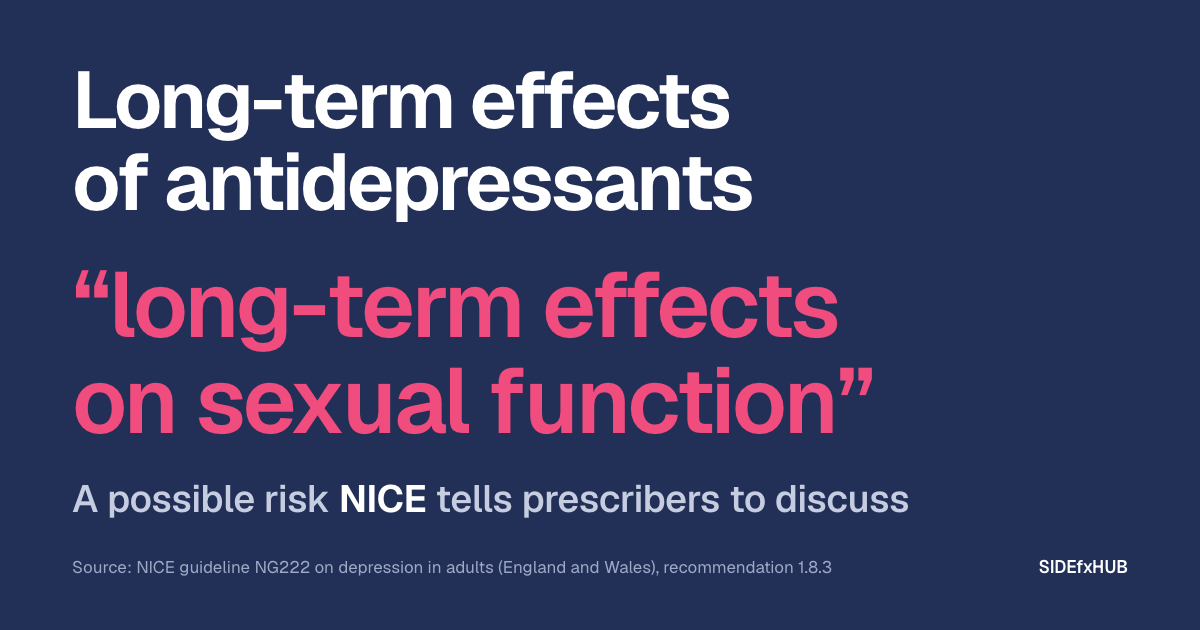
The long-term effects of antidepressants can include sexual problems: NICE names “long-term effects on sexual function” as a possible risk of staying on them. The UK sertraline leaflet warns they have sometimes continued after stopping, known as post-SSRI sexual dysfunction, or PSSD.
NICE writes the health and care guidelines for England and Wales, and it tells prescribers to discuss these risks with people who stay on an antidepressant long term. If nobody has raised sex with you, you can raise it yourself.
The story in 3 lines
- NICE lists potential risks of staying on antidepressants long term. Among them: “an increased bleeding risk or long-term effects on sexual function”.
- The UK sertraline leaflet says sexual symptoms have in some cases “continued after stopping treatment”.
- Nobody has measured how often (2023 review). Patients call it PSSD.
Press: contact@sidefxhub.com
Katie is from the UK. She was 21 when she was prescribed fluoxetine (Prozac), and she took it for around three years, with some gaps.

Her mood lifted at first, she says, but over time she “couldn’t feel excited or happy or enjoy anything properly”. Later she noticed a sexual problem, which she says began while she was on the medicine. She has lived with it for 14 years: she remembers sexual feelings and desires but “can’t actually access these functions any more”.
What are the long-term effects of antidepressants?
NICE names three possible risks for people who stay on them: a higher risk of bleeding, long-term effects on sexual function, and difficulty stopping.
Its guideline on depression in adults tells prescribers to discuss “the potential risks of continuing with antidepressants long term”, and how these balance against the risk of depression coming back. It lists “possible side effects, such as an increased bleeding risk or long-term effects on sexual function”, and “difficulty stopping antidepressants”.
The UK sertraline leaflet doesn’t say which side effects come with long-term use. It lists weight gain as common, and says older people may be more at risk of low sodium in the blood. It also says “an increased risk of bone fractures has been observed in patients taking this type of medicines”.
The flatness Katie describes isn’t in NICE’s list. Our article on emotional blunting on antidepressants covers it.
When side effects should come up
Do antidepressant side effects wear off over time?
Many do in the first weeks, but some can stay for as long as you take the medicine.
The Royal College of Psychiatrists says side effects are mild for most people and “usually wear off over a couple of weeks”. NICE asks prescribers to explain “how some side effects may persist throughout treatment”. It doesn’t say which ones.
An online survey in New Zealand heard from 180 people who had taken antidepressants for three years or more. About 7 in 10 reported sexual difficulties, and most said the medicine had helped their depression. They chose to take part, so that isn’t a rate for everyone.
Katie says she went back to her GP several times while she was on fluoxetine and described a sexual problem. Nobody told her it could be a side effect, she says.
Katie did raise it. A lot of women and men don’t, says the Mayo Clinic psychologist Jordan Rullo in a film. She asks them to tell their prescriber.

Can sexual problems continue after you stop antidepressants?
Yes, for some people. The UK leaflet for Lustral (sertraline) says medicines like it, called SSRIs, may cause sexual problems, and adds: “In some cases, these symptoms have continued after stopping treatment.”
In 2019 the EU medicines regulator asked for that warning on every SSRI and SNRI. What regulators say about PSSD follows what happened next.
NICE doesn’t say whether its “long-term effects on sexual function” can continue after the last tablet. The Royal College of Psychiatrists names PSSD in its patient information, and says more research is needed to understand “why this happens and how common it is”. We go through the NHS pages in what the NHS says about antidepressants and sex.
Nobody has measured how often it happens. A 2023 review of the research couldn’t find a reliable estimate. Joanna Moncrieff, professor of critical and social psychiatry at UCL, says people’s doctors may well not know about it.
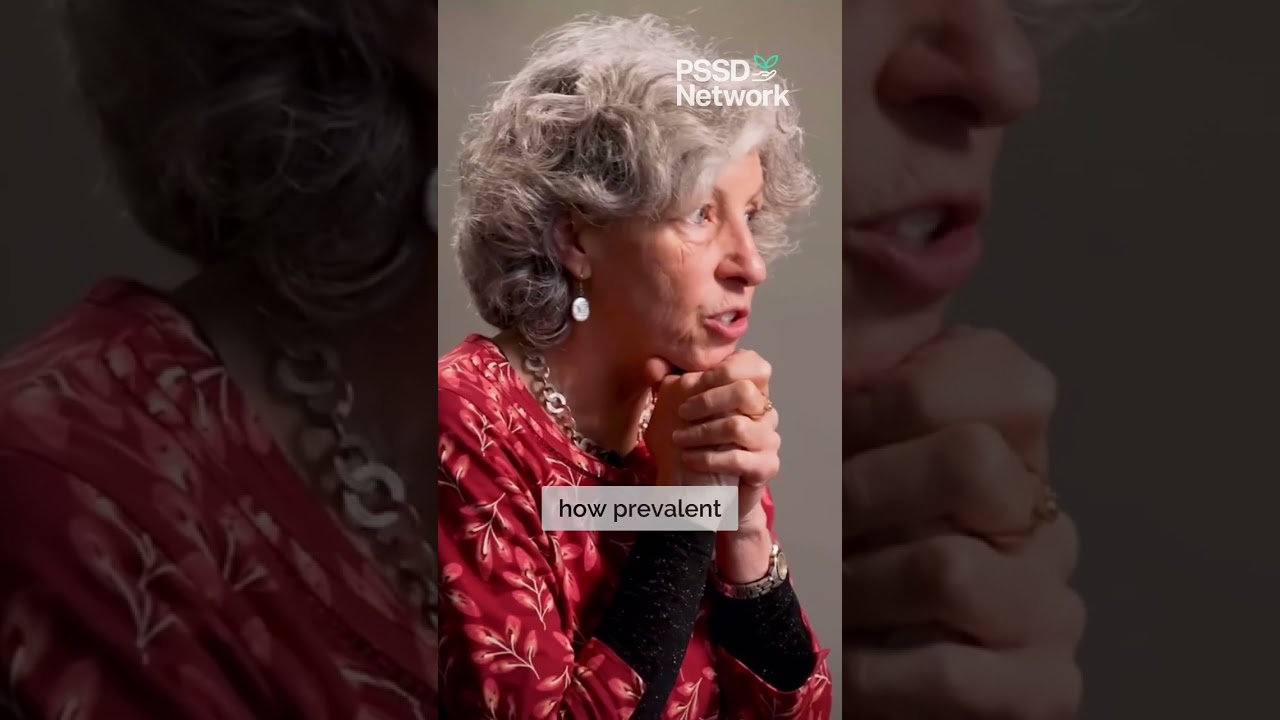
For some people it has lasted years after stopping. Nobody knows yet who will be affected, or whether it will ease. The medicine itself leaves the blood far sooner, as our article on how long sertraline stays in your system explains.
What can I do?
These medicines help many people. If you have side effects, that’s a decision for you and your prescriber. Don’t stop suddenly.
NICE says people who stay on an antidepressant to prevent a relapse should have a review at least every six months, with side effects looked at each time. You can bring up sex at a review even if nobody asks. Say what changed and when: “Sertraline 100 mg since March 2021. Orgasm weaker since that summer.”
If a problem has lasted since you stopped, give your dates too: “Last tablet 14 June 2026.”
Many people say it took time to be taken seriously. Bring the leaflet line. You can report it without a doctor agreeing.
Report it: it helps everyone
A doctor’s note helps you. A report to the medicines regulator helps everyone else: it is how patterns get noticed.
- No proof needed. A suspicion is enough, even years after stopping.
- Where: the Yellow Card scheme in the UK, MedWatch in the US.
- Use the right words. If symptoms continued after stopping, write Post-SSRI sexual dysfunction (MedDRA 10086208).
Our reporting guide walks you through it
What else do people ask?
Is it safe to take antidepressants for years? NICE’s guideline gives no yes or no. It tells prescribers to discuss with people that continuing treatment “may reduce their risk of relapse and may help them stay well”, and to discuss “the potential risks of continuing with antidepressants long term”.
How many people take antidepressants long term? In England, about 930,000 people had been on an antidepressant prescription without a break for at least three years by March 2018, a Public Health England review found. It counted prescriptions, so it can’t say how those people were doing.
Are lasting sexual problems a kind of withdrawal? The UK leaflet treats them separately, under two headings: “Withdrawal reactions” and “Sexual problems”. It says withdrawal reactions are common, and that the risk depends partly on how long you’ve taken the medicine. Our article on PSSD or withdrawal sets the two side by side.
Nobody told Katie. If sex has changed since you started an antidepressant, or hasn’t come back since you stopped, start with our page on post-SSRI sexual dysfunction.
Sources
- National Institute for Health and Care Excellence (NICE), Depression in adults: treatment and management, NICE guideline NG222, published 29 June 2022, last reviewed 30 January 2026. NICE describes its guidelines as “evidence-based recommendations for health and care in England and Wales” (About NICE guidelines). Recommendation 1.8.3 opens: “Discuss with people the potential risks of continuing with antidepressants long term, and how these balance against the risks of depression relapse”. Its list follows: “These include: possible side effects, such as an increased bleeding risk or long-term effects on sexual function; difficulty stopping antidepressants”. Recommendation 1.8.1 says continuing treatment “may reduce their risk of relapse and may help them stay well”. It also says: “Reach a shared decision on whether or not to continue a treatment for depression”. Recommendation 1.8.11 asks for a review “at least every 6 months” for people continuing antidepressants to prevent relapse. Each review should “review any side effects”. Recommendation 1.4.10 covers the talk before starting. It names side effects people “would particularly like to avoid (for example, weight gain, sedation, effects on sexual function)”. Recommendation 1.4.11 asks for information on “how some side effects may persist throughout treatment”. The only other mention of sexual effects is about antipsychotic medicines (1.4.34). Wording checked on 12 October 2026.
- Lustral 50 mg and 100 mg film-coated tablets (sertraline), patient information leaflet, Viatris, electronic medicines compendium (emc 2835), last revised December 2025. Section 2, “Sexual problems”: “Medicines like Lustral (so called SSRIs) may cause symptoms of sexual dysfunction (see section 4). In some cases, these symptoms have continued after stopping treatment”. Section 2, “Withdrawal reactions”: they “are common, particularly if the treatment is stopped suddenly”. The same section: “The risk of withdrawal symptoms depends on the length of treatment, dosage, and the rate at which the dose is reduced”. On sodium: “If you are elderly as you may be more at risk of having low sodium level in your blood”. Section 4 lists “weight increased” under common side effects, which may affect up to 1 in 10 people. It ends: “An increased risk of bone fractures has been observed in patients taking this type of medicines”. The prescribing information for the same medicine (emc 1070, revised December 2025) says that finding comes from studies “mainly conducted in patients 50 years of age and older”.
- Royal College of Psychiatrists, Antidepressants, patient information, published March 2025. Side effects “will be mild for most people”. They “will also usually wear off over a couple of weeks as your body gets used to the medication”. On PSSD: “Rarely people can experience more persistent sexual side-effects after they have stopped taking SSRIs”. It adds that the term PSSD “has been used by some people to describe these symptoms”. And: “More research is needed to understand why this happens and how common it is”. The word “rarely” is the college’s own. No study has measured how often.
- Cartwright C, Gibson K, Read J, Cowan O, Dehar T. Long-term antidepressant use: patient perspectives of benefits and adverse effects. Patient Prefer Adherence 2016;10:1401-7. An anonymous online survey in New Zealand, advertised through the media; 180 adults who had taken antidepressants for 3 to 15 years. Sexual difficulties: 125 of 174 who answered (71.8%). Antidepressants reduced their depression: 160 of 179 (89.4%). Self-reported, and not a random sample.
- European Medicines Agency, PRAC, recommendations on signals adopted at the 13-16 May 2019 PRAC meeting, EMA/PRAC/265212/2019, section 1.3, “Persistent sexual dysfunction after drug withdrawal”, adopted 16 May 2019. Warning text for six SSRIs and four SNRIs.
- Tarchi L, Merola GP, Baccaredda-Boy O and colleagues. Selective serotonin reuptake inhibitors, post-treatment sexual dysfunction and persistent genital arousal disorder: a systematic review. Pharmacoepidemiol Drug Saf 2023;32(10):1053-67. “It was not possible to determine reliable estimates of prevalence”. The review also says a cause-and-effect link could not be established from the studies it found.
- Public Health England, Prescribed medicines review: summary, updated 3 December 2020. Section 2.4: 930,000 people received an antidepressant prescription continuously between April 2015 and March 2018. The review also says some patients need long-term antidepressants “to maintain benefit and prevent relapse”.
- Moral Medicine, I Lost My Sexual Identity After Prozac, film with Katie, 26 May 2026, 10 minutes. The title is the channel’s. Prescribed at 21 and “around 3 years with some gaps” at 0:40. Her mood lifting, then “couldn’t feel excited or happy or enjoy anything properly”, at 2:48 to 3:08. The sexual problem “which started while taking fluoxetine” at 3:08. Going back to her GP “several times” at 4:06. “I can’t actually access these functions any more” at 6:04 to 6:10. “For 14 years” at 6:14. Embedded from 0:35 to 3:14. Her story on our site: Katie’s story: 14 years after Prozac.
- Mayo Clinic, Dr. Jordan Rullo discusses antidepressants and sexual dysfunction, 5 October 2016. Mayo’s news page of the same date calls her a “Mayo Clinic psychologist”. Embedded to stop at 0:33.
- PSSD Network, Professor Joanna Moncrieff discusses Post-SSRI Sexual Dysfunction, 25 June 2026, 89 seconds. Embedded from 1:04 to the end. Joanna Moncrieff is Professor of Critical and Social Psychiatry at University College London. The views are her own.
This information does not replace medical advice. Talk to your doctor before you make any decision about your treatment.
610+ people have joined the community.
Join them, then report your side effects.
Free. Sign up takes 2 minutes.