NHS on antidepressant sexual side effects
The NHS says sexual problems from antidepressants may carry on after stopping. UK leaflets for SSRIs have warned of it since 2019. That is called PSSD.
SIDEfxHUB is a patient charity. We are not health professionals, and this does not replace medical advice. Don't start, stop or change any medicine because of what you read here. Talk to your doctor first.
If you are in crisis:116 123 Samaritans (UK)988 Lifeline (US)Find a helpline
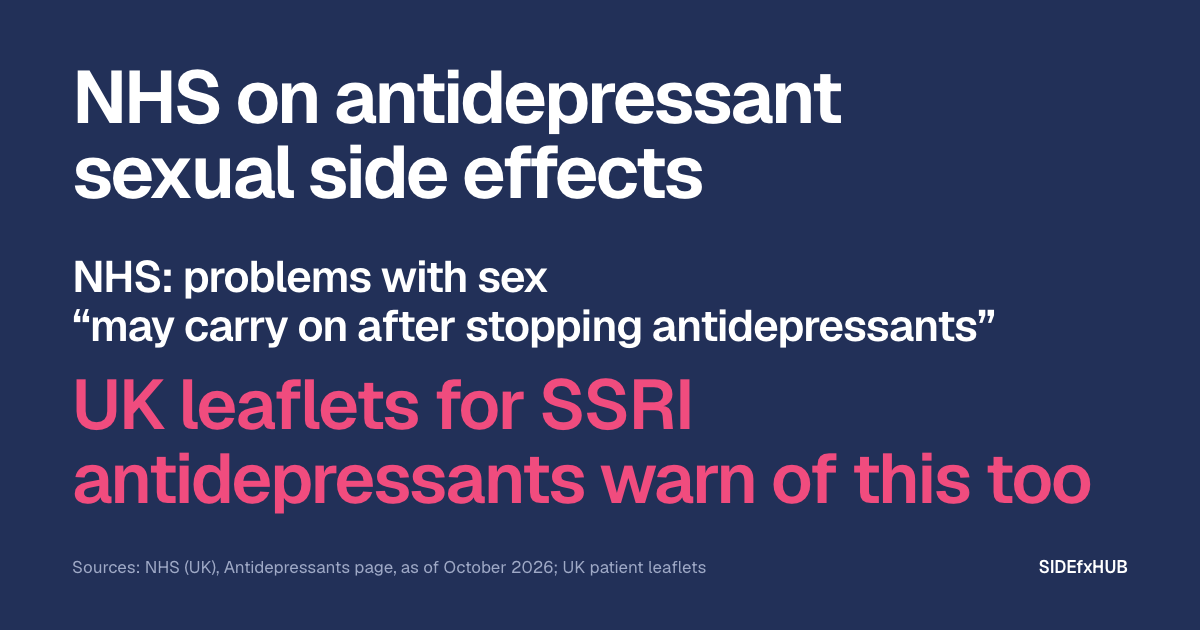
The NHS lists problems with sex, such as low sex drive and difficulty reaching orgasm, as a common side effect of antidepressants. Its antidepressants page says that for some people they may carry on after stopping; when they do, it’s called post-SSRI sexual dysfunction, or PSSD.
That line is new. Copies of the page saved by the Internet Archive show it appeared in late August 2026, so it’s worth reading again if you looked before then.
The story in 3 lines
- The NHS says problems with sex “may carry on after stopping antidepressants” (NHS, as of October 2026).
- UK leaflets for SSRI antidepressants have warned of this since 2019 (government answer).
- Nobody has measured how often it happens (2023 review). Patients call it PSSD.
Press: contact@sidefxhub.com
Connor, not his real name, started sertraline in his 30s. His first side effect, he told BBC News in 2023, was “total genital numbness”.

“The problem for me,” he says in the film, “is that these effects have persisted for 12 months after stopping taking sertraline.”
What does the NHS say about antidepressant sexual side effects?
It lists them among the common side effects. The NHS page on antidepressants names low sex drive, finding it difficult to orgasm, vaginal dryness, and finding it difficult to get or keep an erection.
Then it adds: “for some people, these problems may carry on after stopping antidepressants”. That’s the wording as of October 2026.
The page tells you what to do as well. Talk to your doctor if side effects are hard to manage, it says. You can report any suspected side effect through the Yellow Card scheme.
The NHS also has a page for each of the seven SSRI and SNRI antidepressants it names, from sertraline and citalopram to venlafaxine. If you searched for your own medicine, that’s the page you’ll have seen. We read all seven on 12 October 2026.
Each one gives “sexual problems, such as low sex drive (loss of libido)” as a common side effect. Each says its list isn’t the full one, and sends you to the leaflet that comes with your medicine.
What does the leaflet in my pack say?
It carries the warning in one line. The UK leaflet for Lustral, a brand of sertraline, says: “In some cases, these symptoms have continued after stopping treatment.”
UK leaflets for SSRIs have had that line since 2019. The EU medicines regulator asked for it that year, and the UK made the same change. Other countries word their warnings differently.
In the leaflet, the line comes early, well before the list of side effects. The steps below show where to look. Our article on sertraline’s sexual side effects goes through the rest of that leaflet.
Find the line in your own leaflet
It's in the pack. The NHS also points to the electronic medicines compendium website (medicines.org.uk/emc), where you can search for it.
“What you need to know before you take” your medicine.
The heading is “Sexual problems” or “Sexual dysfunction”.
“In some cases, these symptoms have continued after stopping treatment.”
What does NICE say about antidepressants and sexual function?
It asks prescribers to talk about side effects with you before you start. NICE writes the guidance that NHS prescribers in England work from.
Its guideline on depression in adults says to discuss the possible harms, including any side effects you’d particularly like to avoid. Its examples are “weight gain, sedation, effects on sexual function”.
It also asks prescribers to talk through the risks of staying on antidepressants for a long time, and gives long-term effects on sexual function as one example. Our article on the long-term effects of antidepressants covers that.
So as of October 2026, the line about sexual problems after stopping is on the NHS antidepressants page and in the leaflet, and it isn’t on the seven medicine pages or in NICE’s recommendations. In December 2025 the UK medicines regulator said it was talking to NICE and others “to improve consistency of safety messaging”.
What can I do?
These medicines help many people. If you have side effects, that’s a decision for you and your prescriber. Don’t stop suddenly.
If the problems haven’t lifted since you stopped, tell your GP and give your dates: “Sertraline 50 mg from January 2023, last tablet March 2024.”
Many people say it took time to be taken seriously. Bring the leaflet line. You can report it without a doctor agreeing.
Report it: it helps everyone
A doctor’s note helps you. A report to the medicines regulator helps everyone else: it is how patterns get noticed.
- No proof needed. A suspicion is enough, even years after stopping.
- Where: the Yellow Card scheme in the UK, MedWatch in the US.
- Use the right words. If symptoms continued after stopping, write Post-SSRI sexual dysfunction (MedDRA 10086208).
Our reporting guide walks you through it
Our Yellow Card guide for PSSD shows the form step by step.

What else do people ask?
Does the NHS use the name PSSD? As of October 2026, the NHS antidepressants page describes the problem without a name. The Royal College of Psychiatrists’ page for patients uses the name. NHS records have had a code for it since October 2024, the government told Parliament. Our article Is PSSD real? goes through what’s recognised so far.
How long can the problems last? For some people it has lasted years after stopping. Nobody knows yet who will be affected, or whether it will ease. Doctors and researchers who wrote criteria for PSSD in 2022 say that once the problems have lasted three months after stopping, PSSD is the more likely explanation.
How often does it happen? The NHS page says “for some people” and the leaflet says “in some cases”. Neither gives a figure. A 2023 review of the research looked for a reliable estimate and couldn’t find one. Nobody has counted how often it happens yet. That’s why reports matter.
When Connor spoke to the BBC, it was a year since his last tablet and the problems hadn’t gone. If that describes you, report it: a report counts even years later.
Sources
- NHS, Antidepressants, page last reviewed 12 June 2025, read 12 October 2026. Common side effects include “problems with sex, such as low sex drive, finding it difficult to orgasm, vaginal dryness or finding it difficult to get or keep an erection – for some people, these problems may carry on after stopping antidepressants”. Also: “Talk to your doctor if you’re finding side effects hard to manage” and “You can report any suspected side effect using the Yellow Card safety scheme.” The antidepressants the page names include five SSRIs (sertraline, citalopram, escitalopram, fluoxetine, paroxetine) and two SNRIs (duloxetine, venlafaxine). “Page last reviewed” is the NHS’s own review date.
- Internet Archive (Wayback Machine) copies of the same NHS page, opened 12 October 2026. In the copy saved on 25 August 2026 the entry reads “problems with sex – such as low sex drive, finding it difficult to orgasm, or finding it difficult to get or keep an erection”. The copy saved on 28 August 2026 has today’s wording. Both copies show “Page last reviewed: 12 June 2025”, so that date does not show when the line was added. “Late August 2026” in this article rests on these two copies.
- NHS pages for the seven SSRI and SNRI antidepressants in source 1, each read 12 October 2026, among them sertraline (page last reviewed 8 September 2025), citalopram (26 June 2026) and venlafaxine (6 July 2026). Each lists “sexual problems, such as low sex drive (loss of libido)” under common side effects. Each says “These are not all the side effects” of the medicine and points to the leaflet in the pack, or to the electronic medicines compendium website to search for it.
- Lustral (sertraline) 50 mg and 100 mg film-coated tablets, patient information leaflet, Electronic Medicines Compendium (EMC 2835), last revised December 2025. Section 2, “Sexual problems”: “Medicines like Lustral (so called SSRIs) may cause symptoms of sexual dysfunction (see section 4). In some cases, these symptoms have continued after stopping treatment.” The fluoxetine leaflet (EMC 15755, revised September 2022) has the same line in section 2 under “Sexual dysfunction”.
- NICE, Depression in adults: treatment and management, guideline NG222, published 29 June 2022, last reviewed 30 January 2026 (a review of the section on treatment-resistant depression), read 12 October 2026. Recommendation 1.4.10: discuss “the harms, covering both the possible side effects and withdrawal effects, including any side effects they would particularly like to avoid (for example, weight gain, sedation, effects on sexual function)”. Recommendation 1.4.11: “how some side effects may persist throughout treatment”. Recommendation 1.8.3 covers the risks of continuing long term, with long-term effects on sexual function as one of its examples. NICE guidelines apply in England.
- MHRA, Patient and family experiences inform antidepressant safety information review, 1 December 2025. The review covered the leaflets of 28 antidepressants. “The MHRA is engaging with the National Institute for Health and Care Excellence (NICE), the British National Formulary (BNF), and the Royal Colleges of General Practice and Psychiatrists to improve consistency of safety messaging in a range of additional communications.”
- UK Parliament, written question 50758, answered by Karin Smyth MP for the Department of Health and Social Care on 13 May 2025: the product information for all SSRIs “was updated in 2019”. Written question HL7363, answered by Baroness Merron on 16 May 2025: a code was added to the electronic health records system, SNOMED, in October 2024.
- European Medicines Agency, PRAC, new product information wording, signals adopted at the 13–16 May 2019 meeting, EMA/PRAC/265221/2019. The package leaflet wording for SSRIs and SNRIs.
- Royal College of Psychiatrists, Antidepressants, information for patients, published March 2025. It says the term “post SSRI sexual dysfunction” (PSSD) “has been used by some people to describe these symptoms”.
- Tarchi L, Merola GP, Baccaredda-Boy O and colleagues. Selective serotonin reuptake inhibitors, post-treatment sexual dysfunction and persistent genital arousal disorder: a systematic review. Pharmacoepidemiol Drug Saf 2023;32(10):1053-67. “It was not possible to determine reliable estimates of prevalence.”
- Healy D, Bahrick A, Bak M and colleagues. Diagnostic criteria for enduring sexual dysfunction after treatment with antidepressants, finasteride and isotretinoin. Int J Risk Saf Med 2022;33(1):65-76. “Once dysfunction lasts for three months, it is more likely to be PSSD.”
- BBC News, Antidepressants: Should we talk about side-effects?, reported by Anton Ferrie, posted 11 August 2023 (12 minutes 30 seconds), embedded here as an extract from 5:54 to 6:57. Connor’s words are from the film’s captions at 5:54 and 6:48. Connor is a pseudonym; his age when he started is from the BBC’s article, Antidepressants: I wasn’t told about the side effects, 9 August 2023. That article also tells of a young man’s death by suicide. If you’re struggling, the Samaritans are on 116 123 in the UK.
- NHS Black Country Integrated Care Board, What is the Yellow Card Scheme?, Medicine Safety Week, YouTube, 4 November 2021.
This information does not replace medical advice. Talk to your doctor before you make any decision about your treatment.
610+ people have joined the community.
Join them, then report your side effects.
Free. Sign up takes 2 minutes.