No sex drive after stopping antidepressants
Low libido after stopping antidepressants usually lifts. UK leaflets warn it has sometimes continued. When it does, it's called PSSD.
SIDEfxHUB is a patient charity. We are not health professionals, and this does not replace medical advice. Don't start, stop or change any medicine because of what you read here. Talk to your doctor first.
If you are in crisis:116 123 Samaritans (UK)988 Lifeline (US)Find a helpline
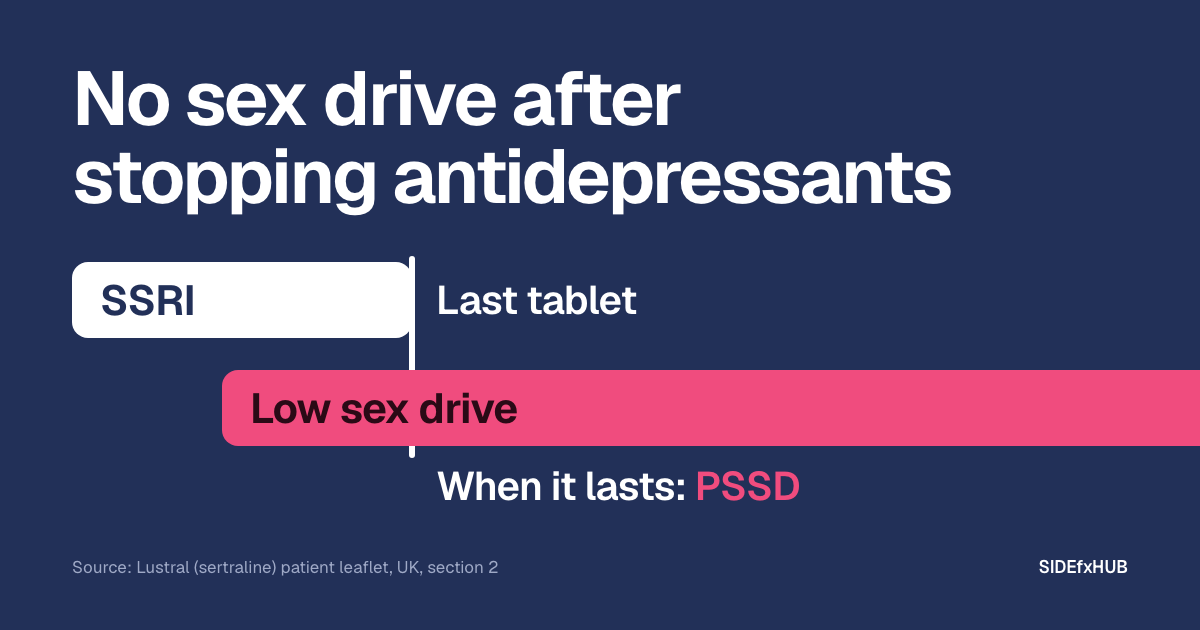
A lower sex drive is a common side effect of antidepressants, and for most people it comes back after they stop. UK leaflets for SSRIs warn that sexual problems have sometimes continued after stopping, a condition known as post-SSRI sexual dysfunction, or PSSD.
Waiting a few weeks makes sense, because the usual sexual side effects can linger after the last tablet. If your sex drive still hasn’t come back three months after stopping, PSSD is more likely, say the researchers who wrote the criteria for diagnosing it.
The story in 3 lines
- A lower sex drive is a common side effect of SSRIs, and it usually goes once the tablets stop (New Zealand's regulator).
- UK leaflets for SSRIs warn that sexual problems have sometimes continued after stopping (sertraline leaflet).
- Nobody has measured how often (review). When it lasts, it's called PSSD.
Press: contact@sidefxhub.com
Grant took Lexapro (escitalopram) for about a month in 2022, for anxiety and trouble sleeping. A month after his last tablet, the sexual side effects were still there, so he saw a urologist. He was told to wait a little longer, because side effects like his can take time to go.

Before Lexapro, his sex drive had been very high. “I have no libido whatsoever,” he says, and he describes genital numbness too. About two years after stopping, he hadn’t seen “a single improvement”.
Will my sex drive come back after stopping antidepressants?
For most people, yes. Sexual side effects usually last as long as the medicine is taken, then go once it stops, says a 2026 paper by New Zealand’s medicines regulator.
A lower sex drive is one of them. The UK sertraline leaflet lists “decreased sexual interest” as a common side effect, along with erection problems. Antidepressants can cause other sexual problems too.
How long to wait is the harder question. The doctors and researchers who wrote the 2022 criteria for diagnosing PSSD say the usual sexual side effects may linger “for some days or weeks” after the last tablet. Once the problems have lasted three months, they say, PSSD is more likely.
So the advice Grant got fitted the first few weeks. Three months after his last tablet, nothing had improved.
Grant's sex drive after Lexapro
Can low libido last after stopping antidepressants?
Yes, for some people. The UK sertraline leaflet says that in some cases, sexual symptoms “have continued after stopping treatment”. In 2019 the EU medicines regulator asked for a warning on every SSRI and SNRI.
The Dutch drug-safety centre Lareb looked at reports from people whose sexual problems hadn’t lifted after stopping an SSRI. Lost desire was often part of what stayed: about 6 in 10 described a lost or lower sex drive. In one report, the problems had lasted 23 years.
Nobody has measured how often this happens. A 2023 review of the research couldn’t find a reliable estimate.
Is it PSSD or just a low sex drive?
How touch feels is the main clue. The one symptom the 2022 criteria require for PSSD is a lasting change in genital feeling after the tablets stop. Losing desire is on their list as well.
People describe that change in two ways. The genitals feel numb, as if anaesthetised, or touch there feels like touch anywhere else on the body. Orgasm can lose its pleasure too.
The authors warn that the change in feeling “may be hidden beneath” a loss of desire, and they want doctors to ask about it directly. Grant describes both.
In a 2026 UK study of people with PSSD, everyone interviewed described genital numbness, a loss of interest in sex, or both.
One man, called Frank in the study, told a friend he had “no libido”. The friend said most men their age lose a bit. “I’ve lost all of it,” Frank says.
What can I do?
These medicines help many people. If you have side effects, that’s a decision for you and your prescriber. Don’t stop suddenly.
If your sex drive hasn’t come back since you stopped, tell your GP. Give your dates and say exactly what changed: “Sertraline 50 mg from January 2023, last tablet March 2024. No sex drive since, and touch feels numb.”
Many people say it took time to be taken seriously. Bring the leaflet line. You can report it without a doctor agreeing.

Report it: it helps everyone
A doctor’s note helps you. A report to the medicines regulator helps everyone else: it is how patterns get noticed.
- No proof needed. A suspicion is enough, even years after stopping.
- Where: the Yellow Card scheme in the UK, MedWatch in the US.
- Use the right words. If symptoms continued after stopping, write Post-SSRI sexual dysfunction (MedDRA 10086208).
Our reporting guide walks you through it
What else do people ask?
Could it be my depression? It can play a part. Depression itself often lowers sex drive, the New Zealand paper notes, and the PSSD criteria ask what sex was like before the medicine. In one report to Lareb, a woman wrote that her depression had lifted but her “sex drive is still close to zero”.
Is PSSD permanent? For some people it has lasted years after stopping. Nobody knows yet who will be affected, or whether it will ease. How many people fully recover “has never been properly investigated”, the researchers David Healy and Dee Mangin wrote in 2024. There’s more on our PSSD page, and in our article on whether SSRI sexual side effects go away.
Does it happen to women? Yes. Women commonly describe it as a loss of libido, while men sometimes call it erectile dysfunction, Healy and Mangin write. People don’t always mention changes in genital feeling unless someone asks. Our page on PSSD in women explains why women’s symptoms can be missed.
Grant was told to wait, and two years later nothing had improved. If your sex drive hasn’t come back, you don’t have to wait to report it: a suspicion is enough.
Sources
- Lustral 50 mg and 100 mg film-coated tablets, patient information leaflet, last revised December 2025. Electronic Medicines Compendium. Section 2, “Sexual problems”: “In some cases, these symptoms have continued after stopping treatment.” Section 4: decreased sexual interest and erectile dysfunction are listed as common (may affect up to 1 in 10 people).
- Medsafe, Update on sexual dysfunction following discontinuation of serotonin reuptake inhibitors, paper for the Medicines Adverse Reactions Committee, 11 June 2026. Section 2.2.2: sexual side effects “usually persist for as long as the medicine is taken and resolve after discontinuation”. Section 2.2.1: sexual problems in depression, mainly low sex drive. Section 3.3.1: summary of the Lareb reports, including the quoted report from a woman aged 31 to 40 after citalopram.
- Healy D, Bahrick A, Bak M and colleagues. Diagnostic criteria for enduring sexual dysfunction after treatment with antidepressants, finasteride and isotretinoin. Int J Risk Saf Med 2022;33(1):65-76. An expert consensus. Necessary criteria: prior treatment with a serotonin reuptake inhibitor, and an enduring change in genital sensation after treatment stops; an enduring loss of sexual desire is an additional criterion. Ordinary sexual side effects “may linger for some days or weeks”; at three months, PSSD is more likely. Changes in genital sensation “may be hidden beneath symptoms of loss of sexual desire or arousal”.
- European Medicines Agency, PRAC, recommendations on signals adopted at the 13-16 May 2019 PRAC meeting, EMA/PRAC/265212/2019, section 1.3, adopted 16 May 2019. Warning text for six SSRIs and four SNRIs.
- Chinchilla Alfaro K, van Hunsel F, Ekhart C. Persistent sexual dysfunction after SSRI withdrawal: a scoping review and presentation of 86 cases from the Netherlands. Expert Opin Drug Saf 2022;21(4):553-561. Reports to the Netherlands Pharmacovigilance Centre Lareb, 1992 to 2021: loss or decreased libido in 53 of 86 reports (62%); the longest case had lasted 23 years. Spontaneous reports: a count of what people described, not a rate.
- Tarchi L, Merola GP, Baccaredda-Boy O and colleagues. Selective serotonin reuptake inhibitors, post-treatment sexual dysfunction and persistent genital arousal disorder: a systematic review. Pharmacoepidemiol Drug Saf 2023;32(10):1053-67.
- Brugi S, Budd B, Mackie C, Fish S. “It’s taken away the most fundamental things about being human”: the lived experience and impact of post-SSRI sexual dysfunction. Int J Qual Stud Health Well-being 2026;21(1):2717470, published online 13 August 2026. University of East Anglia; interviews with ten people in the UK. Frank is a pseudonym (male, aged 50 to 59). Open access, CC BY 4.0.
- Healy D, Mangin D. Post-SSRI sexual dysfunction: barriers to quantifying incidence and prevalence. Epidemiol Psychiatr Sci 2024;33:e40. On how men and women describe it, symptoms not volunteered unless asked about, and recovery never properly investigated.
- Videos: Moral Medicine, interview with Grant on PSSD after Lexapro, 24 June 2024; NHS Black Country Integrated Care Board, What is the Yellow Card Scheme?, 4 November 2021.
This information does not replace medical advice. Talk to your doctor before you make any decision about your treatment.
590+ people have joined the community.
Join them, then report your side effects.
No diagnosis needed. Researchers never see your name.