Orgasm with no pleasure after SSRIs
SSRIs can make orgasm feel muted, with little or no pleasure. UK leaflets warn sexual problems have sometimes continued after stopping. That is PSSD.
SIDEfxHUB is a patient charity. We are not health professionals, and this does not replace medical advice. Don't start, stop or change any medicine because of what you read here. Talk to your doctor first.
If you are in crisis:116 123 Samaritans (UK)988 Lifeline (US)Find a helpline
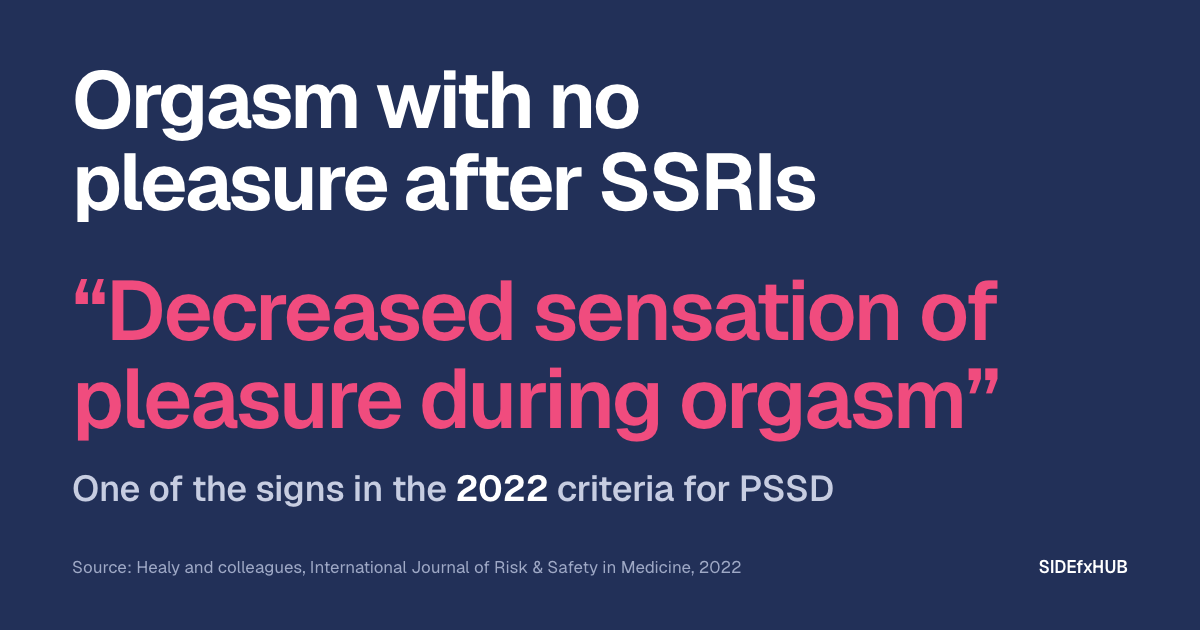
SSRI antidepressants can mute orgasm, so it still happens but brings little or no pleasure. UK leaflets warn that sexual problems have sometimes continued after stopping, a condition called post-SSRI sexual dysfunction, or PSSD.
UK SSRI leaflets list orgasms that are hard to reach or never come. None of the five we checked mentions an orgasm that comes but feels like nothing, though researchers count it as a sign of PSSD.
The story in 3 lines
- SSRIs often change orgasm. The UK Seroxat leaflet lists "lack of orgasm" as a very common side effect.
- UK leaflets warn that sexual problems have sometimes continued after stopping. The fluoxetine leaflet names orgasm problems.
- Less pleasure during orgasm is one of the signs in the 2022 criteria for PSSD. Nobody has measured how often it happens.
Press: contact@sidefxhub.com
Lee took sertraline for about 18 months, for panic attacks and depression. A few months after he came off it, he realised he was “getting no pleasure from ejaculation”. His body felt “completely empty of feelings and tingles”, he says in an account published by the patient group PSSD Network.
Four years on, his emotions had come back. His orgasms were “still terribly blunted”. No one understands, he says, not even his doctor.
What does an orgasm with no pleasure feel like?
The body still goes through orgasm, but the good feeling is faint or missing. Researchers who studied reports to the drug-safety website RxISK describe “a set of rhythmic muscle contractions with little accompanying sensation”. Men may also notice they ejaculate with less force.
In those reports, about 4 in 10 of the men whose sexual problems had lasted after an antidepressant described a pleasureless or weak orgasm. People chose to send the reports in, so they show what people describe, not how often it happens.
Doctors call it anhedonic orgasm. Anhedonia means losing the ability to feel pleasure. For some people with PSSD, it reaches beyond sex.
It can come with other sexual problems. Lee lost his sex drive too.
In the clip below, Cobi Reisman, a urologist and sexologist in the Netherlands, lists “unpleasurable orgasm” among the signs of PSSD.
Can it last after stopping an SSRI?
Yes, for some people. A UK leaflet for fluoxetine, the medicine in Prozac, lists “sexual problems, including orgasm problems, occasionally persisting after treatment discontinuation”. All five UK SSRI leaflets we checked share one line: in some cases, sexual symptoms “have continued after stopping treatment”.
For some, it starts on the tablets. A 2021 survey asked people with PSSD about their time on the medicine. More than half reported “muted or pleasureless orgasms” while still taking it, says a summary by New Zealand’s medicines regulator. Lee only noticed it after he stopped.
What happened to Lee
Doctors and researchers proposed criteria for diagnosing PSSD in 2022. They include “decreased sensation of pleasure during orgasm” that’s still there three months or more after stopping.
Nobody has measured how often it happens. A 2023 review of the research couldn’t find a reliable estimate.
Why does orgasm feel weaker since I stopped?
Because getting orgasm back isn’t always the same as getting the feeling back. Some people can’t reach orgasm on an antidepressant, then can again once they stop.
But “it will often feel weaker than before”, write the researchers David Healy and Dee Mangin. People can easily put that down to getting older, they add.
A weaker orgasm still counts. If sex hasn’t fully returned to how it was before the medicine, the 2022 criteria say it should be classed as PSSD, even when the problem is mild.
It can also go unsaid. Changes in how intense orgasm feels “are not always volunteered unless asked about directly”, Healy and Mangin write. A 2026 guide for doctors lists orgasm without pleasure among the most useful signs, and asks doctors to follow up with direct questions.
Saying it out loud can be hard, even at home. In a 2026 UK study, a man the researchers call Thomas remembers his partner asking, “do you not feel pleasure?” “I don’t feel pleasure,” he says. “But I can’t say that.”
What can I do?
These medicines help many people. If you have side effects, that’s a decision for you and your prescriber. Don’t stop suddenly.
If orgasm has felt muted since you stopped, tell your GP and say exactly what changed: “Sertraline 50 mg from January 2023, last tablet March 2024. Orgasm still happens, but there’s almost no pleasure. It was normal before 2023.”
Many people say it took time to be taken seriously. Bring the leaflet line. You can report it without a doctor agreeing.

Report it: it helps everyone
A doctor’s note helps you. A report to the medicines regulator helps everyone else: it is how patterns get noticed.
- No proof needed. A suspicion is enough, even years after stopping.
- Where: the Yellow Card scheme in the UK, MedWatch in the US.
- Use the right words. If symptoms continued after stopping, write Post-SSRI sexual dysfunction (MedDRA 10086208).
Our reporting guide walks you through it
What else do people ask?
Could it be my depression? It can play a part. Depression mostly lowers sex drive, and orgasm problems are less common, notes a 2026 paper by New Zealand’s medicines regulator. In one survey run through a PSSD forum, orgasms with little pleasure went along with depression. Genital numbness didn’t. So tell your doctor how your mood is, and whether touch feels numb as well.
Does it happen to women? Yes. The 2022 criteria apply to women and men alike. In the reports to RxISK, about 1 in 4 of the women who had taken an antidepressant described a pleasureless or weak orgasm. Our page on PSSD in women explains why women’s symptoms can be missed.
Is it permanent? For some people it has lasted years after stopping. Nobody knows yet who will be affected, or whether it will ease. How many people get the full feeling back “has never been properly investigated”, Healy and Mangin wrote in 2024. There’s more on our PSSD page.
Lee’s emotions came back, but four years on his orgasms were still blunted. If yours have felt muted since your last tablet, report it, and say plainly that the pleasure has gone.
Sources
- Seroxat 10 mg, 20 mg and 30 mg film-coated tablets (paroxetine), patient leaflet, Electronic Medicines Compendium (EMC 7592), last revised October 2024. Section 2: “In some cases, these symptoms have continued after stopping treatment.” Section 4, very common (more than 1 in 10 people): “Change in sex drive or sexual function. For example, lack of orgasm and, in men, abnormal erection and ejaculation.”
- Fluoxetine 20 mg hard capsules, patient leaflet, EMC 15755, last revised September 2022. Section 2, “Sexual dysfunction”; section 4, uncommon: “sexual problems, including orgasm problems, occasionally persisting after treatment discontinuation”.
- Also checked: Lustral (sertraline, EMC 2835, revised December 2025), Cipralex (escitalopram, EMC 7718, revised May 2025) and Cipramil Drops (citalopram, EMC 1392, revised January 2025). Each has the same section 2 line. Cipralex lists “difficulties achieving orgasm” in women, Cipramil “failing to reach an orgasm” and Lustral “ejaculation failure”. None of the five mentions pleasure at orgasm.
- Healy D, Le Noury J, Mangin D. Enduring sexual dysfunction after treatment with antidepressants, 5α-reductase inhibitors and isotretinoin: 300 cases. Int J Risk Saf Med 2018;29(3-4):125-134. Reports to RxISK.org from 37 countries. Pleasureless or weak orgasm after serotonin reuptake inhibitors: 73 of 171 men (43%) and 13 of 50 women (26%). Self-selected reports: a count of what people described, not a rate.
- Trost L, Rowland D, Meston C and colleagues. Definitions, classification, and epidemiology of sexual dysfunction: a consensus statement from the Fifth International Consultation on Sexual Medicine 2024. Sex Med Rev 2026;14(2):qeag028. Lists “anhedonic/hypohedonic orgasm” among its definitions.
- Peleg LC, Rabinovitch D, Lavie Y and colleagues. Post-SSRI sexual dysfunction (PSSD): biological plausibility, symptoms, diagnosis, and presumed risk factors. Sex Med Rev 2022;10(1):91-98. Orgasmic and ejaculatory anhedonia; non-sexual symptoms including anhedonia.
- Healy D, Bahrick A, Bak M and colleagues. Diagnostic criteria for enduring sexual dysfunction after treatment with antidepressants, finasteride and isotretinoin. Int J Risk Saf Med 2022;33(1):65-76. Additional criterion 5: “Enduring inability to orgasm or decreased sensation of pleasure during orgasm”; criterion 6: present three months or more after stopping. Persisting effects, severe or mild, “should be classified as PSSD if there hasn’t been a full return to pre-drug baseline”.
- Medsafe, Update on sexual dysfunction following discontinuation of serotonin reuptake inhibitors, paper for the Medicines Adverse Reactions Committee, 11 June 2026. Section 3.2.5 summarises Studt and colleagues: more than 50% reported “muted or pleasureless orgasms” while taking a serotonin reuptake inhibitor. Section 2.2.1.2: sexual problems in depression are mainly low sex drive, with orgasm problems less common.
- Studt A, Gannon M, Orzel J, Vaughan A, Pearlman AM. Characterizing post-SSRI sexual dysfunction and its impact on quality of life through an international online survey. Int J Risk Saf Med 2021;32(4):321-329. 239 people from an online PSSD support group. The full text is not open access and its abstract does not give the orgasm figure, so the article gives that figure as Medsafe summarises it (source 8).
- Tarchi L, Merola GP, Baccaredda-Boy O and colleagues. Selective serotonin reuptake inhibitors, post-treatment sexual dysfunction and persistent genital arousal disorder: a systematic review. Pharmacoepidemiol Drug Saf 2023;32(10):1053-67.
- Healy D, Mangin D. Post-SSRI sexual dysfunction: barriers to quantifying incidence and prevalence. Epidemiol Psychiatr Sci 2024;33:e40. On orgasm that returns but feels weaker, changes put down to ageing, orgasm intensity not volunteered unless asked, and full recovery never properly investigated.
- Broul M, Hujová A, Liegertová M, Langmaierová K, Albrecht J. Persistent sexual dysfunction after SSRIs and SNRIs: a clinical framework for assessment, counseling, and pharmacovigilance. J Sex Marital Ther, published online 2 September 2026. “Orgasmic or ejaculatory anhedonia” named among “high-value clinical features”; recommends “direct follow-up questioning”.
- Brugi S, Budd B, Mackie C, Fish S. “It’s taken away the most fundamental things about being human”: the lived experience and impact of post-SSRI sexual dysfunction. Int J Qual Stud Health Well-being 2026;21(1):2717470. University of East Anglia; interviews with ten people in the UK, with written consent. Thomas is a pseudonym (male, aged 20 to 29). Open access, CC BY 4.0; full text on PubMed Central.
- Ben-Sheetrit J, Aizenberg D, Csoka AB and colleagues. Post-SSRI sexual dysfunction: clinical characterization and preliminary assessment of contributory factors and dose-response relationship. J Clin Psychopharmacol 2015;35(3):273-8. Online survey of 532 people recruited through a PSSD forum. Pleasureless orgasm predicted depression, and also how likely someone was to count as a PSSD case; genital anaesthesia was not linked to depression or anxiety.
- PSSD Network, Patient Spotlight: Lee, undated (page image from September 2023). His own account, published on the patient group’s website: sertraline from 2017 for about 18 months.
- ISSM International Society for Sexual Medicine, What is post SSRI syndrome and how is it treated?, video, 5 May 2023, five minutes. Speakers, as named on screen: Anita Clayton, a psychiatrist in the US, who gives the introduction, and Cobi Reisman, urologist and sexologist in the Netherlands. Reisman names “unpleasurable orgasm” at about 1:22. Embedded to stop at 1:34. ISSM’s description says the speakers give their own views, which are not necessarily the society’s.
- NHS Black Country Integrated Care Board, What is the Yellow Card Scheme?, video, 4 November 2021, with pharmacist Jyoti Saini.
This information does not replace medical advice. Talk to your doctor before you make any decision about your treatment.
590+ people have joined the community.
Join them, then report your side effects.
No diagnosis needed. Researchers never see your name.