Low libido in your 20s: is it a medicine?
Low sex drive in your 20s often has an everyday cause. UK leaflets for SSRIs, finasteride and isotretinoin warn sexual problems can last: PSSD, PFS, PAS.
SIDEfxHUB is a patient charity. We are not health professionals, and this does not replace medical advice. Don't start, stop or change any medicine because of what you read here. Talk to your doctor first.
If you are in crisis:116 123 Samaritans (UK)988 Lifeline (US)Find a helpline
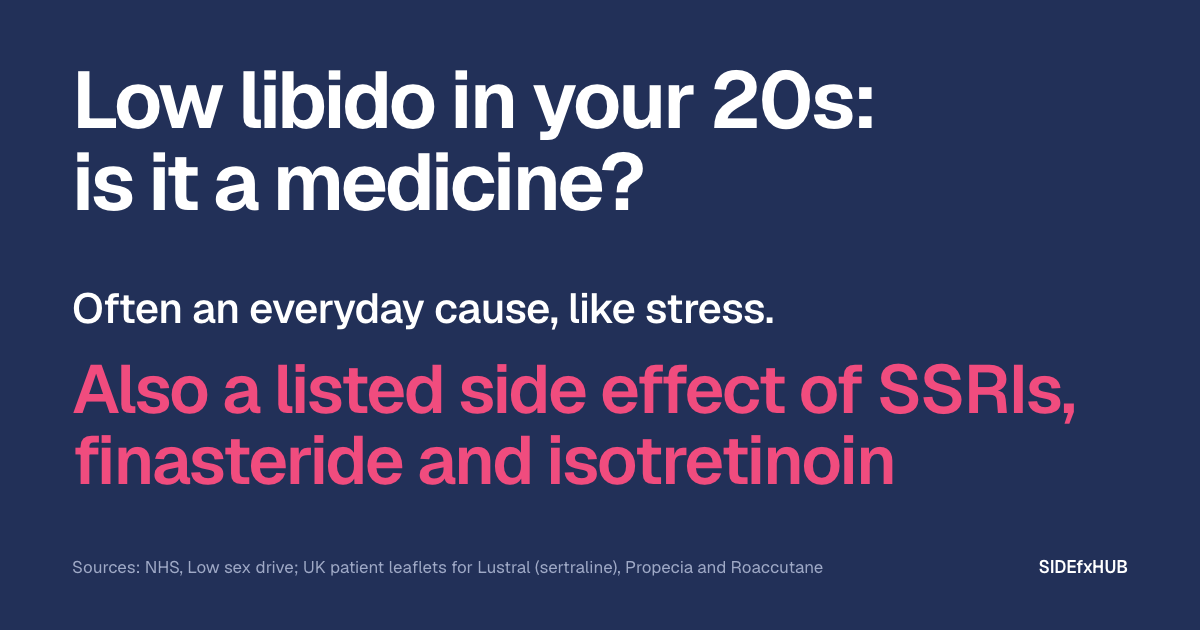
Low libido in your 20s often has an everyday cause, like stress or low mood. It’s also a listed side effect of SSRI antidepressants, finasteride and isotretinoin, and their UK leaflets warn sexual problems can last after stopping: post-SSRI sexual dysfunction (PSSD), post-finasteride syndrome (PFS) and post-Accutane syndrome (PAS).
The NHS page on low sex drive names antidepressants among the causes and says treating the cause should help. It doesn’t name finasteride (a hair-loss tablet) or isotretinoin (an acne capsule), or say the change can outlast the medicine.
The story in 3 lines
- A low sex drive has many possible causes, from stress and depression to hormonal contraception and some medicines, says the NHS.
- The UK leaflets for sertraline (an SSRI), finasteride and isotretinoin list a lower sex drive, and warn that sexual problems have continued after stopping.
- Nobody knows how often that happens, say the researchers who set out how to diagnose it. When it does, it's called PSSD, PFS or PAS.
Press: contact@sidefxhub.com
Victoria was at university, stressed and not sleeping, when a doctor prescribed her an antidepressant. She says she asked three times whether it was safe. She was on medicine for about three months.

The first change was sexual, she says: she couldn’t be aroused at all, and felt no attraction to anyone. She wrote to her doctor straight away, and was told that a slightly lower libido is common and that hers would come back. Four months after she stopped, when she was interviewed, it hadn’t.
Is it normal to have low libido in your 20s?
It’s common. A British survey of sex and relationships asked people who’d had a sexual partner in the past year. Of those aged 16 to 24, about 12 in 100 men and 25 in 100 women said they’d lacked interest in sex for three months or more that year.
The survey found it more often in people with depression or poor health. It was also more common in people who didn’t feel close to their partner during sex, or who didn’t always find it easy to talk about sex.
The NHS adds relationship problems, stress, alcohol and pregnancy. Medicines are on its list too.

Which medicines can lower your sex drive?
Quite a few can. The NHS names antidepressants, blood pressure medicines and hormonal contraception. Three medicines prescribed to people in their twenties list it in their UK leaflets:
- SSRI antidepressants, for depression or anxiety. The sertraline leaflet lists “decreased sexual interest”.
- Finasteride, the hair-loss tablet for men, sold as Propecia. Its leaflet says “you may have less desire to have sex”.
- Isotretinoin, the acne capsule sold as Roaccutane. Its leaflet lists “lower libido”.
The same leaflets list erection problems, which we cover in erectile dysfunction at 20.
It isn’t always the medicine. Depression and anxiety can lower desire on their own, so timing matters: was your sex drive different before the first dose?
Newcastle Hospitals makes the same point in its film for patients starting isotretinoin. It says reduced libido has been reported during and after treatment, and that the evidence is sparse. Mental health and other medicines can play a part, it adds.

Can a medicine cause permanent low libido?
For some people it has lasted years after stopping. Nobody knows yet who will be affected, or whether it will ease.
All three leaflets carry a warning. The Propecia leaflet lists a “persistent decrease in sex drive after discontinuation of treatment”. The Roaccutane leaflet describes “long-lasting sexual problems” that continued “despite stopping treatment”.
The sertraline leaflet says that in some cases, sexual symptoms “have continued after stopping treatment”. Our article on no sex drive after stopping antidepressants looks at how long to wait.
Lost desire is a big part of what people describe. One study collected reports from people whose sexual problems had lasted after one of these medicines. About 8 in 10 described a loss of libido.
Those people chose to report to a drug-safety website, so the study can’t show how often it happens. Nobody has counted that yet.
What can I do?
These medicines help many people. If you have side effects, that’s a decision for you and your prescriber.
Don’t stop an antidepressant suddenly. For finasteride and isotretinoin, follow what the leaflet says.
If your sex drive dropped on one of these medicines, or hasn’t come back since you stopped, tell your GP. Five details help them weigh up every cause:
"Sertraline 50 mg from January 2025, last tablet June 2025."
"No interest in sex", "I don't feel attracted to anyone", "touch feels numb".
Before the medicine, while taking it, or after stopping.
"No problems before 2025."
Other medicines, contraception, alcohol, your mood, your relationship.
Many people say it took time to be taken seriously. Bring the leaflet line. You can report it without a doctor agreeing.
Report it: it helps everyone
A doctor’s note helps you. A report to the medicines regulator helps everyone else: it is how patterns get noticed.
- No proof needed. A suspicion is enough, even years after stopping.
- Where: the Yellow Card scheme in the UK, MedWatch in the US.
- Use the right words. If symptoms continued after stopping, write Post-SSRI sexual dysfunction (MedDRA 10086208) for an SSRI or SNRI, or Post 5-alpha-reductase inhibitor syndrome (MedDRA 10082430) for finasteride. For isotretinoin there’s no term yet, so say the symptoms continued after stopping.
Our reporting guide walks you through it
What else do people ask?
Could it be the contraceptive pill? It could. The NHS lists hormonal contraception, such as the pill, patch or implant, among the main causes of a low sex drive. It says to see a GP if you think yours is affecting you. Women who could get pregnant must use contraception before, during and after isotretinoin, its leaflet says. If that’s you, tell your GP about both.
Does this happen to women too? Yes. The sertraline and Roaccutane leaflets are written for women as well as men, while Propecia is for men only. In the study of patient reports, loss of libido was the symptom women described most often. Our page on PSSD in women explains why women’s symptoms can be missed.
How do I know if it’s PSSD, PFS or PAS? The researchers’ checklist looks for a sexual problem that is still there three months or more after stopping. It mustn’t have been there before the medicine, and no other condition should explain it. Read more about PSSD, PFS and PAS.
Victoria wrote to her doctor as soon as she noticed. If your sex drive changed on one of these medicines, write the dates down while you still remember them, for your GP and for your report.
Sources
- NHS, Low sex drive (loss of libido), page last reviewed 26 May 2026. “There are many possible reasons for having a low sex drive (loss of libido). Treating the cause should help increase your sex drive.” The main causes listed include relationship problems, “stress, anxiety or depression”, pregnancy and having a baby, and drinking too much alcohol. Also listed: “taking certain medicines, such as medicine for high blood pressure or antidepressants” and “using hormonal contraception like the pill, patch or implant”. See a GP if “you’re taking a medicine or using hormonal contraception and you think it may be affecting your sex drive”. Finasteride and isotretinoin are not named. The page doesn’t say a change can continue after a medicine is stopped.
- Lustral (sertraline) 50 mg and 100 mg film-coated tablets, patient leaflet, Electronic Medicines Compendium (EMC 2835), last revised December 2025. Section 2, “Sexual problems”: “In some cases, these symptoms have continued after stopping treatment.” Section 4: “decreased sexual interest” is listed as common (may affect up to 1 in 10 people).
- Propecia 1 mg film-coated tablets, patient leaflet (UK, EMC 2194), last revised May 2026. Section 4: uncommon (may affect up to 1 in 100 people), “you may have less desire to have sex”; frequency unknown, “persistent decrease in sex drive after discontinuation of treatment”. Section 2: not to be taken by women (“this medicine is for men”), and “Propecia should not be used in children.”
- Roaccutane 10 mg and 20 mg soft capsules, patient leaflet (UK, EMC 100633), last revised April 2026. Section 2: isotretinoin has been associated with sexual problems, including “lower libido”, and “There have been reports of long-lasting sexual problems where the symptoms have continued despite stopping treatment with isotretinoin.” Section 4: lower libido, frequency unknown. Section 2, pregnancy prevention: “Women must use effective contraception before, during and after taking Roaccutane”.
- Graham CA, Mercer CH, Tanton C and colleagues. What factors are associated with reporting lacking interest in sex and how do these vary by gender? Findings from the third British national survey of sexual attitudes and lifestyles. BMJ Open 2017;7(9):e016942. Natsal-3, a probability sample survey in Britain, 2010 to 2012: 4,839 men and 6,669 women aged 16 to 74 with at least one sexual partner in the past year. Lacking interest in sex for three months or more in the past year, ages 16 to 24: 11.5% of men and 24.8% of women (ages 25 to 34: 14.6% and 31.9%). Associated in both men and women with current depression, poorer self-reported general health, not feeling emotionally close to a partner during sex and not finding it “always easy to talk about sex” with a partner. A survey at one point in time: it shows links, not causes, and it did not ask about these three medicines.
- Healy D, Le Noury J, Mangin D. Enduring sexual dysfunction after treatment with antidepressants, 5α-reductase inhibitors and isotretinoin: 300 cases. Int J Risk Saf Med 2018;29(3-4):125-134. Reports made by patients to RxISK.org, a drug-safety website set up by the authors and colleagues, from 37 countries; ages 15 to 66. Loss of libido: 193 of 245 men and 41 of 55 women (234 of 300, 78%); it was the most commonly reported symptom in women and the second most in men. Twenty reports were left out for lack of detail, for example ones that described only a loss of libido. People chose to send these reports in, so the figure counts what they described and can’t give a rate.
- Healy D, Bahrick A, Bak M and colleagues. Diagnostic criteria for enduring sexual dysfunction after treatment with antidepressants, finasteride and isotretinoin. Int J Risk Saf Med 2022;33(1):65-76. “The incidence of these conditions is unknown.” The paper sets criteria for PSSD, PFS and post-retinoid sexual dysfunction, its name for the isotretinoin condition. For each, “enduring reduction or loss of sexual desire” is an additional criterion, and so is a problem present for three months or more after stopping. All three exclude matching sexual problems before the medicine and medical conditions that could explain the symptoms.
- Moral Medicine, interview with Victoria, 10 August 2026 (35 minutes). From the YouTube auto-captions. At university, with stress and insomnia (1:13, 3:59 to 4:13). She names two medicines, the first taken for two weeks and then a second for her insomnia; the names are unclear in the captions, and the interviewer calls the medicine Lexapro (4:43 to 5:04). Asked her doctor three times whether the medicine was safe (5:19 to 5:59). Says she took the medicine for three months (6:52 to 6:56). Could not be aroused and felt no attraction; wrote to her doctor at once and was told a lower libido is common and would return (7:10 to 8:18). Off the medicine for four months, with no libido (23:28 to 23:58). The channel’s title says Lexapro (escitalopram) for three months; this article goes by what she says on camera. Her story on our site: Victoria’s story.
- Mayo Clinic, Low Sexual Desire Biological Aspects, Mayo Clinic Women’s Health Clinic, posted 30 July 2014 (under 3 minutes). Paraphrased from the captions at 0:28 to 0:46: pain medicines, antidepressants and contraceptive pills can affect sex drive, and patients should talk to their doctor about risks and benefits.
- Newcastle Hospitals, Newcastle dermatology - Isotretinoin, 29 November 2024 (8 minutes). At 5:13 to 5:42: reports of sexual dysfunction “during and following treatment”, including reduced libido; the evidence “is sparse”; sexual function problems can be related to mental health issues or other medicines such as antidepressants.
This information does not replace medical advice. Talk to your doctor before you make any decision about your treatment.
590+ people have joined the community.
Join them, then report your side effects.
No diagnosis needed. Researchers never see your name.