Low-dose Accutane side effects: can they last?
What counts as a low dose of Accutane, whether it means fewer side effects, and what you can do if problems have lasted.
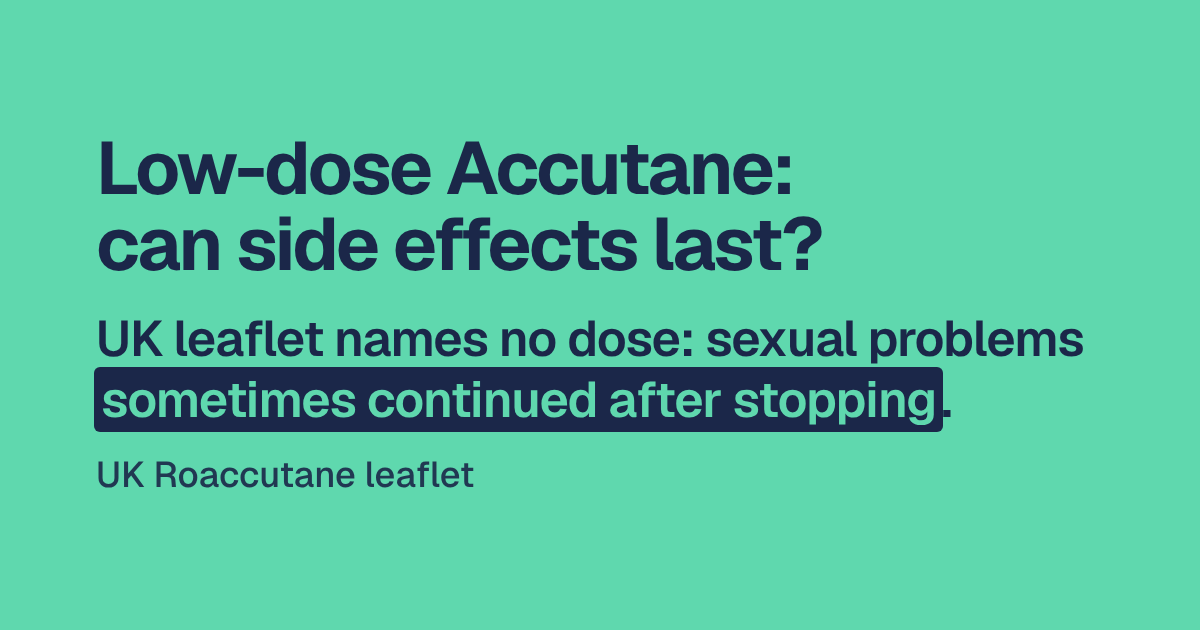
Taking low-dose Accutane (isotretinoin), or finished a course? It is the same medicine with the same UK leaflet. That leaflet says sexual problems have sometimes continued after stopping.
Lasting effects like this are what patients call post-Accutane syndrome, or PAS. We found no study that checked whether a lower dose changes the risk.
Trials of low doses mostly counted dry lips, dry skin and blood tests. They can’t tell you about effects that stay.
Miriam was 30 when a dermatologist in Spain prescribed isotretinoin. She calls it low-dose Accutane: 20 mg a day for ten months, she says. In this extract she explains why that first course seemed easy.

She noticed dry eyes, skin and hair. “To be fair, I didn’t have so many side effects,” she says. Later she was prescribed a second course, which she also calls low-dose.
So what counts as a low dose, and does it change what can last?
What counts as a low dose of Accutane?
It depends on your weight, and no UK document sets one figure in milligrams. The UK leaflet works the dose out per kilo: “if you weigh 60 kg, your dose will usually start at 30 mg a day”. So the same number of milligrams is a bigger dose for a lighter person.
Most patients, the leaflet says, settle between half and one milligram per kilo a day. NICE, which writes NHS guidance in England, calls anything under half a milligram per kilo a “reduced daily dose”.
The leaflet mentions a lower dose for people whose body “can’t tolerate the recommended dose”. That, it says, “can mean you are treated for longer and your acne might be more likely to come back”.
In this short clip, the NHS acne clinic at Newcastle Hospitals explains why the length of a course depends on the dose.

Does a low dose of Accutane have fewer side effects?
The UK leaflet has one line on it: “Some of the side effects associated with the use of isotretinoin are related to the dose.” It doesn’t name them.
Other UK documents mention dose too. The 2023 review asks for “the lowest effective dose”, with psychiatric side effects in mind. NICE says “consider a reduced daily dose” for people at increased risk of side effects. Neither is a finding about problems that continue after stopping.
Cochrane, a group that reviews medical trials, looked at trials that compared doses. They had counted side effects in different ways. Its reviewers were “uncertain if there is a difference in number of minor adverse effects, such as skin dryness, between doses/regimens”.
What the trials comparing doses recorded
Can sexual side effects last after low-dose Accutane?
The leaflet’s warning names no dose: “There have been reports of long-lasting sexual problems where the symptoms have continued despite stopping treatment with isotretinoin.” Documents in four other countries carry a similar line.
The UK expert review looked at reports of sexual side effects sent to the regulator. Most left the dose out, and they generally left out the person’s weight. So nobody can tell whether a dose was low or high for that person.
Among the reports that gave a dose, about 1 in 5 gave 20 mg a day or less. The experts drew no firm conclusions from the doses. A link between dose and sexual side effects, they wrote, is plausible but “has not been formally demonstrated”.
We found no study of dose and sexual side effects that continue after stopping. A 2024 review of studies on isotretinoin and sex called the evidence of a link “very weak”.
Miriam had vaginal dryness during treatment, she says, one of the sexual problems the leaflet lists. “Once I stopped taking isotretinoin it didn’t get better.”
For some people it has lasted years after stopping. Nobody knows yet who will be affected, or whether it will ease. UK documents say the medicine is completely eliminated within a month.
PAS is more than sexual problems. Diagnostic criteria proposed in 2022 list problems with cognition, depression and suicidal thoughts among lasting effects of isotretinoin, with or without sexual symptoms.
Our post-Accutane syndrome page covers the other lasting effects people describe.
What can I do?
Isotretinoin helps many people. What dose you take, and what to do about a side effect, are decisions for you and your prescriber.
If something hasn’t lifted since your last capsule, tell your GP and give your dose with your dates: “Isotretinoin 20 mg a day from March 2024, last capsule January 2025. Vaginal dryness since then.”
Three questions for your GP
- Could my dose explain what I still notice?
- What else could cause these symptoms, and how do we check?
- What's our next step if nothing changes?
You could start with: “I stopped isotretinoin months ago, and some symptoms haven't gone. Can we go through them?”
Mention changes beyond sex too, such as cognitive problems or low mood. Bring the leaflet line. You can report it without a doctor agreeing.
Report it: it helps everyone
A doctor’s note helps you. A report to the medicines regulator helps everyone else: it is how patterns get noticed.
- No proof needed. A suspicion is enough, even years after stopping.
- Where: the Yellow Card scheme in the UK, MedWatch in the US.
- Give your dose. Most UK reports the experts read left it out. Write your daily dose, your weight at the time, and your dates.
- Use the right words. PAS has no MedDRA reporting term yet, so name each symptom and write that it continued after stopping isotretinoin.
Our reporting guide walks you through it
What else do people ask?
Is 10 mg of isotretinoin a low dose? That depends on your weight: the UK leaflet sets the dose per kilo. Roaccutane capsules come in 10 mg and 20 mg. Researchers draw their own lines: one study called 20 mg a day low, and another trial used 5 mg.
Is low-dose Accutane for adults with mild acne? The UK leaflet makes no separate rule for lower doses: it says isotretinoin is for severe acne that hasn’t got better with other treatments. The UK expert review noted that low-dose courses had mostly been tried in mild to moderate acne.
Is anyone testing low-dose isotretinoin in the UK? Yes. A publicly funded trial called Acne-ID (registry number ISRCTN45540647) is comparing a low dose with the standard one in people aged 12 to 24. It records side effects by questionnaire until 12 months after the course. As of October 2026 it has posted no results, and its registry record doesn’t mention sexual side effects.
Miriam’s first course brought dry eyes and dry hair, the things trials count. Nobody counted the vaginal dryness that she says stayed. If something has stayed since your last capsule, report it, with your dose.
Sources
- Roaccutane 10 mg and 20 mg soft capsules, patient leaflet, Electronic Medicines Compendium (EMC 100633), last revised April 2026, read 12 October 2026. One leaflet covers both strengths. Section 6: “soft capsules containing either 10 mg or 20 mg isotretinoin”. Section 1: for “severe forms of acne”, used “when your acne has not got better with anti-acne treatments, including antibiotics and skin treatments”. Section 3: “The usual starting dose is 0.5 mg per kilogram body weight per day (0.5 mg/kg/day). So if you weigh 60 kg, your dose will usually start at 30 mg a day”. It goes on: “For most patients the dose will be between 0.5 and 1.0 mg/kg/day”. On kidneys: “If you have severe kidney problems, you will usually start on a lower dose (such as 10 mg/day)”. On tolerance: “If your body can’t tolerate the recommended dose, you may be prescribed a lower dose: that can mean you are treated for longer and your acne might be more likely to come back”. Section 2 says that if liver enzymes or blood fats stay high, “your doctor may lower your dose”. The sexual problems paragraph in section 2 is quoted in the article. It lists vaginal dryness and ends: “Talk to your doctor if you experience any sexual problems during treatment”. Section 4: “Some of the side effects associated with the use of isotretinoin are related to the dose”. The leaflet does not use the words “low dose”.
- Roaccutane 10 mg soft capsules, summary of product characteristics, EMC 100633, revised 27 April 2026. Section 4.2: treatment starts at 0.5 mg/kg daily, and “For most patients, the dose ranges from 0.5‑1.0 mg/kg per day”. In severe intolerance, “treatment may be continued at a lower dose with the consequences of a longer therapy duration and a higher risk of relapse”. Section 4.4: “There have been reports of long-lasting sexual dysfunction where the symptoms have continued despite discontinuation of isotretinoin”. No dose is given there. Section 4.8: “Some of the side effects associated with the use of isotretinoin are dose-related”. The document defines no “low dose”.
- National Institute for Health and Care Excellence, Acne vulgaris: management (NG198), published 25 June 2021, last updated 3 August 2026. Recommendation 1.5.23: “a standard daily dose of 0.5 to 1 mg/kg”. Recommendation 1.5.24, written for prescribers, in full: “Consider a reduced daily dose of isotretinoin (less than 0.5 mg/kg) for people at increased risk of, or experiencing, adverse effects”. NICE’s “Rationale and impact” chapter says of it: “Based on expertise and clinical experience, the committee agreed that people who have an intolerance or are at risk of significant adverse effects may need a reduced daily dose”. It adds that the risk “could not be quantified as part of the recommendation” and that “the evidence for lower dose oral isotretinoin was scarce”. It names no side effect. We report the line; this page gives no view on dose.
- Commission on Human Medicines, Report of the Isotretinoin Expert Working Group, 26 April 2023, published by the MHRA. Section 5.3.2 and Table 3: of 184 Yellow Card reports of sexual side effects, 73 gave some information on dose. Of those, 15 gave 20 mg a day or under (20.6%), 33 gave 21 to 40 mg, 16 gave 41 to 60 mg and 9 gave 61 to 80 mg. “patients’ weights have generally not been provided”. The report concludes: “no firm conclusions can be made on the relationship between dose and sexual dysfunction”. These are voluntary reports of sexual side effects during or after treatment. Some describe effects during treatment, and some describe effects that continued. Section 5.4.3: a dose-dependent response for sexual dysfunction “has not been formally established”. It also summarises Cunningham and colleagues (J Am Acad Dermatol 2020), a questionnaire study of 80 patients with at least 3 months of treatment. The report says that study linked daily doses above 50 mg with vulval dryness. It does not say what happened after treatment ended. This is one small questionnaire study and we read only the report’s summary (we could not open the letter itself), so it is not used in the text. Section 5.6: “it is postulated that sexual side effects with isotretinoin may be dose-dependent. This is plausible but has not been formally demonstrated”. Section 4.3.5: low-dose regimens “have been used with varying degrees of success for acne, mostly mild to moderate acne”. The same section, on psychiatric side effects: a dose-dependent response “has not been formally established”. Section 4.6, the discussion that closes the chapter on psychiatric side effects, written for prescribers: “isotretinoin should be prescribed at the lowest effective dose”. The sentence gives its reason first: “a dose-dependent effect has been noted in the clinical development programme” and in side effects. We report the line; this page gives no view on dose. Section 6.10: “there have been suggestions that lower doses may be associated with lower risks but there is limited efficacy data for these alternate dosing regimens and not all side effects are dose related”. Section 6.12 lists “Investigating dosing regimens” among areas for research.
- Costa CS, Bagatin E, Martimbianco ALC and colleagues. Oral isotretinoin for acne. Cochrane Database Syst Rev 2018;11:CD009435. 31 randomised trials, 3,836 participants. On different doses and regimens, 14 trials (906 participants) reported no serious adverse events. That covered “treatment (from 12 to 32 weeks) or follow-up after end of treatment (up to 48 weeks)”. Thirteen trials (858 participants) analysed less serious adverse effects, “which included skin dryness, hair loss, and itching”, and could not be pooled. The evidence was low to very low quality. We searched the full text for sexual, libido, erectile, erection, orgasm, genital and vaginal. None appears as an outcome or a side effect.
- Amichai B, Shemer A, Grunwald MH. Low-dose isotretinoin in the treatment of acne vulgaris. J Am Acad Dermatol 2006;54(4):644-6. 638 patients with moderate acne on 20 mg a day for 6 months, with no comparison group. Blood fats and liver tests were recorded. The 4-year follow-up was for relapse. Rademaker M, Wishart JM, Birchall NM. Isotretinoin 5 mg daily for low-grade adult acne vulgaris. J Eur Acad Dermatol Venereol 2014;28(6):747-54. We read the abstracts only.
- Lin L, Lin W, Zheng Y, Cai H. Effectiveness and safety of different dosing regimens of isotretinoin for acne vulgaris: a systematic review. Postepy Dermatol Alergol 2025;42(4):346-53. 15 randomised trials, with treatment for 3 to 6 months. The side effects reported were mainly cheilitis, dry skin, liver enzymes and lipids. The same word search of the full text found no mention of sexual function.
- Tan E, Kennedy H, Rademaker M. Exploring the association between isotretinoin and sexual dysfunction: a comprehensive scoping review. Clin Exp Dermatol 2024;49(11):1396-1404. 46 human studies, 2,420 patients, and “very weak evidence supporting a link”. “The most frequently observed dose range of isotretinoin was 0.5-1.0 mg kg-1 per day”. That was 20 of the 46 studies, by the MHRA’s summary in source 9. We read the abstract and that summary.
- MHRA, Review of the impact of recommendations for the prescribing of isotretinoin, Public Assessment Report, 22 January 2026. Section 4.5.2.3: “In the longer term, the ACNE-ID trial may provide some useful information on use of a lower dosage of isotretinoin”. The same section says the trial “has just started recruiting patients, but results are unlikely to be available soon”. We read the PDF linked from that page.
- ISRCTN registry, record ISRCTN45540647, Acne-ID, last updated 19 August 2026. We read it through the registry’s data service on 12 October 2026. The record’s web page did not open for our link check, so it is given by number. University of Nottingham, funded by the NIHR Health Technology Assessment Programme. The low-dose strategy is 0.25 mg/kg a day, against at least 0.5 mg/kg a day. The primary aim is whether the low dose clears acne as well as the standard one. Target: 800 participants aged 12 to 24. Recruitment runs to March 2027 and the trial ends on 30 August 2028. Side effects are recorded with a “Modified British Association of Dermatologists side effect questionnaire”, monthly, then 1 month and 12 months into follow-up. The results part of the record is empty. The record does not use the word sexual.
- Our search, 12 October 2026: PubMed and Europe PMC, for isotretinoin with dose or low-dose and sexual, erectile or libido, and with persistent, enduring or post-retinoid. No study compared doses for sexual side effects that continue after stopping. Healy D, Le Noury J, Mangin D, Enduring sexual dysfunction after treatment with antidepressants, 5α-reductase inhibitors and isotretinoin: 300 cases, Int J Risk Saf Med 2018;29(3-4):125-34, does not analyse isotretinoin dose. Nor does the US Food and Drug Administration’s response to citizen petition FDA-2018-P-4088, 16 June 2026.
- Moral Medicine, From Mild Acne to Severe Dry Eyes, Hair Loss and Infertility: Miriam’s Nightmare After Isotretinoin, interview with Miriam, 13 October 2025 (the title is the channel’s). “In 2020 when I turned 30” at about 5:25. “They gave me 20 milligrams” for 10 months at about 8:05, confirmed at 8:42. Her first course from 8:55. The second course at about 10:50. Vaginal dryness at about 37:00. Quotes are from YouTube’s automatic captions. Embedded as an extract from 8:37 to 9:49. Her story on our site: Miriam’s story: 2 courses of isotretinoin.
- Newcastle Hospitals, Newcastle dermatology - Isotretinoin, 29 November 2024, a film for patients of the trust’s acne clinic. At 1:12: “On average it takes between 20 to 24 weeks but this is dependent on the dose that you take and how well you tolerate the side effects”. Embedded from 1:04 to 1:23.
- Healy D, Bahrick A, Bak M and colleagues. Diagnostic criteria for enduring sexual dysfunction after treatment with antidepressants, finasteride and isotretinoin. Int J Risk Saf Med 2022;33(1):65-76. Proposed criteria from expert agreement. Isotretinoin effects that “can occur independently of any sexual difficulties but may also accompany sexual problems” include cognitive impairment, depression and suicidality. The term post-Accutane syndrome “equally often appears to include suicidality and other cognitive effects without sexual difficulties”. “The incidence of these conditions is unknown.” Wording as recorded from the full text on 21 October 2026 for our article on emotional numbness after Accutane; the page did not open for our check on 22 October 2026.
Sources checked on 22 October 2026. AI-assisted writing and review, not clinical review.
Lasting side effects after isotretinoin?
Make them count.
Our step-by-step guide finds the form for your country.