How long does Accutane stay in your system?
Isotretinoin's half-life is about 19 hours. UK documents say it is completely eliminated within a month. Some side effects may continue. That is PAS.
SIDEfxHUB is a patient charity. We are not health professionals, and this does not replace medical advice. Don't start, stop or change any medicine because of what you read here. Talk to your doctor first.
If you are in crisis:116 123 Samaritans (UK)988 Lifeline (US)Find a helpline
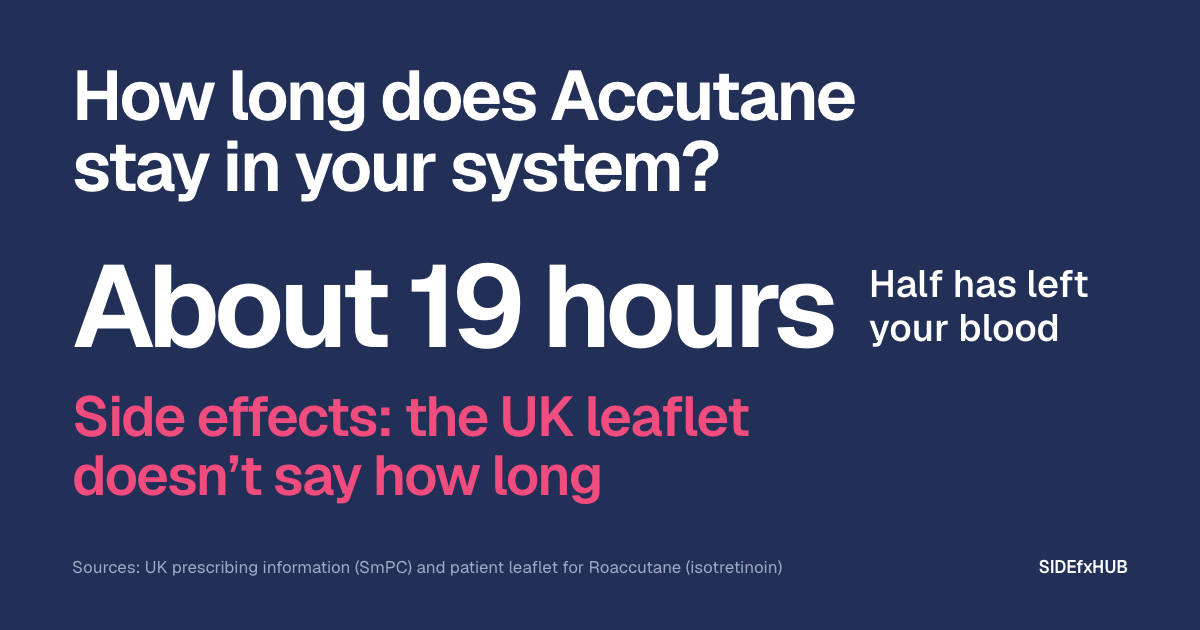
Accutane (isotretinoin) has a half-life of about 19 hours. The pregnancy warning in the UK prescribing information says it is “completely eliminated” within one month of the end of treatment. Neither figure says when a side effect ends: the UK leaflet says some “may continue after treatment has stopped”, which patients call post-Accutane syndrome (PAS). A separate line says there have been reports of long-lasting sexual problems.
In the UK it’s sold as Roaccutane, and the leaflet’s pregnancy rules run for the same month. If your course ended long ago and something still feels wrong, “is it out of my system?” and “have the side effects gone?” are two different questions.
The story in 3 lines
- Half the isotretinoin in your blood has gone in about 19 hours (UK prescribing information).
- The pregnancy warning in the same document says the drug is “completely eliminated” within one month of the end of treatment. The leaflet's pregnancy rules run for that month.
- The UK leaflet says some side effects “may continue after treatment has stopped”. It doesn't say for how long. Patients call it PAS.
Press: contact@sidefxhub.com
Elliot took Accutane at 17 and went through the whole course, he says. When Moral Medicine filmed him, he’d been off it for 13 years.

He was almost 18 by the time he came off it, he says, and his acne had gone. He still had back pain and dry skin, and expected all of that to “get better over the years”. Thirteen years on, he says, both are still with him. What does PAS feel like? has his account.
What is isotretinoin’s half-life?
About 19 hours, says the UK prescribing information. A half-life is the time it takes for the amount in your blood to halve.
Your body turns isotretinoin into a second substance, which the document says adds to the drug’s effect. It leaves more slowly, with a half-life of about 29 hours.
A rule of thumb in pharmacology is that after five half-lives almost all of a drug has left the blood. For the slower substance that comes to about six days. That sum is ours, and it’s an average: in one small study, the half-life varied widely from one patient to the next.
The document itself gives a wider limit. Its pregnancy warning says the risk to an unborn baby “persists until the product has been completely eliminated, which is within one month following the end of treatment”.
How long after Accutane can you get pregnant?
The UK leaflet sets one month: “You must not get pregnant for one month after stopping this treatment because some medicine may still be left in your body.”
The medicine “can seriously harm an unborn baby”, the leaflet says, and “makes a miscarriage more likely”. Under its Pregnancy Prevention Programme, women who could get pregnant “must use contraception for a month before taking Roaccutane, during treatment and for a month afterwards”.
The leaflet adds: “if you become pregnant within one month after you stop taking Roaccutane, you should contact your doctor”.
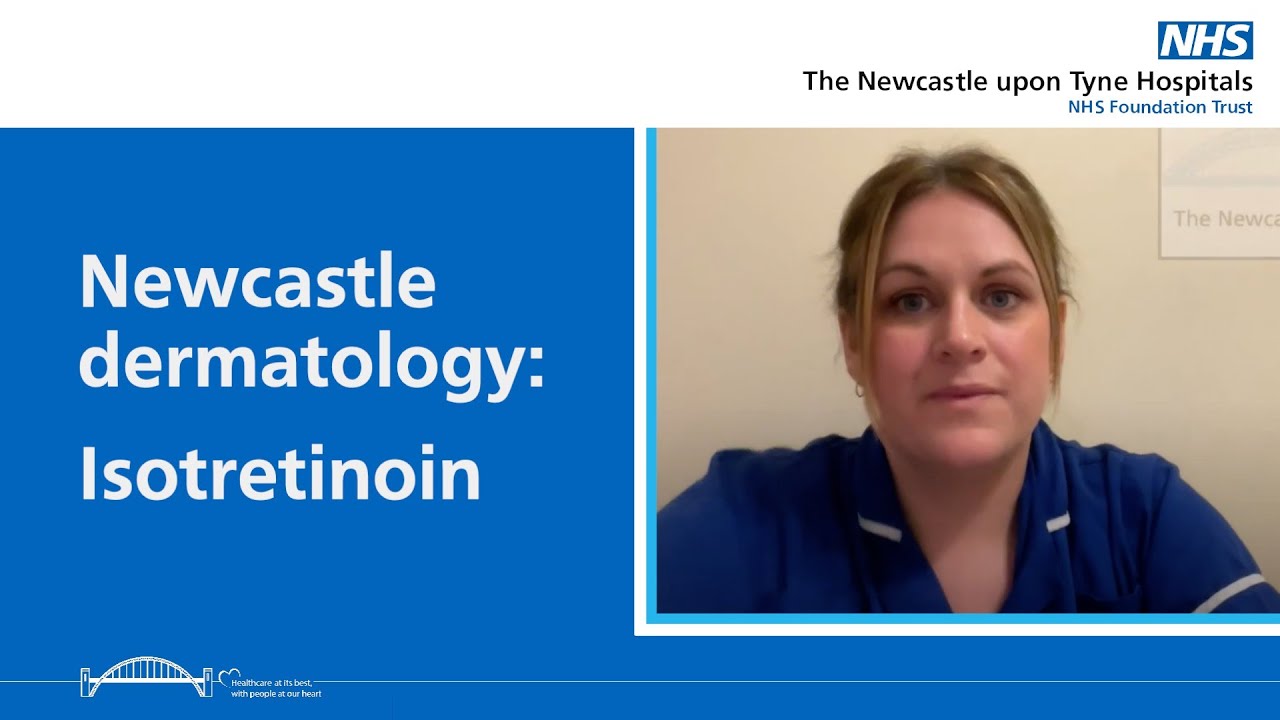
We’re a patient charity, and this is not pregnancy advice: your prescriber or pharmacist can answer for you. The NHS page on isotretinoin says contraception must continue “for at least 1 month” after you stop.
Can side effects last after Accutane has gone?
Some may, according to the UK leaflet. Side effects, it says, are “generally reversible after changing the dose or stopping treatment, however some may continue after treatment has stopped”. It doesn’t say which.
On sex it’s more specific: “There have been reports of long-lasting sexual problems where the symptoms have continued despite stopping treatment with isotretinoin.” Our article on Accutane’s sexual side effects describes them. Official documents in the US, Canada and Australia now carry a similar line.
The leaflet’s one month is about the medicine. For side effects that continue, it gives no length of time.
Why would a problem outlast the drug? Nobody knows yet. A US urology team wrote in 2025 that the mechanism is unknown.
In 2022, a panel of doctors and researchers published criteria for sexual problems that last after isotretinoin. One marker is a problem still there at least three months after stopping.
After the last capsule: the drug and the side effects
For some people it has lasted years after stopping. Nobody knows yet who will be affected, or whether it will ease. Long-term side effects of Accutane goes through the lasting effects the labels name, and Does post-Accutane syndrome go away? sets out what’s known about recovery.
What can I do?
Isotretinoin helps many people with severe acne. If you have side effects, that’s a decision for you and your prescriber. During treatment, the UK leaflet asks you to talk to your doctor about any sexual problems.
If something has lasted since your course ended, tell your GP and give your dates: “Isotretinoin 40 mg a day from September 2024, last capsule 20 February 2025. Reduced sensation since March 2025.” The date of your last capsule shows how long it’s gone on.
Many people say it took time to be taken seriously. Bring the leaflet line: “some may continue after treatment has stopped”. You can report it without a doctor agreeing.
Report it: it helps everyone
A doctor’s note helps you. A report to the medicines regulator helps everyone else: it is how patterns get noticed.
- No proof needed. A suspicion is enough, even years after stopping.
- Where: the Yellow Card scheme in the UK, MedWatch in the US.
- Use the right words. PAS has no reporting term yet, so name each symptom and say it continued after stopping.
Our reporting guide walks you through it
What else do people ask?
Can I give blood after Accutane? As of October 2026, the UK blood services’ guidelines say four weeks from the last dose. The UK leaflet says: “You should not donate blood during treatment with this medicine and for 1 month after stopping Roaccutane because an unborn baby could be harmed if a pregnant patient receives your blood.”
Does the pregnancy rule apply to men? The leaflet’s pregnancy rules are written for women who could get pregnant. Its “Advice for men” reads: “The levels of oral retinoid in the semen of men taking Roaccutane are too low to harm their partners’ unborn baby. However, you must never share your medication with anyone.”
How long after Accutane can I have waxing or laser? The UK leaflet says isotretinoin may make your skin more fragile. It says not to have waxing, dermabrasion or laser treatments during treatment, “or for at least 6 months after treatment”.
Elliot’s last capsule was 13 years behind him when he was filmed. The UK prescribing information says the medicine is completely eliminated within a month. If a side effect has lasted since your course ended, read about post-Accutane syndrome and report it.
Sources
- Roaccutane 10 mg soft capsules (isotretinoin), summary of product characteristics, electronic medicines compendium (emc 100633), text revised 27 April 2026. Section 5.2: “the terminal elimination half-life of unchanged drug in patients with acne has a mean value of 19 hours”. For 4-oxo-isotretinoin it “is longer, with a mean value of 29 hours”. The same section calls 4-oxo-isotretinoin the major metabolite and “a significant contributor to the activity of isotretinoin”. It adds that “endogenous retinoid concentrations are reached within approximately two weeks following the end of isotretinoin therapy”. On tissues it says “little information is available”. Section 4.4, the pregnancy warning (under “Teratogenic effects”, in the part headed “Pregnancy Prevention Programme”): “If pregnancy occurs after stopping treatment there remains a risk of severe and serious malformation of the foetus. This risk persists until the product has been completely eliminated, which is within one month following the end of treatment”. The “completely eliminated” line is in that warning; section 5.2, on how the body handles the drug, gives the half-lives. Also 4.4: “There have been reports of long-lasting sexual dysfunction where the symptoms have continued despite discontinuation of isotretinoin”. The half-lives are measured in blood plasma. Our sums: five half-lives of 19 hours are 95 hours, about four days. Five of 29 hours are 145 hours, about six days.
- Roaccutane 10 mg soft capsules, patient information leaflet, emc 100633, last revised April 2026. Section 2, “Pregnancy prevention programme”, is quoted word for word in the article: the one-month rule and its reason (“because some medicine may still be left in your body”), harm to an unborn baby, miscarriage, contraception, and becoming pregnant within a month of stopping. The rules are addressed to “Women who could get pregnant”. “Advice for men” and the blood donation line under “Additional precautions”, both in section 2, are quoted in full in the article. Also section 2: “Don’t have any waxing (hair removal), dermabrasion or laser treatments (removing horny skin or scars) during treatment, or for at least 6 months after treatment”. The sexual problems line ends: “Talk to your doctor if you experience any sexual problems during treatment”. Section 4: “The side effects are generally reversible after changing the dose or stopping treatment, however some may continue after treatment has stopped”.
- Absorica and Absorica LD (isotretinoin), US prescribing information, revised August 2026. DailyMed, US National Library of Medicine. Section 12.3 gives mean elimination half-lives of 18 hours for isotretinoin and 38 hours for 4-oxo-isotretinoin after a single 40 mg Absorica dose. For Absorica LD it gives about 24 and 38 hours. With 38 hours, our five-half-life sum is 190 hours, about eight days. Section 6: sexual dysfunction “that may continue after discontinuation of treatment”. The label also says not to donate blood during treatment and for one month after.
- Ito S. Pharmacokinetics 101. Paediatr Child Health 2011;16(9):535-6. A teaching paper: after a single dose the level in the blood falls to 50% of its peak by one half-life, 25% by two, and about 3% by five.
- Nulman I, Berkovitch M, Klein J and colleagues. Steady-state pharmacokinetics of isotretinoin and its 4-oxo metabolite: implications for fetal safety. J Clin Pharmacol 1998;38(10):926-30. The Hospital for Sick Children, Toronto. 16 adults treated for acne, 11 of them women, sampled for as long as 28 days. Half-life 29 hours for isotretinoin, with a standard deviation of 40 hours, and 22 hours (standard deviation 10) for the metabolite. The abstract reports “large variability in apparent clearance”. We read the abstract only.
- Healy D, Bahrick A, Bak M and colleagues. Diagnostic criteria for enduring sexual dysfunction after treatment with antidepressants, finasteride and isotretinoin. Int J Risk Saf Med 2022;33(1):65-76. Section 6, post-retinoid sexual dysfunction: “The problem is present for ≥3 months after stopping treatment” is one of the additional criteria. The term post-Accutane syndrome “is in widespread use” and often covers more than sexual problems. An expert consensus built from case reports.
- Stachelek J, Zwaans BMM, Shtein R, Peters KM. Insights into the peripheral nature of persistent sexual dysfunction associated with post-finasteride, post-SSRI and post-accutane syndromes: lessons learned from a case study. Int Urol Nephrol 2025;57(8):2387-94. Corewell Health William Beaumont University Hospital, Michigan. “The underlying mechanism of this post-drug syndrome is unknown”. A review of the records of three men seen in the hospital’s urology clinic. We read the abstract only.
- Commission on Human Medicines, Report of the Isotretinoin Expert Working Group, 26 April 2023, published by the MHRA. Section 5.3.4, Table 4: how long erectile dysfunction had lasted after stopping “at the time of reporting” in the 27 men who said, from under a year to 24 years. Voluntary Yellow Card reports.
- Joint UK Blood Transfusion and Tissue Transplantation Services Professional Advisory Committee (JPAC), Whole Blood and Components Donor Selection Guidelines, Acne, edition 203, release 55, 21 January 2021, read 12 October 2026. Must not donate if “Less than 4 weeks from the last dose of isotretinoin (Roaccutane)”. Reason given: isotretinoin taken by mouth “can cause birth defects in babies exposed to them while inside the womb”, and time is needed “for the drug to be cleared from the blood of a donor”.
- NHS, Isotretinoin (Roaccutane), page last reviewed 26 June 2026. “You must continue to use contraception for at least 1 month after you stop taking isotretinoin”. It does not say how long the medicine stays in the body.
- Moral Medicine, He Took Accutane at 17. His Life Never Returned to Normal., interview with Elliot, 28 January 2025 (the title is the channel’s). Seventeen when he started at 3:45. The whole course at 49:53. Inside the extract: his acne gone at 55:22, not feeling good in the year or so after at 56:10, and “almost probably 18” by the time he had come off it at 56:28. Back pain and dry skin after the course, and “get better over the years”, at 64:49. Thirteen years off the drug at 71:20; dryness and lower back pain among what he lives with now at 76:40. Quotes from YouTube’s automatic captions. Embedded as an extract from 55:09 to 56:40. His story on our site: Elliot’s story: Accutane at 17.
- Newcastle Hospitals, Newcastle dermatology - Isotretinoin, 29 November 2024, a film for patients of the trust’s acne clinic. Pregnancy from 6:01: avoid it during treatment “and for one month after stopping”. Embedded from 6:01 to 6:32.
This information does not replace medical advice. Talk to your doctor before you make any decision about your treatment.
610+ people have joined the community.
Join them, then report your side effects.
Free. Sign up takes 2 minutes.