I think I have post-Accutane syndrome
If problems began on Accutane (isotretinoin) and stayed after you stopped, it may be PAS. What to write down, what to tell your doctor, how to report it.
SIDEfxHUB is a patient charity. We are not health professionals, and this does not replace medical advice. Don't start, stop or change any medicine because of what you read here. Talk to your doctor first.
If you are in crisis:116 123 Samaritans (UK)988 Lifeline (US)Find a helpline
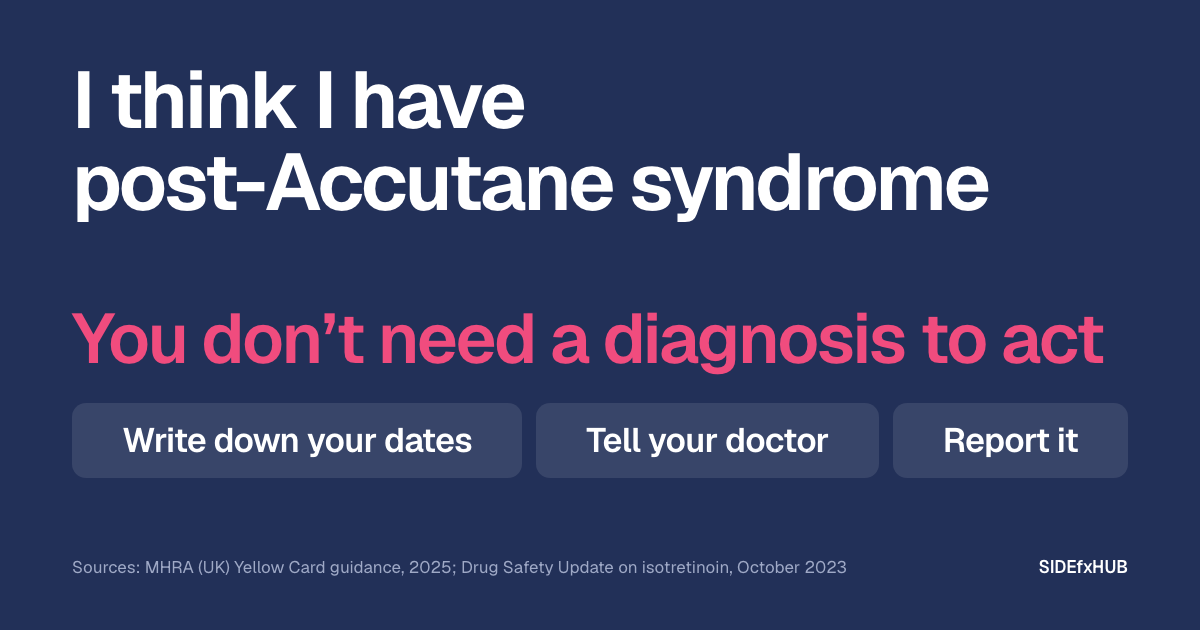
If problems with sex, mood or your body began on Accutane (isotretinoin, Roaccutane in the UK) or in the months after it, and haven’t gone, it may be post-Accutane syndrome, or PAS. The UK leaflet says some side effects “may continue after treatment has stopped”.
The NHS page on isotretinoin lists side effects but doesn’t say any can continue after the course. You don’t need a diagnosis to act: this week you can tell your doctor, report it and find other people going through the same thing.
The story in 3 lines
- Isotretinoin’s side effects generally go away after the course, the UK leaflet says. Some may not.
- PAS has no test and no official diagnosis. Criteria from 2022 ask if sexual problems are still there three months after the last capsule.
- You don’t need proof to report it: “only a suspicion is needed”, says the UK medicines regulator. Nobody has measured how often PAS happens.
Press: contact@sidefxhub.com
Joseph was 13 when he took isotretinoin for acne. He felt fine during the course, he says. Six or seven months after it ended, severe panic attacks began.

At first he didn’t blame the medicine, because the trouble had started months later. Go to a doctor, he says, and you’ll be told it’s impossible. What helped was finding other people online: “OK, I’m not mad, I’m not the only one.”
How do I know if I have post-Accutane syndrome?
You can’t know for certain, and nor can your doctor. PAS has no official definition, and there’s no blood test or scan for it. Our article Is post-Accutane syndrome real? goes through the evidence.
The closest thing to a checklist is a set of criteria that doctors and researchers proposed in 2022, for sexual problems that last after isotretinoin.
Did you take isotretinoin? Were the problems there before it? Are they still there three months after your last capsule?
People also use the name PAS for mental health or cognitive problems with no sexual symptoms at all, the authors note. We have articles on the sexual side effects, on depression after stopping and on other long-term effects.
Joseph says his symptoms started months after the course. In 2023, UK experts who went through reports to the medicines regulator wrote that “in a few cases” erection problems didn’t begin until after the course. In 2026 the US regulator said it had found no reports in its own database of sexual problems that first appeared after stopping.
Other things can cause the same symptoms, and the criteria ask about that too. So the next step is a doctor. If yours followed an antidepressant or finasteride instead, see our guides to PSSD and PFS.
What should I write down first?
Your dates. Find them before you do anything else. An old pack, a prescription or a pharmacy label may show them.
The UK medicines regulator, the MHRA, asks for them by name: “onset timing, treatment dates, and product brand name”.
When those UK experts looked at reports of erection problems, not all gave the dose or the dates. That made it “very difficult to draw conclusions” about dose and length of treatment, they wrote.
If you can’t remember yours, the clinic that prescribed it or your GP surgery may be able to look them up. Then put everything on one page, like this.
“Roaccutane 30 mg a day from February 2023, last capsule August 2023.”
Each symptom, in your own words: “low sex drive”, “panic attacks”.
During the course, or after it. Give the month if you can.
“No problems before 2023.”
Other medicines, before and since.
What do I say to my doctor?
Say what changed and when, and hand over your page. Ask for it to go in your notes, even if your course was years ago. Your doctor will want to rule out other causes, and that’s worth doing.
They may never have seen this before. When the same experts asked health professionals, most of those who replied said they hadn’t seen sexual side effects with isotretinoin. Several said they didn’t usually ask.
Many people say it took time to be taken seriously. Bring the leaflet line. You can report it without a doctor agreeing.
The prescribing information that UK doctors use has a warning in their language: reports of sexual problems that “continued despite discontinuation of isotretinoin”. The US label has carried a similar line since 2026, as our article on the FDA label change explains.
Nobody has yet proved what causes these problems, and some doctors are looking for answers. Dr Kenneth Peters chairs the urology department at a university hospital in Michigan, and in April 2026 he organised a medical summit on PAS, PFS and PSSD. There he told SIDEfxHUB that it angers him to hear patients blamed.

What can I do without a diagnosis?
Report it, and find other people. You can do both today.
These medicines help many people. If you have side effects, that’s a decision for you and your prescriber.
Report it: it helps everyone
A doctor’s note helps you. A report to the medicines regulator helps everyone else: it is how patterns get noticed.
- No proof needed. A suspicion is enough, even years after stopping.
- Where: the Yellow Card scheme in the UK, MedWatch in the US.
- Use the right words. PAS has no medical term yet, so name each symptom and say whether it continued or began after stopping. The MHRA asks for detail “particularly if a side effect continued or started after treatment was stopped”.
Our reporting guide walks you through it

Find other people. Joining the SIDEfxHUB community needs no diagnosis either. It puts your condition on the record, and researchers never see your name. It’s also the way into our small, private WhatsApp groups, where you can talk to people who’ve been through it.
What else do people ask?
Does post-Accutane syndrome go away? For some people it has lasted years after stopping. Nobody knows yet who will be affected, or whether it will ease. Joseph says his symptoms are still there but much milder than they were. Our page on post-Accutane syndrome covers what is known so far.
I’m still taking isotretinoin. Should I stop? That’s a decision for you and your prescriber. The UK leaflet says to talk to your doctor about any sexual problems during treatment. If you get signs of depression or another mental health problem, it says to contact your doctor straight away.
Is it too late if my course was years ago? The MHRA sets no deadline. In 2023 it said reports can be made of reactions “experienced at any time, including historic adverse experiences”. Our article on reporting a side effect years later shows how.
It took Joseph more than ten years to understand where his symptoms came from, he says. Your first step is smaller: find your dates and write them down, for your doctor and for your report.
Sources
- Roaccutane 10 mg and 20 mg soft capsules, patient leaflet, Electronic Medicines Compendium (EMC 100633), last revised April 2026. Section 2: “Talk to your doctor if you experience any sexual problems during treatment”. Section 4: side effects are “generally reversible after changing the dose or stopping treatment, however some may continue after treatment has stopped”. Also section 4: “Contact your doctor straight away if you get signs of any of these mental problems”, and reporting of side effects through the Yellow Card scheme.
- Roaccutane 10 mg soft capsules, summary of product characteristics, EMC 100633, text revised 27 April 2026. Section 4.4, sexual disorders: “There have been reports of long-lasting sexual dysfunction where the symptoms have continued despite discontinuation of isotretinoin”.
- NHS, Isotretinoin (Roaccutane), page last reviewed 26 June 2026. Lists “problems with sex”; advises speaking to a pharmacist or doctor about side effects that “bother you or do not go away”.
- Healy D, Bahrick A, Bak M and colleagues. Diagnostic criteria for enduring sexual dysfunction after treatment with antidepressants, finasteride and isotretinoin. Int J Risk Saf Med 2022;33(1):65-76. Section 6, post-retinoid sexual dysfunction: prior treatment with isotretinoin, no matching problem before the drug, and present for 3 months or more after stopping. No other condition or medicine that could account for it. The name PAS “equally often appears to include suicidality and other cognitive effects without sexual difficulties”. An expert consensus, built from case reports.
- MHRA, Drug Safety Update: isotretinoin, introduction of new safety measures, 31 October 2023. Under “Report any reactions on a Yellow Card”: reports can be made of reactions “experienced at any time, including historic adverse experiences”. Detail is wanted “particularly if a side effect continued or started after treatment was stopped”. Reports should include “medical history, any concomitant medication, onset timing, treatment dates, and product brand name”.
- MHRA, The Yellow Card scheme: guidance for healthcare professionals, patients and the public, last updated 24 July 2025. “You do not have to prove causality to report a suspected ADR, only a suspicion is needed.”
- Commission on Human Medicines, Report of the Isotretinoin Expert Working Group, 26 April 2023, published by the MHRA. Section 5.2: most health professionals who responded had not seen sexual side effects with isotretinoin, and several “did not usually ask about it”. Section 5.3.4.1: reports of erectile dysfunction “did not always have full information” on dose and dates. It was “very difficult to draw conclusions on how dose and treatment duration contribute to this side effect”. The same section, on the Yellow Card database: “it appears that erectile dysfunction can occur days, weeks or months after starting isotretinoin, and in a few cases, it did not occur until after stopping isotretinoin treatment”. Voluntary reports.
- Absorica and Absorica LD (isotretinoin), US prescribing information, revised August 2026. DailyMed, US National Library of Medicine. Section 6: sexual dysfunction “that may continue after discontinuation of treatment”. The wording follows the FDA’s response to citizen petition FDA-2018-P-4088, 16 June 2026.
- US Food and Drug Administration, response to citizen petition FDA-2018-P-4088, 16 June 2026. Page 15: “we found no FAERS reports of sexual dysfunction that worsened or first emerged after isotretinoin discontinuation”. FAERS was the FDA’s database of side-effect reports at the time. Voluntary reports. The FDA also found no “reasonable evidence of a causal association”.
- Moral Medicine, French Patient Shares His Long-Term Struggle After Accutane (isotretinoin), interview with Joseph, 17 November 2025, in French (the title is the channel’s). Our page plays an extract, 5:14 to 7:04; the views are his own. Isotretinoin at 13, with panic attacks six or seven months after the course (about 1:37). “OK, I’m not mad, I’m not the only one” (about 6:53). Symptoms still there but much milder (about 7:57). More than ten years to understand (about 18:30). Quotes are our translation of the YouTube captions. His story on our site: Joseph’s story: isotretinoin at 13.
- SIDEfxHUB, Interview with Dr. Kenneth Peters, PFS / PAS / PSSD Summit 2026, April 2026. Our page plays an extract, 13:53 to 14:29; the views are his own. The summit was a medical meeting on PFS, PAS and PSSD that Dr Peters organised. Our article: the interview in full.
- MHRA, Yellow Card - How to report, 12 November 2024, 1 minute 33 seconds. An animation, listed on the MHRA’s Yellow Card resources page.
This information does not replace medical advice. Talk to your doctor before you make any decision about your treatment.
590+ people have joined the community.
Join them, then report your side effects.
No diagnosis needed. Researchers never see your name.