Is post-Accutane syndrome real?
Post-Accutane syndrome (PAS) isn't a formal diagnosis. But UK and US labels now warn that isotretinoin's sexual side effects may continue after stopping.
SIDEfxHUB is a patient charity. We are not health professionals, and this does not replace medical advice. Don't start, stop or change any medicine because of what you read here. Talk to your doctor first.
If you are in crisis:116 123 Samaritans (UK)988 Lifeline (US)Find a helpline
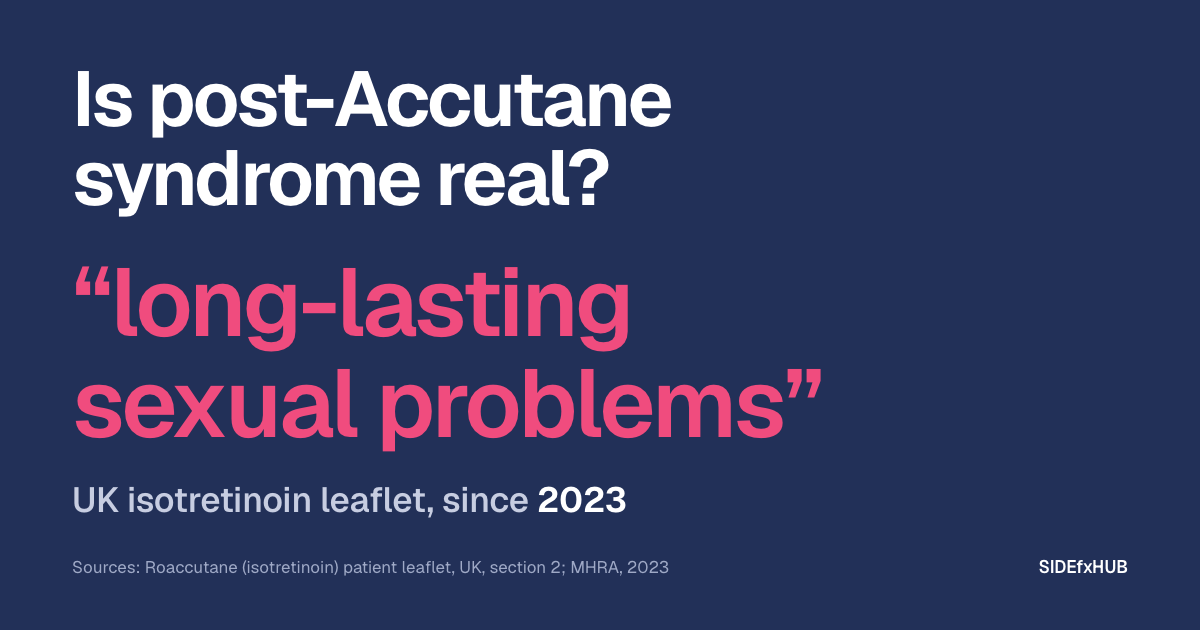
Post-Accutane syndrome (PAS) isn’t a formal diagnosis. But the UK leaflet for isotretinoin (Roaccutane) has warned since 2023 of sexual problems that continued after stopping, and US labels have carried a similar line since 2026.
The NHS page on isotretinoin lists problems with sex but doesn’t say they can last. If you’ve been told PAS isn’t real, start with the UK leaflet’s own words.
The story in 3 lines
- PAS has no official definition. In 2022 doctors and researchers proposed criteria for its sexual form.
- The UK leaflet warns of “long-lasting sexual problems” that continued after stopping isotretinoin.
- In June 2026 the FDA told US makers to list the same risk. Nobody has measured how often it happens.
Press: contact@sidefxhub.com
Stefan was 15 when he took a short course of Accutane. He was the first person with PAS to be filmed by Moral Medicine, a channel that records patients’ stories.
When the interview came out in December 2024, Moral Medicine said he had lived with PAS for almost 19 years. The second person with PAS the channel filmed was Elliot, who took Accutane at 17.

Elliot told the channel that 13 years after his last capsule, he still had dry skin, aches and tiredness every day. Apart from fear and panic, his emotions felt flat.
Is post-Accutane syndrome a recognised diagnosis?
No. There’s no official definition of PAS and no test for it. It has no diagnosis code of its own either.
The nearest thing is a set of diagnostic criteria that a group of doctors and researchers proposed in 2022. They cover its sexual form, which they call post-retinoid sexual dysfunction.
The signs they list include low sex drive, erection problems or less wetness during sex, and less feeling in the genitals and at orgasm. To count, the problems have to last at least three months after the last capsule.
The criteria are a proposal from experts. The authors add that many people use the name PAS more widely. Used that way, it also covers mental health and cognition, such as memory, sometimes with no sexual symptoms at all.
Do Accutane labels warn about lasting side effects?
Yes. The UK leaflet for Roaccutane says: “There have been reports of long-lasting sexual problems where the symptoms have continued despite stopping treatment with isotretinoin.”
That line was added in 2023, after a review that had started in 2019. It was carried out by experts who advise the UK medicines regulator, the MHRA.
The experts couldn’t say that isotretinoin “definitely caused” many of the reported side effects. They still asked for the warning. Patients’ experiences, they said, “continue to cause concern”.
In the US, a 2018 petition asked the FDA for a warning. On 16 June 2026 the FDA replied. It told the makers of every isotretinoin product to add sexual problems “that may continue after discontinuation of treatment” to the label’s list of side effects.
Until then, US generic labels, which follow the original Accutane label, said nothing about sexual side effects. Labels such as Amnesteem’s now carry the new line.
The FDA turned down the stronger warning the petition wanted. It said it had found no “reasonable evidence” that isotretinoin causes these problems. In the cases it reviewed where problems continued after stopping, half the people were 21 or younger.
Why do some doctors say PAS isn’t real?
Mostly because nobody has proved that isotretinoin causes it, or counted how often it happens. The evidence is mainly reports sent in by patients and doctors. The FDA says its own database of reports can’t tell us how common it is.
Reports do tell us what people went through. Some describe problems that lasted. Where UK reports of erection problems said what happened after stopping, about half said the problems carried on.
Some doctors may simply never have asked. Most health professionals who wrote to the UK review said they hadn’t seen sexual side effects with isotretinoin.
Several said they didn’t usually ask. “I don’t tend to ask,” one wrote. Since 2023 the UK label has said every patient should be asked about sexual problems before they start, and checked during treatment.
Other doctors have studied the medicine closely. Doug Bremner, a professor of psychiatry and radiology at Emory University in the US, has researched isotretinoin and the brain. He talks about that work, and about PAS, in this interview.
What can I do?
These medicines help many people. If you have side effects, that’s a decision for you and your prescriber. The UK leaflet says to talk to your doctor about any sexual problems during treatment.
If problems haven’t lifted since your course ended, tell your GP and give your dates: “Isotretinoin 20 mg a day from January 2023, last capsule July 2023.”
Many people say it took time to be taken seriously. Bring the leaflet line. You can report it without a doctor agreeing.
Report it: it helps everyone
A doctor’s note helps you. A report to the medicines regulator helps everyone else: it is how patterns get noticed.
- No proof needed. A suspicion is enough, even years after stopping.
- Where: the Yellow Card scheme in the UK, MedWatch in the US.
- Use the right words. We couldn’t find a MedDRA term for PAS, so name each symptom and say it continued after you stopped isotretinoin.
Our reporting guide walks you through it
What else do people ask?
Is PAS permanent? For some people it has lasted years after stopping. Nobody knows yet who will be affected, or whether it will ease.
The UK review had reports of erection problems lasting up to 24 years. Elliot took Accutane at 17, and Moral Medicine says he has lived with PAS ever since.
Could it just be isotretinoin still in my body? Not for long: the UK label says the medicine is fully cleared within a month of the last capsule. Problems that go on long after that are what the 2022 criteria describe. Our page on post-Accutane syndrome lists the other symptoms people report.
Does PAS affect women? Yes. The UK leaflet lists vaginal dryness and reduced feeling in the genitals among the sexual side effects, and US labels say vaginal dryness may continue after stopping. The UK review adds that in girls and women some problems may be “less immediately obvious”, so they may not notice them until they’re older.
Stefan’s course of Accutane was short. Almost 19 years later, he was still living with PAS. If sex or mood has felt different since your own last capsule, report it, however long ago that was.
Sources
- Roaccutane 10 mg and 20 mg soft capsules, patient leaflet, Electronic Medicines Compendium (EMC), last revised April 2026. Section 2, “Warnings and precautions”: the sexual problems listed, and reports of long-lasting sexual problems that continued after stopping.
- Roaccutane 10 mg soft capsules, Summary of Product Characteristics, EMC, text revised 27 April 2026. Section 4.4: long-lasting sexual dysfunction after stopping; patients to be asked about sexual dysfunction before starting and monitored during treatment; the medicine is completely eliminated within one month of the end of treatment.
- NHS, Isotretinoin capsules, page last reviewed 26 June 2026.
- Healy D, Bahrick A, Bak M and colleagues. Diagnostic criteria for enduring sexual dysfunction after treatment with antidepressants, finasteride and isotretinoin. Int J Risk Saf Med 2022;33(1):65-76. Section 6, post-retinoid sexual dysfunction (PRSD): the criteria, including problems present for 3 months or more after stopping, and the wider use of the name PAS. An expert consensus built from case reports to RxISK.org.
- MHRA, Outcome of the expert review of the safety of isotretinoin, 26 April 2023.
- MHRA, Drug Safety Update: isotretinoin, new safety measures to be introduced in the coming months, 26 April 2023. The review began in September 2019; the new warning on long-lasting sexual dysfunction.
- MHRA, Drug Safety Update: isotretinoin, introduction of new safety measures, 31 October 2023. Product information updated with the new warnings and checks on sexual function.
- Commission on Human Medicines, Report of the Isotretinoin Expert Working Group, April 2023. Section 5.2: most health professionals who responded had not seen sexual side effects, several did not usually ask. Section 5.3: 184 Yellow Card reports of sexual side effects to 20 May 2021; where information was given, half of men said their erectile dysfunction did not stop when they stopped isotretinoin; reports of up to 24 years; problems in girls and women may be less immediately obvious. Voluntary reports, often missing dates and doses.
- US Food and Drug Administration, response to citizen petition FDA-2018-P-4088, 16 June 2026, signed by Michael Davis, Acting Director, Center for Drug Evaluation and Research, to David Healy (petition received 29 October 2018). Granted in part and denied in part. Page 8: generic labels based on Accutane carried no information on sexual dysfunction. Page 11: FAERS reports cannot be used to calculate incidence. Page 14: no reasonable evidence of a causal association, so no Warnings and Precautions entry; median age 21 in cases where problems continued after stopping. Page 16: the wording required in the Adverse Reactions section of all isotretinoin labels. Page 18: boxed warning denied.
- Amnesteem (isotretinoin), US prescribing information, Mylan, revised August 2026. DailyMed, US National Library of Medicine. Section 6, Adverse Reactions, Reproductive System.
- Moral Medicine, interview with Stefan, 11 December 2024. His story on our site: Stefan’s story: Accutane at 15.
- Moral Medicine, interview with Doug Bremner, 29 September 2025. On our site: Doug Bremner on Accutane, PAS and the brain.
- Moral Medicine, interview with Elliot, 28 January 2025. The channel’s second patient with PAS (at about 2 minutes); Accutane at 17; 13 years since stopping (at about 71 minutes); his symptoms now, including flat emotions apart from fear and panic (from about 76 minutes). On our site: Elliot’s story: Accutane at 17.
This information does not replace medical advice. Talk to your doctor before you make any decision about your treatment.
590+ people have joined the community.
Join them, then report your side effects.
No diagnosis needed. Researchers never see your name.