Isotretinoin under 18: UK rules changed in 2026
Since January 2026, UK under-18s need only one prescriber for isotretinoin (Roaccutane). The risk form and checks stay. Lasting effects are called PAS.
SIDEfxHUB is a patient charity. We are not health professionals, and this does not replace medical advice. Don't start, stop or change any medicine because of what you read here. Talk to your doctor first.
If you are in crisis:116 123 Samaritans (UK)988 Lifeline (US)Find a helpline
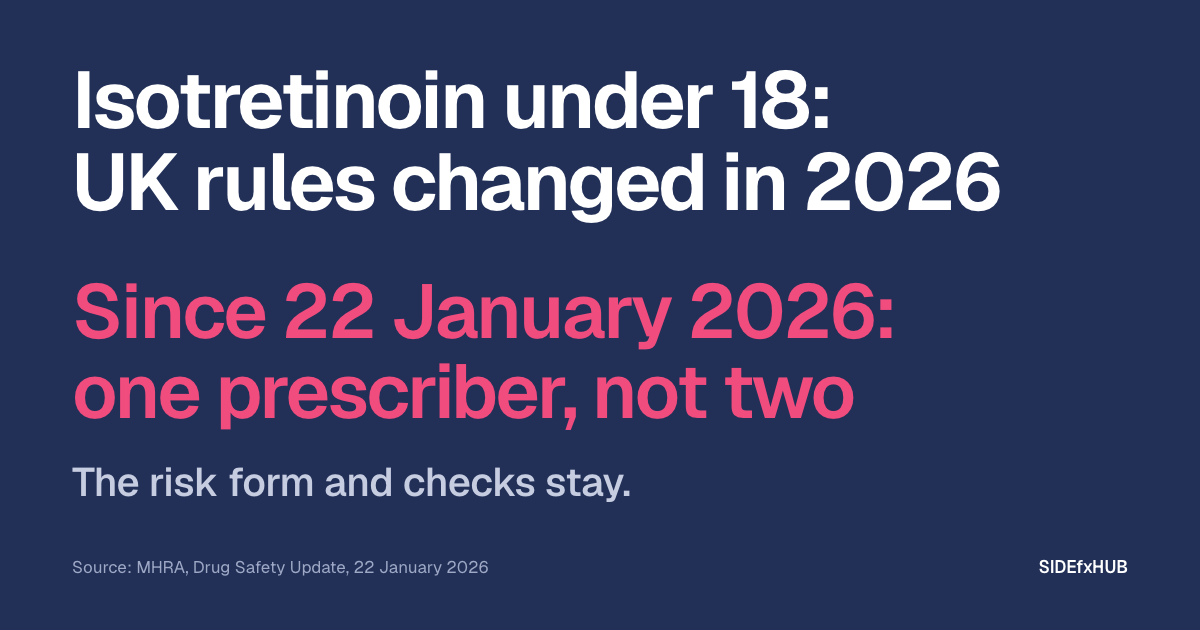
Since 22 January 2026, under-18s in the UK can start isotretinoin (Roaccutane, or Accutane) without a second prescriber agreeing. Every patient still signs a risk form, and it says some side effects “have been reported to continue after treatment”, which patients call post-Accutane syndrome, or PAS.
If your child is offered the medicine, the clinic should still assess their mental health and ask about sexual function before prescribing. The NHS page on isotretinoin doesn’t mention the form or the rule change.
The story in 3 lines
- From 31 October 2023, two prescribers had to agree before anyone under 18 started isotretinoin (UK medicines regulator, 2023).
- On 22 January 2026 the regulator, the MHRA, dropped the second prescriber, on the advice of the Commission on Human Medicines.
- The signed risk form and the checks on mood and sexual function remain. Nobody has measured how often side effects last. Patients call it PAS.
Press: contact@sidefxhub.com
Elliot was 17 when a hospital skin clinic in the UK offered him Roaccutane for severe acne. That was more than ten years ago, before today’s rules. He remembers a long form to sign, and thinks his mum was with him.

“You’re not going to sit down and read all of that”, he says of the form. He remembers the clinic’s tone as “this is serious”. But whatever was said, he adds, the risks weren’t “put to me clear enough”. Thirteen years after his last capsule, he told Moral Medicine, he still had symptoms every day, from dry skin to “flatline emotions”.
What changed for under-18s on isotretinoin in 2026?
One rule went. Since 22 January 2026, nobody under 18 needs a second prescriber’s agreement to start isotretinoin, says the MHRA, the UK medicines regulator.
That rule began on 31 October 2023. Two independent healthcare professionals then had to agree there was “no other appropriate effective treatment”. Now one prescriber makes that judgement, the medicine’s prescribing information says.
Three things took the second prescriber’s place: a shorter risk form for every patient, a patient video and a regular audit of clinics. As of October 2026, we’ve found no further change.
UK rules for under-18s on isotretinoin
Why was the isotretinoin second prescriber removed?
Prescribers almost never disagreed, and the extra step could delay treatment. That’s the reasoning in the MHRA’s review.
The review cites a 2024 survey of dermatologists. By its estimate, those who answered had started more than 4,000 under-18s while the rule applied, with two reported cases where the second prescriber disagreed. Dermatologists also reported delays, which the review says could raise the risk of scarring.
Why was there a second check at all? In 2023 an expert group advising the MHRA didn’t find a higher risk in under-18s than in older patients. But concerns had been raised about information and monitoring, and it asked for more oversight “until further data on the level of risk could be established in this age group”.
The 2026 review says the newer studies have weaknesses, with “little specific evidence for under 18s”. The Commission on Human Medicines, which advises the MHRA, said their mental health findings pointed in a “reassuring” direction.
Clinics are now audited instead, and the results go to the MHRA. Professor Sir Munir Pirmohamed chairs the commission. In the MHRA’s own film, he says stricter measures would be brought in without hesitation if future data showed isotretinoin wasn’t being prescribed safely.

What checks do under-18s still get before isotretinoin?
Everything except the second prescriber stays. The MHRA’s January 2026 update lists the checks.
With a prescriber experienced in isotretinoin.
Before prescribing, with a questionnaire.
Also before prescribing.
Gone through together, usually with a parent.
Mood and sexual function are checked each time.
The form lists possible mental health side effects, from low mood and anxiety to self-harm and suicidal thoughts. If you’re struggling, the Samaritans are on 116 123, free, at any hour.
It also names “issues relating to sexual function”. Of side effects that continue after stopping, the MHRA’s review says: “We do not know how often this happens, or how long those side effects can last”.
Our articles on depression after stopping and sexual side effects cover what’s known. Another asks whether PAS is real.
What can I do?
Isotretinoin helps many people with severe acne. Whether to start it, and what to do about side effects, is a decision for you, your child and the prescriber.
Read the form at home before the first appointment. It’s two pages, and there’s a guide for young people too.
Keep the signed copy and the patient reminder card, and write down the dates: “Isotretinoin 20 mg a day from 3 March 2026, last capsule 14 August 2026”.
The form asks patients to agree: “If I notice significant changes in my mental health, I will stop isotretinoin immediately and seek help”.
If mood or sex still feels different once the course is over, tell your GP and bring those dates. You can report it without a doctor agreeing, and parents and carers can report too.
Report it: it helps everyone
A doctor’s note helps you. A report to the medicines regulator helps everyone else: it is how patterns get noticed.
- No proof needed. A suspicion is enough, even years after stopping.
- Where: the Yellow Card scheme in the UK, MedWatch in the US.
- Use the right words. PAS has no medical term yet, so name each symptom and say it continued after stopping.
Our reporting guide walks you through it
What else do people ask?
Does a parent have to sign the isotretinoin form? A parent or guardian “should also be asked to sign” when the patient is under 18, the form’s notes say. The exception is when the prescriber thinks that isn’t in the young person’s best interests. The reason then goes in the patient’s record.
Can a teenager talk to the prescriber without a parent there? They should be given the option. The UK prescribing information tells prescribers to weigh a patient’s age and maturity when they talk about sexual side effects, “including giving the option to discuss without parents or carers present where appropriate”. The form also records that every patient was offered a second opinion.
Do the rules apply at private clinics? Yes. The MHRA says it expects all prescribers, “including those in the private sector”, to follow them. The British Association of Dermatologists’ audit covers private clinics too. As of October 2026, the association says data collection runs until 4 December 2026; no results have been published.
Elliot signed at 17, a form he remembers as too long to sit and read. Today’s is two pages. If side effects last beyond the course, report them.
Sources
- MHRA, Isotretinoin: changes to prescribing guidance and additional risk minimisation measures, Drug Safety Update, 22 January 2026. The second prescriber is no longer required “from today”. New measures: the updated form, the patient video and a clinical audit “initiated in 2026”. Measures that stay: a mental health assessment and a question about sexual function before prescribing, monitoring at each follow-up, and a Lead Prescriber with expertise. If services don’t follow the measures, “further regulatory measures will need to be considered”. Reports are asked for from “healthcare professionals, patients, and caregivers”.
- MHRA, Isotretinoin prescribing requirements updated with revised risk-minimisation measures, news story, 22 January 2026. It expects “all prescribers, including those in the private sector, to comply fully”.
- MHRA, Review of the impact of recommendations for the prescribing of isotretinoin, Public Assessment Report, 22 January 2026. Plain language summary: the quote on how often side effects last. Section 4.5.2.3: a July 2024 survey of members of the British Association of Dermatologists and the British Society for Paediatric and Adolescent Dermatology. Of 486 who answered, 343 had started under-18s on isotretinoin, estimated at more than 4,000 patients, with two reported disagreements. The review adds that it can’t tell whether the second check made first prescribing more consistent, and that the evidence on delays has limitations. Section 4.5.8.1: “little specific evidence for under 18s”. Section 5: the Commission on Human Medicines’ advice, including the audit of NHS and private services.
- Commission on Human Medicines, Report of the Isotretinoin Expert Working Group, 26 April 2023, published by the MHRA. Section 8.3: specific increased risks “were not identified within the under 18 age group”, and the recommendation for greater oversight.
- MHRA, Isotretinoin: introduction of new safety measures, Drug Safety Update, 31 October 2023. The recommendations were first announced in a Drug Safety Update of 26 April 2023.
- MHRA, Isotretinoin: updates to prescribing guidance and survey of services, Drug Safety Update, 27 October 2025. Follow-ups “could be remote if appropriate, however the first appointment should be in person”.
- Isotretinoin Acknowledgement of Risk Form, version 3.0, MHRA approval date February 2026. The patient confirms: “I have been offered a second opinion with another Lead Prescriber”. The parent or guardian’s signature is in the notes for the Lead Prescriber.
- Roaccutane 10 mg soft capsules, summary of product characteristics, EMC 100633, revised 27 April 2026. Section 4.1: “The prescriber must consider that there is no other appropriate effective treatment before initiation of isotretinoin therapy”. Section 4.2: not recommended under 12 years of age. Section 4.4, sexual disorders: the option to discuss without parents or carers present.
- MHRA, Isotretinoin: an expert review of suspected psychiatric and sexual side effects, last updated 25 February 2026. We checked this page and the MHRA’s other isotretinoin pages on 10 October 2026.
- NHS, Isotretinoin (Roaccutane), page last reviewed 26 June 2026. When we checked on 10 October 2026, it mentioned neither the form nor the rule change.
- British Association of Dermatologists, Isotretinoin patient video. Medicines for Children, Oral isotretinoin: guide for young people.
- MHRA, Isotretinoin Impact Review information session, held 22 January 2026. Professor Sir Munir Pirmohamed on the audits at about 9:50 and on stricter measures at 11:54, checked against the MHRA’s own captions.
- Moral Medicine, interview with Elliot, 28 January 2025. The form at about 15:30 to 17:25. Thirteen years since stopping at about 71 minutes, and his daily symptoms at about 76 to 78 minutes. On our site: Elliot’s story: Accutane at 17.
- British Association of Dermatologists, National clinical audit on isotretinoin prescribing, summary and instructions dated September 2026. Data collection runs from 25 September to 4 December 2026, in NHS and private practice. We checked the page on 10 October 2026.
This information does not replace medical advice. Talk to your doctor before you make any decision about your treatment.
590+ people have joined the community.
Join them, then report your side effects.
No diagnosis needed. Researchers never see your name.