Is isotretinoin safe? What the warnings say
The UK regulator says isotretinoin's benefits outweigh its risks in severe acne. The leaflet says some side effects may last: post-Accutane syndrome (PAS).
SIDEfxHUB is a patient charity. We are not health professionals, and this does not replace medical advice. Don't start, stop or change any medicine because of what you read here. Talk to your doctor first.
If you are in crisis:116 123 Samaritans (UK)988 Lifeline (US)Find a helpline
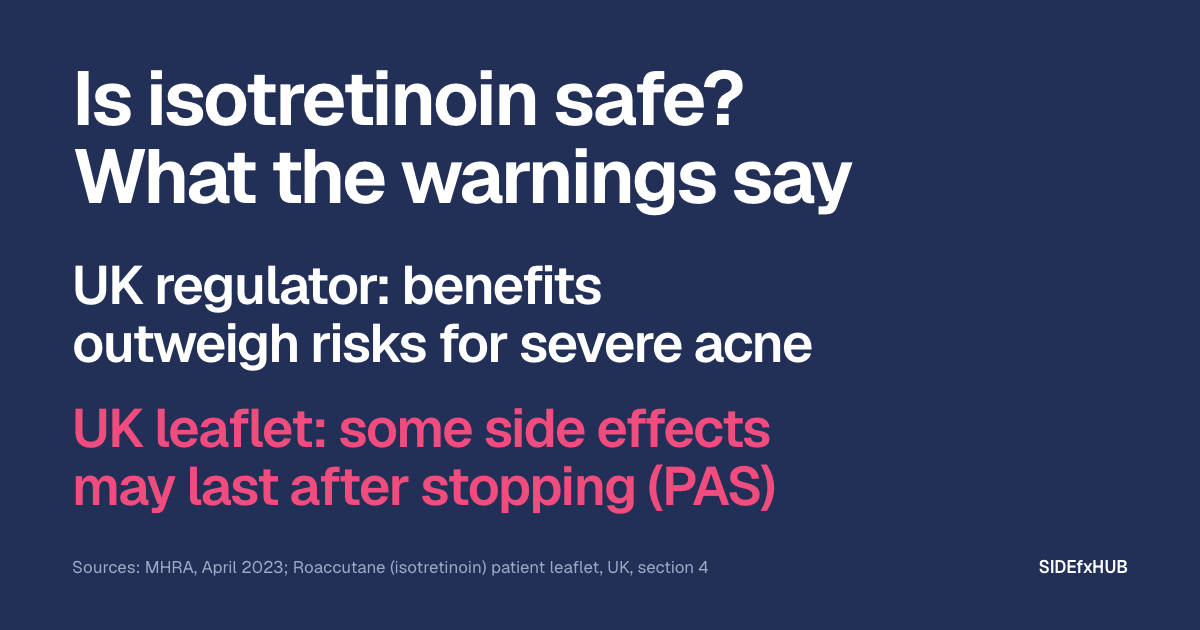
The UK medicines regulator says the benefits of isotretinoin (Accutane, or Roaccutane) outweigh its risks for severe acne. The UK leaflet also warns of sexual problems that have continued after stopping, one part of what patients call post-Accutane syndrome, or PAS.
The NHS page on isotretinoin lists problems with sex but doesn’t say they can continue after stopping. If you’re deciding whether to take it, you can read both statements before your first appointment.
The story in 3 lines
- In April 2023 the UK medicines regulator said isotretinoin’s benefits “continue to outweigh the risks” for severe acne (MHRA).
- The UK leaflet warns of serious harm to an unborn baby, of depression, and of sexual problems that “have continued despite stopping treatment”.
- Nobody has measured how often side effects last (MHRA, 2026). When they do, patients call it PAS.
Press: contact@sidefxhub.com
Miriam had lived with acne since she was 12. When a dermatologist in Spain first suggested isotretinoin, she heard about the regular blood tests and the contraception. “That alone scared me enough not to do it,” she says.

Four years later she went ahead. She remembers being warned about pregnancy, and told her skin would be dry until the course ended. Asked whether lasting side effects came up, she says no. She took two courses. After the second, she says, she could no longer tolerate contact lenses.
Is isotretinoin safe, according to regulators?
The UK regulator, the MHRA, says isotretinoin’s benefits outweigh its risks for severe acne. It said so in April 2023, after a safety review that began in 2019.
“No medicine is completely free of risk,” it said. Its independent advisers had concluded that “on balance the benefits of isotretinoin for severe acne continue to outweigh the risks”.
The medicine is meant for severe acne that other treatments haven’t cleared. The UK leaflet says: “Your prescriber must have considered that there is no other appropriate treatment before starting your isotretinoin therapy.”
The advisers’ report said the evidence couldn’t show that isotretinoin caused many of the mental health and sexual side effects people had reported. A link, it added, “cannot be ruled out”. A later analysis of the research found that, on average, people who took isotretinoin were no more likely than others to have a mental health condition.
The regulator also asked for action: patients should be better aware of the risks and “carefully monitored throughout treatment”. The MHRA’s Dr Shareen Doak later set out what patients had asked the review for, and what followed.

What are the main warnings on isotretinoin?
The UK leaflet gives two warnings a headed section of their own: pregnancy and mental health. Its “very common” side effects, which may affect more than 1 in 10 people, include dry skin and chapped lips.
On pregnancy, the leaflet says isotretinoin “can seriously harm an unborn baby”. It must not be taken in pregnancy, and anyone who could get pregnant takes it under strict rules.
On mental health, it lists depression, frequency “not known”. It says: “Some people have had thoughts about hurting themselves or ending their own lives (suicidal thoughts), have tried to end their own lives (attempted suicide), or have ended their lives (suicide). These people may not appear to be depressed.”
The leaflet asks you to contact your doctor straight away if you notice signs of any of this. If you’re struggling now, the Samaritans are on 116 123, free, at any hour.
Can isotretinoin’s side effects last after you stop?
Some can, the leaflet says. Side effects are “generally reversible” once you stop, “however some may continue after treatment has stopped”. We list those in Accutane’s long-term side effects.
About sexual side effects, the leaflet is specific: “There have been reports of long-lasting sexual problems where the symptoms have continued despite stopping treatment with isotretinoin.”
In June 2026 the US regulator told makers to list sexual problems that “may continue after discontinuation of treatment”.
UK warnings on isotretinoin, 1983 to 2026
Nobody has measured how often. The MHRA’s 2026 review says of side effects that continue: “We do not know how often this happens, or how long those side effects can last.”
For some people it has lasted years after stopping. Nobody knows yet who will be affected, or whether it will ease.
When side effects last, patients call it PAS. It isn’t a formal diagnosis, though in 2022 doctors and researchers proposed criteria for lasting sexual problems after isotretinoin. More in Is post-Accutane syndrome real?
What can I do?
Isotretinoin helps many people with severe acne. Whether to take it, or what to do about a side effect: that’s a decision for you and your prescriber. The UK leaflet says to talk to your doctor about any sexual problems during treatment.
If you’re offered it, the MHRA advises patients to “take time to think about the information provided by your doctor about the benefits and risks”. In the UK there’s a risk form to sign, which you can read at home first.
If something hasn’t gone back to normal since your last capsule, tell your GP and give your dates: “Isotretinoin 30 mg a day from February 2025, last capsule August 2025.”
Many people say it took time to be taken seriously. Bring the leaflet line: “some may continue after treatment has stopped”. You can report it without a doctor agreeing.
Report it: it helps everyone
A doctor’s note helps you. A report to the medicines regulator helps everyone else: it is how patterns get noticed.
- No proof needed. A suspicion is enough, even years after stopping.
- Where: the Yellow Card scheme in the UK, MedWatch in the US.
- Use the right words. PAS has no term yet in MedDRA, the regulators’ dictionary, so name each symptom and say it continued after you stopped isotretinoin.
Our reporting guide walks you through it
What else do people ask?
Is isotretinoin safe for teenagers? The UK leaflet covers adults and adolescents, and says it shouldn’t be used under 12. In 2023 the UK experts didn’t find a higher risk in under-18s than in older patients, but they wanted more data. Isotretinoin under 18 explains the checks.
Is a low dose of isotretinoin safer? The UK experts left that open. Some side effects are related to the dose, the leaflet says. The 2023 report noted suggestions that lower doses may carry lower risks, but added that “not all side effects are dose related”.
Why has isotretinoin been reviewed more than once? Concerns kept being raised, the 2023 report says: about mood, and later about sex. Views sent to that review ranged from “a life-changing medicine” to wanting it “taken off the market or severely restricted”. We ask the same question of another medicine in Is finasteride safe?
Miriam’s appointment was in Spain, in 2020. She remembers no mention of side effects that might stay. Today’s UK leaflet says some may. If something has stayed since your last capsule, report it and say how long it has lasted.
Sources
- MHRA, Outcome of the expert review of the safety of isotretinoin, news story, 26 April 2023. The statement is from Dr Alison Cave, MHRA Chief Safety Officer. It gives the conclusion of the independent Commission on Human Medicines: “on balance the benefits of isotretinoin for severe acne continue to outweigh the risks”. It asks for patients to be “better aware” of the risks and “carefully monitored throughout treatment”.
- Commission on Human Medicines, Report of the Isotretinoin Expert Working Group, 26 April 2023, published by the MHRA. Executive summary: “the overall balance of risks and benefits for isotretinoin remains favourable”; “conflicting study data”. Section 1: the group was reconvened in September 2019. Section 1.1.4: first authorised in 1983 as Roaccutane; warnings about possible psychiatric disorders in the product information since the 1990s. Section 1.1.6: earlier reviews in 2005 and 2014 (in the timeline); reports of erectile dysfunction increasing from 2012. Section 6.10: lower doses. Section 8.1: the data “are insufficient to establish causal associations for many of the acute and longer term psychiatric and sexual side effects reported”. Also section 8.1: “an association cannot be ruled out”; views ranged from “a life-changing medicine” to “wanting it taken off the market or severely restricted”. Section 8.3: specific increased risks “were not identified within the under 18 age group”, with more oversight “until further data on the level of risk could be established”.
- Roaccutane 10 mg and 20 mg soft capsules, patient leaflet, Electronic Medicines Compendium (EMC 100633), last revised April 2026. Section 1: severe acne in adults and adolescents; not under 12; the prescriber “must have considered that there is no other appropriate treatment”. Section 2: the headings “Pregnancy prevention programme” and “Mental health problems”; sexual problems, including “long-lasting sexual problems where the symptoms have continued despite stopping treatment with isotretinoin”. Section 4: side effects “generally reversible” but “some may continue”; “Mental problems”, with depression and the sentence we quote under “Frequency not known”; very common side effects (may affect more than 1 in 10 people).
- MHRA, Review of the impact of recommendations for the prescribing of isotretinoin, Public Assessment Report, 22 January 2026. Plain language summary: “Some side effects may continue even after stopping isotretinoin. We do not know how often this happens, or how long those side effects can last.” It also repeats the 2023 conclusion that the balance of risks and benefits “remains favourable”.
- MHRA, Drug Safety Updates on isotretinoin. 26 October 2017, sexual dysfunction added to the list of side effects. 26 April 2023, the new warning on long-lasting sexual dysfunction announced. 31 October 2023, product information updated, and the advice to patients to “take time to think”.
- Isotretinoin Acknowledgement of Risk Form, version 3.0, MHRA approval date February 2026.
- US Food and Drug Administration, response to citizen petition FDA-2018-P-4088, 16 June 2026. The wording required in the Adverse Reactions section of isotretinoin labels. It is on the Absorica label, revised August 2026 (DailyMed, US National Library of Medicine).
- NHS, Isotretinoin (Roaccutane), page last reviewed 26 June 2026. Lists “problems with sex”; when we checked on 11 October 2026 it did not say they can continue after stopping.
- Tan NKW, Tang A, MacAlevey NCYL and colleagues. Risk of suicide and psychiatric disorders among isotretinoin users: a meta-analysis. JAMA Dermatol 2024;160(1):54-62. 25 studies, 1,625,891 participants; no raised risk of psychiatric disorders overall “at a population level”.
- Healy D, Bahrick A, Bak M and colleagues. Diagnostic criteria for enduring sexual dysfunction after treatment with antidepressants, finasteride and isotretinoin. Int J Risk Saf Med 2022;33(1):65-76. Section 6, post-retinoid sexual dysfunction.
- Moral Medicine, From Mild Acne to Severe Dry Eyes, Hair Loss and Infertility: Miriam’s Nightmare After Isotretinoin, interview with Miriam, 13 October 2025. Her first dermatologist and the decision in 2020, at about 4:55 to 5:45; what she was told, at about 6:00 to 6:50; her two low-dose courses, at about 7:30 to 11:30; contact lenses, at about 13:20. Her story on our site: Miriam’s story: 2 courses of isotretinoin.
- MHRA, Isotretinoin Impact Review information session, held 22 January 2026. Dr Shareen Doak, Deputy Director of Benefit Risk Evaluation, from about 3:09, checked against the MHRA’s own captions.
This information does not replace medical advice. Talk to your doctor before you make any decision about your treatment.
590+ people have joined the community.
Join them, then report your side effects.
No diagnosis needed. Researchers never see your name.