FDA Accutane label: sexual effects may last
In June 2026 the FDA told isotretinoin (Accutane) makers to list sexual problems that may continue after stopping, without a warning. Patients call it PAS.
SIDEfxHUB is a patient charity. We are not health professionals, and this does not replace medical advice. Don't start, stop or change any medicine because of what you read here. Talk to your doctor first.
If you are in crisis:116 123 Samaritans (UK)988 Lifeline (US)Find a helpline
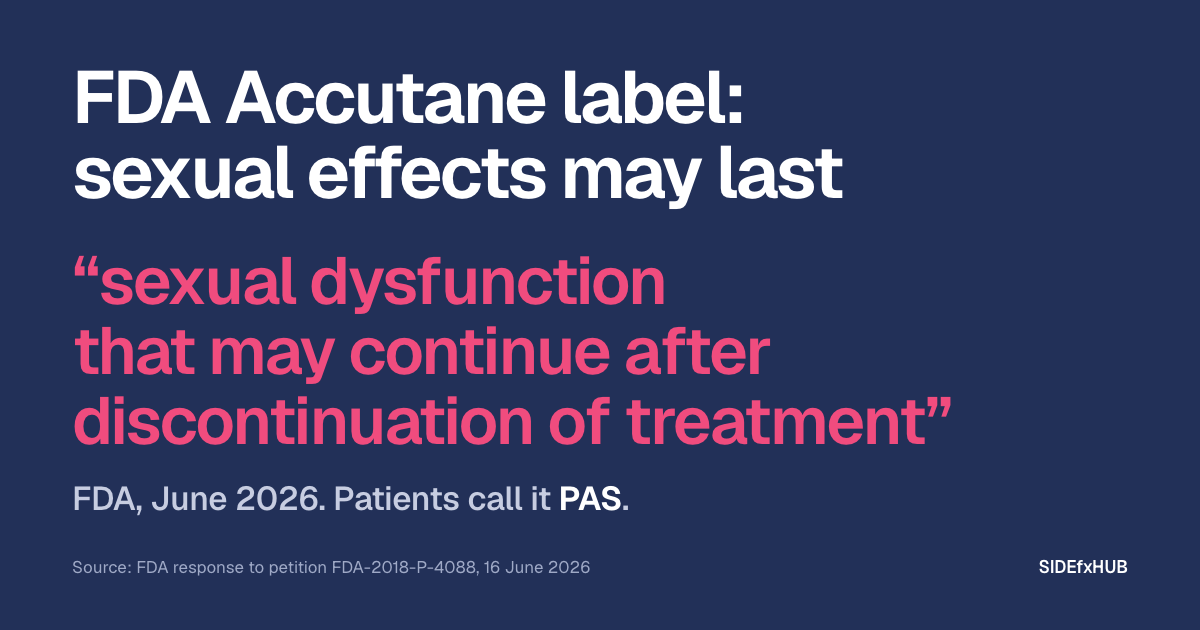
In June 2026 the US Food and Drug Administration (FDA) told every maker of isotretinoin (Accutane) to list sexual problems that may continue after stopping, but not as a formal warning. When these problems last, patients call it post-Accutane syndrome, or PAS.
Until then, US generic labels copied from Accutane said nothing about sexual side effects. The new line names erection problems, low sex drive and vaginal dryness, but leaves out genital numbness, which some patients report.
The story in 3 lines
- A 2018 petition asked the FDA to warn that isotretinoin’s sexual side effects can last after stopping (docket).
- On 16 June 2026 the FDA told every maker to list sexual dysfunction “that may continue after discontinuation of treatment”, without a formal warning (FDA response).
- To change the generic labels, the FDA used a 2020 law for the first time (FDA bulletin). Patients call the condition PAS.
Press: contact@sidefxhub.com
The request came from David Healy, a professor of psychiatry who helped set up the drug-safety website RxISK. He filed it in October 2018. The FDA’s answer reached him on 17 June 2026, nearly eight years later.
He had asked for a boxed warning, the strongest kind. He got one line. “Any mention in the label gives the person affected a better footing in their dealings with doctors,” he wrote three days later.
What did the FDA change on the Accutane label?
It told every maker to use the same line in the label’s list of side effects. That line covers sexual problems that may continue after stopping, “including erectile dysfunction, decreased libido, decreased vaginal lubrication, and vaginal dryness”. Absorica, a newer brand, already listed these four, but not that they may continue.
By October 2026 the new line was on the labels of Claravis, Amnesteem, Absorica and others on DailyMed, the US library of medicine labels. Some older listings there still show the old wording, so check the date.
Generics copied from Accutane were the hard part. They must match the original Accutane label, which was last updated in February 2010. That year Accutane’s approval was withdrawn at its maker’s request, so the generics’ labels stayed out of date.
A law known as MODERN, passed in December 2020, lets the FDA order updates to these labels. It covers generics whose original brand was withdrawn for reasons other than safety. The FDA says it’s the first time it has used that power.
The US isotretinoin label, 2010 to 2026
Why didn’t the FDA add a warning?
It said the evidence didn’t reach its bar. A warning needs “reasonable evidence of a causal association”: good reason to think the medicine causes the problem. The FDA said the studies and reports it reviewed fell short.
The list of side effects has a lower bar, so that’s where the line went. In the cases the FDA reviewed where problems continued after stopping, half the people were 21 or younger. Some had been sent to specialists such as urologists, “often with little to no improvement”, and the causes “remain unknown”, the FDA wrote.
The FDA also noted that sexual problems are common, especially in people with severe acne, who are also more likely to be depressed. A 2024 study of US health records found no clear link in young men in the year after their first prescription. The FDA judged it too imprecise to settle the question.
What did the FDA leave out?
Three symptoms the petition asked for: genital numbness, orgasms that feel weaker, and no orgasm at all. RxISK called leaving them out “a missed opportunity”. The FDA said it had found “very few reports” of them, too few to put them on the label.
In a 2018 collection of reports by Healy’s team, about 4 in 10 of those with lasting problems after isotretinoin described genital numbness. The FDA said studies like this, built on online self-reports, can’t show cause. The UK leaflet already lists “reduced sensation in the genitals”.
The new line sits in the prescribing information, which is written for doctors. The US Medication Guides we checked, the leaflets patients get with the capsules, still say nothing about sexual side effects.
Dr Kenneth Peters, chair of urology at a Michigan hospital, once saw four young patients with genital numbness within two weeks. Two of them had taken Accutane.

What can I do?
These medicines help many people. If you have side effects, that’s a decision for you and your prescriber. The UK leaflet says to talk to your doctor about any sexual problems during treatment.
If problems have stayed since your course ended, tell your GP and give your dates: “Isotretinoin 20 mg a day from March 2023, last capsule September 2023.” Bring the new US line, or the UK leaflet’s.
Many people say it took time to be taken seriously. You can report it without a doctor agreeing.
Report it: it helps everyone
A doctor’s note helps you. A report to the medicines regulator helps everyone else: it is how patterns get noticed.
- No proof needed. A suspicion is enough, even years after stopping.
- Where: the Yellow Card scheme in the UK, MedWatch in the US.
- Use the right words. PAS has no MedDRA term yet, so name each symptom, such as genital numbness, and say it continued after you stopped isotretinoin.
Our reporting guide walks you through it
What else do people ask?
Is post-Accutane syndrome a diagnosis? Not a formal one, and the FDA’s letter doesn’t use the name. In 2022 doctors and researchers proposed criteria for lasting sexual problems after isotretinoin. Patients use PAS more widely, for changes in mood and cognition too, and Doug Bremner, a professor of psychiatry, talks about PAS and the brain.
Can it be permanent? For some people it has lasted years after stopping. Nobody knows yet who will be affected, or whether it will ease. Nobody has counted how often it happens either: the FDA says its reports “cannot be used to calculate the incidence”.
Elliot took Accutane at 17. Moral Medicine, which interviewed him in January 2025, says he had lived with PAS ever since.

Does it affect women? Yes. The new line lists less vaginal lubrication, and vaginal dryness too, which the FDA added even though the petition hadn’t asked for it. Our article on Accutane sexual side effects covers the symptoms in more detail.
Healy’s petition has given people one line to show their doctor. If sex has felt different since your course of isotretinoin, report it: the FDA weighed reports like yours.
Sources
- US Food and Drug Administration, final response to citizen petition FDA-2018-P-4088, letter from Michael Davis, Acting Director, Center for Drug Evaluation and Research, to David Healy, 16 June 2026 (posted 17 June 2026). Petition received 29 October 2018. Granted in part and denied in part. Section I.B and note 39: labels of generics based on Accutane carried no information on sexual dysfunction; the Absorica and Absorica LD label already listed erectile dysfunction, decreased libido, decreased vaginal lubrication and vaginal dryness, without saying they may continue. Accutane’s label was last revised on 1 February 2010. Note 32: Accutane’s approval was withdrawn in 2010 at the maker’s request, not for safety reasons. Section II.A: no “reasonable evidence of a causal association”, so no Warnings and Precautions entry. FAERS data “cannot be used to calculate the incidence”. The 2024 controlled study was judged imprecise. Severe acne carries a higher background risk of sexual dysfunction and depression. Median age 21 in cases where problems continued after stopping. Genital anaesthesia, anorgasmia and decreased orgasmic sensation not added (“very few reports”). No reports of problems that first emerged or worsened after stopping. The required Adverse Reactions wording, with vaginal dryness added though not requested. Section II.A.4: section 505(o)(4) used for Absorica, MODERN (section 503D) for generics based on Accutane. Sections II.B and II.C: boxed warning and Highlights denied.
- FDA, docket FDA-2018-P-4088, the petition and public comments, regulations.gov.
- FDA Center for Drug Evaluation and Research, Small Business and Industry Assistance, FDA Requests Labeling Updates for Generic Isotretinoin Products, 17 June 2026: “This is the first time FDA has used its authority under section 324 of the Consolidated Appropriations Act, 2021” (MODERN). That Act is Public Law 116-260, signed on 27 December 2020.
- Absorica and Absorica LD (isotretinoin), US prescribing information and Medication Guide, Sun Pharmaceutical Industries, effective 19 August 2026. DailyMed, US National Library of Medicine. Section 6, Adverse Reactions, Reproductive System. Also checked on DailyMed, 10 October 2026: Claravis (Teva, effective 22 July 2026), Amnesteem (Mylan, 15 August 2026) and Zenatane (Dr. Reddy’s, 20 September 2026), each with the new line in section 6. In the Absorica and Claravis Medication Guides, sex is mentioned only in the pregnancy prevention advice. Old wording, with only “abnormal menses” under Reproductive System: Zenatane (Bluepoint Laboratories, ANDA 202099, effective 1 April 2026), still listed on DailyMed on 10 October 2026.
- Roaccutane 10 mg and 20 mg soft capsules, patient leaflet, Electronic Medicines Compendium (EMC 100633), last revised April 2026. Section 2: the sexual problems listed, including reduced sensation in the genitals; long-lasting sexual problems that continued after stopping; talk to your doctor about sexual problems during treatment. The Summary of Product Characteristics, revised 27 April 2026, lists genital hypoaesthesia in section 4.8.
- Healy D, Le Noury J, Mangin D. Enduring sexual dysfunction after treatment with antidepressants, 5α-reductase inhibitors and isotretinoin: 300 cases. Int J Risk Saf Med 2018;29(3-4):125-34. Isotretinoin: 54 of 300 reports (49 men, 5 women); genital anaesthesia in 18 of 49 men and 3 of 5 women. Self-reports to RxISK.org, a site run by the authors; the FDA’s response criticises the method.
- Thang CJ, Garate D, Golovko G, Barbieri JS. Isotretinoin exposure does not appear to be associated with risk of adverse male sexual health outcomes in acne patients. Int J Dermatol 2024;63(2):e54-7. US health records (TriNetX), male acne patients aged 14 to 40, outcomes within one year of the first prescription.
- Healy D, Bahrick A, Bak M and colleagues. Diagnostic criteria for enduring sexual dysfunction after treatment with antidepressants, finasteride and isotretinoin. Int J Risk Saf Med 2022;33(1):65-76.
- David Healy, Regulators Bearing Gifts, davidhealy.org, 20 June 2026.
- RxISK, FDA Responds to Isotretinoin Petition, 19 June 2026. On genital anaesthesia, anorgasmia and decreased orgasmic sensation.
- SIDEfxHUB, Interview with Dr. Kenneth Peters, PFS / PAS / PSSD Summit 2026, 25 April 2026. Dr Peters is chair of urology at Corewell Health William Beaumont University Hospital, Michigan. The interview on our site: Dr. Kenneth Peters on the First PFS/PSSD/PAS Summit.
- Moral Medicine, interview with Elliot, 28 January 2025. On our site: Elliot’s story: Accutane at 17.
This information does not replace medical advice. Talk to your doctor before you make any decision about your treatment.
590+ people have joined the community.
Join them, then report your side effects.
No diagnosis needed. Researchers never see your name.