Erectile dysfunction at 20: is it a medicine?
Erection problems at 20 often have an everyday cause. UK leaflets for SSRIs, finasteride and isotretinoin warn sexual problems can last: PSSD, PFS, PAS.
SIDEfxHUB is a patient charity. We are not health professionals, and this does not replace medical advice. Don't start, stop or change any medicine because of what you read here. Talk to your doctor first.
If you are in crisis:116 123 Samaritans (UK)988 Lifeline (US)Find a helpline
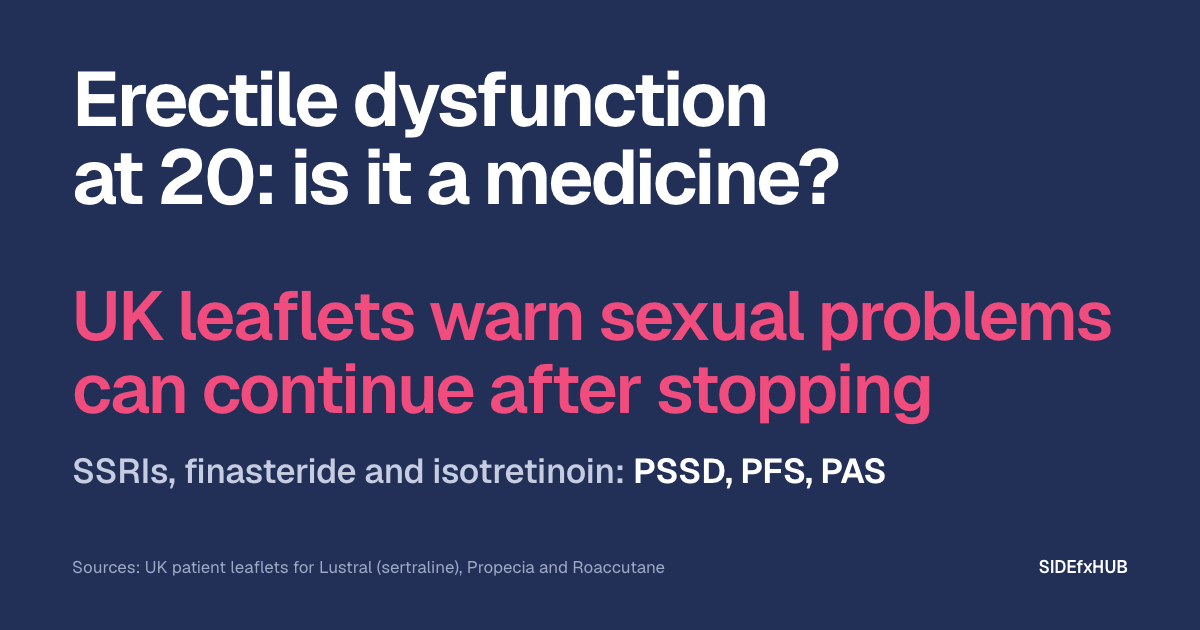
Occasional erectile dysfunction at 20 usually has an everyday cause, such as stress, tiredness or alcohol. But UK leaflets for SSRI antidepressants, the hair-loss tablet finasteride and the acne medicine isotretinoin warn sexual problems can continue after stopping: post-SSRI sexual dysfunction (PSSD), post-finasteride syndrome (PFS) and post-Accutane syndrome (PAS).
The NHS page on erection problems says they can be a side effect of “some medicines”, but it doesn’t say which ones, or that the problem can outlast the medicine. If you take one of these three, or took one before your erections changed, that’s worth knowing before you put it down to nerves.
The story in 3 lines
- An occasional erection problem is usually down to stress, tiredness or alcohol, says the NHS.
- The UK leaflets for sertraline (an SSRI), finasteride and isotretinoin list erection problems, and warn that sexual problems have continued after stopping.
- Nobody knows how often, say the authors of the 2022 diagnostic criteria. Patients call it PSSD, PFS or PAS.
Press: contact@sidefxhub.com
Lucas was 18 when he started taking finasteride, prescribed by a doctor for his hair loss. By the third day, he says, he couldn’t get a full erection.

By the time he was 20, he says, he was “another person”. He told himself he was just depressed, and kept taking the tablets. “I lost my youth,” he says.
Is it normal to have erectile dysfunction at 20?
Now and then, yes. The NHS says most men sometimes can’t get or keep an erection, and that this is “nothing to worry about”.
Young men get it too. At one clinic in Milan, about 1 in 4 men coming for help with new erection problems were 40 or younger. The younger men were more likely to smoke and to use illegal drugs.
If it keeps happening, the NHS lists possible causes such as anxiety, depression, diabetes and hormone problems. It says to see a GP or go to a sexual health clinic, because it “might be a sign of a health condition that can be treated”.
Can medication cause erectile dysfunction in young men?
Yes. Three medicines that young men are prescribed list erection problems in their UK leaflets:
- SSRI antidepressants, for depression or anxiety. The sertraline leaflet lists erectile dysfunction as a common side effect.
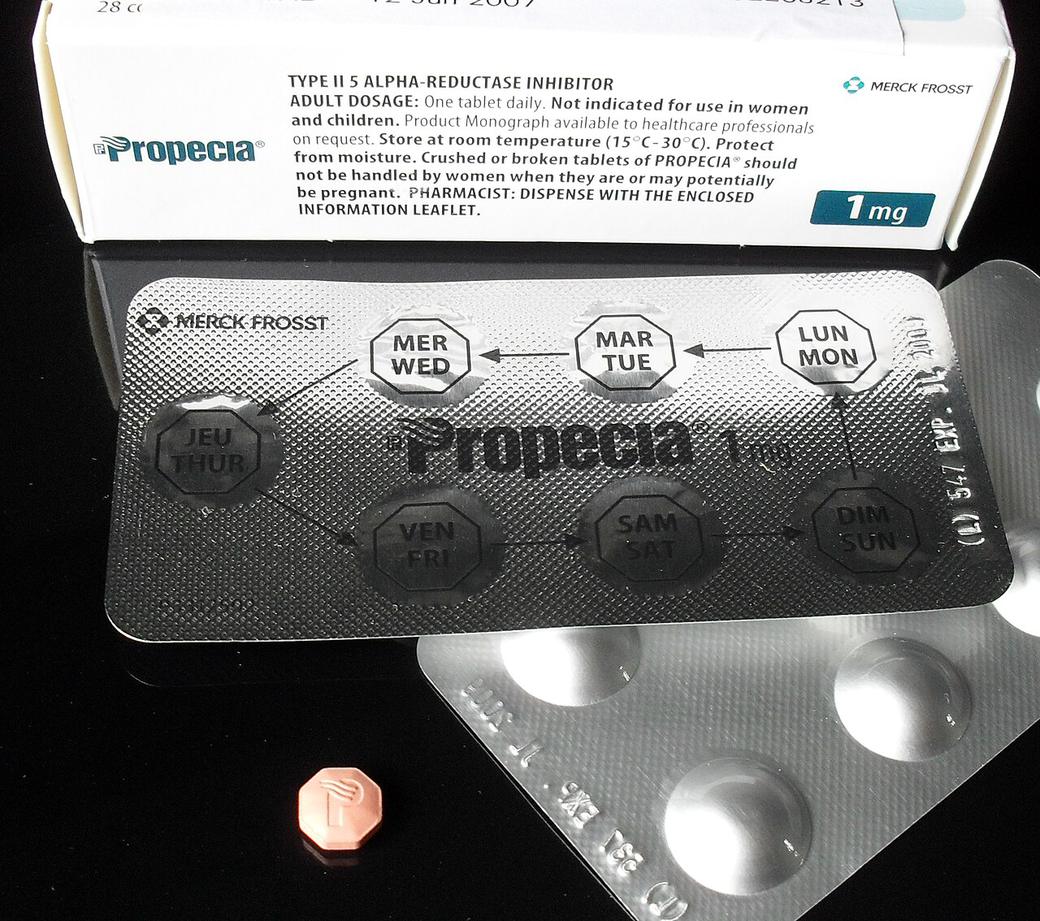
- Finasteride, the hair-loss tablet sold as Propecia. Its leaflet says you “may be unable to have an erection”.
- Isotretinoin, the acne capsule sold as Roaccutane. Its leaflet lists “problems getting or maintaining an erection”. Since 2023, the UK medicines regulator has told prescribers to ask about sexual function before starting it.
Depression and anxiety can cause erection problems on their own, so it isn’t always the tablet. A study in Israel tried to separate the two.
It looked at healthy, non-smoking men aged 21 to 49. About 9 in 100 who had taken an antidepressant were prescribed an erection drug such as sildenafil, against about 3 in 100 who hadn’t. The gap was still there after allowing for depression and anxiety.
Can erectile dysfunction last after stopping the medicine?
For some people, yes. All three leaflets warn that sexual problems have carried on after stopping. The Propecia leaflet names erections: it lists “persistent difficulty having an erection after discontinuation of treatment”.
One US study of medical records looked at young men, aged 16 to 42, on the hair-loss dose of finasteride. Of those diagnosed with new erection problems, about 1 in 3 still had them at least three months after stopping. A study of records can show a link. It can’t prove the medicine was the cause.
The doctors and researchers who wrote criteria for diagnosing PSSD, PFS and PAS in 2022 use the same mark: a problem still there three months or more after stopping.
For some people it has lasted years after stopping. Lucas says he has had PFS for about 14 years. Nobody knows yet who will be affected, or whether it will ease.
Dr Maria Uloko is a urologist who was teaching at UC San Diego in 2023. That year she spoke to a meeting of urologists about what doctors tell patients: that finasteride’s sexual side effects should go away once they stop taking it. She told them this may not be correct.


What can I do?
These medicines help many people. If you have side effects, that’s a decision for you and your prescriber.
Don’t stop an antidepressant suddenly. For finasteride and isotretinoin, follow what the leaflet says.
If your erections changed while you were taking one, or haven’t recovered since you stopped, tell your GP or a sexual health clinic. Give your dates: “Finasteride 1 mg from March 2024, last tablet June 2024.”
Many people say it took time to be taken seriously. Bring the leaflet line. You can report it without a doctor agreeing.
Report it: it helps everyone
A doctor’s note helps you. A report to the medicines regulator helps everyone else: it is how patterns get noticed.
- No proof needed. A suspicion is enough, even years after stopping.
- Where: the Yellow Card scheme in the UK, MedWatch in the US.
- Use the right words. If symptoms continued after stopping, write Post-SSRI sexual dysfunction (MedDRA 10086208) for an SSRI or SNRI, or Post 5-alpha-reductase inhibitor syndrome (MedDRA 10082430) for finasteride. For isotretinoin there’s no term yet, so say the symptoms continued after stopping.
Our reporting guide walks you through it
What else do people ask?
Could it just be anxiety? It could. The 2022 criteria rule out problems that were there before the medicine, or that another condition explains. For PSSD, the key sign is a lasting change in how the genitals feel, such as numbness. Read more about PSSD, PFS and PAS.
Does isotretinoin definitely cause it? Nobody has settled that. In 2023 an expert review for the UK regulator said gaps in the evidence meant it couldn’t say isotretinoin definitely caused many of the sexual side effects people reported. It still asked for sexual health to be checked throughout treatment.
Do antidepressants cause other sexual problems? Yes. The sertraline leaflet lists failure to ejaculate as very common, and less interest in sex as common. Our article on antidepressant sexual problems covers what they feel like and whether they last.
Lucas told himself he was just depressed. If your erections changed on one of these medicines and haven’t come back since your last dose, report it and say when you stopped.
Sources
- NHS, Erectile dysfunction (impotence), page last reviewed 28 July 2023. Occasional problems are “usually caused by stress, tiredness or drinking too much alcohol, and it’s nothing to worry about. It can also be a side effect of some medicines.” No medicine is named, and the page doesn’t say a problem can continue after stopping. When it happens often: high blood pressure or high cholesterol, diabetes, depression or anxiety, hormone problems. See a GP or a sexual health clinic if erection problems keep happening: “It might be a sign of a health condition that can be treated.”
- Lustral (sertraline) 50 mg and 100 mg film-coated tablets, patient leaflet, Electronic Medicines Compendium (EMC 2835), last revised December 2025. Section 2, “Sexual problems”: “In some cases, these symptoms have continued after stopping treatment.” Section 4: erectile dysfunction and decreased sexual interest are common (up to 1 in 10 people); ejaculation failure is very common (more than 1 in 10).
- Propecia 1 mg film-coated tablets, patient leaflet (UK, EMC 2194), last revised May 2026. Section 4: uncommon (up to 1 in 100), “you may be unable to have an erection (impotence)”; frequency unknown, “persistent difficulty having an erection after discontinuation of treatment”, with persistent decrease in sex drive and persistent problems with ejaculation. Section 2: not for use under 18.
- Roaccutane 10 mg and 20 mg soft capsules, patient leaflet (UK, EMC 100633), last revised April 2026. Section 2: isotretinoin has been associated with sexual problems, including “problems getting or maintaining an erection”, and “There have been reports of long-lasting sexual problems where the symptoms have continued despite stopping treatment with isotretinoin.” Section 4: frequency unknown.
- Capogrosso P, Colicchia M, Ventimiglia E and colleagues. One patient out of four with newly diagnosed erectile dysfunction is a young man: worrisome picture from the everyday clinical practice. J Sex Med 2013;10(7):1833-41. 114 of 439 consecutive men (26%) seeking first help for new erectile dysfunction at one clinic in Milan were 40 or younger (range 17 to 40). Younger men more often smoked and used illicit drugs.
- Ben-Sheetrit J, Hermon Y, Birkenfeld S and colleagues. Estimating the risk of irreversible post-SSRI sexual dysfunction (PSSD) due to serotonergic antidepressants. Ann Gen Psychiatry 2023;22:15. Records from one district of Clalit Health Services, Israel, over 19 years: 12,302 men aged 21 to 49, non-smokers with a BMI under 25 and no illness, medicine, alcohol or drug use linked to erectile dysfunction, and no finasteride or dutasteride. Erectile dysfunction was defined as a prescription for a PDE-5 inhibitor such as sildenafil: 74 of 866 men (8.5%) who had taken a serotonergic antidepressant, against 286 of 11,436 (2.5%) who had not. The link held after allowing for age, income group, BMI, depression and anxiety (adjusted odds ratio 3.2).
- Kiguradze T, Temps WH, Yarnold PR and colleagues. Persistent erectile dysfunction in men exposed to the 5α-reductase inhibitors, finasteride, or dutasteride. PeerJ 2017;5:e3020. Northwestern Medicine electronic records. Men aged 16 to 42 on finasteride 1.25 mg a day or less, with no sexual dysfunction before: of 103 with new erectile dysfunction, 34 (33%) had erectile dysfunction documented as lasting at least 90 days after stopping (median 1,534 days); 34 of all 4,284 men (0.8%). New erectile dysfunction meant a doctor’s diagnosis plus a prescription for a PDE-5 inhibitor. Single-group design; an association, not proof of cause.
- Healy D, Bahrick A, Bak M and colleagues. Diagnostic criteria for enduring sexual dysfunction after treatment with antidepressants, finasteride and isotretinoin. Int J Risk Saf Med 2022;33(1):65-76. “The incidence of these conditions is unknown.” For PSSD, PFS and post-retinoid sexual dysfunction (the criteria’s name for the isotretinoin condition), enduring erectile dysfunction is an additional criterion and a problem present 3 months or more after stopping is another. The necessary criterion for PSSD is an enduring change in genital sensation; the paper describes it as genitals that “feel like they were exposed to an anesthetic” and speaks of “genital numbness”. All three exclude matching sexual problems before the drug and medical conditions that could explain the symptoms.
- MHRA, Isotretinoin (Roaccutane): introduction of new safety measures, including additional oversight of the initiation of treatment for patients under 18 years of age, Drug Safety Update, 31 October 2023. Prescribers to ask patients about any sexual function concerns before prescribing, and to monitor sexual function side effects at each follow-up. Reports can be made of suspected reactions experienced at any time, including in the past.
- MHRA, Outcome of the expert review of the safety of isotretinoin, 26 April 2023. The Commission on Human Medicines’ expert group concluded that “the gaps in the available evidence meant that it was not possible to say that isotretinoin definitely caused many of the short-term or long-term psychiatric and sexual side effects”. It recommended consistent monitoring of psychiatric and sexual health throughout treatment.
- Moral Medicine, interview with Lucas, 16 June 2026 (43 minutes). From the YouTube auto-captions: prescribed finasteride by a doctor for hair loss, with no warning about side effects (2:06 to 2:40); started taking it at 18 (3:22 to 3:28, 6:46). Erection problems by the third day (3:48 to 4:04). “Another person” by 20 (6:46 to 6:52). Told himself he was just depressed and kept taking it (9:35 to 10:41). “I lost my youth” (36:45; also in the opening, 0:13). About 14 years of PFS, in his own words (1:38 to 1:43, 42:06). His story on our site: Lucas’s story: finasteride at 18.
- Grand Rounds in Urology, Common Drug-Induced Sexual Dysfunction in Men, Maria Uloko, listed by Grand Rounds in Urology as an assistant professor at UC San Diego School of Medicine, at the 30th Annual Perspectives in Urology: Point-Counterpoint, San Diego, 10 March 2023; posted 20 July 2023 (13 minutes). Paraphrased, not quoted, from the YouTube auto-captions at 3:15 to 3:22: speaking of finasteride and dutasteride, she says that telling patients the symptoms should go away when the medicine stops may not be correct.
- Photo: Propecia box and tablet, Kristoferb, public domain, via Wikimedia Commons.
This information does not replace medical advice. Talk to your doctor before you make any decision about your treatment.
590+ people have joined the community.
Join them, then report your side effects.
No diagnosis needed. Researchers never see your name.