How to report isotretinoin side effects
You can report isotretinoin (Accutane) side effects yourself, in the UK or the US. If they continued after stopping, known as PAS, say so in your report.
SIDEfxHUB is a patient charity. We are not health professionals, and this does not replace medical advice. Don't start, stop or change any medicine because of what you read here. Talk to your doctor first.
If you are in crisis:116 123 Samaritans (UK)988 Lifeline (US)Find a helpline
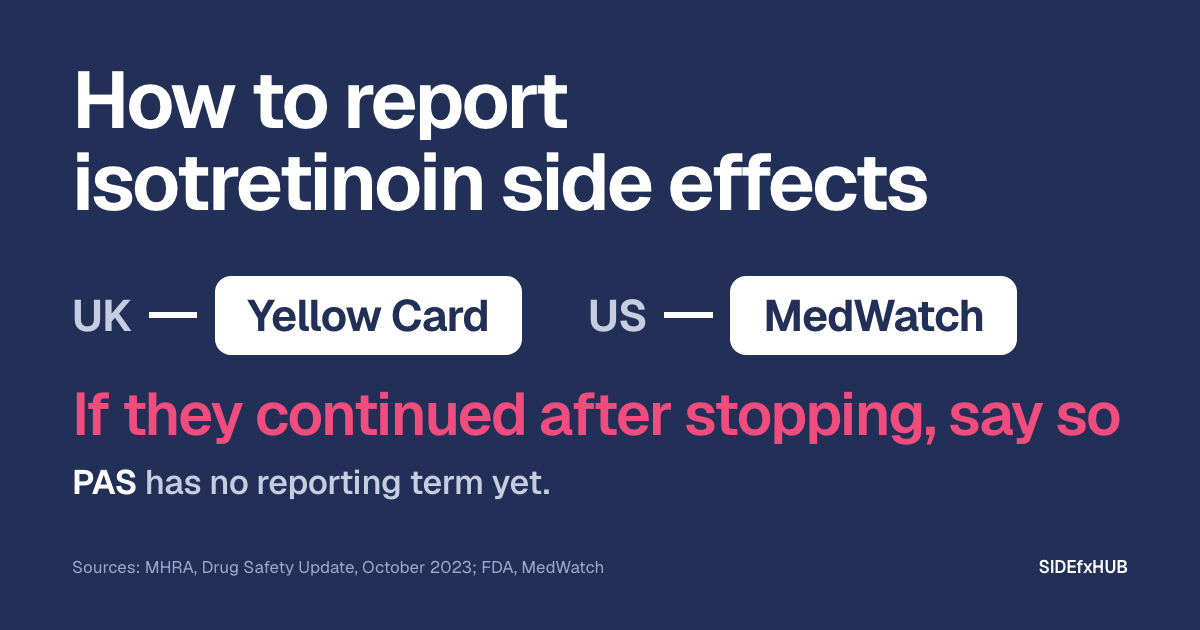
You can report side effects of isotretinoin (Accutane, or Roaccutane in the UK) yourself: to the Yellow Card scheme in the UK, or to MedWatch in the US. That includes problems that continued after stopping, which patients call post-Accutane syndrome, or PAS.
The dictionary that regulators file reports under, MedDRA, has no term for PAS yet. So your own words do the work. Name each symptom, and say that it continued after stopping.
The story in 3 lines
- Roaccutane's UK leaflet says the medicine is under extra monitoring, then: “You can help by reporting any side effects you may get” (leaflet).
- The UK regulator asks for detail, “particularly if a side effect continued or started after treatment was stopped” (MHRA).
- In 2026 the US regulator said it had relatively few reports of sexual problems with isotretinoin, and that reports “do not always contain enough detail” (FDA).
Press: contact@sidefxhub.com
Elliot took Roaccutane at 17. Thirteen years later, he says, he was “filling out boxes that only allow me to put one thing in at a time”.

He says he wrote to the UK medicines regulator, the MHRA. He asks how he can even get all of it across. Both forms have a box for your own words, and both regulators have said what they look for.
What should I write if I have post-Accutane syndrome?
Write each symptom, when it began, and that it continued after you stopped.
The MHRA asks for all three, along with your treatment dates, the brand and any other medicines.
By May 2021 the MHRA had 184 Yellow Cards that mentioned sexual side effects of isotretinoin.
The experts who reviewed them found the dose wasn’t always given. Most reports said nothing about other medicines or health conditions. They thought there was “likely to be significant under reporting”.
The US regulator, the FDA, says it checked each report’s timing: did the problem begin on isotretinoin, or after stopping? It also looked for other possible causes. It said it did not find “reasonable evidence of a causal association” with isotretinoin.
One at a time, in plain words: “low sex drive”, “low mood”.
During the course, or after it.
“Symptoms continued after stopping.”
“Roaccutane 40 mg a day, March to September 2022.”
What you take and what you've had, or “none”.
Can’t find your dates? Our article I think I have post-Accutane syndrome says where to look.
How do I fill in the Yellow Card form for isotretinoin?
Start at the Yellow Card site. You don’t need an account. Steps 3 to 8 are what our own run-through showed in September 2026.
-
Search for your medicine. Type “Isotretinoin” or your brand, for example “Roaccutane”, and pick it from the list.
-
Say who it’s about. Choose “Member of the public”, then “A suspected side effect”. The next page asks who had the side effect, then for your name, email and postcode.
-
Add each symptom. In the Side effect box, start typing and choose from the list. Add them one at a time.
-
Give the start date. “Reaction start date” takes a year, or a year and month.
-
Say whether it’s still there, and how it affected you. The form asks “Is the reaction still occurring, or has it resolved?” Then come tick boxes asking how severely it affected you.
-
Describe it in your own words. For example: “Isotretinoin 40 mg from March 2022, last capsule September 2022. Symptoms continued after stopping.” Leave your name out of this box.
-
Add the dose and dates. The form asks for them again. It also asks “What action was taken with this medicine as a result of the side effect(s)?”
-
Finish and send. There’s room at the end for other medicines and your medical history. Choose Submit and keep your report ID.
Where the form asks how it affected you, or what was done about the medicine, answer what happened to you. Dose, dates and other medicines are what the experts found missing. Our guides for PSSD and finasteride use the same form.

How do I report Accutane side effects to the FDA?
Use MedWatch, the FDA’s reporting programme. The US label for isotretinoin has said since 2026 that sexual problems “may continue after discontinuation of treatment”. Our article on the label change has more.
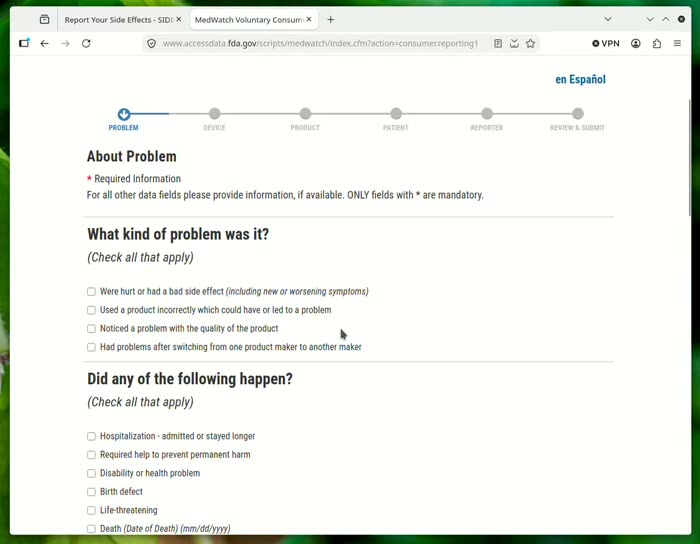
On the MedWatch site, choose Consumer/Patient (FDA Form 3500B).
-
Tick only what happened. As of October 2026, “Did any of the following happen?” lists what the problem led to. It has no star.
-
Describe it. “Tell us what happened and how it happened” has a star, so it’s required, and takes 4,000 characters. Write your symptoms, your dose and dates, any other medicines, and “Symptoms continued after stopping.”
-
Name the medicine. Type the name on the pack and give your dates of use. The form takes a best estimate.
-
Answer the two questions about stopping. Did the problem stop after you reduced the dose or stopped? Did it return if you started again?
Our FDA guide takes you through every page.
What can I do if I think I have PAS?
These medicines help many people. If you have side effects, that’s a decision for you and your prescriber.
If you think you have PAS, tell your GP or dermatologist and give your dates. Many people say it took time to be taken seriously.
Bring the leaflet line: “some may continue after treatment has stopped”. You can report it without a doctor agreeing.
Report it: it helps everyone
A doctor’s note helps you. A report to the medicines regulator helps everyone else: it is how patterns get noticed.
- No proof needed. A suspicion is enough, even years after stopping.
- Where: the Yellow Card scheme in the UK, MedWatch in the US.
- Use the right words. PAS has no term yet, so say that the symptoms continued after stopping.
Our reporting guide walks you through it
What else do people ask?
Is it too late if my course was years ago? The MHRA says reports can be made of reactions “experienced at any time, including historic adverse experiences”. As of October 2026, the MedWatch form and pages set no deadline. More in our article on reporting a side effect years later.
Can a parent report for a teenager? Yes. The Yellow Card form asks who the report relates to, and “Your child” is one of the answers. The FDA’s form says you can have someone fill it in for you.
Do reports change anything? They’re part of the evidence, as our page on why reporting matters explains. Yellow Card reports were “an integral part” of the UK’s 2023 review, which led to new warnings. When experts checked in 2025 how the prescribing rules were working, they looked at Yellow Card data again.

Elliot asked how he could get all of it across. Start with one sentence: “Symptoms continued after stopping.”
Sources
- Roaccutane 10 mg and 20 mg soft capsules, patient leaflet, Electronic Medicines Compendium (EMC 100633), last revised April 2026. Under the pregnancy warning at its top, it has a black triangle (▼) and “This medicine is subject to additional monitoring”. Then: “You can help by reporting any side effects you may get”. Section 2 has “reports of long-lasting sexual problems where the symptoms have continued despite stopping treatment with isotretinoin”. Section 4 says side effects “are generally reversible after changing the dose or stopping treatment, however some may continue after treatment has stopped”, and explains the Yellow Card scheme.
- MHRA, Isotretinoin (Roaccutane▼): introduction of new safety measures, Drug Safety Update volume 17 issue 3, 31 October 2023. “Isotretinoin is a black triangle medicine and all suspected adverse reactions, including any sexual and psychiatric adverse reactions, should be reported via the Yellow Card scheme”. Reports can be made of reactions “experienced at any time, including historic adverse experiences with medicines”. Reporters should give as much detail as possible, “particularly if a side effect continued or started after treatment was stopped”. They should also give “medical history, any concomitant medication, onset timing, treatment dates, and product brand name”. The April 2023 review drew on “information from patients and their families”. New warnings on mental health and sexual function side effects were then added to the product information.
- MHRA, The Yellow Card scheme: guidance for healthcare professionals, patients and the public, last updated 24 July 2025. “You do not have to prove causality to report a suspected ADR, only a suspicion is needed”. On the black triangle: “It does not mean the medicine is unsafe”, and “You should report all suspected ADRs for these products”. Patients without online access can call 0800 731 6789, Monday to Friday, 9am to 5pm.
- Commission on Human Medicines, Report of the Isotretinoin Expert Working Group, 26 April 2023, published by the MHRA. Section 5.3 counts “a total of 184 Yellow Cards for isotretinoin that included one or more terms pertaining to sexual side effects” up to 20 May 2021. Section 5.3.2: “the dose of isotretinoin was not always reported by patients submitting Yellow Cards”. Section 5.3.3: most of these Yellow Cards “provided no information about co-morbidities or concomitant medications”; the report adds that, given the patients’ generally young age, “this was not surprising”. Section 5.6: “there is likely to be significant under reporting given how sensitive these issues are”. Section 2.1: Yellow Card information “was an integral part” of the review. These are voluntary reports, so the count cannot show how often a side effect happens.
- US Food and Drug Administration, response to citizen petition FDA-2018-P-4088, 16 June 2026, pages 11 to 14. Reports to its database, FAERS, “do not always contain enough detail to properly evaluate an event”. For each report the FDA assessed “the quality and completeness of the report”, whether the problem began after starting or after stopping isotretinoin, and “the presence or absence of other potential causes”. It wrote that “the number of sexual dysfunction adverse event reports is relatively low given the many decades of usage of isotretinoin”. On causation: “we did not find reasonable evidence of a causal association to justify the inclusion of information in the WARNINGS AND PRECAUTIONS section of labeling”. The same letter concluded that the evidence on four sexual side effects that may continue after stopping “warrants inclusion” in the label’s adverse reactions section, and says “the underlying causes of these adverse events remain unknown”. It says FAERS data cannot be used to calculate how often a side effect happens.
- Absorica and Absorica LD (isotretinoin), US prescribing information and Medication Guide, revised August 2026. DailyMed, US National Library of Medicine. Section 6: “Abnormal menses and sexual dysfunction that may continue after discontinuation of treatment”. Medication Guide: “You may report side effects to FDA at 1-800-FDA-1088”.
- The Yellow Card form, seen on the live site on 11 October 2026. The product search lists “ISOTRETINOIN” and “ROACCUTANE”. “Start your report” asks whether you are a member of the public, and “What does your report relate to?”. “About You” asks “Who does your report relate to?”, with the answers You, Consumer, Your child and Someone else. It also asks for a title, first name, last name, email and postcode. The address and telephone boxes are marked optional, and the button reads “Continue without registering”. We entered no personal details, and the pages after “About You” open only once they are filled in.
- The later pages of the Yellow Card form (steps 3 to 8) were read from our own screen recording of a report on the same form, 2 September 2026. We could not check them again in October 2026. “Add reactions one at a time and then select ‘Add’”. Side effect: “Please start typing to select from the list”. “Is the reaction still occurring, or has it resolved?” “Please let us know how severely you, or the patient you are reporting about, were affected by the reaction(s)”, with tick boxes marked optional. The reaction start date can be “YYYY, YYYY/MM, YYYY/MM/DD”. The description box asks reporters not to add identifiable patient information. The medicine page asks “What action was taken with this medicine as a result of the side effect(s)?”. In the recording the last page had other medicines, medical history and Submit. The site’s confirmation text reads “Here is your Yellow Card report ID”.
- US Food and Drug Administration, MedWatch Online Voluntary Reporting Form. We read the first page of the Consumer/Patient form, “About Problem”, on the live site on 11 October 2026, entering nothing. “ONLY fields with * are mandatory”. “Did any of the following happen?” has no star. “Tell us what happened and how it happened” has a star, with “Total of 4000 characters allowed”. The later pages were read from our own screen recording, September 2026: the product name, dates of use with a “best estimate”, and the two questions about stopping and restarting. They match Form FDA 3500B, version 09/2025, section C, questions 12 to 16. That form says: “You can fill out this form yourself or have someone fill it out for you”. It also says to send the report “even if you do not have all the information”, and it states no deadline.
- MedDRA terms as listed in our reporting data: Post-SSRI sexual dysfunction (10086208) and Post 5-alpha-reductase inhibitor syndrome (10082430). There is no term yet for lasting effects after isotretinoin.
- Moral Medicine, He Took Accutane at 17. His Life Never Returned to Normal., interview with Elliot, 28 January 2025 (the title is the channel’s). Our page plays an extract, 37:56 to 39:10; the views are the speakers’ own. “I wrote to the MHRA” (34:01). “13 years later in my case, I’m filling out boxes that only allow me to put one thing in at a time” (38:09). “How do I even communicate the entirety” (38:18), which we paraphrase. Quotes from the YouTube captions, which do not label speakers; we quote only lines whose speaker is clear from what is said (the interviewer says he is in America and reported to the FDA; Elliot confirms 13 years at 71:10). His story on our site: Elliot’s story: Accutane at 17.
- MHRA, Isotretinoin Impact Review information session, held 22 January 2026. Our page plays an extract, 6:29 to 7:31. Professor Sir Munir Pirmohamed chairs the Commission on Human Medicines. He lists the sources the 2025 review used, checked against the MHRA’s own captions.
- MHRA, Yellow Card - How to report, 12 November 2024, 1 minute 33 seconds.
- Picture: the first page of the MedWatch consumer reporting form (Form FDA 3500B online), a still from our own screen recording, September 2026. No box is ticked.
This information does not replace medical advice. Talk to your doctor before you make any decision about your treatment.
Lasting side effects after isotretinoin?
Make them count.
Our step-by-step guide finds the form for your country.