Finasteride in your teens and twenties
Finasteride 1 mg was tested in men aged 18 to 41. Its UK leaflet lists sexual problems that persisted after stopping: post-finasteride syndrome (PFS).
SIDEfxHUB is a patient charity. We are not health professionals, and this does not replace medical advice. Don't start, stop or change any medicine because of what you read here. Talk to your doctor first.
If you are in crisis:116 123 Samaritans (UK)988 Lifeline (US)Find a helpline
Finasteride 1 mg, the hair-loss tablet sold as Propecia, was tested in men aged 18 to 41. Its UK leaflet lists sexual problems that have persisted after stopping, known as post-finasteride syndrome (PFS).
The NHS says most men aged 18 or over can take finasteride. We found no separate advice for a man of 19 or 25 in its UK leaflet or its US label, as of October 2026. A change can be hard to spot when you’ve had little to compare it with.
The story in 3 lines
- Propecia's UK leaflet says it “should not be used in children”, and that no data show it's effective or safe under 18.
- The trials behind its US label were in men aged 18 to 41. Both list sexual problems that continued after stopping.
- Most UK reports of its sexual and mood side effects name the hair-loss dose. The MHRA says “this does not necessarily mean a different level of risk”.
Press: contact@sidefxhub.com
Lucas began losing his hair at 16 or 17. He was into rock music and wanted long hair. A doctor prescribed finasteride, and he was 18 when he started taking it.

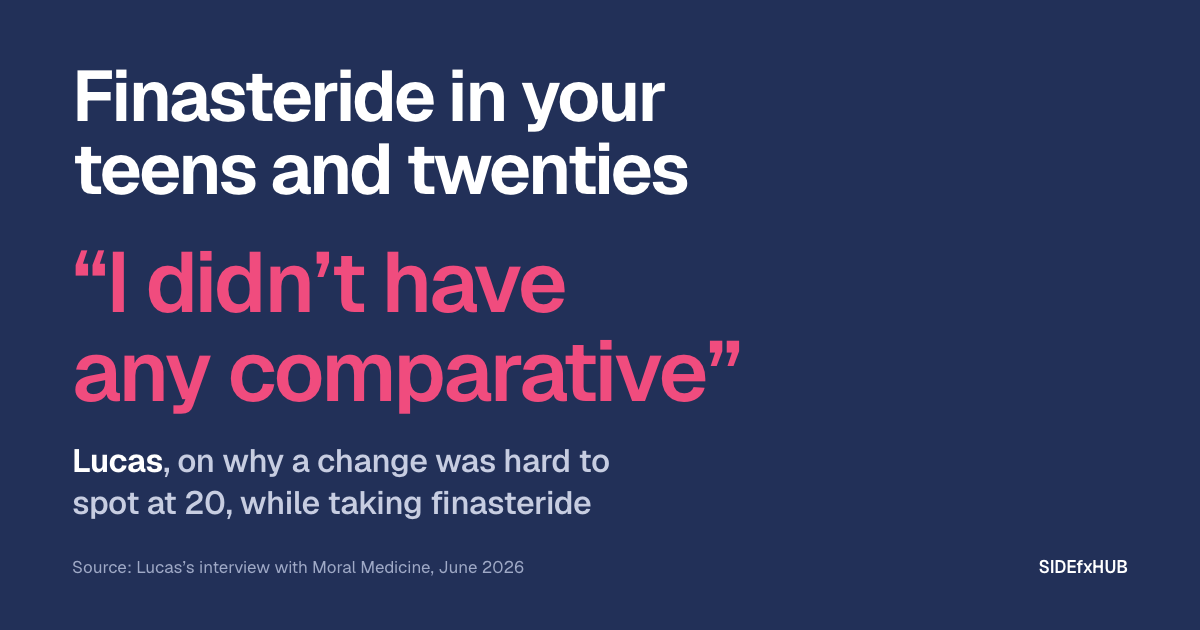
By the third day his erections had changed, he says, but he kept taking the tablets for about five years. At 20 or 21 he told himself he was just someone who didn’t like sex very much. “It was the first time of my life I was being 20 years old,” he says, “so I didn’t have any comparative.”
Can you take finasteride at 18?
The 1 mg dose is “indicated in men”, the UK medicines regulator, the MHRA, said in May 2026. The trials were in men aged 18 to 41, the leaflet’s version for prescribers says.
On under-18s, Propecia’s UK leaflet, last revised in May 2026, says it “should not be used in children”. It adds that there are “no data demonstrating efficacy or safety of finasteride in children under the age of 18”. The prescribers’ version says it is “not indicated for use in women or children and adolescents”.
Are side effects more likely in young men?
The labels don’t say. Propecia’s US label gives one set of figures for all the men in its trials, with no split by age. About 4 in 100 on finasteride reported a sexual side effect in the first year, against about 2 in 100 on a dummy pill.
Reports don’t answer it either. The MHRA has reviewed the ones it holds on finasteride’s sexual and mood side effects. More were about the 1 mg hair-loss dose than the 5 mg prostate dose.
The men on the 1 mg dose “usually are young men”, the review says, and for some, hair loss itself may lower mood. It adds that a different number of reports for the two doses “does not necessarily mean a different level of risk”.
The 1 mg dose is sold privately, and accurate prescription numbers aren’t available, the MHRA says. It draws no firm conclusions from the reports. They can’t show how likely a side effect is at 19 or at 39.
Dr Michael Irwig, a US hormone specialist, interviewed men aged 21 to 46 whose sexual side effects had lasted at least three months after stopping. His study can’t put a number on the risk, he says in a 2012 film. He wants doctors to talk about it, so that young men know the risk exists when they decide.

Can finasteride’s side effects last after stopping?
The sexual ones can, the UK leaflet says. It lists “persistent difficulty having an erection after discontinuation of treatment”, and the same for sex drive and ejaculation.
A few weeks after Lucas stopped, there was one week when he felt like himself. “It was the first time I remember who I was before finasteride,” he says. Within a week it had gone again.
For some people it has lasted years after stopping. Nobody knows yet who will be affected, or whether it will ease. Lucas says he has had PFS for about 14 years.
He couldn’t tell what had changed, he says, because he’d had little sexual experience before his first tablet. The 2022 diagnostic criteria for PFS include the same before and after: one asks whether a matching problem was there before the medicine.
How Lucas says it unfolded
What can I do?
Finasteride helps many men keep their hair. If you have side effects, that’s a decision for you and your prescriber.
If you feel low or have suicidal thoughts, the UK leaflet says to stop taking it and contact your doctor as soon as possible. For changes in sexual function, it says to contact your doctor. The Samaritans are on 116 123, free, at any hour.
In 2024 the MHRA’s advice for patients said “you may not notice some changes in your mood and behaviour”. It asked men to tell friends and family they’re taking finasteride, because others may notice changes.
The leaflet also says it “will help if you make a note of what happened, when it started and how long it lasted”. Add how things were before, the comparison Lucas didn’t have: “Finasteride 1 mg from March 2026, aged 19. No problems before. Erections weaker since April.”
Many people say it took time to be taken seriously. Bring the leaflet line on sexual problems that persisted after stopping. You can report it without a doctor agreeing.
Report it: it helps everyone
A doctor’s note helps you. A report to the medicines regulator helps everyone else: it is how patterns get noticed.
- No proof needed. A suspicion is enough, even years after stopping.
- Where: the Yellow Card scheme in the UK, MedWatch in the US.
- Use the right words. If symptoms continued after stopping, write Post 5-alpha-reductase inhibitor syndrome (MedDRA 10082430).
Our reporting guide walks you through it
What else do people ask?
Could it just be stress, or my age? It could. The NHS says occasional erection problems usually come from stress, tiredness or alcohol. Our articles on erectile dysfunction at 20 and low libido in your 20s cover the everyday causes, and when a medicine might be involved.
Does it matter how long I take it? Nobody knows yet. The 2022 criteria set no minimum time on the tablets, and some people report symptoms after a short course. Can PFS happen after a few pills? covers what is known. We also look at finasteride’s risks and benefits.
Is PFS only about sex? No. The 2022 criteria include less feeling in the genitals, and say cognitive problems and depression can come with the sexual symptoms. What does PFS feel like? has people’s own accounts. Our page on post-finasteride syndrome has the rest.
At 20, Lucas thought the change was simply who he was. If something has shifted since your first tablet, write down when it began and report it.
Sources
- Propecia 1 mg film-coated tablets, patient information leaflet (UK, EMC 2194), last revised May 2026. Section 2, “Children and adolescents”, in full: “Propecia should not be used in children. There are no data demonstrating efficacy or safety of finasteride in children under the age of 18”. Section 2, “Mood alterations and depression”: for depressed mood, depression or suicidal thoughts, “stop taking Propecia and contact your doctor for further medical advice as soon as possible”. For impaired sexual function, it says to contact your doctor. Section 4, frequency unknown: “persistent difficulty having an erection after discontinuation of treatment”, a persistent decrease in sex drive and persistent problems with ejaculation. Section 4 also says: “It will help if you make a note of what happened, when it started and how long it lasted”.
- Propecia 1 mg film-coated tablets, summary of product characteristics (UK, EMC 2194), text revised 29 June 2026. Section 4.1: “indicated for the treatment of men with male pattern hair loss”, with no age range. Sections 4.1 and 4.3: “not indicated for use in women or children and adolescents”. Section 4.4, “Paediatric population”: the same two sentences as the leaflet. Section 5.1: clinical studies in 1,879 men aged 18 to 41.
- Propecia (finasteride), US prescribing information, Organon, on DailyMed, US National Library of Medicine. Prescribing information revised August 2022. Sections 5.4 and 8.4: “PROPECIA is not indicated for use in pediatric patients”, and “Safety and effectiveness in pediatric patients have not been established”. Section 14: efficacy was shown in men between 18 and 41 years of age. Section 6.1 covers three controlled trials lasting 12 months. In them, 36 of 945 men on Propecia (3.8%) reported decreased libido, erectile dysfunction or an ejaculation disorder judged to be drug-related, against 20 of 934 on placebo (2.1%). We found no figures by age in the label. Section 6.2: post-marketing reports of sexual dysfunction that continued after discontinuation.
- MHRA, Finasteride: reminder of the risk of psychiatric side effects and of sexual side effects (which may persist after discontinuation of treatment), Drug Safety Update, 29 April 2024. Advice for patients: “you may not notice some changes in your mood and behaviour so it is very important to tell your friends and family that you are taking this medicine”. It continues: “Others may notice changes”. The MHRA’s update of 11 May 2026 says: “The 1mg dose is indicated in men for the treatment of male pattern hair loss”, and that for the 1 mg dose “accurate prescription numbers are not available”. The April 2024 update had said “indicated in men 18 to 41 years of age”.
- MHRA, Safety review of finasteride: public assessment report, April 2024. Section 5.2 covers Yellow Card reports up to 5 January 2023. Sexual dysfunction: 375 reports, of which 226 were about the 1 mg dose or hair loss, 110 about the 5 mg dose or an enlarged prostate, and 39 unknown. Depressed mood and suicidal behaviour: 231 reports, of which 155 were about 1 mg, 50 about 5 mg, and 26 unknown. Section 5.1 says usage of the 5 mg dose is higher. It says the men on 1 mg “usually are young men using finasteride for hair loss”, and that for some “hair loss may be the cause, or lead to depressive symptoms”. On the two doses, it says a different number of reports “does not necessarily mean a different level of risk”. Its conclusion on the Yellow Card data: “it is not possible to draw any firm conclusions from the trends seen with the spontaneously reported data in the UK”. It names under-reporting and the lack of a denominator, and says “accurate private prescribing data is not available”.
- NHS, Who can and cannot take finasteride, page last reviewed 2 August 2023. “Most men aged 18 years old or over can take finasteride”. It adds that finasteride is “generally not recommended for women or children”.
- Irwig MS, Kolukula S. Persistent sexual side effects of finasteride for male pattern hair loss. J Sex Med 2011;8(6):1747-53. Standardised interviews with 71 otherwise healthy men aged 21 to 46. Their sexual side effects had persisted for at least 3 months after stopping finasteride. The authors name selection bias and recall bias as limits. These were men who came forward, so the study can’t show how often this happens.
- Healy D, Bahrick A, Bak M and colleagues. Diagnostic criteria for enduring sexual dysfunction after treatment with antidepressants, finasteride and isotretinoin. Int J Risk Saf Med 2022;33(1):65-76. Section 5, PFS: there should be “no evidence of pre-drug sexual dysfunction that matches the current profile”. An enduring reduction in genital and orgasmic sensation is an additional criterion. Cognitive impairment and depression may accompany the sexual problems. The criteria give no minimum length of treatment. “The incidence of these conditions is unknown”.
- NHS, Erectile dysfunction (impotence), page last reviewed 28 July 2023. Occasional problems are “usually caused by stress, tiredness or drinking too much alcohol”.
- Moral Medicine, interview with Lucas, 16 June 2026 (43 minutes), embedded here as an extract from 17:11 to 18:22. All from the YouTube auto-captions. English is not his main language (1:47 to 1:50). Hair loss from 16 or 17, rock music and long hair, the doctor’s prescription (2:06 to 2:25). Started at 18 (3:22 to 3:28, 6:46). Erections changed by the third day (3:48 to 4:04). Took it for five years (15:18 to 15:20). No full sexual experience before he started (16:58 to 17:09). At 20 or 21: “maybe I’m just that guy that don’t like sex very much. Maybe that’s who I am” (17:11 to 17:23). “It was the first time of my life I was being 20 years old, so I didn’t have any comparative” (17:37 to 17:46). Weeks after stopping, one week of feeling normal (19:02 to 19:36). “It was the first time I remember who I was before finasteride” (19:44 to 19:48). “In one week, all went away” (21:10). About 14 years of PFS (1:38 to 1:43). His sexual side effects got better and his motor and neurological symptoms got worse, he says (34:54 to 35:35). His story on our site: Lucas’s story: finasteride at 18.
- PFS Foundation, Persistent sexual side effects of finasteride (Propecia) for male pattern hair loss, interview with Dr Michael Irwig, then at George Washington University, posted 28 August 2012 (4 minutes). Embedded here as an extract from the start to 1:45. Paraphrased, not quoted, from the YouTube captions at 1:10 to 1:43. He says his study can’t quantify the risk. He says doctors considering prescribing should talk about it, so that young men know the risk exists when they decide.
This information does not replace medical advice. Talk to your doctor before you make any decision about your treatment.
590+ people have joined the community.
Join them, then report your side effects.
No diagnosis needed. Researchers never see your name.