Can't orgasm: could a medicine be why?
Trouble reaching orgasm has many causes. SSRIs often delay it. UK leaflets warn sexual problems have sometimes continued after stopping: PSSD, PFS and PAS.
SIDEfxHUB is a patient charity. We are not health professionals, and this does not replace medical advice. Don't start, stop or change any medicine because of what you read here. Talk to your doctor first.
If you are in crisis:116 123 Samaritans (UK)988 Lifeline (US)Find a helpline
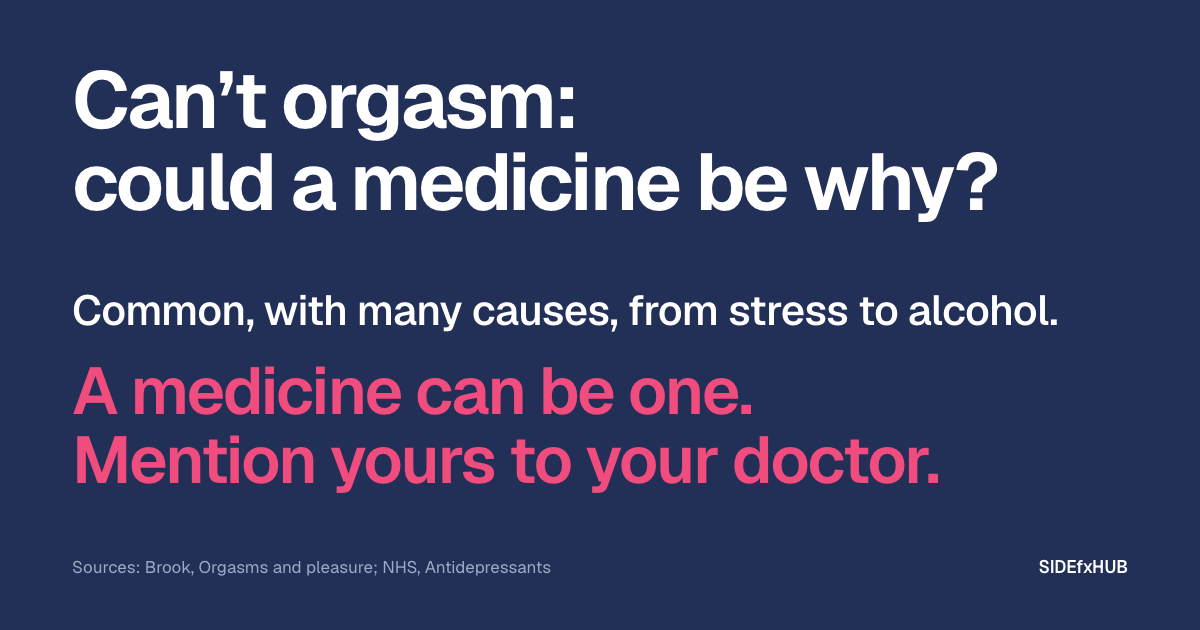
Trouble reaching orgasm is common and has many causes, from stress to alcohol. A medicine can be one: SSRI antidepressants often delay or stop orgasm, and their UK leaflets warn that sexual problems have sometimes continued after stopping, a condition called post-SSRI sexual dysfunction (PSSD).
Two other medicines carry a similar warning: isotretinoin (Accutane) for acne, and finasteride for hair loss. The lasting conditions are called post-Accutane syndrome (PAS) and post-finasteride syndrome (PFS).
The NHS page on ejaculation problems, written for men, names SSRIs as a cause. As of October 2026 it doesn’t say the problem can continue after stopping. The NHS page on antidepressants does.
The story in 3 lines
- Trouble reaching orgasm has many causes, including stress, alcohol and antidepressants, says the sexual health charity Brook.
- The UK sertraline leaflet lists "ejaculation failure" as very common. The paroxetine leaflet lists "lack of orgasm".
- Both warn that sexual problems have sometimes continued after stopping. Nobody knows how often, say the researchers who set out how to diagnose it.
Press: contact@sidefxhub.com
Cael was 18 or 19 and had just moved out when his doctor prescribed an SSRI for anxiety. Later the dose went up and a second antidepressant was added. Then sex changed.

“It took me longer to orgasm,” he says. He thought that was “kind of weird” and went back to his doctor, who said it was common on antidepressants. “He never told me that was possible,” Cael says.
Why can’t I orgasm?
There are many possible reasons, and it happens to a lot of people. A British survey of sex and relationships asked sexually active people about the past year. Among 16 to 24-year-olds, about 2 in 10 women and 1 in 10 men had found it hard to reach climax for three months or more.
The sexual health charity Brook says stress, anxiety and depression can all make orgasm harder to reach. So can being drunk or high. Pressure to get there can backfire too.
The NHS ejaculation page adds relationship problems, diabetes and getting older.
It also describes treatments for delayed ejaculation. Sex therapy, it says, “can help to increase your feeling of enjoyment during sex and help make ejaculation easier”. It tells men with a lasting problem to see a GP.
Which medicines can stop you reaching orgasm?
Several kinds can. We list eight kinds with sexual side effects. The NHS says many medicines are known to delay ejaculation, including antidepressants, “particularly” SSRIs. Beta-blockers are on its list too.
What the UK leaflets say:
- SSRI antidepressants. The sertraline leaflet lists “ejaculation failure” among its very common side effects. The escitalopram leaflet says “women may experience difficulties achieving orgasm”.
- Isotretinoin, the acne capsule sold as Roaccutane, or Accutane in the US. Its leaflet lists “difficulties having an orgasm”. It gives no figure for how often.
- Finasteride, the hair-loss tablet for men, sold as Propecia. Its leaflet lists “problems with ejaculation”, such as less semen. It doesn’t mention orgasm.
It isn’t always the medicine. Low mood can get in the way of orgasm on its own, so timing matters: was it different before your first dose? Our guide to telling PSSD from depression goes through it.
Below, the urologist Carolyn Salter explains delayed orgasm in men. She names medicines as one cause, antidepressants in particular, and tells patients to talk to their prescriber.

Can it last after stopping the medicine?
For some people it has lasted years after stopping. Nobody knows yet who will be affected, or whether it will ease.
SSRI leaflets share one line: in some cases, sexual symptoms “have continued after stopping treatment”. The NHS antidepressants page says so too.
The Roaccutane leaflet says there have been reports of “long-lasting sexual problems” that continued “despite stopping treatment”. The Propecia leaflet lists “persistent problems with ejaculation after discontinuation of treatment”.
Researchers published criteria for diagnosing PSSD in 2022. One sign is an “enduring inability to orgasm”, still there three months or more after the last dose.
Katie started fluoxetine, the medicine in Prozac, at 21 and took it for about three years. At 35, she still lists anorgasmia, not reaching orgasm, among her symptoms.

Researchers collected reports from people whose sexual problems had lasted after a medicine. Of the reports on antidepressants, about 6 in 10 from women and 3 in 10 from men described difficulty reaching orgasm. People chose to write in, so the figures can’t show how often it happens.
Nobody has counted that yet. That’s why reports to the regulator matter.
Other sexual problems can come with it, such as numb genitals. Cael’s are still numb, he says, more than a year after his last antidepressant.
What can I do?
See a GP about a change that lasts, whatever you think the cause is.
These medicines help many people. If you have side effects, that’s a decision for you and your prescriber. Don’t stop an antidepressant suddenly. For finasteride and isotretinoin, follow what the leaflet says.
Five details help your doctor:
"I can't reach orgasm at all", or "it takes much longer now".
"Two weeks after I started sertraline", or "it's always been like this".
"Sertraline 50 mg from January 2025, last tablet June 2025." Include ones you've stopped.
"No problems before 2025."
Alcohol, your mood, your relationship, contraception, diabetes.
Many people say it took time to be taken seriously. Bring the leaflet line. You can report it without a doctor agreeing.
Report it: it helps everyone
A doctor’s note helps you. A report to the medicines regulator helps everyone else: it is how patterns get noticed.
- No proof needed. A suspicion is enough, even years after stopping.
- Where: the Yellow Card scheme in the UK, MedWatch in the US.
- Use the right words. If symptoms continued after stopping, write Post-SSRI sexual dysfunction (MedDRA 10086208) for an SSRI or SNRI, or Post 5-alpha-reductase inhibitor syndrome (MedDRA 10082430) for finasteride. For isotretinoin there’s no term yet, so say the symptoms continued after stopping.
Our reporting guide walks you through it
What else do people ask?
What is anorgasmia? It’s the medical word for not being able to reach orgasm. In men, the NHS calls it delayed ejaculation: a long delay, or not ejaculating at all despite wanting to. You may have it, the NHS says, if it happens more than half the times you have sex.
Is it normal not to orgasm from sex alone? Yes. Brook says most people with a vagina can’t orgasm through penetration alone, and most need the clitoris touched as well. What matters is a change: the 2022 criteria only count problems that weren’t there before the medicine.
What if I orgasm but feel nothing? That’s a different change, and the 2022 criteria count it as a sign of PSSD too. Our article on orgasm with no pleasure explains it. Read more about PSSD, PAS and PFS.
Cael only learnt that antidepressants can delay orgasm when he told his doctor. If your orgasm changed on a medicine, tell your doctor too. If it hasn’t come back since your last dose, report it.
Sources
- NHS, Ejaculation problems, page last reviewed 9 February 2023. “Ejaculation problems are common sexual problems in men.” The page defines delayed ejaculation (male orgasmic disorder) as “experiencing a significant delay before ejaculation” or “being unable to ejaculate at all, even though the man wants to and his erection is normal”. “You may have delayed ejaculation if you’re unable to ejaculate more than half the times you have sex.” Psychological causes: “relationship problems, stress or depression”. Physical causes include diabetes, spinal cord injuries, multiple sclerosis, surgery to the bladder or prostate gland, and increasing age. “Many medicines are known to cause delayed ejaculation, including: antidepressants, particularly selective serotonin reuptake inhibitors (SSRIs)”, “medicines to treat high blood pressure, such as beta-blockers” and “antipsychotics”. Sex therapy “can help to increase your feeling of enjoyment during sex and help make ejaculation easier”. “If you have a persistent problem with ejaculation, visit your GP”. The page is about men. As read on 12 October 2026, it does not name isotretinoin or finasteride, and does not say delayed ejaculation can continue after a medicine is stopped. The NHS Antidepressants page (source 9) does say sexual problems may carry on after stopping.
- Brook, Orgasms and pleasure, page updated 28 July 2026. Brook is a UK sexual health charity for young people. “When someone is dealing with a lot of stress, anxiety or depression, they might find it hard to enjoy sex or to reach orgasm. Anti-depressants (medication some people take to help with depression), can also lower your sex drive and make it harder to orgasm.” “It can also be more difficult to have an orgasm while high or drunk”. “Putting pressure on yourself or your partner to have an orgasm can actually make it harder to do”. “Most people with vaginas can’t orgasm through vaginal penetrative sex alone. Most need some kind of stimulation of the clitoris”.
- Mitchell KR, Mercer CH, Ploubidis GB and colleagues. Sexual function in Britain: findings from the third National Survey of Sexual Attitudes and Lifestyles (Natsal-3). Lancet 2013;382(9907):1817-29. A probability sample survey in Britain, 2010 to 2012. Table 3, sexually active participants reporting a problem lasting three months or more in the past year: difficulty in reaching climax, ages 16 to 24, 9.2% of men and 21.0% of women (all ages: 9.2% and 16.3%). A survey at one point in time: it did not ask about these medicines.
- Lustral (sertraline) 50 mg and 100 mg film-coated tablets, patient leaflet, Electronic Medicines Compendium (EMC 2835), last revised December 2025. Section 2, “Sexual problems”: “In some cases, these symptoms have continued after stopping treatment.” Section 4, very common (may affect more than 1 in 10 people): “ejaculation failure”.
- Seroxat (paroxetine) 10 mg, 20 mg and 30 mg film-coated tablets, patient leaflet, EMC 7592, last revised October 2024. Section 2: “In some cases, these symptoms have continued after stopping treatment.” Section 4, very common: “Change in sex drive or sexual function. For example, lack of orgasm and, in men, abnormal erection and ejaculation.”
- Cipralex (escitalopram) 5 mg, 10 mg and 20 mg film-coated tablets, patient leaflet, EMC 7718, last revised May 2025. Section 2 has the same line. Section 4, common: “Sexual disturbances (delayed ejaculation, problems with erection, decreased sexual drive and women may experience difficulties achieving orgasm)”.
- Roaccutane (isotretinoin) 10 mg and 20 mg soft capsules, patient leaflet, EMC 100633, last revised April 2026. Section 2: “Isotretinoin has been associated with sexual problems. These include problems getting or maintaining an erection, lower libido, vaginal dryness, orgasm difficulties and reduced sensation in the genitals. There have been reports of long-lasting sexual problems where the symptoms have continued despite stopping treatment with isotretinoin.” Section 4, unknown frequency (cannot be estimated from the available data): “Difficulties having an orgasm”.
- Propecia (finasteride) 1 mg film-coated tablets, patient leaflet, EMC 2194, last revised May 2026. Section 4, uncommon: “you may have problems with ejaculation, for example a decrease in the amount of semen released during sex”. Frequency unknown: “persistent problems with ejaculation after discontinuation of treatment”. The leaflet does not use the word orgasm. All five leaflets were read on 12 October 2026.
- NHS, Antidepressants, page last reviewed 12 June 2025. Common side effects include “problems with sex, such as low sex drive, finding it difficult to orgasm, vaginal dryness or finding it difficult to get or keep an erection – for some people, these problems may carry on after stopping antidepressants”. “Do not stop taking an antidepressant suddenly or without talking to your doctor first.”
- Healy D, Bahrick A, Bak M and colleagues. Diagnostic criteria for enduring sexual dysfunction after treatment with antidepressants, finasteride and isotretinoin. Int J Risk Saf Med 2022;33(1):65-76. An expert consensus. PSSD, additional criterion 5: “Enduring inability to orgasm or decreased sensation of pleasure during orgasm”; criterion 6: “The problem is present for ≥3 months after stopping treatment”; criterion 7: “No evidence of pre-drug sexual dysfunction that matches the current profile”. For PFS and post-retinoid sexual dysfunction, the paper’s name for the isotretinoin condition, criterion 5 is “Enduring reduction in genital and orgasmic sensation”. “The incidence of these conditions is unknown.”
- Healy D, Le Noury J, Mangin D. Enduring sexual dysfunction after treatment with antidepressants, 5α-reductase inhibitors and isotretinoin: 300 cases. Int J Risk Saf Med 2018;29(3-4):125-134. Reports sent to RxISK.org, a drug-safety website set up by the authors and colleagues. Difficulty achieving orgasm after a serotonin reuptake inhibitor: 30 of 50 women (60%) and 56 of 171 men (33%). After isotretinoin: 2 of 5 women and 3 of 49 men. After a 5α-reductase inhibitor such as finasteride: 2 of 25 men. Genital anaesthesia and pleasureless or weak orgasm are counted separately. People chose to send these reports in, so the figures count what they described and cannot give a rate.
- Moral Medicine, interview with Cael, 18 August 2025 (29 minutes), embedded here as an extract from 5:28 to 6:01. From the YouTube auto-captions: prescribed Lexapro (escitalopram) “at 18, 19”, just after moving out, for anxiety and panic attacks (2:31 to 3:38). The dose was raised and Effexor (venlafaxine) added (5:01 to 5:08). “Just a little bit of erectile dysfunction and just it took me longer to orgasm”; “that’s kind of weird” (5:33 to 5:40). His doctor said this was common on antidepressants; “he never told me that was possible” (5:44 to 5:59). More than a year and four months after his last medicine, “my genitals are still numb” (13:49 to 14:01). His story on our site: Cael’s story.
- ISSM International Society for Sexual Medicine, How Long Is Considered Delayed Ejaculation?, 19 October 2022 (4 minutes), with Dr Carolyn Salter, a urologist specialising in male sexual and reproductive medicine. Paraphrased, not quoted, from the captions at 1:05 to 1:39: medicines are one cause of delayed orgasm, particularly antidepressants; patients should talk to their prescriber and never stop these medicines suddenly. Embedded to stop at 1:40, before she discusses changing medicines and other treatments; this article recommends none. ISSM’s description says the speaker’s views are her own and not necessarily the society’s.
- Moral Medicine, I Lost My Sexual Identity After Prozac, interview with Katie, 26 May 2026 (10 minutes), embedded here as an extract from 0:35 to 1:23. From the YouTube auto-captions: “I’m 35 and I’m from the UK” (0:35). Fluoxetine at 21, taken “for around 3 years with some gaps” (0:40 to 0:50). Her symptoms “include loss of pleasure, physically numb sexual sensation, sexual dysfunction, anorgasmia” (1:00 to 1:06). “I had not ever experienced any of these issues prior to taking the drugs” (1:17). Her story on our site: Katie’s story: 14 years after Prozac.
This information does not replace medical advice. Talk to your doctor before you make any decision about your treatment.
610+ people have joined the community.
Join them, then report your side effects.
Free. Sign up takes 2 minutes.