What does PSSD feel like?
People with post-SSRI sexual dysfunction (PSSD) describe numb genitals, orgasm with no pleasure and flat emotions that continued after stopping.
SIDEfxHUB is a patient charity. We are not health professionals, and this does not replace medical advice. Don't start, stop or change any medicine because of what you read here. Talk to your doctor first.
If you are in crisis:116 123 Samaritans (UK)988 Lifeline (US)Find a helpline
People with post-SSRI sexual dysfunction (PSSD) describe genitals that feel numb, orgasm with little or no pleasure and emotions turned down. They say it began on an SSRI or SNRI antidepressant and continued after stopping.
The NHS page on antidepressants lists a low sex drive and difficulty reaching orgasm, and says that for some people these problems may carry on after stopping. It doesn’t mention numb genitals, and a list can’t tell you what any of it is like.
The story in 3 lines
- The UK leaflet for Cipralex (escitalopram) says SSRIs and SNRIs may cause sexual problems that, in some cases, have continued after stopping (leaflet).
- The 2022 diagnostic criteria for PSSD require a lasting change in how the genitals feel, and say emotional numbing can come with it.
- Nobody has measured how often PSSD happens. What it feels like is known from the people who have it.
Press: contact@sidefxhub.com
Benjamin felt something was missing from his life, and thought it was depression. He tried duloxetine (Cymbalta), an SNRI antidepressant. Half an hour after his first dose, he says, a “heavy grey blanket” came down on everything he enjoyed.

“It felt like my genitals were missing,” he says, and that scared him. He took the medicine for a month and stopped. He was interviewed almost 14 years later.
What does PSSD feel like sexually?
Numb at first, Benjamin says, for about three years. That faded, but the sexual feeling didn’t come back: “It’s no longer numb, but it just feels like a finger.”
The researchers who wrote the 2022 criteria for diagnosing PSSD describe both. Some people’s genitals feel as if they’ve had an anaesthetic. For others, touch there feels like touch on any other part of the body.
How Benjamin says it changed
He never had erection problems, and he can reach orgasm. “I don’t feel anything when it happens,” he says. It’s so muted that he has to look down to check.
His sex drive went too. On a hard day he used to know that sex would pick him up. That “back burner part of sexuality”, he says, is what he misses most.
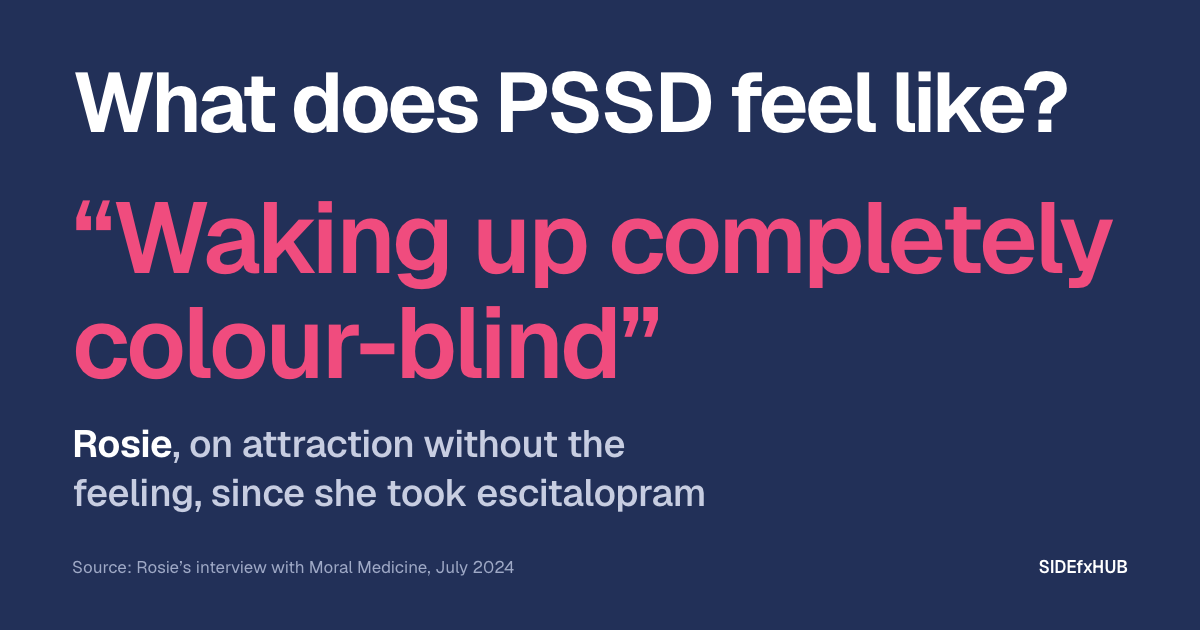
Rosie took escitalopram (Lexapro) for four and a half months. More than three years after her last tablet, she describes orgasm with almost no pleasure: “maybe like 1%” of what it would normally feel like.
The attraction hasn’t gone, she says, but the feeling has, like “waking up completely colour-blind”.

The UK leaflets for escitalopram and duloxetine both list a lower sex drive and difficulty reaching orgasm. Neither mentions numb genitals.
What does PSSD feel like emotionally?
Grey, in Rosie’s words. Her life used to be “so in colour”, she says, and now everything is “very numb”. “Life doesn’t feel like life any more.”
Katie was 21 when she was prescribed fluoxetine (Prozac). Her mood lifted at first. Then she found she “couldn’t feel excited or happy or enjoy anything properly”.

The NHS lists feeling “emotionally numb” among the common side effects of antidepressants. The 2022 criteria say it can come with PSSD after stopping.
People say it isn’t the same as depression. Even at her lowest before the medicine, Katie “still had feelings”.
Researchers at the University of East Anglia interviewed ten people in the UK who have PSSD. Many spoke at length about emotional numbness. One said he was “walking around like a statue”.
What is it like to live with PSSD?
Hard to explain, people say. Benjamin can have sex. The difficult part, he says, is telling a partner that he doesn’t really care whether they have sex or not.
Katie noticed she “wasn’t developing any crushes”. Nobody had told her it could be a side effect. So for years she believed there was “something wrong with me personally”.
A health professional suggested she might be asexual. She doesn’t see it that way. “I remember what it’s like to have sexual feelings and desires,” she says, “but I can’t actually access these functions any more.”
Everyone in the East Anglia study described an effect on their relationships. They often felt they hadn’t been heard in healthcare appointments. Our article Is PSSD real? explains where the condition stands with doctors and regulators.
Benjamin found help in other people who have it. Talking to them, he says, has been “more therapeutic” than any therapy he had tried.
What can I do?
These medicines help many people. If you have side effects, that’s a decision for you and your prescriber. Don’t stop suddenly.
Symptoms like these are hard to put into words in a short appointment. Write them down first, in plain language: “Sertraline 50 mg from January 2023, last tablet March 2024. Touch feels numb. Orgasm happens, but I feel almost nothing. No problems before 2023.”
Many people say it took time to be taken seriously. Bring the leaflet line on sexual problems that continued after stopping. You can report it without a doctor agreeing.
Report it: it helps everyone
A doctor’s note helps you. A report to the medicines regulator helps everyone else: it is how patterns get noticed.
- No proof needed. A suspicion is enough, even years after stopping.
- Where: the Yellow Card scheme in the UK, MedWatch in the US.
- Use the right words. If symptoms continued after stopping, write Post-SSRI sexual dysfunction (MedDRA 10086208).
Our reporting guide walks you through it
What else do people ask?
Is PSSD only sexual? Not for everyone. Benjamin describes brain fog, and says he takes in new information slowly. Rosie has tinnitus and can’t enjoy music any more. The 2022 criteria list cognitive problems, and sensory problems involving skin, smell, taste or vision, among the symptoms that can come with it.
Is it like PFS? The descriptions overlap. Men with post-finasteride syndrome (PFS), lasting symptoms after finasteride, also talk about numb genitals and flat emotions. The 2022 criteria cover both conditions, and say each commonly brings less feeling in the genitals and less desire. Those men’s words are in What does PFS feel like?
Does PSSD go away? For some people it has lasted years after stopping. Nobody knows yet who will be affected, or whether it will ease. Some of Benjamin’s symptoms faded over the years, while the sexual feeling hasn’t returned. Rosie said she hadn’t made any kind of recovery. Our page on PSSD sets out what is known.
For ten years Benjamin was afraid to talk about it and tried to forget. That got him nowhere, he says. If you’ve kept it to yourself too, a report is one place to say it.
Sources
- Cipralex 5 mg, 10 mg and 20 mg film-coated tablets (escitalopram), patient leaflet, Electronic Medicines Compendium (EMC 7718), last revised May 2025. Section 2: “Medicines like Cipralex (so called SSRIs/SNRIs) may cause symptoms of sexual dysfunction (see section 4). In some cases, these symptoms have continued after stopping treatment.” Section 4 lists delayed ejaculation, problems with erection, decreased sexual drive and, in women, difficulties achieving orgasm.
- Also checked: Duloxetine 30 mg and 60 mg gastro-resistant capsules, patient leaflet (EMC 13593, last revised August 2024), and Fluoxetine 20 mg hard capsules, patient leaflet (EMC 15755, last revised September 2022). The duloxetine leaflet has the same section 2 sentence (“so called SSRIs/SNRIs”); the fluoxetine leaflet has it as “Medicines like Fluoxetine (so called SSRIs)”. Duloxetine lists “less sex drive” and “difficulty or failure to experience orgasm”; fluoxetine lists “decreased sex drive or sexual problems” and “sexual problems, including orgasm problems, occasionally persisting after treatment discontinuation”. None of the three mentions numbness of the genitals. The duloxetine leaflet lists “numbness, including numbness, pricking or tingling of the skin” as a general side effect.
- NHS, Antidepressants, page last reviewed 12 June 2025. Common side effects include “mood changes – like feeling more angry or emotionally numb”. They also include “problems with sex, such as low sex drive, finding it difficult to orgasm, vaginal dryness or finding it difficult to get or keep an erection – for some people, these problems may carry on after stopping antidepressants”. The page does not mention genital numbness.
- Healy D, Bahrick A, Bak M, et al. Diagnostic criteria for enduring sexual dysfunction after treatment with antidepressants, finasteride and isotretinoin. International Journal of Risk & Safety in Medicine, 2022; 33(1): 65–76. PSSD, necessary criteria: prior treatment with a serotonin reuptake inhibitor (the paper counts SSRIs and SNRIs among them) and “an enduring change in somatic (tactile) or erogenous (sexual) genital sensation after treatment stops”. “Some describe reduced somatic (tactile) sensation – genitals feel like they were exposed to an anesthetic. Others describe reduced erogenous (sexual) sensation – genital touch feels like being touched on any other body part.” Ancillary non-sexual symptoms “may include” emotional numbing, depersonalization, “other sensory problems involving skin, smell, taste or vision” and cognitive impairment. “Features of PSSD, PFS and PRSD commonly include decreased genital and orgasmic sensation, decreased sexual desire and erectile dysfunction.” “The incidence of these conditions is unknown.”
- Brugi S, Budd B, Mackie C, Fish S. “It’s taken away the most fundamental things about being human”: the lived experience and impact of post-SSRI sexual dysfunction. International Journal of Qualitative Studies on Health and Well-being, 2026; 21(1): 2717470. University of East Anglia. Interviews with ten people in the UK, recruited through the UK PSSD Association, with written consent; names are pseudonyms. “Many participants spoke at length regarding their experiences of emotional numbness”; “I’m walking around like a statue” (Frank). “All participants described an impact on relationships with others.” “Participants frequently described feeling like they had not been heard, particularly in the context of healthcare appointments.” A small interview study: it shows what people describe, not how often.
- Moral Medicine on YouTube. Benjamin, 16 July 2024, embedded here as an extract from 3:27 to 7:51: “almost 14 years” at 1:46. “Something was missing and I thought it was depression” at 3:34, and a month on the medicine at 3:55. “30 minutes after the first pill” at 4:14, the “heavy gray blanket” at 4:26 and “it felt like my genitals were missing” at 4:52. “It never went away” at 5:27. Emotional blunting “nearly gone now”, after “about five or six years”, at 6:00. No erection problems at 6:36. “I don’t really care if we do or not” at 7:12. “I don’t feel anything when it happens” at 7:19, the numbness gone “after about 3 years” at 7:35 and “it just feels like a finger” at 7:39. “The sexuality hasn’t returned at all” at 7:45. Outside the extract: “I’m having a hard time in life but I know what’ll… pick me up” at 9:49 and “the back burner part of sexuality is what I miss the most” at 10:05. “Muted orgasms” at 24:33, and slow processing of new information from 24:46. Other people with the condition “more therapeutic and more cathartic than any therapy” at 28:49. “I was afraid to talk about it, I would push it aside and try to forget about it for, you know, 10 years” from 29:05. The medicine’s name is unclear in the automatic captions at 3:55; the channel’s description and his story page on our site name it as Cymbalta. Rosie, 9 July 2024, embedded here as an extract from 25:48 to 29:12: four and a half months on Lexapro, taper included, at 6:03. Last tablet on 7 December 2020 at 11:18, and no recovery since at 15:24. Orgasm “maybe like 1%” at 26:30. “It’s not that I don’t have attraction… I can’t feel anything, same as like waking up completely colorblind, like I can still see but I can’t see color” from 26:58, and “life doesn’t feel like life anymore” at 27:46. Her life before, “so in color”, and now “very numb and very kind of gray”, from 1:57. Tinnitus and “I can’t enjoy music” from 28:47. Katie, 26 May 2026, embedded here as an extract from 0:35 to 3:13: prescribed fluoxetine at 21 at 0:45. “Couldn’t feel excited or happy or enjoy anything properly” at 3:01. Outside the extract: “something wrong with me personally” at 5:22, “still had feelings” at 5:41, the suggestion of asexuality at 5:52, “I remember what it’s like” at 6:04 and “wasn’t developing any crushes” at 6:46.
- Their stories on our site: Benjamin, Rosie and Katie.
This information does not replace medical advice. Talk to your doctor before you make any decision about your treatment.
590+ people have joined the community.
Join them, then report your side effects.
No diagnosis needed. Researchers never see your name.