When does it count as PSSD?
The 2022 criteria for PSSD list three months as an additional sign. Once sexual problems last that long after stopping an SSRI, PSSD is more likely.
SIDEfxHUB is a patient charity. We are not health professionals, and this does not replace medical advice. Don't start, stop or change any medicine because of what you read here. Talk to your doctor first.
If you are in crisis:116 123 Samaritans (UK)988 Lifeline (US)Find a helpline
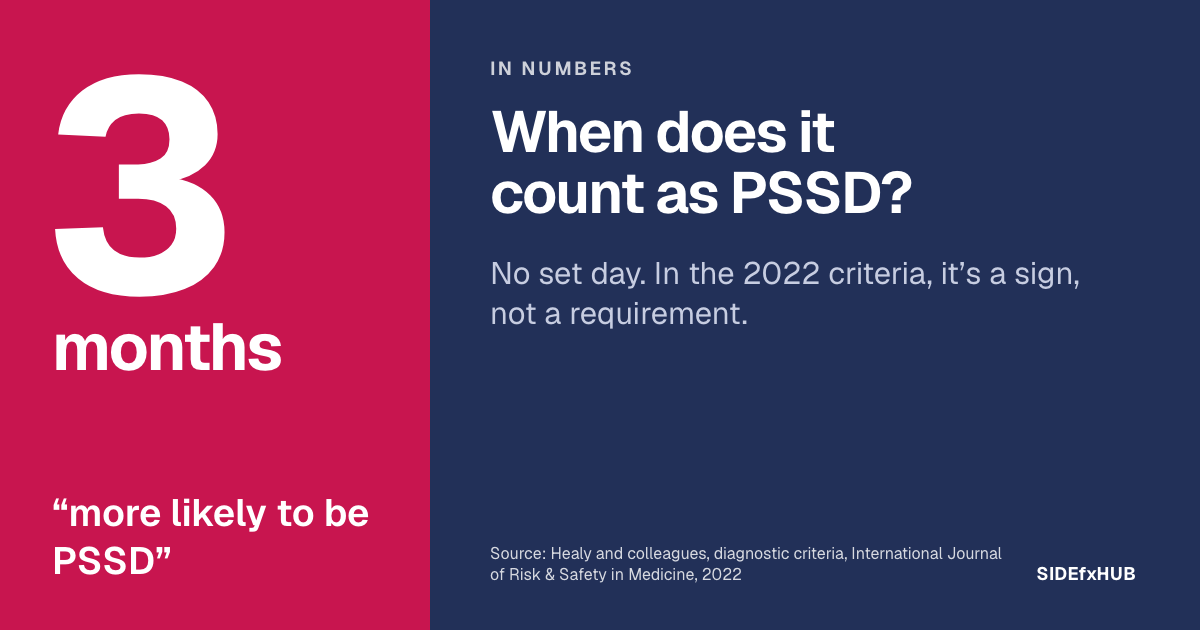
Sexual problems from an SSRI can continue after the last tablet, and there’s no set day when they become post-SSRI sexual dysfunction, or PSSD. The authors of the 2022 diagnostic criteria say that once the problems have lasted three months after stopping, it’s “more likely to be PSSD”.
Those three months are a marker for doctors and researchers. Nothing in the criteria, the leaflet or the UK’s reporting scheme asks you to wait before you see your GP or report it.
The story in 3 lines
- The 2022 criteria require a lasting change in how the genitals feel after the medicine is stopped. Three months is listed further down, as an additional sign.
- The UK sertraline leaflet says sexual problems “have continued after stopping treatment” in some cases. It gives no timescale.
- The UK medicines regulator said in 2023 that people should report “as soon as they suspect a side effect”.
Press: contact@sidefxhub.com
Daryl had been prescribed antidepressants and other medicines. He stopped them, he says, because his erections had stopped working. Then he kept asking his doctors one thing: “When’s it going to go away?”

First he was told a few weeks, he says, and that it would definitely come back. Then it was a few months, he says, and then that for some people it might take a year or more. When he gave the interview, it had been 13 years.
How long after stopping an SSRI is it PSSD?
The criteria name one length of time: three months. The line reads: “The problem is present for ≥3 months after stopping treatment.” It sits under the heading “Additional”, next to lost desire and erection problems.
The criteria were agreed by an international group of doctors and researchers, with David Healy as first author. “The present consensus is that once dysfunction lasts for three months, it is more likely to be PSSD,” they write.
So three months isn’t one of the two points the criteria call “Necessary”.
The first is that you took an SSRI, an SNRI or another medicine that blocks serotonin reuptake. The second is that the feeling in your genitals changed, and stayed changed after you stopped. Our article on how PSSD is diagnosed goes through the whole list.
After the last tablet: what the 2022 criteria say
What if it’s only been a few weeks?
Then it may be too early to say whether it’s PSSD. You can still tell your GP now. The criteria’s authors write that ordinary sexual side effects “may linger for some days or weeks” after an antidepressant is stopped.
Dr Josef Witt-Doerring is a psychiatrist who used to work at the US medicines regulator. In a film made for other doctors, he says they’d usually expect these side effects to go within a couple of weeks of stopping. In PSSD, he says, people still have them months or years later.

How many people get all of their sexual function back after stopping “has never been properly investigated”, the criteria’s authors write. No reliable figure exists for how often PSSD happens either, a 2023 review found.
The first weeks can also bring withdrawal, which has its own symptoms and its own timing. We compare the two in PSSD or withdrawal. What’s known about recovery is in do SSRI sexual side effects go away?
Do I have to wait three months to see a doctor?
No. Nothing in the criteria says to wait, and a GP can start now, by noting your dates and looking for other causes.
The criteria ask for that check anyway. There should be no matching problem from before the medicine, and no other condition, medicine or substance that explains it.
Nothing asks you to wait before you report, either. The UK medicines regulator, the MHRA, said in 2023 that people should report to its Yellow Card scheme “as soon as they suspect a side effect”. Its Yellow Card pages, read in October 2026, set no minimum time and no deadline. Our guide to reporting PSSD on the Yellow Card shows the form.
What can I do?
These medicines help many people. If you have side effects, that’s a decision for you and your prescriber. Don’t stop suddenly.
If sex has felt different since you stopped, tell your GP and give your dates: “Sertraline 50 mg from January 2023, last tablet March 2024. Touch has felt numb since April 2024.” The three months are counted from the day you stopped, so write the dates down while you remember them.
Many people say it took time to be taken seriously. Bring the leaflet line. The sertraline one reads: “In some cases, these symptoms have continued after stopping treatment.” You can report it without a doctor agreeing.
Report it: it helps everyone
A doctor’s note helps you. A report to the medicines regulator helps everyone else: it is how patterns get noticed.
- No proof needed. A suspicion is enough, even years after stopping.
- Where: the Yellow Card scheme in the UK, MedWatch in the US.
- Use the right words. If symptoms continued after stopping, write Post-SSRI sexual dysfunction (MedDRA 10086208).
Our reporting guide walks you through it
What else do people ask?
Does it count if things got partly better? It can. The authors write that sexual side effects can sometimes “improve significantly” after stopping but “still leave residual symptoms”. They class lasting effects as PSSD, mild or severe, if there hasn’t been “a full return to pre-drug baseline”, meaning how things were before the medicine.
Can PSSD start after the last tablet? Yes. The authors write that a lasting problem “may only appear when the drug is stopped”, or a mild one may get worse. Where there’s a gap first, they suggest it’s typically up to a couple of weeks, and say the data is limited. For problems that began on the tablets, see when do SSRI sexual side effects start?
Is there a point where it’s too late to count? No. The criteria “provide no upper limit” on how long it can last. For some people it has lasted years after stopping. Nobody knows yet who will be affected, or whether it will ease. A short course doesn’t rule PSSD out either: see PSSD after a few pills.
Daryl asked when it would go away, and each answer, he says, was a longer wait. If sex still feels different since your last tablet, you don’t have to count to three months first: tell your GP, and report it.
Sources
- Healy D, Bahrick A, Bak M and colleagues. Diagnostic criteria for enduring sexual dysfunction after treatment with antidepressants, finasteride and isotretinoin. Int J Risk Saf Med 2022;33(1):65-76. Read in full on 12 October 2026. An expert consensus of 37 authors; David Healy is the first and corresponding author. The first draft came from two published case series (Hogan and colleagues, 2014; Healy and colleagues, 2018) built on reports people chose to send to RxISK.org, and the group revised it “until agreement was reached”. The paper reports no test of the criteria on patients. Necessary for PSSD: “(1) Prior treatment with a serotonin reuptake inhibitor” and “(2) An enduring change in somatic (tactile) or erogenous (sexual) genital sensation after treatment stops”. Additional: enduring loss of desire (3), erectile dysfunction (4), inability to orgasm or less pleasure in orgasm (5), and “(6) The problem is present for ≥3 months after stopping treatment”. Under “There should be”, criteria 7 to 9 exclude a matching problem before the drug, and a current condition, medication or substance misuse that could account for the symptoms. On timing: ordinary sexual side effects “may linger for some days or weeks following discontinuation of treatment”. “The present consensus is that once dysfunction lasts for three months, it is more likely to be PSSD”. Persisting effects, severe or mild, “should be classified as PSSD if there hasn’t been a full return to pre-drug baseline”. The criteria “provide no upper limit” on duration. On onset: a delay between the last dose and the first symptoms is “typically up to a couple of weeks”, and “it is not possible to set a time limit after which an enduring condition cannot be diagnosed”. How many people regain all of their sexual function after stopping “has never been properly investigated”.
- Lustral (sertraline) 50 mg and 100 mg film-coated tablets, patient leaflet, Viatris, Electronic Medicines Compendium (EMC 2835), last revised December 2025. Section 2, “Sexual problems”: “In some cases, these symptoms have continued after stopping treatment”. Section 4, “Reporting of side effects”: “If you get any side effects, talk to your doctor or pharmacist”. Side effects can also be reported directly through the Yellow Card scheme.
- MHRA, Suspect you have experienced a side effect or incident from a healthcare product? Submit a Yellow Card report to improve safety for everyone, press release for #MedSafetyWeek, 6 November 2023. “It is important that everyone submits a report to the Yellow Card scheme as soon as they suspect a side effect from a medicine”. Also: “just a suspicion is enough for you to submit a report”.
- MHRA, Yellow Card scheme: “Anyone can report an issue with a medicine”. Its page How to report: “You can report for yourself or for someone else, with their permission”. It also says: “We are unable to provide medical advice”. Neither page names a minimum time or a deadline. Read on 12 October 2026.
- Tarchi L, Merola GP, Baccaredda-Boy O and colleagues. Selective serotonin reuptake inhibitors, post-treatment sexual dysfunction and persistent genital arousal disorder: a systematic review. Pharmacoepidemiol Drug Saf 2023;32(10):1053-67. “It was not possible to determine reliable estimates of prevalence.” One study of health records gives an estimate for men who took these antidepressants, counted through prescriptions for erection medicines: Ben-Sheetrit J and colleagues, Ann Gen Psychiatry 2023;22(1):15.
- Moral Medicine, 13 Years of Post SSRI Sexual Dysfunction (PSSD), interview with Daryl, 17 October 2024, embedded here as an extract from 8:56 to 9:26. From the YouTube auto-captions: why he stopped (4:56 to 5:15), “it didn’t go away and it hasn’t gone away in 13 years” (6:39 to 6:47), the answers he says he was given (8:56 to 9:26). His story on our site: Daryl’s story.
- Dr Josef Witt-Doerring, PSSD (An Explanation For Doctors), 27 May 2024, embedded here as an extract from 0:41 to 1:25. He describes himself in the film as a psychiatrist and former FDA medical officer. Paraphrased from the auto-captions.
- MedDRA lowest level term Post-SSRI sexual dysfunction, code 10086208.
This information does not replace medical advice. Talk to your doctor before you make any decision about your treatment.
610+ people have joined the community.
Join them, then report your side effects.
Free. Sign up takes 2 minutes.