PFS is listed as a rare disease
Orphanet, the European rare disease database, lists post-finasteride syndrome (PFS) as ORPHA:686468, a rare neurologic disease, under a drug-class name.
SIDEfxHUB is a patient charity. We are not health professionals, and this does not replace medical advice. Don't start, stop or change any medicine because of what you read here. Talk to your doctor first.
If you are in crisis:116 123 Samaritans (UK)988 Lifeline (US)Find a helpline
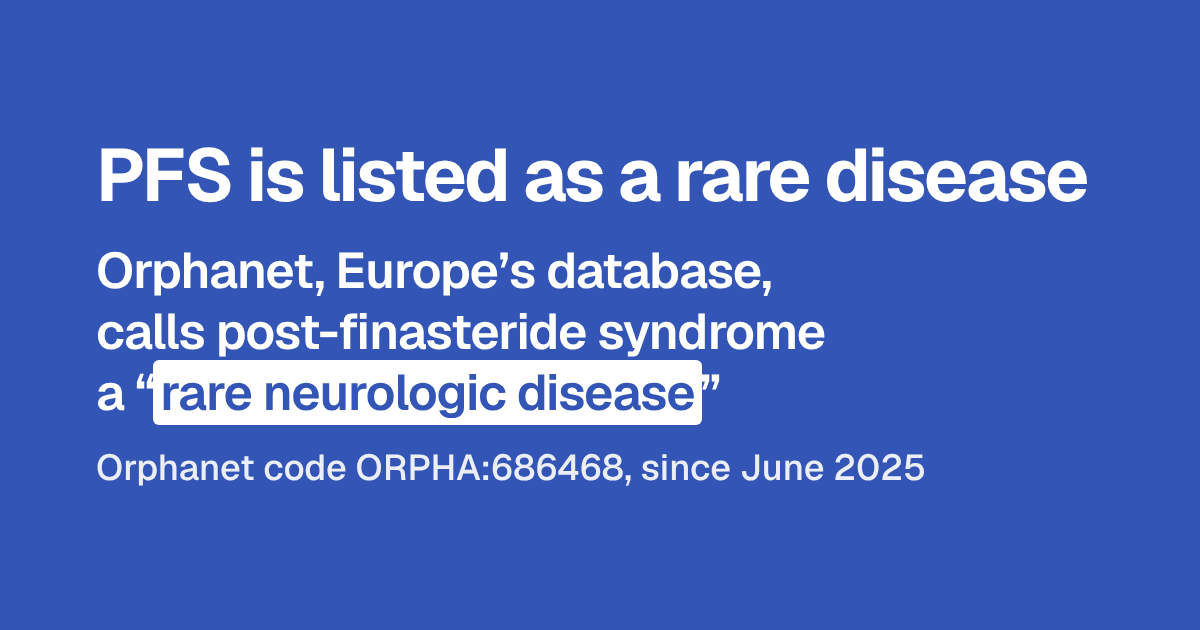
Since June 2025, Orphanet, the European rare disease database, has listed post-finasteride syndrome (PFS) as a rare neurologic disease, code ORPHA:686468. It’s filed under the drug family’s name, Post 5-alpha-reductase inhibitors treatment syndrome: side effects that can continue after treatment with finasteride or dutasteride has ended.
If you’ve been told PFS isn’t a recognised condition, it now has its own entry in the codes health and research records use for rare diseases.
The entry also shows PFS is more than a sexual problem. Orphanet’s definition includes depression, anxiety and brain fog, and the 2022 diagnostic criteria say problems with thinking, depression and suicidality can occur with or without sexual difficulties.
The story in 3 lines
- Orphanet's yearly code files list PFS as newly included in the release of 25 June 2025 (Orphanet).
- Orphanet calls it a “rare neurologic disease” of “persistent side effects of terminated 5-alpha-reductase inhibitor treatment” (ORPHA:686468).
- We found no figure in Orphanet's data for how many people have it (checked 21 October 2026), and its link to the WHO's disease codes is “Not yet validated” (Orphanet).
Press: contact@sidefxhub.com
Matt used topical dutasteride for about eight months. His short clip is worth 91 seconds because it shows why the entry’s drug-family name matters: his symptoms began with dutasteride, not finasteride.
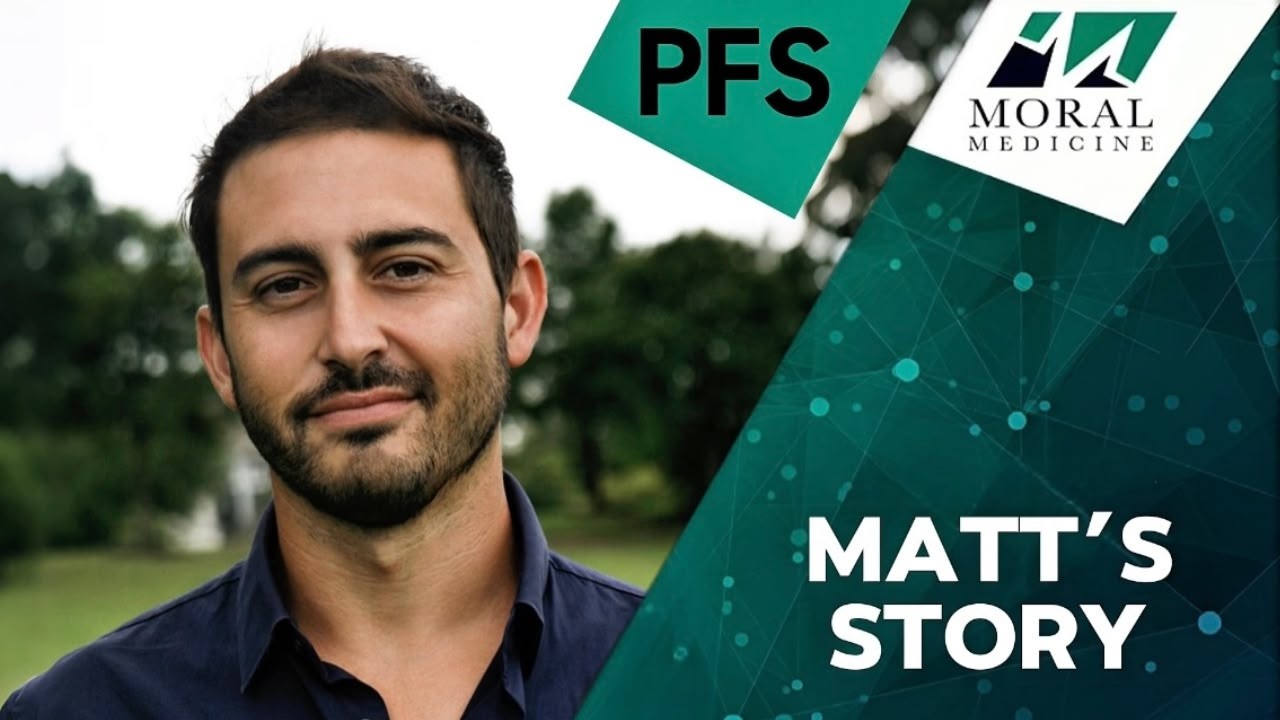
He stopped when the sexual side effects began. Since then, he says, they’ve “progressively gotten worse” for five months: genital numbness, erection problems and muted orgasms.
What does Orphanet say about PFS?
It calls it a “rare neurologic disease characterized by persistent side effects of terminated 5-alpha-reductase inhibitor treatment”. That’s the opening of its definition.
The definition lists low libido, erectile dysfunction, less semen, genital numbness, breast swelling, depression, anxiety and problems with cognition, which it calls “brain fog”. It adds possible muscle tics and spasms, joint pain, chronic fatigue, migraine, a lower body temperature and dry skin.
Orphanet publishes its codes once a year, and ORPHA:686468 first appears in the release dated 25 June 2025, on its list of “newly included” codes. It isn’t in the 2024 files. The entry now shows the date 2 July 2026, but that’s the date of the latest yearly release, not the day it was added.
Orphanet is run from Paris by Inserm, France’s national health research institute. The EU has backed it since its first rare disease programme in 1999, the European Commission says.
The UK leaflet for Propecia, the 1 mg finasteride tablet, already covers part of the definition. Its list of side effects includes “persistent difficulty having an erection after discontinuation of treatment”.
Why doesn’t Orphanet call it post-finasteride syndrome?
It names the drug family instead. Orphanet’s preferred term is Post 5-alpha-reductase inhibitors treatment syndrome, and it lists no other names. We searched its July 2026 list of rare diseases for “finasteride” on 21 October 2026 and found no entry.
The 5-alpha-reductase inhibitors are finasteride and dutasteride. So the entry covers people like Matt, whose symptoms began with dutasteride.
MedDRA, the dictionary regulators use for side effect reports, does the same. Its term is Post 5-alpha-reductase inhibitor syndrome. If you’re a journalist checking whether PFS “exists” in a database, search for the drug family, not the patients’ name.
Does an Orphanet listing mean PFS is officially recognised?
It means PFS has a code. Orphanet describes its codes as “a common language across healthcare and research systems”. The European Commission says the code “serves to identify rare disease patients”, so records and registries can find them. A code doesn’t diagnose anyone, and Orphanet isn’t a medicines regulator.
The entry doesn’t say what causes PFS or how to treat it, and it can’t show that finasteride caused any one person’s symptoms. Our article on whether PFS is real covers the research.
Its link to the WHO’s disease codes is provisional. In July 2026 Orphanet tied it to the ICD-10 code F52.8 and marked that “Not yet validated”, which it defines as a mapping “needing further medical expertise”. Our article on PSSD and PFS codes explains those codes.
The definition reaches health records too. SNOMED CT, the clinical terms behind electronic health records, carries it word for word as concept 1373752007.
Marko took finasteride for three days. He says his physical symptoms were then “written off as purely psychological”. Watch the extract if you’ve heard the same: it’s what a recognised code can help you push back on.

PFS in Orphanet's yearly files
What can I do?
These medicines help many people. If you have side effects, that’s a decision for you and your prescriber. The UK leaflet says to stop and contact your doctor if your mood changes.
If symptoms have lasted since your last tablet, tell your GP and give your dates: “Finasteride 1 mg from March 2023, last tablet January 2024.” Add the Orphanet code to your notes. Our letter for your doctor and our guide to which doctor to see can help.
Many people say it took time to be taken seriously. Bring the leaflet line. You can report it without a doctor agreeing.
Questions to take to your GP
An opening line: “My symptoms started on finasteride and haven't gone since I stopped. Orphanet lists this as ORPHA:686468.”
- Can you add my medicine dates and symptoms to my record?
- Which other causes should we check, and which have we ruled out?
- Can my mood and thinking problems be looked at too, not only the sexual ones?
- Will you report this to the Yellow Card scheme, or should I?
Report it: it helps everyone
A doctor’s note helps you. A report to the medicines regulator helps everyone else: it is how patterns get noticed.
- No proof needed. A suspicion is enough, even years after stopping.
- Where: the Yellow Card scheme in the UK, MedWatch in the US.
- Use the right words. If symptoms continued after stopping, write Post 5-alpha-reductase inhibitor syndrome (MedDRA 10082430).
Our reporting guide walks you through it
What else do people ask?
What is the Orphanet code for post-finasteride syndrome? ORPHA:686468, under the name Post 5-alpha-reductase inhibitors treatment syndrome. Orphanet’s entry page carries the definition. When you cite it, give the name, the code and the release you read, because the files change every July.
Are PSSD and PAS on Orphanet too? PSSD is. Post-selective serotonin reuptake inhibitor sexual dysfunction is ORPHA:686475, added in the same June 2025 release. We found no entry for lasting effects after isotretinoin (PAS) in the July 2026 files; Orphanet’s isotretinoin entries are about babies exposed before birth. Is PSSD real? covers what regulators have said.
How common is PFS? We found no figure for it in Orphanet’s data: its epidemiology records had nothing for this code on 21 October 2026. Orphanet only lists a disease that affects fewer than 1 in 2,000 people, its own rules say. That’s a rule for getting in, not a count.
Matt’s symptoms got worse after he stopped dutasteride. Orphanet’s entry now describes symptoms like his. If your symptoms have lasted since your last dose and PFS sounds like yours, report it and use the term.
Sources
- Orphanet, Post 5-alpha-reductase inhibitors treatment syndrome, ORPHA:686468, read 21 October 2026 through the ORPHAcodes API (api.orphacode.org, English and French) while orpha.net was in maintenance (“Site non accessible”, tried 21 October 2026). The API record’s “Date: 2026-07-02” is the date of the July 2026 yearly release; the first release that contains the code is the one of 25 June 2025 (source 2). Status Active; typology Disease; level Disorder; no synonyms; preferential parent “Rare neurologic disease” (ORPHA:98006). Definition: “A rare neurologic disease characterized by persistent side effects of terminated 5-alpha-reductase inhibitor treatment”. It goes on: “including impaired sexual function (low libido, erectile dysfunction, diminished semen volume and force), genital numbness or paresthesia, gynecomastia, depression, brain fog and elevated anxiety.” Additional symptoms as listed in the text. Orphadata’s natural history data gives inheritance as “Not applicable”; its epidemiology data has no record for this code.
- Orphanet, nomenclature packs, English, 2023 to 2026 releases, read 21 October 2026. ORPHA:686468 is absent from the 2023 and 2024 packs. The 2025 differential file, dated 25/06/2025, lists it on the sheet “Newly included ORPHAcodes”, with ORPHA:686475 (PSSD). The 2026 differential file, dated 01/07/2026, lists both on “New ORPHA-to-ICD10 mapping”, code F52.8. The “List of all rare diseases of the Orphanet nomenclature and their synonyms – July 2026 release” includes ORPHA:686468; no entry contains “finasteride”. The ORPHAcodes site says the files “are released annually” in July, and that the nomenclature is “updated based on the literature and collaborations with expert groups”, giving “a common language across healthcare and research systems”. Searched 21 October 2026 for isotretinoin and retinoid: the only entries are Isotretinoin syndrome (ORPHA:2305, an embryopathy), Isotretinoin-like syndrome (ORPHA:2306) and Acitretin/etretinate embryopathy (ORPHA:40366); none for lasting effects after isotretinoin.
- Orphanet, Orphanet nomenclature pack description, V6, July 2026. Orphanet’s definition of a rare disorder: “point prevalence of less than 1/2,000 persons in the general population”. Mapping status “Not yet validated (provisional mapping needing further medical expertise)”. Orphadata’s cross-referencing data for ORPHA:686468: “Attributed code (ICD-10/ICD-11: The targeted code is assigned by Orphanet)”; “NTBT (ORPHAcode is narrower than the targeted code used to represent it)”.
- European Commission, Rare diseases, read 21 October 2026. The EU has supported Orphanet “since the launch of the Programme of Community Action on Rare Diseases (1999-2003)”; a “Consortium of 40 countries”; the ORPHAcode is “an internationally valid classification system for rare diseases that serves to identify rare disease patients”. Orphadata: the knowledge base is maintained by the US14-Orphanet department of Inserm in Paris.
- SNOMED CT, concept 1373752007, Post 5-alpha-reductase inhibitor treatment syndrome, read 21 October 2026 in the Dutch national browser. Same definition as Orphanet’s. Its map to ICD-10 gives G97.8, “Other postprocedural disorders of nervous system”, and Y42.6, “Antigonadotrophins, antiestrogens, antiandrogens, not elsewhere classified” (WHO ICD-10 Version:2019). The US National Library of Medicine’s MedGen record carries the same definition. We could not confirm the date the SNOMED concept was added.
- Propecia 1 mg film-coated tablets, patient leaflet, Organon, last revised May 2026. Section 4, frequency not known: “persistent difficulty having an erection after discontinuation of treatment”, “persistent decrease in sex drive after discontinuation of treatment”. Section 2, mood alterations: “stop taking Propecia and contact your doctor”.
- MedDRA term as listed in our reporting data: Post 5-alpha-reductase inhibitor syndrome (10082430).
- Moral Medicine, Topical Dutasteride Left Me With Persistent Sexual Side Effects, short testimonial by Matt, August 2026. His story on our site: Matt’s story: topical dutasteride.
- Moral Medicine, I Took Finasteride for 3 Days. It Changed My Life for 5 Years., film about Marko, 9 March 2026; the article plays an extract from 2:28 to 3:03. His story on our site: Marko’s story: three days of finasteride.
- Healy D, Bahrick A, Bak M and colleagues. Diagnostic criteria for enduring sexual dysfunction after treatment with antidepressants, finasteride and isotretinoin. Int J Risk Saf Med 2022;33(1):65-76. Proposed expert criteria, section 5: after finasteride, problems with thinking, depression and suicidality can occur with or without sexual difficulties.
This information does not replace medical advice. Talk to your doctor before you make any decision about your treatment.
620+ people have joined the registry.
Join them, then report your side effects.
Free. Sign up takes 2 minutes.