Finasteride gynaecomastia: can it last?
Finasteride's UK leaflet lists breast swelling or tenderness. For some men the swelling (gynaecomastia) stayed after stopping. It's a symptom of PFS.
SIDEfxHUB is a patient charity. We are not health professionals, and this does not replace medical advice. Don't start, stop or change any medicine because of what you read here. Talk to your doctor first.
If you are in crisis:116 123 Samaritans (UK)988 Lifeline (US)Find a helpline
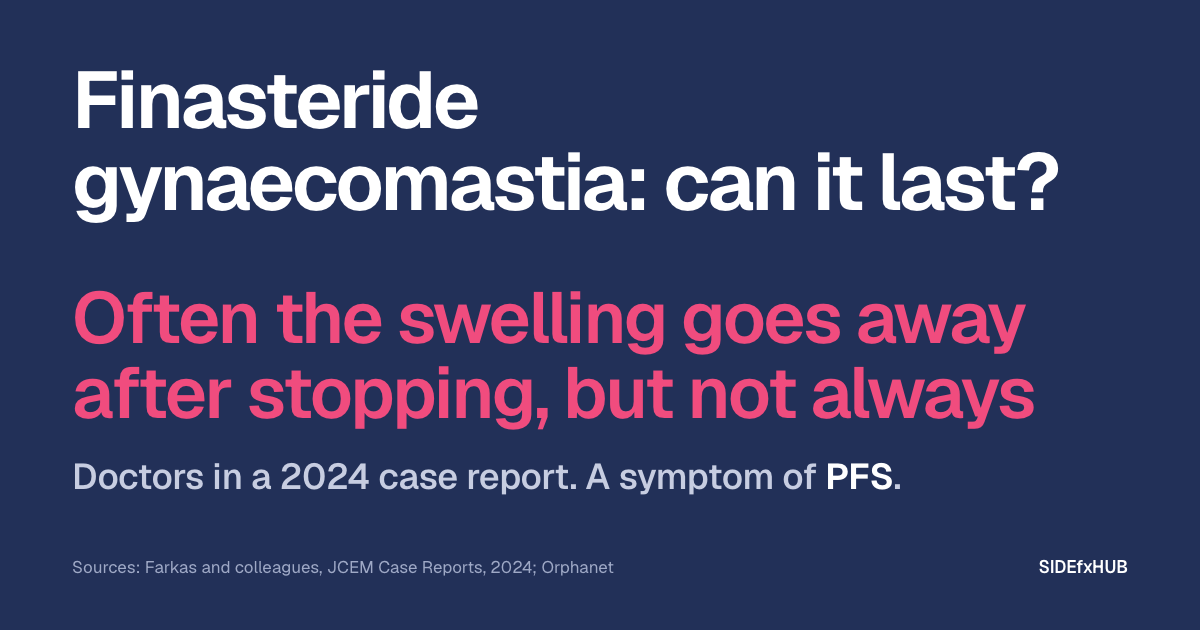
Finasteride’s UK leaflet lists breast swelling or tenderness as a side effect, and the swelling is called gynaecomastia. Doctors have reported men whose swelling stayed after stopping, and it’s one of the physical symptoms of post-finasteride syndrome (PFS).
The UK leaflet and the NHS both ask you to report breast changes quickly, because they may be signs of a serious condition such as breast cancer. Neither says whether the swelling goes away once you stop, and the doctors who have studied it say the first year matters.
The story in 3 lines
- The UK leaflet lists breast swelling or tenderness as a side effect of finasteride 1 mg, and asks men to report breast changes promptly.
- Doctors found 9 published cases on the hair-loss dose. In 3, the swelling stayed after the men stopped (2024 case report).
- Europe's rare-disease database includes gynaecomastia in its definition of PFS (Orphanet). Nobody has measured how often it lasts.
Press: contact@sidefxhub.com
He was 20 and had been taking finasteride 1 mg for hair loss for a month when he noticed a tender swelling on one side of his chest. His dermatologist halved the dose. The swelling stayed, so after two months he stopped.
One man's case, as his doctors described it
Five months after his last tablet, his doctors wrote, the swelling was “unchanged”. Gynaecomastia from the hair-loss dose, they concluded, “does not always resolve when the drug is discontinued”.
How common is breast enlargement on finasteride?
There’s no reliable figure for the hair-loss dose. The UK leaflet lists breast swelling or tenderness under “frequency unknown”. In the 1 mg trials behind the US label, breast tenderness and enlargement were no more common than on a dummy pill.
On the prostate dose, 5 mg, it has been counted. A 2019 review of prostate trials found gynaecomastia in about 4 in 100 men on finasteride, against about 2 in 100 on a dummy pill. Those men were being treated for an enlarged prostate.
The doctors behind the 2024 case think it’s “probably much more common than is reported” on the hair-loss dose. In many studies, they point out, nobody examined the chest. The men had to mention it themselves.
Does finasteride gynaecomastia go away after stopping?
Often it does, but not always, say the doctors behind the 2024 case.
The UK leaflet says some sexual side effects have continued after stopping. It doesn’t say that about breast swelling. In some published cases, the swelling has stayed too.
The 2024 authors gathered the published cases on the hair-loss dose. Of 9 men, by their count, the swelling went away on its own in 5 and stayed in 3. In the ninth, surgeons removed it as soon as it was found.
The longest follow-up among them is a 65-year-old man. His swelling improved a lot within two months of stopping. Six years later, his dermatologists wrote, there was “still slight residual swelling”.
Swelling that has been there for more than a year is unlikely to shrink back fully, the 2024 authors write, because the tissue scars. Once that happens, they say, only surgery works. On the NHS, that operation may not be available.

Is gynaecomastia part of PFS?
It can be one of its symptoms. Orphanet, the European database of rare diseases, includes gynaecomastia in its definition of the condition.
Breast swelling alone isn’t enough for a diagnosis. The 2022 diagnostic criteria rest on lasting sexual symptoms, and list gynaecomastia among the “related features” that may come from finasteride.
In 2023, PFS patients spoke to staff at the US medicines regulator. One man, aged 30, had taken finasteride for four days, and after he stopped he developed gynaecomastia among many other symptoms. The patient group’s summary of the session says he still had it 20 months on.
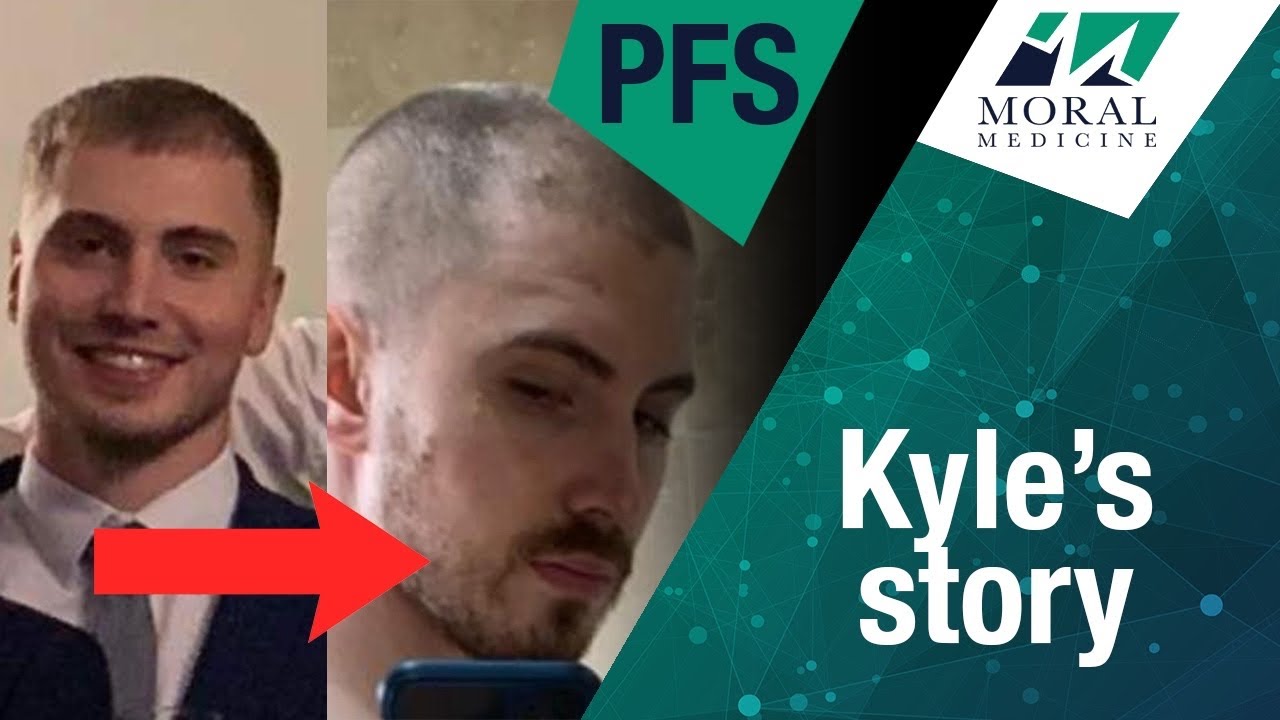
Breast swelling is one of many physical changes on the list of PFS symptoms, and other men describe different ones. Kyle took finasteride for a short time. In the months after he stopped, he says, his skin, his face and his weight changed.
What can I do?
Finasteride helps many men keep their hair. If you have side effects, that’s a decision for you and your prescriber.
The UK leaflet says: “You should promptly report to your doctor any changes in your breast tissue such as lumps, pain, enlargement or nipple discharge”. Go early. The doctors behind the 2024 case say the time to act is before the tissue scars.
Give your GP the dates: “Finasteride 1 mg from March 2025. Tender swelling under my left nipple since May 2025. Last tablet July 2025.”

Report it: it helps everyone
A doctor’s note helps you. A report to the medicines regulator helps everyone else: it is how patterns get noticed.
- No proof needed. A suspicion is enough, even years after stopping.
- Where: the Yellow Card scheme in the UK, MedWatch in the US. The UK regulator asks you to say if a side effect “continued or started after treatment was stopped”.
- Use the right words. Name the symptom, such as gynaecomastia. If symptoms continued after stopping, write Post 5-alpha-reductase inhibitor syndrome (MedDRA 10082430).
Our reporting guide walks you through it
What else do people ask?
What does finasteride gynaecomastia feel like? The NHS says the nipples or breasts may look swollen or feel sore, and that nipple pain which doesn’t go away is a reason to see a GP. In the finasteride cases it was usually on one side, starting between one month and about a year in. A doctor can tell it from chest fat, sometimes with a scan.
Could it be breast cancer? The leaflet asks you to report any breast change because it may be a sign of a serious condition, such as breast cancer. Breast cancer has been reported in men taking finasteride 1 mg, says the UK prescribing information. A study of UK GP records followed men taking finasteride or dutasteride for an enlarged prostate. It found more gynaecomastia but no clear rise in breast cancer, though it had few cancer cases to go on. More in the serious side effects of finasteride.
Does dutasteride cause it too? Its leaflet says it may. The UK Avodart leaflet lists breast enlargement or tenderness among its common side effects, which may affect up to 1 in 10 men. Like the finasteride leaflet, it asks men to tell their doctor about breast lumps or nipple discharge. More in dutasteride side effects.
The 20-year-old in the 2024 case stopped after two months, and still ended up having surgery. If your chest changed on finasteride and hasn’t settled since your last tablet, see your GP soon, and read about post-finasteride syndrome.
Sources
- Propecia 1 mg film-coated tablets, patient information leaflet (UK, electronic Medicines Compendium), Organon, last revised May 2026. Section 4 asks men to report breast changes promptly (the line is quoted in the text), “as these may be signs of a serious condition, such as breast cancer”. Breast swelling or tenderness is listed under “Frequency unknown”, as are persistent erection, sex drive and ejaculation problems after discontinuation. The leaflet does not list breast swelling as persisting after stopping. Its only general line is that some side effects “are temporary with continued treatment or disappeared when treatment is stopped”; it does not say which.
- Propecia 1 mg, summary of product characteristics (UK), revised 29 June 2026. Section 4.4: breast cancer has been reported in men taking finasteride 1 mg after marketing; doctors should tell patients to report breast changes promptly, including gynaecomastia. Section 4.8: breast tenderness and enlargement, frequency not known.
- Propecia, US prescribing information (DailyMed), prescribing information revised August 2022, patient information revised November 2023. Section 6.1: in the clinical studies with Propecia, breast tenderness and enlargement were not different from placebo. Post-marketing reports: breast tenderness and enlargement; male breast cancer.
- Farkas HS, Jee YH, Szymczuk V, Leschek EW. Persistent gynecomastia due to short-term low-dose finasteride for androgenetic alopecia. JCEM Case Reports, 2024; 2(5): luae050. A 20-year-old on 1 mg daily noticed unilateral, tender gynaecomastia after 1 month. The dose was cut to 0.5 mg, then stopped at 2 months. It was unchanged 5 months after stopping, with normal blood tests. Raloxifene for 6 months gave partial regression; bilateral reduction mammoplasty followed a year later. He had passing gynaecomastia at puberty that had fully cleared, and started two antidepressants about 6 months after the onset; the authors note a single case cannot prove cause. Signed consent for publication. Their literature review of 9 cases on low-dose finasteride: resolved in 5, persisted in 3, removed at diagnosis in 1. That is the count in the paper’s text; its table of the same cases describes four full resolutions and calls the 65-year-old’s “incomplete resolution” at six years. Gynaecomastia present for more than a year is unlikely to fully regress because of fibrosis, after which surgery is the only effective treatment (citing Bharathidasan and colleagues, 2022). Many studies rely on self-report rather than examination. Learning points: “probably much more common than is reported”; “does not always resolve when the drug is discontinued”.
- Ramot Y, Czarnowicki T, Zlotogorski A. Finasteride induced gynecomastia: case report and review of the literature. International Journal of Trichology, 2009; 1(1): 27–29. Hadassah-Hebrew University Medical Center, Jerusalem. A 21-year-old with bilateral gynaecomastia showed no improvement 10 months after stopping; a 65-year-old improved greatly within two months of stopping, with “still slight residual swelling” six years later.
- Fang Q, Chen P, Du N, Nandakumar KS. Analysis of data from breast diseases treated with 5-alpha reductase inhibitors for benign prostatic hyperplasia. Clinical Breast Cancer, 2019; 19(5): e624–e636. Systematic review and meta-analysis of 14 randomised trials in men with an enlarged prostate. Gynaecomastia: finasteride 4.08% against placebo 2.43%. Measured during treatment, mainly at the 5 mg dose.
- Hagberg KW, Divan HA, Fang SC, Nickel JC, Jick SS. Risk of gynecomastia and breast cancer associated with the use of 5-alpha reductase inhibitors for benign prostatic hyperplasia. Clinical Epidemiology, 2017; 9: 83–91. UK Clinical Practice Research Datalink, 94,701 men aged 40 and over with an enlarged prostate. Gynaecomastia risk was raised with 5-alpha reductase inhibitors (finasteride and dutasteride, analysed together), and higher for dutasteride than finasteride. No increased risk of breast cancer (odds ratio 1.52, 95% CI 0.61 to 3.80), based on 48 breast cancer cases; the authors say there were too few to compare the two medicines.
- Healy D, Bahrick A, Bak M, et al. Diagnostic criteria for enduring sexual dysfunction after treatment with antidepressants, finasteride and isotretinoin. International Journal of Risk & Safety in Medicine, 2022; 33(1): 65–76. Section 5: gynaecomastia is one of the “related features” that may stem from finasteride without being diagnostic for PFS.
- Orphanet, Post 5-alpha-reductase inhibitors treatment syndrome, ORPHA:686468, its entry for the condition known as post-finasteride syndrome. Definition dated 2 July 2026: “persistent side effects of terminated 5-alpha-reductase inhibitor treatment”, including gynaecomastia.
- PFS Network, FDA Patient Listening Session on Post-Finasteride Syndrome, 2 June 2023. The summary was written by PFS Network, the patient group that hosted the session, and is published on the US Food and Drug Administration’s website; its disclaimer says it reflects PFS Network’s account and is unofficial. Patient 1, a 30-year-old man, took finasteride for four days; gynaecomastia was among the symptoms that followed. One year and eight months later his fatigue, insomnia and cognitive symptoms had improved, and he was “still dogged by all other symptoms mentioned”.
- NHS, Side effects of finasteride, page last reviewed 2 August 2023. Call a doctor or 111 for any lumps, pain or swelling in the chest area or discharge from the nipples.
- NHS, Gynaecomastia, page last reviewed 31 May 2024. Nipples or breasts may look swollen or feel sore; surgery may not be available on the NHS.
- Avodart 0.5 mg soft capsules, patient information leaflet (UK), last revised March 2026. Common side effects, up to 1 in 10 men: breast enlargement or tenderness (gynecomastia).
- MHRA, Finasteride: reminder of the risk of psychiatric side effects and of sexual side effects (which may persist after discontinuation of treatment). Drug Safety Update, volume 17, issue 9, April 2024. Asks reporters to say whether a side effect continued or started after treatment was stopped.
- CBC News: The National, A popular hair loss drug and its lesser-known, rare and potentially life-altering side effects, March 2025, with the CBC/Radio-Canada article: 25 people interviewed over six months said their sexual, psychological and physical side effects lasted months or years after stopping. This page plays an extract only, from 0:00 to 2:11.
- Moral Medicine, interview with Kyle, October 2024. He says he took 1 mg tablets for two weeks and later a topical version for two to three weeks, and describes changes to his skin, face and weight in the months after stopping. He does not mention his chest.
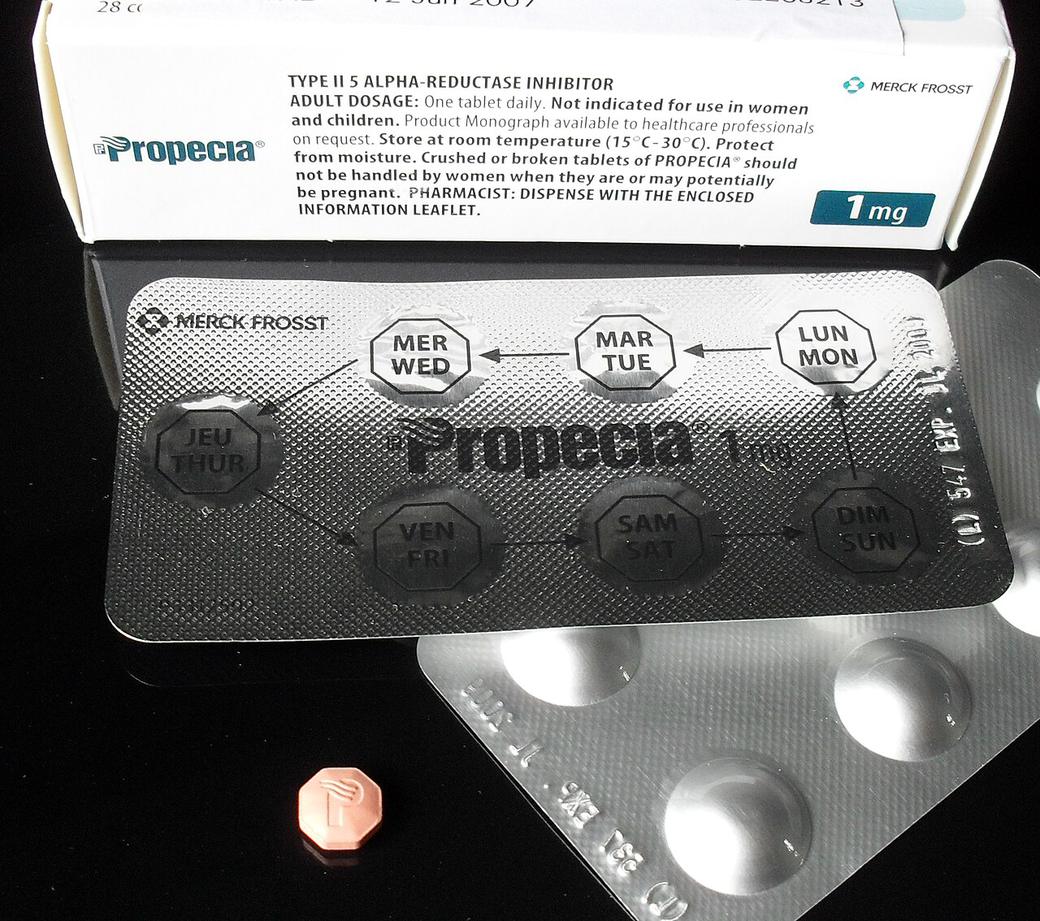
- Photo: Propecia box and tablet, Kristoferb, public domain, via Wikimedia Commons.
This information does not replace medical advice. Talk to your doctor before you make any decision about your treatment.
590+ people have joined the community.
Join them, then report your side effects.
No diagnosis needed. Researchers never see your name.