Finasteride and ejaculation: less semen
Whether watery semen and other ejaculation changes from finasteride can outlast the tablets, and the steps you can take now.
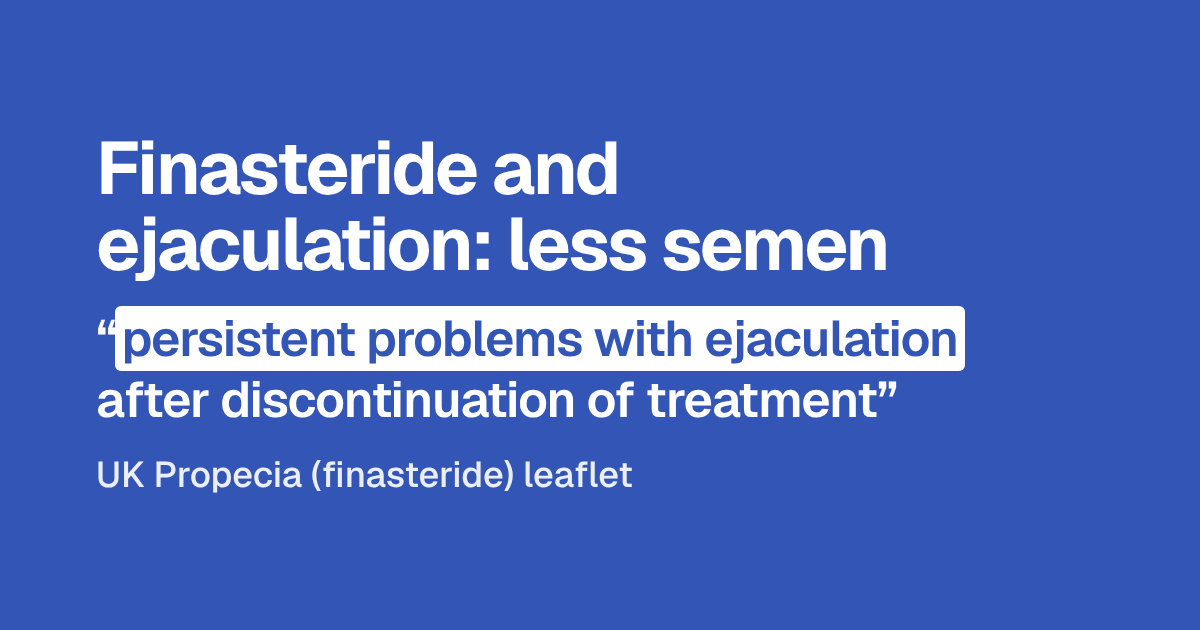
Less semen since you started finasteride? It can do that, and some men say their orgasm feels weaker too.
The UK leaflet also lists ejaculation problems that persisted after stopping. They are among the lasting problems known as post-finasteride syndrome, or PFS.
The leaflet says less semen “does not appear to affect normal sexual function”, so it’s easy to shrug off. Neither the leaflet nor the NHS page mentions orgasm.
Lucas was 18 when he started finasteride for hair loss, and he took it for about five years. In this 47-second extract he lists what changed. Semen is one item of many.

“I had watery semen,” he says, in a list that runs from low sex drive and tiredness to muscle loss. His semen later went back to normal, he says, but other symptoms have stayed. When he was interviewed, he’d had PFS for about 14 years.
So what does the evidence say about semen and orgasm, and can the changes last?
Does finasteride cause less or watery semen?
Less, for some men. The UK leaflet lists “a decrease in the amount of semen released during sex” as an uncommon side effect.
In the year-long trials behind the 1 mg hair-loss tablet, 8 in 1,000 men on finasteride reported less semen, against 4 in 1,000 on a dummy tablet. In those trials, says Propecia’s US label, the sexual side effects cleared up in the men who stopped and in most who carried on.
Men who reported less semen in the first year, per 1,000
Those are reports. A 48-week study measured semen instead, and the volume dipped by about the same amount on finasteride 1 mg as on the dummy tablet.
“Watery” is Lucas’s word, and no leaflet uses it. When researchers gathered reports of lasting sexual problems after a medicine, watery semen was one thing men described after finasteride.
Nobody has shown exactly why. One explanation researchers give is the fall in DHT, the hormone finasteride lowers. The US label says the enzyme it blocks sits in the prostate, which helps make semen.
Can finasteride weaken your orgasm?
Some men say it did. The UK leaflet doesn’t mention orgasm, and the trial results on Propecia’s US label don’t list it. That label names “orgasm disorders” only among the problems reported after stopping.
Dr Michael Irwig, a US hormone specialist, interviewed men whose sexual side effects had gone on for at least three months after finasteride. About 7 in 10 had problems with orgasm. In this one-minute film he explains.

His study can’t show how common this is: these men came forward themselves.
An Italian study asked men with lasting symptoms what they’d noticed. A weaker ejaculation was one of the most common answers.
Doctors and researchers who set out how to diagnose PFS count a lasting “reduction in genital and orgasmic sensation” as one of its signs. Matt describes it in what PFS feels like. Other medicines can affect orgasm too, as our guide explains.
Can ejaculation problems last after stopping finasteride?
Yes, for some men. The UK leaflet lists “persistent problems with ejaculation after discontinuation of treatment”. It puts that line under “Frequency unknown”.
Propecia’s US label lists “sexual dysfunction that continued after discontinuation of treatment, including erectile dysfunction, libido disorders, ejaculation disorders, and orgasm disorders”. The US regulator, the FDA, announced the wording on ejaculation and orgasm after reviewing reports from men. It said no clear causal link had been established.
How the warning reached Propecia's US label
For some men it has lasted years. Nobody knows yet who will be affected, or whether it will ease.
PFS is more than sexual problems. Criteria proposed by doctors and researchers in 2022 also describe cognitive problems, depression and suicidal thoughts, which can happen with or without sexual changes.
When finasteride side effects start covers the timing.
What can I do?
Finasteride helps many men keep their hair. If you have side effects, that’s a decision for you and your prescriber.
The UK leaflet says to contact your doctor if you have symptoms of impaired sexual function. The NHS says to speak to your doctor if you ejaculate less than usual or have no semen at all.
When you see your doctor, plain words and dates are enough: “Finasteride 1 mg from May 2023, last tablet January 2025. Less semen since autumn 2023, and orgasm feels weaker. No problems before.” Mention changes beyond sex too, such as low mood.
Three questions for your GP
- Could finasteride explain what I've noticed, even after stopping?
- What else should we check, and why?
- What's our next step if it doesn't settle?
You could start with: “The leaflet lists ejaculation problems that persisted after stopping. I think that's what I have.”
Many people say it took time to be taken seriously. You can report it without a doctor agreeing.
Report it: it helps everyone
A doctor’s note helps you. A report to the medicines regulator helps everyone else: it is how patterns get noticed.
- No proof needed. A suspicion is enough, even years after stopping.
- Where: the Yellow Card scheme in the UK, MedWatch in the US.
- Use the right words. If symptoms continued after stopping, write Post 5-alpha-reductase inhibitor syndrome (MedDRA 10082430).
Our reporting guide walks you through it
What else do people ask?
Does finasteride affect fertility? The UK leaflet says infertility “has been reported in men who took finasteride for a long time and had other risk factors that may affect fertility”. Semen quality has been reported to improve or return to normal after stopping, it says, and long-term fertility studies in men haven’t been done.
Is it different on finasteride 5 mg (Proscar)? At that dose, a drop showed up when semen was measured. In a 24-week study on Proscar’s US label, semen volume fell by about a fifth and stayed in the normal range. After the men stopped, it took 84 weeks on average to return to where it started. The UK leaflet for Proscar lists ejaculation problems that “may continue after stopping the medication”. More in our article on finasteride 5 mg.
Is less semen on its own PFS? No. The PFS criteria say sexual problems that clear after stopping are not PFS, and that changes in semen may come from finasteride “without being diagnostic”. They look for sexual problems still there three months after the last tablet. Our page on post-finasteride syndrome lists the signs.
If ejaculation or orgasm has felt different since your last tablet, report it: both reached the US label through reports like yours.
Sources
Every source below was opened on 12 October 2026. The UK Propecia leaflet was checked again on 22 October 2026.
- Propecia 1 mg film-coated tablets, patient leaflet, Organon, Electronic Medicines Compendium (emc 2194), UK, last revised May 2026. Section 4, uncommon (may affect up to 1 in 100 people): “you may have problems with ejaculation, for example a decrease in the amount of semen released during sex. This decrease in the amount of semen does not appear to affect normal sexual function”. Frequency unknown: “persistent problems with ejaculation after discontinuation of treatment”; “male infertility and/or poor quality of semen”. Section 2, effects on fertility: “Infertility has been reported in men who took finasteride for a long time and had other risk factors that may affect fertility. Normalisation or improvement of seminal quality has been reported after discontinuation of finasteride. Long-term clinical studies about the effects of finasteride on fertility in men have not been conducted.” Section 2, on sexual function: “If you experience symptoms of impaired sexual function, contact your doctor for further medical advice.” The leaflet does not use the word orgasm.
- Propecia 1 mg film-coated tablets, summary of product characteristics, emc 2194, UK, text revised 29 June 2026. Section 4.8 covers three 12-month placebo-controlled studies: “decreased volume of ejaculate was reported in 0.8% of men treated with ‘Propecia’ and 0.4% of men treated with placebo”. “The effect of ‘Propecia’ on ejaculate volume was measured in a separate study and was not different from that seen with placebo.” Reported after marketing: “persistence of sexual dysfunction (decreased libido, erectile dysfunction and ejaculation disorder) after discontinuation of treatment”. The frequency of such reports “cannot be determined as they are derived from spontaneous reports”.
- Propecia (finasteride) 1 mg, US prescribing information and patient information, Organon, DailyMed, US National Library of Medicine. Prescribing information revised August 2022, patient information November 2023. Section 6.1 covers three 12-month trials, with 945 men on Propecia and 934 on placebo. Ejaculation disorder: 1.2% against 0.7%. Decreased volume of ejaculate, counted within it: 0.8% against 0.4%. “Resolution occurred in men who discontinued therapy with PROPECIA due to these side effects and in most of those who continued therapy”. In healthy men, “a median decrease in ejaculate volume of 0.3 mL (-11%) compared with 0.2 mL (-8%) for placebo was observed after 48 weeks”. Section 6.2, reported after marketing: “sexual dysfunction that continued after discontinuation of treatment, including erectile dysfunction, libido disorders, ejaculation disorders, and orgasm disorders”. Also there: “male infertility and/or poor seminal quality (normalization or improvement of seminal quality has been reported after discontinuation of finasteride)”. These reactions “are reported voluntarily from a population of uncertain size”, so “it is not always possible to reliably estimate their frequency or establish a causal relationship to drug exposure”. Section 12.1: the type II enzyme “is primarily found in prostate, seminal vesicles, epididymides, and hair follicles as well as liver”.
- US Food and Drug Administration, Questions and answers: finasteride label changes, 11 April 2012 (archived copy; the page is no longer on fda.gov). “A revision to the Propecia label to include libido disorders, ejaculation disorders, and orgasm disorders that continued after discontinuation of the drug.” Erectile dysfunction after stopping “was added as a known event in 2011”. Propecia was approved in 1997. For Propecia the FDA reviewed 421 reports of sexual dysfunction sent in between 1998 and 2011; 59 described problems lasting at least three months after stopping. The FDA wrote that “clear causal links between finasteride (Propecia and Proscar) and sexual adverse events have NOT been established”.
- Proscar (finasteride) 5 mg, US prescribing information, Organon, revised March 2026. DailyMed. Section 5.5 describes healthy volunteers treated for 24 weeks. “A 0.6 mL (22.1%) median decrease in ejaculate volume with a concomitant reduction in total sperm per ejaculate was observed.” These “remained within the normal range and were reversible upon discontinuation of therapy with an average time to return to baseline of 84 weeks”. Section 6.1 has year one of the four-year PLESS trial, with 1,524 men on Proscar and 1,516 on placebo. Decreased volume of ejaculate: 3.7% against 0.8%. Ejaculation disorder: 0.8% against 0.1%. Section 6.2: “sexual dysfunction that continued after discontinuation of treatment, including erectile dysfunction, decreased libido and ejaculation disorders (e.g. reduced ejaculate volume)”. Of these the label says: “The independent role of PROSCAR in these events is unknown.”
- Proscar 5 mg film-coated tablets, patient leaflet, Organon, emc 1008, UK, last revised August 2024. Section 4: “Problems with ejaculation that may continue after stopping the medication”.
- NHS, Side effects of finasteride, page last reviewed 2 August 2023. Common side effects “usually improve after a while, but they can sometimes carry on even after you stop taking finasteride”. “If the amount you ejaculate is less than usual or you have no semen at all, speak to your doctor.” The page does not mention orgasm. NHS, Prostate problems: the prostate “makes semen”.
- Overstreet JW, Fuh VL, Gould J and colleagues. Chronic treatment with finasteride daily does not affect spermatogenesis or semen production in young men. J Urol 1999;162(4):1295-300. 181 men aged 19 to 41, finasteride 1 mg or placebo for 48 weeks; semen samples from 79 of them. Ejaculate volume fell by 0.3 ml on finasteride and 0.2 ml on placebo, with no significant difference between the groups. Read from the abstract.
- Amory JK, Wang C, Swerdloff RS and colleagues. The effect of 5alpha-reductase inhibition with dutasteride and finasteride on semen parameters and serum hormones in healthy men. J Clin Endocrinol Metab 2007;92(5):1659-65. 99 healthy men for one year; finasteride was given at 5 mg. The authors conclude that “the decrease in DHT induced by 5ARIs is associated with mild decreases in semen parameters that appear reversible after discontinuation”. Read from the abstract.
- Healy D, Le Noury J, Mangin D. Enduring sexual dysfunction after treatment with antidepressants, 5α-reductase inhibitors and isotretinoin: 300 cases. Int J Risk Saf Med 2018;29(3-4):125-134. Reports sent to RxISK.org. Of 25 men reporting after finasteride or dutasteride: watery ejaculate 8, reduced seminal volume 5, pleasureless or weak orgasm 3. People chose to send these reports in, so they cannot give a rate.
- Irwig MS, Kolukula S. Persistent sexual side effects of finasteride for male pattern hair loss. J Sex Med 2011;8(6):1747-53. Interviews with 71 men whose sexual side effects had lasted at least three months after stopping; 69% had developed problems with orgasm. The authors list selection bias and recall bias among the limits.
- Chiriacò G, Cauci S, Mazzon G, Trombetta C. An observational retrospective evaluation of 79 young men with long-term adverse effects after use of finasteride against androgenetic alopecia. Andrology 2016;4(2):245-50. Decreased ejaculatory force was reported by 82.3%. Men recruited at a Trieste clinic and through a website, with no comparison group.
- Healy D, Bahrick A, Bak M and colleagues. Diagnostic criteria for enduring sexual dysfunction after treatment with antidepressants, finasteride and isotretinoin. Int J Risk Saf Med 2022;33(1):65-76. PFS criterion 5: “Enduring reduction in genital and orgasmic sensation”; criterion 6: “The problem is present for ≥3 months after stopping treatment”. “Sexual dysfunction that happens on finasteride but clears after treatment stops is not PFS.” “A number of related features may stem from finasteride without being diagnostic for PFS”, among them “altered seminal quantity and quality”. Section 5: for finasteride, cognitive impairment, depression and suicidality can occur with or without sexual difficulties.
- Moral Medicine, interview with Lucas, 16 June 2026 (43 minutes), embedded here as an extract from 14:03 to 14:50. From the YouTube auto-captions: started at 18 (3:22 to 3:28), took it for five years (15:18 to 15:20), “I had low libido”, “fatigue”, “watery semen”, “muscle loss” (14:14 to 14:36), “my semen got normal again” (27:07 to 27:10), about 14 years of PFS (1:38 to 1:43). His story on our site: Lucas’s story: finasteride at 18.
- PFS Foundation, Persistent sexual side effects of finasteride (Propecia) for male pattern hair loss, Dr Michael Irwig, posted 27 August 2012, embedded here as an extract: the first 1 minute 6 seconds. Paraphrased from the captions: the limits of his study at 1:10, just after the extract ends.
- MedDRA term and code: Post 5-alpha-reductase inhibitor syndrome, 10082430.
Lasting side effects after finasteride?
Make them count.
Our step-by-step guide finds the form for your country.