Finasteride for women: can side effects last?
Finasteride isn't licensed for women but is prescribed off-label. In men, side effects can last after stopping (PFS). We found no study of this in women.
SIDEfxHUB is a patient charity. We are not health professionals, and this does not replace medical advice. Don't start, stop or change any medicine because of what you read here. Talk to your doctor first.
If you are in crisis:116 123 Samaritans (UK)988 Lifeline (US)Find a helpline
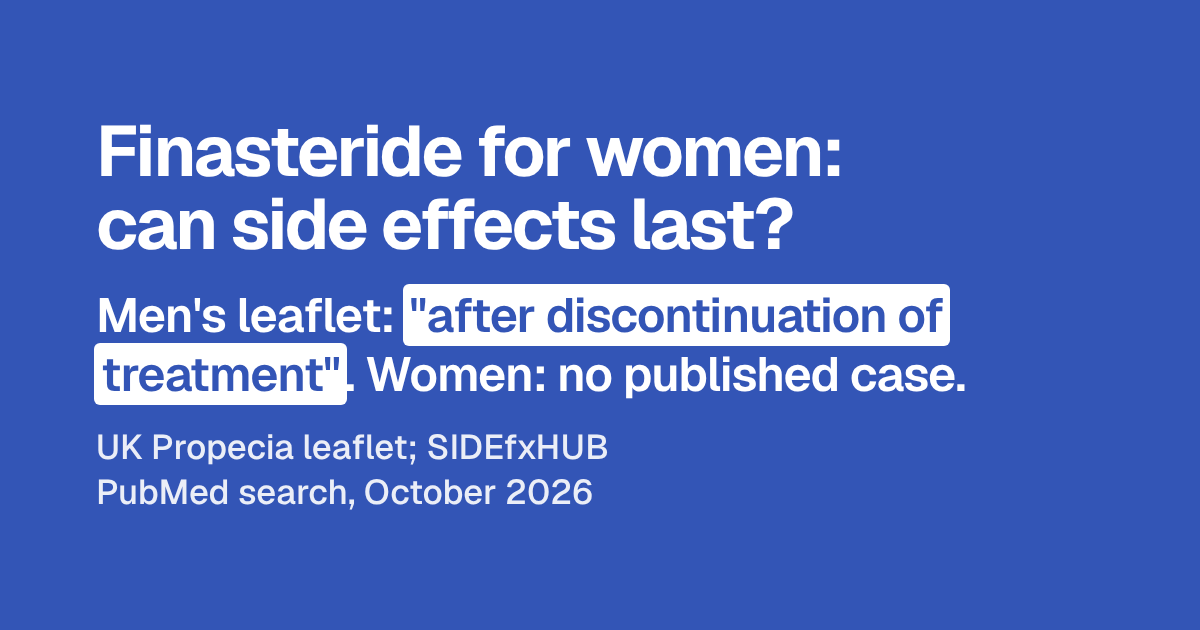
Nobody knows yet whether finasteride side effects can last after stopping in women. In men, they sometimes do, and the UK leaflet lists sexual problems that persisted “after discontinuation of treatment”. We found no published study or case report of this in a woman.
That lasting condition is called post-finasteride syndrome (PFS), and it is more than sexual problems. Criteria proposed in 2022 say problems with thinking, depression and suicidality can occur with or without sexual difficulties. Finasteride isn’t licensed for women, but a 2019 review found it used off-label for hair loss and unwanted hair.
The story in 3 lines
- The UK prescribing information for finasteride 1 mg says it is contraindicated in women.
- A 2019 review found it used off-label for women's hair loss and unwanted hair, including in polycystic ovary syndrome (PCOS).
- The largest published series of lasting cases after finasteride included no women (Healy and colleagues). We found no published case in a woman (PubMed, October 2026).
Press: contact@sidefxhub.com
Almost everything known about lasting finasteride side effects comes from men, and the studies in women were mostly short. So the answer is that nobody knows yet.
Is finasteride licensed for women?
No. As of October 2026, the UK prescribing information for Propecia, the 1 mg tablet, says it is “contraindicated in women” and not indicated for children or teenagers. The UK leaflet tells you not to take it “if you are a woman (because this medicine is for men)”.
The US label says it is “not indicated for use in women” and is contraindicated in women who are or may become pregnant.
For its reasons, the UK document points to pregnancy and to a year-long study in which it didn’t help hair loss in women past the menopause. Finasteride blocks the conversion of testosterone into a stronger hormone, DHT. The UK prescribing information says this may cause abnormalities of the external genitalia of a male foetus when a pregnant woman takes it.
Doctors can still prescribe it off-label. A 2019 review found 65 studies of finasteride in women, covering about 2,700 women, most of them treated for six to twelve months. Most of the trials were for female pattern hair loss or hirsutism, meaning unwanted dark hair on the face or body. PCOS is the most common cause of hirsutism, a Cochrane review says.
What side effects have women reported on finasteride?
The short-term ones look mild in the trials. A Cochrane review of treatments for hirsutism lists reduced libido, breast tenderness and dry skin among the known side effects of finasteride and flutamide, another anti-androgen.
Those trials didn’t look closely. Only about half of the hirsutism studies reported side effects at all, the Cochrane authors found. An older review pointed to the lack of long-term safety information. A 2026 review of sexual side effects in hair loss treatment found none reported consistently in women.
Mood matters too. The UK leaflet lists depression and, less often, suicidal thoughts among the reported side effects of finasteride 1 mg. It tells anyone taking it who notices a change in mood to stop and contact a doctor as soon as possible. If you’re struggling, the Samaritans are on 116 123 in the UK and Ireland.
Can finasteride side effects last after stopping in women?
We don’t know. When we searched PubMed in October 2026, we found no published study or case report of a woman whose finasteride side effects lasted after stopping. The UK leaflet lists “persistent decrease in sex drive after discontinuation of treatment”, along with lasting erection and ejaculation problems. Those are written for men, the only people the medicine is licensed for.
Women are almost absent from the published cases. In 2018, Professor David Healy and colleagues described 300 people whose sexual problems lasted after stopping a medicine, reported to the drug safety website RxISK. Some of the antidepressant cases were women. Every one of the finasteride cases was a man.
Finasteride cases among 300 reports of lasting sexual problems
Reports to the US regulator are mostly about men too. An analysis of 20 years of US reports about finasteride found only a small share were about women. Far fewer women take it, so that tells us little either way.
The closest account on our site is from a woman on a different medicine. Jade, a teacher, took spironolactone, another anti-androgen given to women for hair loss. In her interview, she describes physical, neurological and sexual symptoms that have not gone away.
What can I do?
Finasteride helps many people with hair loss. Whether to take it, or keep taking it, is a decision for you and your prescriber. If your mood changes, the leaflet says to stop and contact a doctor.
If something has felt different since you stopped, tell your GP and give your dates: “Finasteride 1 mg from March 2024 for hair loss, last tablet January 2025.” Say what changed, such as “my genitals feel numb”, and how things were before.
Include changes beyond sex too: low mood, feeling flat, or struggling to think clearly. The 2022 criteria count these as part of PFS.
Three questions for your GP
- Could finasteride explain what I'm feeling now?
- What else should we rule out?
- Can we record this as a suspected side effect and report it?
You could start with: "I took finasteride off-label, and since stopping I've noticed changes I want on my record."
Many people say it took time to be taken seriously. Bring the leaflet line. You can report it without a doctor agreeing.
Report it: it helps everyone
A doctor’s note helps you. A report to the medicines regulator helps everyone else: it is how patterns get noticed. Reports from women are especially scarce.
- No proof needed. A suspicion is enough, even years after stopping.
- Where: the Yellow Card scheme in the UK, MedWatch in the US.
- Use the right words. If symptoms continued after stopping, write Post 5-alpha-reductase inhibitor syndrome (MedDRA 10082430).
Our reporting guide walks you through it
What else do people ask?
What about topical finasteride? The US regulator has had reports of side effects after topical finasteride and says most continued after people stopped. It also warns of a greater risk that a product on the skin passes to others, specifically women. Our article on topical finasteride covers what’s known.
Can a partner’s finasteride affect me? Both labels say women who are or may be pregnant shouldn’t handle crushed or broken tablets. The US label says women could be exposed through a partner’s semen. From studies in monkeys, the UK document says the amount is unlikely to be a risk to a male foetus. The finasteride warnings article covers what the pack says.
What does lasting sexual dysfunction feel like in women? For antidepressants, women describe genital numbness, low desire and weak orgasms. Our article on PSSD in women covers it. For finasteride in women, there aren’t yet enough accounts to say.
If you’re a woman and finasteride left something that hasn’t lifted, your report adds to a record with almost no women in it. Report it, and read more about PFS.
Sources
- Propecia 1 mg film-coated tablets, summary of product characteristics, Electronic Medicines Compendium (EMC 2194), date of revision 29 June 2026. Section 4.1: not indicated for use in women or children and adolescents. Section 4.3: “Contraindicated in women”, referring to sections 4.6 and 5.1. Section 4.6: may cause abnormalities of the external genitalia of a male foetus when given to a pregnant woman; crushed or broken tablets. Section 4.8: persistence of sexual dysfunction after discontinuation; mood alterations and depression. Section 5.1: lack of efficacy in 137 post-menopausal women over 12 months.
- Propecia 1 mg, patient leaflet, EMC, last revised May 2026. Section 2: do not take it “if you are a woman (because this medicine is for men)”; mood alterations and depression, with the advice to stop and contact a doctor. Section 4, frequency unknown: “persistent decrease in sex drive after discontinuation of treatment”, and persistent erection and ejaculation problems.
- Propecia (finasteride), US prescribing information and Patient Information, Organon, DailyMed version published 14 October 2024 (prescribing information revised August 2022). Sections 1 and 5.1: not indicated for use in women. Section 4: contraindicated in women who are or may potentially be pregnant. Section 8.1: exposure through crushed tablets or a partner’s semen. Section 14.2: no benefit shown in 137 post-menopausal women over 12 months.
- NHS, Who can and cannot take finasteride, accessed 21 October 2026.
- Hu AC, Chapman LW, Mesinkovska NA. The efficacy and use of finasteride in women: a systematic review. Int J Dermatol 2019;58(7):759-76. 65 studies, 2,683 patients, published 1997 to 2017; hirsutism and female pattern hair loss; doses 0.5 to 5 mg a day; most courses 6 to 12 months.
- van Zuuren EJ, Fedorowicz Z, Carter B and colleagues. Interventions for hirsutism (excluding laser and photoepilation therapy alone). Cochrane Database Syst Rev 2015;(4):CD010334. Adverse events were addressed in only half of the studies. Known adverse events of flutamide and finasteride: gastrointestinal discomfort, breast tenderness, reduced libido, dry skin.
- Townsend KA, Marlowe KF. Relative safety and efficacy of finasteride for treatment of hirsutism. Ann Pharmacother 2004;38(6):1070-3.
- Złotowska A, Jastrząb-Miśkiewicz B, Krajewski PK. Sexual dysfunction associated with 5α-reductase inhibitors in the treatment of androgenetic alopecia: a systematic review. Front Med 2026;13:1787706.
- Healy D, Le Noury J, Mangin D. Enduring sexual dysfunction after treatment with antidepressants, 5α-reductase inhibitors and isotretinoin: 300 cases. Int J Risk Saf Med 2018;29(3-4):125-34. Table 1: finasteride 24 men, 0 women; dutasteride 1 man, 0 women.
- Zhong X, Yang Y, Wei S, Liu Y. Multidimensional assessment of adverse events of finasteride: a real-world pharmacovigilance analysis based on FAERS from 2004 to April 2024. PLoS One 2025;20(3):e0309849. 11,557 reports; 397 female (3.44%), 9,944 male, 1,216 sex unknown.
- US Food and Drug Administration, FDA alerts health care providers, compounders and consumers of potential risks associated with compounded topical finasteride products, content current as of 22 April 2025. 32 reports to FAERS from 2019 to 2024; sex of reporters not stated.
- Moral Medicine, interview with Jade on spironolactone. Her story on our site: Jade’s story: spironolactone for hair loss.
- SIDEfxHUB search of PubMed, 21 October 2026: “post-finasteride syndrome AND (women OR female)” (17 results) and “finasteride AND (women OR female) AND (persistent OR persistence OR after discontinuation) AND sexual” (16 results). None was a study or case report of a woman with lasting effects after finasteride. One 2018 letter, Mervis, Borda and Miteva, “‘Post-finasteride syndrome’: what to tell our female patients?” (Br J Dermatol 2018;179(3):785-6), has no abstract and could not be opened.
- Healy D, Bahrick A, Bak M and colleagues. Diagnostic criteria for enduring sexual dysfunction after treatment with antidepressants, finasteride and isotretinoin. Int J Risk Saf Med 2022;33(1):65-76. Proposed criteria developed through expert agreement. Section 5: for finasteride, cognitive impairment, depression and suicidality can occur with or without sexual difficulties.
- GOV.UK. Report a problem with a medicine or medical device.
This information does not replace medical advice. Talk to your doctor before you make any decision about your treatment.
620+ people have joined the registry.
Join them, then report your side effects.
Free. Sign up takes 2 minutes.