Finasteride warnings: what the pack now says
UK finasteride packs warn of depression, suicidal thoughts and sexual problems that may last after stopping. Patients call this post-finasteride syndrome.
SIDEfxHUB is a patient charity. We are not health professionals, and this does not replace medical advice. Don't start, stop or change any medicine because of what you read here. Talk to your doctor first.
If you are in crisis:116 123 Samaritans (UK)988 Lifeline (US)Find a helpline
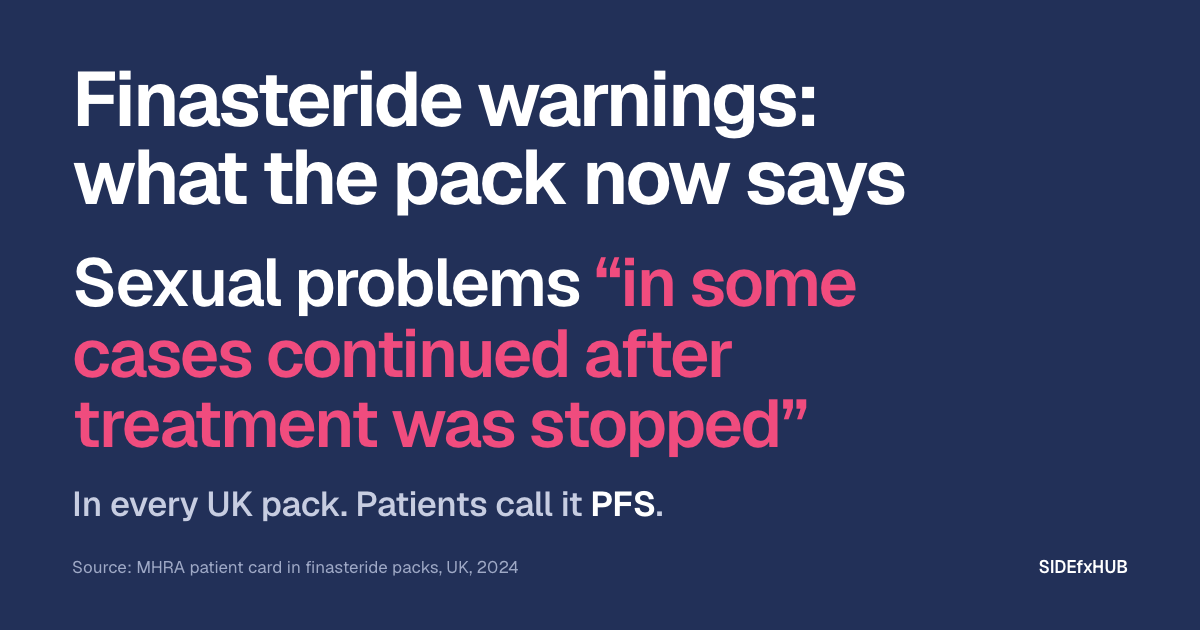
The UK warning for finasteride says it is linked to depression, suicidal thoughts and sexual problems that may continue after stopping. Since 2024 a card in every pack has said so, and patients call the lasting effects post-finasteride syndrome (PFS).
Patients told the UK medicines regulator that many people, doctors included, didn’t know about these side effects. The card came out of the review that followed. We think it has a limit: it reaches you inside the box, after you’ve decided to take the medicine.
The story in 3 lines
1. The UK regulator says finasteride is linked to depression, suicidal thoughts and sexual problems that may continue after stopping (MHRA, May 2026).
2. In 2024 it announced a card for every pack, after patients said the warnings weren't reaching people (MHRA review).
3. Nobody has measured how often the problems last (UK leaflet: "frequency unknown"). Patients call it PFS.
Press: contact@sidefxhub.com

Sam wanted to stop his hair falling out. His GP suggested finasteride and gave him a link to the NHS website, where he read that erection problems might happen.
Was anything said about them lasting? “Nothing permanent,” he says.
He describes numbness and shrinkage of his penis. In his words, the tablets were “handed out like it was nothing”.
What does the finasteride warning say?
The card in every pack, 1 mg or 5 mg, says finasteride can cause depression and, in some cases, thoughts of suicide. Lower sex drive and erection problems have also been reported, it adds, “which in some cases continued after treatment was stopped”.
The leaflet for the 1 mg dose is more specific. It lists “persistent difficulty having an erection after discontinuation of treatment”, along with lasting problems with sex drive and ejaculation. Since May 2026 it has also warned that sexual problems may feed into low mood, including suicidal thoughts.
Doctors got the same message that month. The MHRA, the UK medicines regulator, told them to explain these side effects when they prescribe finasteride. They should ask first about any history of depression.
How the UK warning for finasteride grew
Why is there a warning card in every pack?
Because patients said the warnings weren’t reaching people. When the MHRA reviewed finasteride in 2023, most of these side effects were already in the leaflet. Lasting erection problems had been added in 2010, and depression in 2017.
In the MHRA’s words, patients were worried about “the apparent lack of awareness among health care professionals and patients”. So its independent expert advisers recommended a card inside the box, to highlight the mood and sexual side effects. The MHRA announced it in April 2024.
Does the warning reach people who buy finasteride online?
The card reaches them when the box arrives. What comes before that depends on the pharmacy. The 1 mg dose for hair loss isn’t prescribed on the NHS, and the MHRA says people more often buy it from online pharmacies than from private clinics.
Robb Dixon bought finasteride from a high street pharmacy that sells online, years before the card existed. “I filled out a basic form,” he told ITV’s Good Morning Britain. It was done in “30 seconds probably”, he said, and the tablets came in the post a few days later.

The MHRA met online pharmacies as part of its review. Some, it found, “have thorough screening and monitoring processes in place, others do not”. In October 2024 the pharmacy regulator, the GPhC, told pharmacies that “providing finasteride at a distance carries particular risk”.
What can you do if you have finasteride side effects?
These medicines help many people. If you have side effects, that’s a decision for you and your prescriber.
If you develop low mood, depression or suicidal thoughts, the leaflet for the 1 mg dose says to stop taking it and contact your doctor as soon as possible. If you’re struggling, the Samaritans are free to call on 116 123, day or night.
Many people say it took time to be taken seriously. Bring the card or the leaflet line to your appointment. Write your dates down too: “Finasteride 1 mg from January 2023, last tablet March 2024.”
Report it: it helps everyone
A doctor’s note helps you. A report to the medicines regulator helps everyone else: it is how patterns get noticed.
- No proof needed. A suspicion is enough, even years after stopping.
- Where: the Yellow Card scheme in the UK, MedWatch in the US.
- Use the right words. If symptoms continued after stopping, write Post 5-alpha-reductase inhibitor syndrome (MedDRA 10082430).
Our reporting guide walks you through it
Frequently asked questions
Is finasteride banned in the UK? No. It is still licensed, and the 1 mg dose for hair loss is sold on private prescription. The MHRA has added warnings and a card in every pack. You may know it by its brand names: Propecia for hair loss, and Proscar for an enlarged prostate.
How often do the side effects last after stopping? Nobody has measured how often this happens. The leaflet for the 1 mg dose lists the lasting problems under “frequency unknown”. For some people it has lasted years after stopping. Nobody knows yet who will be affected, or whether it will ease. Our page on stopping finasteride has more.
Is post-finasteride syndrome an official diagnosis? Patients asked the MHRA to recognise it as one, and the regulator said that wasn’t its role. The dictionary regulators use to file reports does have a term for it: Post 5-alpha-reductase inhibitor syndrome. Our page on post-finasteride syndrome explains what is known.
Sam was warned about erection problems, but “nothing permanent”. If yours have lasted, report it: the line about lasting effects in today’s leaflet began with reports like yours.
Sources
- MHRA, Finasteride and dutasteride: updated safety warnings for psychiatric side effects and sexual dysfunction, Drug Safety Update, 11 May 2026.
- MHRA, Finasteride: reminder of the risk of psychiatric side effects and of sexual side effects (which may persist after discontinuation of treatment), Drug Safety Update, 29 April 2024.
- MHRA, Finasteride: review of safety data and expert advice on management of risks, 29 April 2024. The full report (PDF) covers the 2010 and 2017 product information changes (section 3.3), online pharmacies (sections 3.1, 4.3 and 6), the request to recognise post-finasteride syndrome (section 4.2) and the patient card wording (annex 1).
- Propecia 1 mg film-coated tablets: patient information leaflet, last revised May 2026, electronic medicines compendium (emc). Lasting erection, sex drive and ejaculation problems are listed under “frequency unknown” in section 4.
- General Pharmaceutical Council, finasteride update for pharmacy teams, 7 October 2024.
- Moral Medicine, The Hidden Devastation of Finasteride – Sam’s Story, June 2025. Sam’s warning from 3:56; “nothing permanent” at 4:32; “handed out like it was nothing” at 4:50.
- Good Morning Britain, ITV, Pharmacists warn against buying prescription drugs online, 11 February 2026. Robb Dixon on ordering online from 0:49.
This information does not replace medical advice. Talk to your doctor before you make any decision about your treatment.
590+ people have joined the community.
Join them, then report your side effects.
No diagnosis needed. Researchers never see your name.